
Comparing Poultry Infrastructure Proposals on Lifecycle Cost and Operating Requirements

Award-day price is one line of a poultry project's cost. This method helps procurement teams compare proposals on what the site will need to run, maintain and support over its operating years.
By HatchMatch Group Sourcing Desk · Last updated 2026-11-21
In short
Short answer: compare commercial poultry infrastructure proposals on one written basis — the same capacity, cycle, climate design conditions and scope boundary — and then on what each proposal requires to operate: energy and water, backup, maintenance, spares, training, service and warranty conditions. The lowest award price is only comparable once exclusions, freight terms and operating requirements are on the same footing.
Key takeaways
- Procurement, engineering and finance teams at poultry groups and integrators who receive several proposals for broiler, layer, breeder or hatchery infrastructure and must recommend one.
- Each supplier fills gaps in a brief with its own assumptions.
- Write one target per facility and ask every supplier to confirm it in writing: - Birds placed per cycle or hen places, stocking basis, and cycles or flocks per year.
- House and climate: structure, insulation, design temperature and humidity stated by you or your engineer, and how the proposal performs at those conditions.
- Power and backup: connected and peak load per house, generator size, automatic transfer, fuel storage and which loads are kept running.
Short answer: compare commercial poultry infrastructure proposals on one written basis — the same capacity, cycle, climate design conditions and scope boundary — and then on what each proposal requires to operate: energy and water, backup, maintenance, spares, training, service and warranty conditions. The lowest award price is only comparable once exclusions, freight terms and operating requirements are on the same footing.
Planning a commercial poultry project generally from USD 250,000 upward? Send one comparable project brief. It is free for buyers; every brief receives human review, and HatchMatch aims to reply within two business days.
Who is this method for?
Procurement, engineering and finance teams at poultry groups and integrators who receive several proposals for broiler, layer, breeder or hatchery infrastructure and must recommend one. It extends our guide to comparing poultry equipment quotations and the turnkey comparison method by looking past award day to the years of operation.
Why does award price mislead?
Want these figures for your own site, capacity and country? A HatchMatch specialist builds the budget with you — no buyer fees.
Start freeEach supplier fills gaps in a brief with its own assumptions. One sizes cooling for a milder design day; another leaves out the standby generator or water treatment; a third prices commissioning without a test list. These differences move cost into later years — into energy, repairs, spares and downtime — or onto the buyer's own contractors. Normalise the basis first, then compare.
Step 1: Fix the capacity and cycle basis
Write one target per facility and ask every supplier to confirm it in writing: - Birds placed per cycle or hen places, stocking basis, and cycles or flocks per year. - Down-time between cycles for cleaning and preparation. - For hatcheries, eggs set per week and the setting pattern. - Planned expansion, so utilities and layout are not sized for phase one only. Rough the house count and dimensions with the poultry house calculator before sending the brief.
Step 2: Compare the house design, climate and equipment scope
- House and climate: structure, insulation, design temperature and humidity stated by you or your engineer, and how the proposal performs at those conditions. - Ventilation, cooling and heating: fan count and airflow, cooling pad area, static pressure, inlets, heating type and fuel, and the power each draws. Check airflow logic with the tunnel ventilation calculator. - Feeding and drinking: lines per house, bins and augers, water treatment, metering and filtration. - Controls: controller, sensors, alarms, remote access and who supports the software. Browse categories in the equipment section to make sure no system is missing from the brief.
Step 3: Put utilities, backup and biosecurity on the same footing
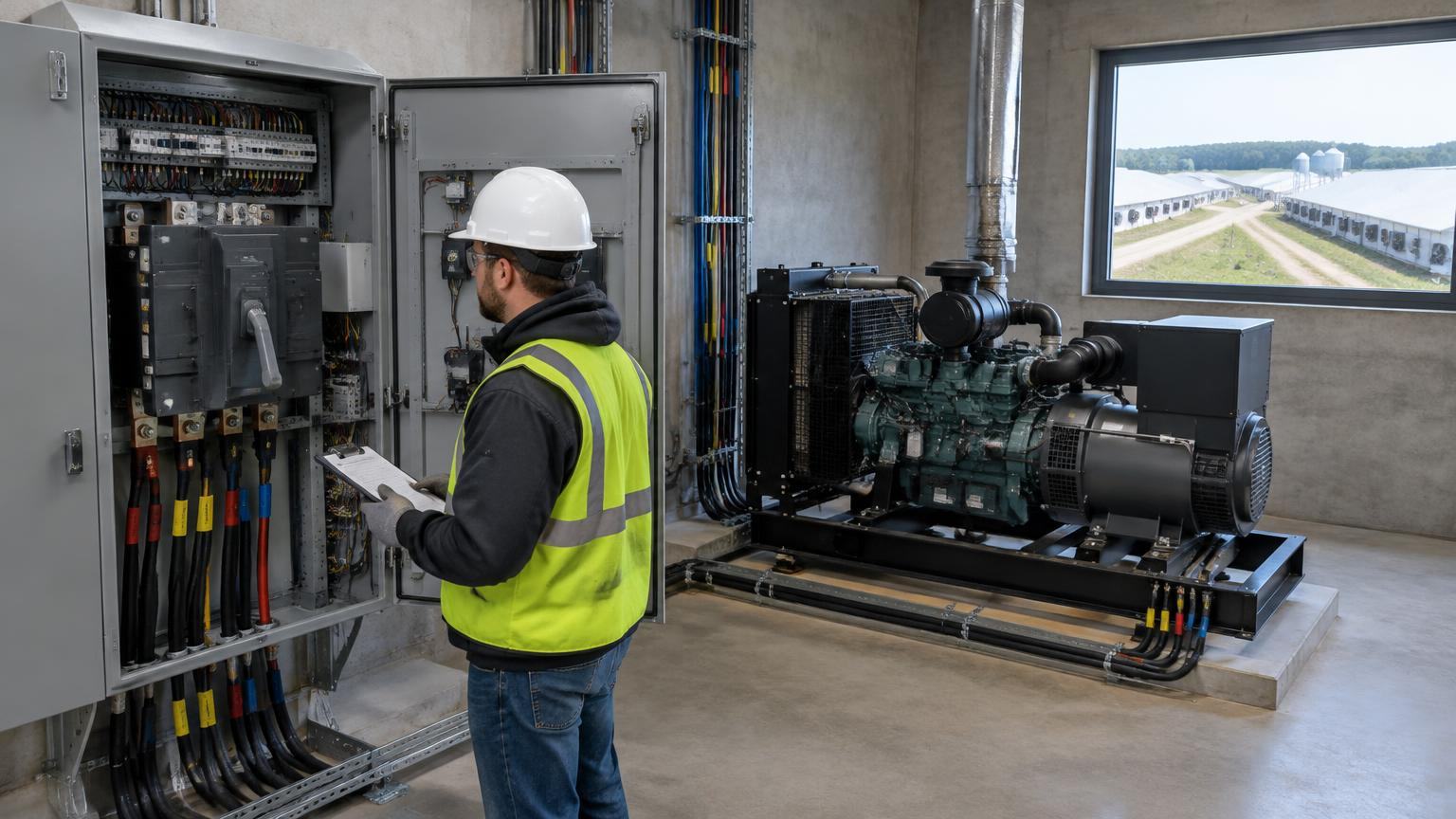
- Power and backup: connected and peak load per house, generator size, automatic transfer, fuel storage and which loads are kept running.
- Water: daily demand for drinking, cooling and cleaning, storage, treatment and backup source.
- Biosecurity: perimeter, controlled entry, vehicle and personnel disinfection, clean and dirty zones, and dead-bird routes, designed into the layout. See biosecurity solutions; hatchery cleaning systems are covered in our hatchery sanitation guide.
- Manure and waste: litter or belt removal, storage, disposal route and wastewater, aligned with local requirements your advisers confirm.
Step 4: Price the operating years, not only the build
Ask every bidder to state, in the same units, what the installation needs once it runs: - Energy and fuel use at the design conditions, and the assumptions behind it. - Routine maintenance tasks, intervals and who performs them. - A recommended spares list for the first operating period, with lead times. - Service route: local or remote, response terms and spare-part availability. - Expected replacement items within your planning horizon, as the supplier sees them. These are supplier-stated figures. Record them as claims until they are supported by a test, a reference you have checked yourself or a contractual commitment. Feed them into the farm cost calculator to test the effect on your own budget.
Step 5: Compare delivery, installation and handover
- Installation: who supplies labour, lifting equipment and supervision, and what civil works must be ready first.
- Commissioning: a written test list, conditions, attendees and acceptance criteria. Our installation and commissioning guide explains how to define it.
- Training: who is trained, for how long, in which language, and the manuals provided.
- Warranty: what it covers, when it starts (shipment, installation or acceptance) and what voids it.
Step 6: Align permits, Incoterms, freight and exclusions
- Permits: which approvals the buyer obtains and which documents the supplier provides for them.
- Incoterms: the named Incoterms® 2020 rule and place, and who pays freight, insurance, import duties and inland transport to site.
- Lead time: from order or down payment to shipment, and to site readiness.
- Exclusions: list every excluded item in one column so it can be priced by you or another contractor.
| Area | Ask each proposal to state | Treat as incomplete when |
|---|---|---|
| Capacity and cycle | Birds or hen places, cycles, down-time | Capacity given only as a number of houses |
| Climate and ventilation | Design conditions, airflow, cooling, heating | No design day stated |
| Utilities and backup | Peak load, generator, water per day | Peak load or backup missing |
| Biosecurity and waste | Zoning, entry, manure and wastewater route | Left entirely to the client |
| Operating requirements | Energy, maintenance, spares, service route | Not stated or not in the same units |
| Handover | Test list, training, warranty start | "Included" with no detail |
| Commercial | Incoterm, freight, lead time, exclusions | Freight or duties unassigned |
How should supplier claims be separated from evidence?
Keep two columns for every performance or durability statement: what the supplier states, and what evidence supports it — an acceptance test written into the contract, a document you have reviewed, or a site visit you arranged. Suppliers can commit to measurable equipment performance at acceptance, such as airflow or temperature control at stated conditions. Bird results such as mortality or feed conversion depend on genetics, feed, health and management, so treat any such figure as a supplier claim, not a guarantee.
RFQ checklist for a comparable lifecycle proposal
1. Facility type, capacity, cycle and expansion plan. 2. Site, layout constraints and biosecurity separation. 3. Climate design conditions and house specification. 4. Ventilation, cooling, heating, feeding, drinking and controls scope. 5. Power, backup and water demand with stated assumptions. 6. Manure, waste and wastewater handling. 7. Operating requirements: energy, maintenance, spares, service route. 8. Installation split, civil works readiness and supervision. 9. Commissioning test list and acceptance criteria. 10. Training, manuals and warranty terms with start date. 11. Permit responsibilities and supporting documents. 12. Incoterm and place, freight, lead time and a complete exclusions list. The RFQ checklist lists further fields.
Where does HatchMatch fit?
HatchMatch is a supplier-neutral procurement platform for commercial poultry projects, generally from USD 250,000 upward. It is not a manufacturer, installer, EPC contractor or lender, and buyers contract directly with the suppliers they choose. HatchMatch helps turn requirements into one written brief so proposals can be compared on the same basis. See how the process works.
Frequently asked questions
What is the first step in comparing poultry infrastructure proposals? Fix one written basis — capacity, cycles, climate design conditions and scope boundary — and ask every supplier to quote against it.
Why include operating requirements in a proposal comparison? Energy, maintenance, spares, service and warranty conditions carry cost through the operating years; leaving them out makes the lowest award price look cheaper than it is.
Can a supplier guarantee bird performance or savings? Treat such statements as supplier claims. Equipment performance can be written into acceptance tests at stated conditions; bird results depend on genetics, feed, health and management.
Does HatchMatch build or finance poultry projects? No. HatchMatch is a supplier-neutral procurement platform, not a manufacturer, installer, EPC contractor or lender; buyers contract directly with suppliers.
Next step
Ready to compare proposals on one basis? Send your poultry project brief — free for buyers, for commercial projects generally from USD 250,000 upward, with human review of every brief.
Frequently asked questions
- What is the first step in comparing poultry infrastructure proposals?
- Fix one written basis — capacity, cycles, climate design conditions and scope boundary — and ask every supplier to quote against it.
- Why include operating requirements in a proposal comparison?
- Energy, maintenance, spares, service and warranty conditions carry cost through the operating years; leaving them out makes the lowest award price look cheaper than it is.
- Can a supplier guarantee bird performance or savings?
- Treat such statements as supplier claims. Equipment performance can be written into acceptance tests at stated conditions; bird results depend on genetics, feed, health and management.
- Does HatchMatch build or finance poultry projects?
- No. HatchMatch is a supplier-neutral procurement platform, not a manufacturer, installer, EPC contractor or lender; buyers contract directly with suppliers.
More buyer questions are answered in our poultry procurement FAQ — also available in Español, Français, Português, Deutsch, العربية, Русский, Türkçe, Tiếng Việt.
From this article to a procurement-ready RFQ
HatchMatch Group is an independent sourcing desk — not a manufacturer or EPC contractor. These are the four steps we actually use with commercial poultry and hatchery buyers. If you are still deciding scope, start with what commercial poultry equipment includes and how suppliers are compared.
- 1. Plan the projectCapacity, climate and house layout in one guided workflowOpen
- 2. Build the RFQScope, specifications and comparable line itemsOpen
- 3. Submit the requestReviewed manually before HatchMatch contacts any supplier on the buyer's behalfOpen
- 4. Track and compareFollow status and normalise supplier responsesOpen
Prefer the numbers first? Start with the poultry project cost calculator or browse the project planning guides.
HatchMatch Intelligence · Email updates
Get poultry sourcing and project updates by email
A short digest of newly published HatchMatch articles, guides and center updates on the topics you choose — with links to the full pieces.