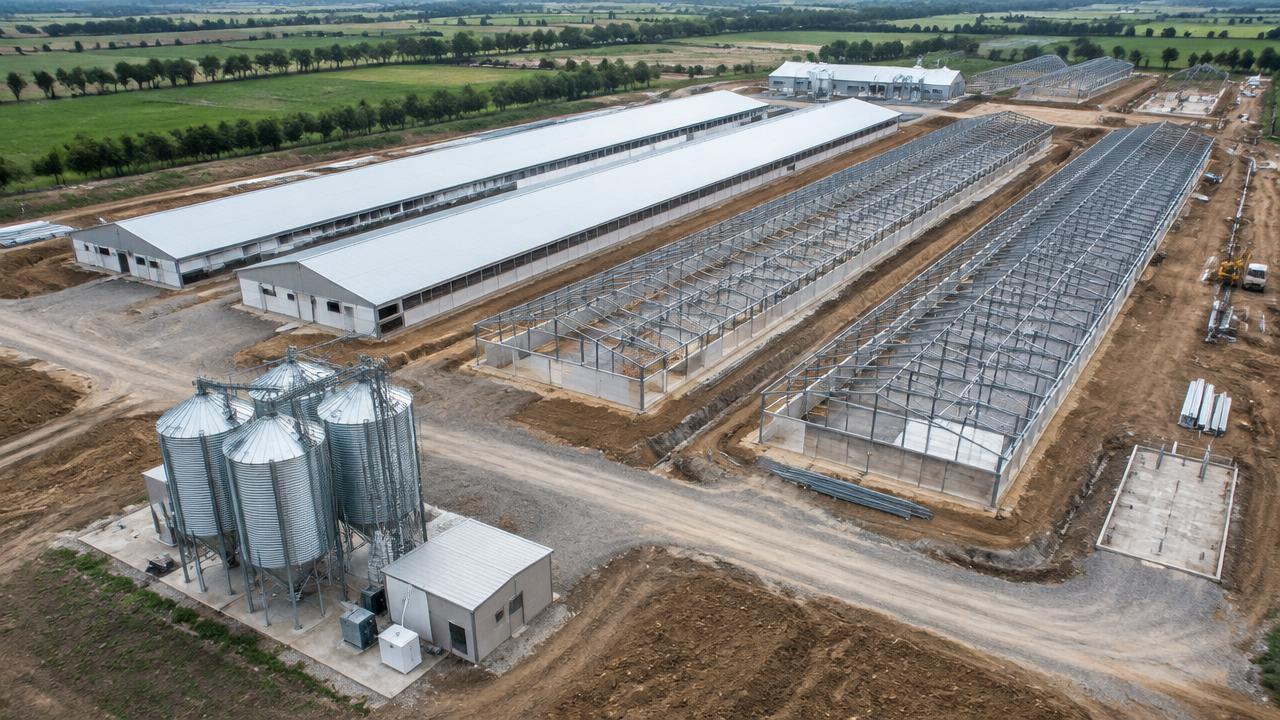
Poultry farm cost calculator — turnkey CAPEX by bird count and country.
Estimate turnkey CAPEX for a broiler, layer or breeder farm, then read the per-bird price bands behind every line item, what each input means, and three fully worked country examples. Class-4 planning estimate (±30%) — not a substitute for engineering or supplier quotes.
Inputs
Country presets
Results
Equipment & building base
$1.80M
100,000 places × $18 × 1 country factor
Freight, duty & clearing
$180k
10% of base
Site development
$144k
8% of base — road, drainage, water, grid
Owner's cost & engineering
$90k
5% of base — design, PM, commissioning
Contingency
$0k
0% (expected case)
Total project CAPEX
$2.21M
Turnkey, excluding land and working capital. Equipment price alone is not total project cost.
Per bird place (effective)
$22.14
All-in, after freight, site works and contingency
Planning range (±30%)
$1.55M–$2.88M
Class-4 accuracy band
Indicative equity @ 30%
$0.66M
Indicative financing need
$1.55M
Debt sizing only — subject to third-party approval. HatchMatch is not a lender.
Planning bands per bird place, in USD, for a modern commercial build. Shares sum across a typical project; the layer housing line is zero on floor-reared broiler farms and dominant on layer farms.
Poultry farm CAPEX line items with share of budget and price band per bird place
Line item
Share of CAPEX
Planning band
What drives it
Site works & foundations
10–18%
USD 1.5–4 / bird
Clearing, levelling, drainage, slabs, access road. Highly site-specific — sloped or waterlogged land can double this line.
House structure & envelope
22–32%
USD 4–9 / bird
Steel frame, insulated panels or masonry, roofing, doors. Insulation grade is the main lever in hot and cold climates.
Ventilation & climate
12–20%
USD 2–6 / bird
Tunnel fans, inlets, cooling pads or fogging, heaters, controllers. The single biggest technical risk line if under-specified.
Feeding system
8–14%
USD 1.5–4 / bird
Silos, augers, pan or chain feeders. Silo capacity should cover 7–10 days of peak intake.
Drinking system & water
4–8%
USD 0.8–2.5 / bird
Nipple lines, regulators, tanks, filtration. Borehole and treatment are separate where mains water is unreliable.
Layer/breeder housing system
0–45%
USD 0 / 12–22 / bird
Zero for floor-reared broilers. For layers, the cage or aviary system is the dominant line and sets the whole budget.
Electrical, lighting & backup power
6–12%
USD 1–3.5 / bird
Panels, dimmable LED, cabling, generator. In weak-grid markets treat the generator as core, not contingency.
Manure handling
3–8%
USD 0.5–2.5 / bird
Belts and drying for layers; litter management and storage for broilers. Often driven by local environmental rules.
Supervision, erection labor, sea/inland freight, duties. Compare quotes on identical Incoterms or this line hides the real difference.
Country cost bands per bird place
Load any of these as a starting point using the market presets above the inputs, then replace the per-bird figure with your own quotes as they arrive.
United States
USD 15–20 / bird place
High civil and labor cost, but short freight and dense dealer/service network. Tunnel houses with full controllers are the default, so little cost is saved by de-speccing.
Brazil
USD 12–17 / bird place
Strong local equipment manufacturing keeps feeding, drinking and ventilation lines cheap. Integrators often specify the package, which compresses the range.
India
USD 8–14 / bird place
Low civil cost and local steel. Environmentally controlled houses sit at the top of the band; open-sided houses at the bottom with far higher summer mortality risk.
Nigeria
USD 18–26 / bird place
Equipment is imported: freight, clearing and duty add 15–30%. Grid unreliability makes generator and fuel storage a mandatory CAPEX line, not an option.
Saudi Arabia / Gulf
USD 22–34 / bird place
Full evaporative cooling, insulated panel envelope, oversized water storage and redundant power. Climate spec, not building size, drives the premium.
EU (Western)
USD 28–45 / bird place
Multi-tier aviary systems, welfare and emissions compliance, manure belt drying and heat exchangers. The aviary system alone is roughly half of total CAPEX.
Vietnam / SE Asia
USD 11–16 / bird place
Regional equipment supply and competitive civil works. Land preparation and flood-resilient foundations can add materially on delta sites.
Kenya / East Africa
USD 18–28 / bird place
Small order sizes lose volume discounts, inland freight is long, and boreholes plus water treatment are commonly part of the project scope.
Every input, explained
Most bad estimates come from one mis-entered field, not from the model. Read this before you trust the output.
Bird capacity
Number of bird places in the finished facility at one time — not annual throughput.
How to set it: Use the design capacity of all houses combined. For broilers, a 100,000-bird site producing 6 cycles a year still enters 100,000 here.
Common mistake: Entering annual production instead of standing capacity overstates CAPEX roughly six-fold on broiler projects.
Cost per bird
Turnkey equipment plus building cost allocated per bird place, before country adjustment.
How to set it: Broiler floor housing 12–20; layer cage 20–32; layer aviary 25–45; breeder 30–55. Start mid-band and move up for full climate control.
Common mistake: Quotes that only cover equipment ex-works look 30–40% cheaper than a turnkey figure. Confirm the scope before you compare.
Country cost factor
Multiplier for local labor, civil cost, freight, duty and climate spec.
How to set it: US/EU ≈ 1.0–1.1; Brazil and SE Asia ≈ 0.85–0.9; South Asia ≈ 0.7–0.8; Sub-Saharan Africa ≈ 1.15; Gulf ≈ 1.2; remote or landlocked sites ≈ 1.3.
Common mistake: The factor covers import cost, not currency risk. If your revenue is local and your equipment is dollar-priced, hold a separate FX buffer.
How to set it: Use conservative for financing submissions and greenfield sites, expected for board-level scoping, optimistic only for repeat builds on prepared land.
Common mistake: Never present the optimistic figure to a lender — it strips the contingency that projects almost always consume.
Freight, duty & clearing
Percentage added on top of the base for moving imported equipment to site and clearing it.
How to set it: 0–5% where the package is manufactured locally, 8–12% for regional supply, 15–30% for a full European or US package landed in Africa, South Asia or Latin America.
Common mistake: Ex-works quotes exclude all of this. Two offers that look 20% apart are often identical once both are restated on the same Incoterm.
Greenfield site development
Off-building infrastructure: access road, drainage, borehole and water treatment, perimeter fencing, grid connection or transformer.
How to set it: 0% on a prepared plot next to an existing farm, 6–10% on a normal greenfield site, 14–20% where you must drill for water, build an access road or bring in a medium-voltage line.
Common mistake: This is the line most first-time developers omit entirely, and it is the most common reason a project runs out of money before first placement.
Owner's cost & engineering
Your side of the project: design and layout, structural and electrical engineering, project management, permit handling, commissioning support and staff training.
How to set it: 4–6% on a standard build using a supplier's layout, 7–10% on an integrated or multi-house complex needing independent engineering.
Common mistake: Budgeting zero here does not remove the cost — it just moves it into unplanned overruns and delays first placement.
Three worked examples
Same engine, same arithmetic you get from the calculator above — shown step by step so you can audit the number before taking it to a lender.
50,000-bird broiler farm, Nigeria
Greenfield site, four tunnel-ventilated houses, imported European equipment package, on-site generator, borehole and treatment.
1.50,000 bird places × USD 20 per bird = USD 1.00M base equipment + building
The same 100,000 birds cost roughly a quarter of the EU layer project — species, housing system and country factor matter far more than headcount.
What the estimate includes — and what it does not
Scope is the difference between a useful planning number and a broken budget. This tool prices the facility, not the business.
Included
Site preparation, foundations and slabs
House structure, envelope and insulation
Ventilation, cooling and heating package
Feeding and drinking systems with silos
Lighting, electrical panels and backup generator
Layer cage or aviary system where applicable
Manure handling and biosecurity infrastructure
Installation, commissioning and inbound freight
Not included
Land purchase or long lease premiums
Permits, environmental studies and legal fees
Working capital, day-old chicks and first feed
Feed mill, hatchery or processing plant (separate projects)
Interest during construction and financing fees
FX hedging cost where equipment is dollar-priced
Staff housing and non-production buildings
Ongoing OPEX of any kind
Turn the estimate into priced quotes
Send your bird count, country and housing type once. We put the same scope in front of vetted suppliers on identical Incoterms so the quotes are actually comparable.
This farm cost calculator is a free browser tool for commercial poultry projects. Enter your own figures and it returns a class-4 planning estimate (about ±30%) under conservative, expected and optimistic scenarios. Use it to size an investment and to brief manufacturers — a firm supplier quote always overrides the estimate.
How to use this calculator
Enter your project figures. Replace the default values in the farm cost calculator with your own flock size, targets and local costs. Defaults are commercial-sector averages, not a recommendation.
Compare the three scenarios. Switch between conservative, expected and optimistic to see how sensitive the result is to your assumptions before committing capital.
Read the assumptions. Check the assumptions panel so you know what the model excludes — typically taxes, import duties, special civil works and land.
Turn the output into a quote request. Send the resulting figures in a single request to receive comparable offers from qualified third-party manufacturers.
As a planning band, a modern broiler farm costs USD 12–20 per bird place and a cage-free layer farm USD 25–45 per bird place, before country adjustment. A 50,000-bird broiler farm therefore lands around USD 0.6–1.0M in low-cost markets and USD 1.0–1.4M where equipment is imported.
Site works, foundations, house structure and envelope, ventilation and climate package, feeding and drinking systems, layer housing where applicable, lighting and backup power, manure handling, biosecurity, plus installation, commissioning and inbound freight.
Land, permits and environmental studies, working capital, day-old chicks and first feed, feed mill / hatchery / processing units, interest during construction, FX hedging and all OPEX.
Three things: local civil and labor cost, whether equipment is manufactured locally or imported with freight and duty (15–30% in many emerging markets), and the climate spec — full evaporative cooling and insulated envelopes are the main premium in Gulf and tropical builds.
±30%. It is built for scoping, board decisions and first financing conversations. Accuracy improves to roughly ±10–15% once you hold supplier quotes on a fixed scope and a site survey.
Per bird place, yes — usually two to three times. The cage or aviary system alone is often 40–45% of layer CAPEX, whereas broilers are floor-reared and carry no housing system line.
20% on greenfield projects and any first build in a new country, 10% on a repeat build on prepared land. The conservative scenario in the calculator applies the 20% figure.
Yes — site preparation, foundations, slabs and the house structure are inside the per-bird figure. On difficult ground, sloped land or flood-prone sites, treat the site-works line as an open item until you have a soil survey.
Use it to frame the ask, not as the feasibility. Lenders expect supplier quotes, engineering drawings, a full P&L and a cash-flow model. Run the conservative scenario for any figure that goes into a submission.
Send the bird count, country and housing type through the quote request. We put an identical scope in front of vetted suppliers on the same Incoterms, which is the only way the numbers become comparable.