
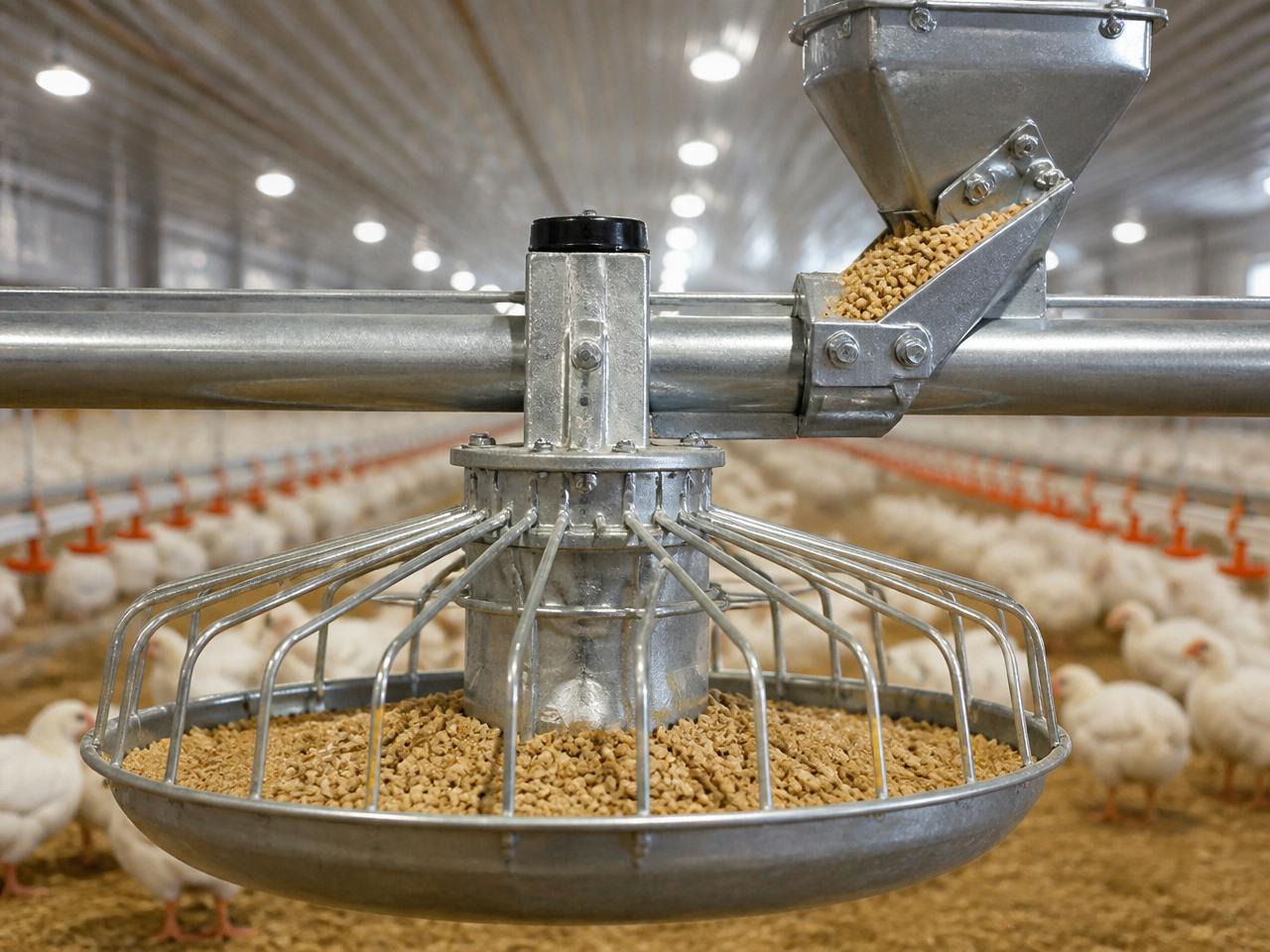
Broiler feeding systems in Ontario — pan lines, winches and bin conveying.
Pan feeding lines, winch systems and bin-to-barn conveying — quoted by vetted manufacturers with CSA-ready controls and DDP pricing landed at your farm gate. Buyers pay zero fees, and your request is answered by a human specialist within 2 business days.
Two feeding quotes are rarely the same scope.
One bid includes the winch package and bin conveying, the next prices lines only, and neither states the electrical scope your ESA inspector will look for. We normalise the specification first, then take it to market.
CSA / CEC controls specified upfront
Panels, motors and drives specified to Canadian Electrical Code and Ontario ESA inspection requirements at RFQ stage — certification documents confirmed in writing before any purchase order.
Engineered for Ontario winters
Bin bridging, boot heaters, condensation-resistant exterior drives and dense winter feed handling are written into the scope instead of showing up as change orders in January.
DDP to your farm gate in CAD
Freight, customs entry, duty and CUSMA treatment where applicable are inside the quoted number, so a Midwest US bid and a European bid are actually comparable.
Parts and service commonality
We can match the pan, auger and controller platform already installed in your other barns — or bid an alternative alongside it so you can price the difference.
Zero buyer fees
Sourcing, RFQ management and quote comparison cost the barn owner nothing. We are compensated on the supply side and stay vendor-neutral.
Answered in 2 business days
A specialist reviews your barn dimensions and comes back with clarifying questions and a supplier shortlist within 2 business days.
Run the numbers for an Ontario broiler barn
Free engineering calculators built for commercial projects. Get a defensible CAPEX, feed and payback estimate first, then request quotes with figures suppliers can price against.
What we source for a feeding package.
Pan feeding lines
Broiler pan feeders on auger lines with chick-friendly open-pan start, grill designs matched to your strain and market weight, and pan counts sized to birds-per-pan targets.
Winch & cable lifting
Line lifting for full-barn cleanout and litter management — manual, electric winch or fully automated, with load-rated cable runs sized to line length.
Bin-to-barn conveying
Flex auger or chain-disc conveying from outdoor bulk bins, with run length, incline and capacity checked against daily feed demand at peak bird weight.
Feed weighing & monitoring
Bin load cells, feed-consumption logging and controller integration so daily intake per barn is measured rather than estimated at pickup.
Brooding & partial-house feeding
Brood-area feeding configuration and partial-house setups for early flock management in cold-weather placements.
Retrofit into existing barns
Replacing tired lines in an operating barn — clearance, ceiling structure, existing electrical capacity and turnaround window planned into the scope.
Feeding is rarely bought alone. If drinking lines, brooders, ventilation or controls are part of the same barn project, we bid them together so the electrical and controller scope stays coherent.
Pan, chain or tube feeding for a broiler barn?
Nearly every Ontario quota barn ends up on pan lines, but it is worth knowing why before you sign a quote — and where the other two still make sense.
| System | Best fit | Strengths | Watch for |
|---|---|---|---|
| Pan feeding on auger | Commercial broilers, 2.0–3.0 kg market weight | Even feed distribution across long barns, chick-friendly open-pan start, low wastage at market weight | Pan count and birds-per-pan must match strain and stocking density |
| Chain / trough feeding | Breeder and pullet rearing, controlled feeding programs | Fast simultaneous feed delivery, good for restricted feeding regimes | Higher wastage with broiler-grade crumb; corner wear parts need spares |
| Tube / hopper feeding | Small barns, brood areas, partial-house or backup feeding | Low capital cost, simple installation, few moving parts | Labour intensive at commercial scale; not practical for full quota barns |
Feed-line sizing reference for common Ontario barns
Indicative starting points only — final line count and pan density depend on stocking density, strain, market weight and the birds-per-pan figure your integrator works to. We confirm these before the RFQ goes out.
| Barn footprint | Birds per placement | Feed lines | Indicative pan count |
|---|---|---|---|
| 40 × 400 ft | ≈ 16,000–19,000 | 4 feed lines | ≈ 260–300 pans |
| 50 × 500 ft | ≈ 25,000–30,000 | 5 feed lines | ≈ 400–470 pans |
| 60 × 600 ft | ≈ 36,000–43,000 | 6 feed lines | ≈ 580–680 pans |
Canada broiler equipment buyer guide
Ontario sits inside a wider Canadian buying context — CAD budget bands, CSA and provincial electrical requirements, cold-climate ventilation and import terms. These guides cover each equipment block.
- Canada broiler equipment buyer guide (hub)
- Ontario broiler equipment: costs, specs & suppliers
- Quebec broiler equipment buyer guide
- Canada: broiler feeding systems
- Canada: broiler drinking systems
- Canada: ventilation, cooling & heat recovery
- Canada: barn controls & automation
- Compare broiler equipment manufacturers
Ontario broiler equipment budget & ROI calculator
Size the equipment package for your barn, get an indicative CAD budget band and a simple payback on your own margin assumption — then turn the result into a prefilled quote request with the specification already written for you.
- Birds per cycle
- 47,058
- Birds per barn
- 23,529
- Birds per year
- 282,348
- Annual contribution
- CAD 240k
- Simple payback
- 2.1–3.5 yrs
- Return on equipment
- 35% / yr
| Scenario | CAPEX | Payback | Return |
|---|---|---|---|
| CAD 554k – CAD 907k | 3.6–5.9 yrs | 21% | |
| CAD 513k – CAD 840k | 2.1–3.5 yrs | 35% | |
| CAD 482k – CAD 789k | 1.5–2.5 yrs | 49% |
Your barn dimensions, scope, budget band and quote basis are written into the request automatically — you only add contact details. Free for buyers, no obligation, shortlist within 2 business days of a complete brief.
Figures are indicative planning ranges built from comparable sourced projects, not quotations, and exclude land, concrete, steel and site services. Payback uses the margin per bird you enter and ignores financing cost, quota cost and depreciation. Any financing introduction is subject to third-party approval.
Assumptions, formulas & source methodologyShow
Where the cost band comes from
Equipment pricing is expressed as CAD 11–18 per square foot of barn floor, landed and installed. The band is derived from comparable sourced broiler projects in Canada and northern-climate equivalents (feeding, drinking, ventilation, heating, lighting and controls, including freight to the farm gate, installation and commissioning). It is a planning range, not a quotation — real quotes vary with brand, steel and freight pricing at the time of order.
Formulas used
- floor area = width × length × barns
- birds per cycle = floor area ÷ placement density (sq ft/bird)
- CAPEX (low/high) = floor area × CAD/sq ft × scope factor × automation factor × heat-exchanger factor × scenario factor
- annual contribution = birds per cycle × cycles per year × margin per bird
- simple payback (yrs) = CAPEX ÷ annual contribution
- return on equipment = annual contribution ÷ midpoint CAPEX × 100
Multipliers applied
- Full new-build package: ×1.00
- Retrofit (feed + water + controls): ×0.55
- Climate only (vent, heat, controls): ×0.45
- Basic controller: ×1.00
- Standard automation: ×1.07
- Advanced + monitoring: ×1.14
- Conservative: CAPEX ×1.08, margin ×0.70, cycles -0.5
- Expected: CAPEX ×1.00, margin ×1.00, cycles +0
- Upside: CAPEX ×0.94, margin ×1.20, cycles +0.5
What is excluded
Land, site works, concrete, steel shell, manure storage, generators, utility connections, quota purchase, working capital, chick, feed and vet costs, financing interest, depreciation, taxes and provincial permit fees. Margin per bird is your own input — it should already net feed, chick, labour, energy and mortality against revenue.
Compliance & quote basis
Pricing assumes DDP delivery to the farm gate in CAD with CSA-certified or field-approvable electrical components and provincial electrical inspection. Duties and brokerage on imported equipment are assumed to be inside the landed figure; spares packages and extended warranties are quoted separately. Figures are indicative planning ranges, not offers, and any financing introduction is subject to third-party approval.
Model last reviewed for the 2026 build season. Verify with at least two supplier quotations before committing capital.
What broiler feeding systems cost in Ontario (CAD).
Indicative planning bands for a complete pan-feeding package — lines, pans, drives, winch lifting and bin-to-barn conveying. They are budgeting ranges drawn from comparable sourced projects, not quotations: actual bids move with specification, origin, freight, exchange rate and the week you buy.
| Barn / line count | Equipment ex-works | Landed DDP, farm gate | Installed & commissioned |
|---|---|---|---|
| 40 × 400 ft (4 lines) | CAD 55,000 – 85,000 | CAD 65,000 – 100,000 | CAD 80,000 – 125,000 |
| 50 × 500 ft (5 lines) | CAD 80,000 – 125,000 | CAD 95,000 – 145,000 | CAD 115,000 – 180,000 |
| 60 × 600 ft (6 lines) | CAD 110,000 – 170,000 | CAD 130,000 – 200,000 | CAD 160,000 – 245,000 |
Bands exclude HST, bulk bins, barn electrical service upgrades and structural work. Financing, where offered, is provided by an independent third-party partner and is subject to third-party approval.
What moves the number
Line count and pan density
The single biggest driver — a sixth line and 100 extra pans moves the number more than brand choice does.
Winch automation level
Manual winches sit at the bottom of the band; fully automated lifting with controller integration sits at the top.
Conveying distance from the bin
Flex auger runs are cheap; long or inclined chain-disc runs with multiple corners add material and drive cost.
Weighing and monitoring
Bin load cells and feed-consumption logging typically add a mid-four-figure CAD amount per barn.
Freight, duty and FX
European origin lands higher than US origin, where CUSMA preference may apply. Quotes in EUR or USD carry FX exposure until the order is placed.
Electrical and installation labour
Ontario installer rates, ESA inspection and any panel work are quoted separately by most manufacturers — we ask for them explicitly.
The nine specifications that decide whether two quotes are comparable.
Most feeding quotes look similar on the front page and differ badly underneath. This is the line-by-line comparison we build for every Ontario RFQ before the bids are presented.
| Specification | Ask every supplier for | Why it changes the comparison |
|---|---|---|
| Pan diameter & grill type | Outer diameter, grill style, chick-start (open pan) capability | Determines birds per pan and feed wastage at market weight |
| Birds per pan (design) | Stated figure at your strain and market weight | Two quotes with different assumptions are not comparable on price per barn |
| Auger diameter & tube gauge | Auger size, tube wall thickness, material spec | Drives delivery rate at peak intake and service life of the line |
| Drive motor & enclosure | kW rating, 60 Hz, voltage, IP/NEMA rating, CSA mark | Exterior drives in Ontario winters need condensation-resistant enclosures |
| Winch capacity & cable spec | Rated load, cable diameter, anchor and ceiling load requirements | Undersized lifting is the most common retrofit surprise in older barns |
| Controller & integration | Platform, protocol, whether it talks to your existing barn controller | Avoids a second controller and a second party to call at 3 a.m. |
| Cold-weather package | Boot heater, bin vibrator/heater, drop-tube design for dense feed | Cheapest as a line item in the RFQ, expensive as a January change order |
| Warranty & parts channel | Warranty term, Canadian/North American parts stock, named service contact | A failed drive shouldn't wait six weeks on a container |
| Incoterm & currency | DDP to farm gate, priced in CAD where possible | Puts freight, customs entry and duty inside the number you compare |
Supply management, codes and what they mean for the equipment.
Buying under supply management
Ontario broiler production runs under national supply management, administered provincially by Chicken Farmers of Ontario. Your quota allocation — not market appetite — sets how many kilograms you may produce in a given quota period, which in turn fixes barn size, placement numbers and the feeding capacity worth installing.
- Size the feeding package to your allocated production, not to the barn's theoretical maximum
- Allocation changes between quota periods — ask suppliers whether lines can be extended or pans added later
- Placement calendars are known well in advance, so delivery dates can be locked backwards from a real date
- Growers under an integrator or processor agreement should confirm equipment expectations before the RFQ
Quota, licensing and marketing rules are set by Chicken Farmers of Ontario and are the grower's responsibility. HatchMatch sources equipment and is not a regulatory or quota advisor — confirm current requirements with CFO and your municipality.
Canadian Electrical Code / ESA
Feeding-line panels, motors and drives must meet CSA-certified requirements under the Canadian Electrical Code and pass Electrical Safety Authority inspection in Ontario, at 60 Hz and the barn's service voltage. Imported panels without CSA certification usually need a field evaluation before energizing — we ask for certification evidence before the purchase order, not after delivery.
Canadian Farm Building Code / Ontario Building Code
Feeding lines are suspended loads on the barn structure. Winch anchor points, cable runs and line weight have to work with the truss design and the farm-building provisions applicable to your barn. On retrofits we survey the existing structure before line weight is specified; structural sign-off remains with your engineer and municipality.
NFACC Code of Practice (chickens)
The national Code of Practice for the care and handling of hatching eggs, breeders, chickens and turkeys informs feeder space and access expectations, and is what on-farm audits reference. Feeder space per bird is checked against the Code alongside your integrator's own program.
Ventilation interaction
Feed lines, drinker lines and brooders share the same ceiling space and the same airflow path. Line height and drop-tube placement affect air distribution at bird level in a tunnel or minimum-ventilation barn — worth resolving on paper rather than after the first winter placement.
Biosecurity and on-farm programs
Equipment arriving on a quota farm falls under your Raised by a Canadian Farmer On-Farm Food Safety and Animal Care program requirements, including installer access and cleanability of the delivered equipment. Cleanout access and washdown tolerance are part of how we compare feeding designs.
Retrofitting a barn vs equipping a new build.
Replacing tired feeding lines
The constraint is the cleanout window, not the equipment. We survey ceiling structure, existing winch anchor points, available electrical capacity and the bin and boot you are keeping, then quote only what changes — so you are not paying twice for conveying that still works.
- Match the existing pan and controller platform, or price an alternative alongside it
- Reuse serviceable bins, boots and drop tubes where inspection allows
- Delivery date locked backwards from your next placement
Equipping a new barn
Feeding is specified alongside drinking, brooding, ventilation and controls so one electrical scope covers the barn and one supplier owns controller integration. That also gives you real leverage on freight, because it ships as a package rather than four separate consignments.
- One coherent CSA / CEC electrical scope across all systems
- Package freight and DDP pricing landed at the farm gate in CAD
- Commissioning and installer coordination planned into the schedule
How to source an Ontario feeding system in four steps.
Send your barn details
Barn dimensions, bird placement, strain, market weight and target install window. 3 minutes, no signup.
Specialist review
A poultry engineer checks line count, pan density, conveying capacity and electrical scope against Ontario code — within 2 business days.
Comparable bids
Shortlisted manufacturers quote the same scope on the same Incoterms, landed in Ontario, so you compare like with like.
Order, ship, install
Documentation, freight, customs and delivery tracked to your farm. Installer coordination optional; financing subject to third-party approval.
Areas we serve across Ontario
- Southwestern Ontario — Perth, Oxford, Huron
- Niagara & Haldimand-Norfolk
- Eastern Ontario — Ottawa Valley, Stormont
- Central Ontario — Waterloo, Wellington, Grey-Bruce
Quota, licensing and barn approvals remain the grower's responsibility with Chicken Farmers of Ontario and the local municipality. HatchMatch sources equipment and does not act as a regulatory advisor.
Get feeding-system quotes for your Ontario barn.
Send your barn dimensions and placement plan. A specialist replies within 2 business days with clarifying questions and a supplier shortlist. Free, no signup, zero buyer fees.