
Poultry Processing Chilling and Refrigeration Systems: A Buyer's Guide to Stages, Methods and Validation
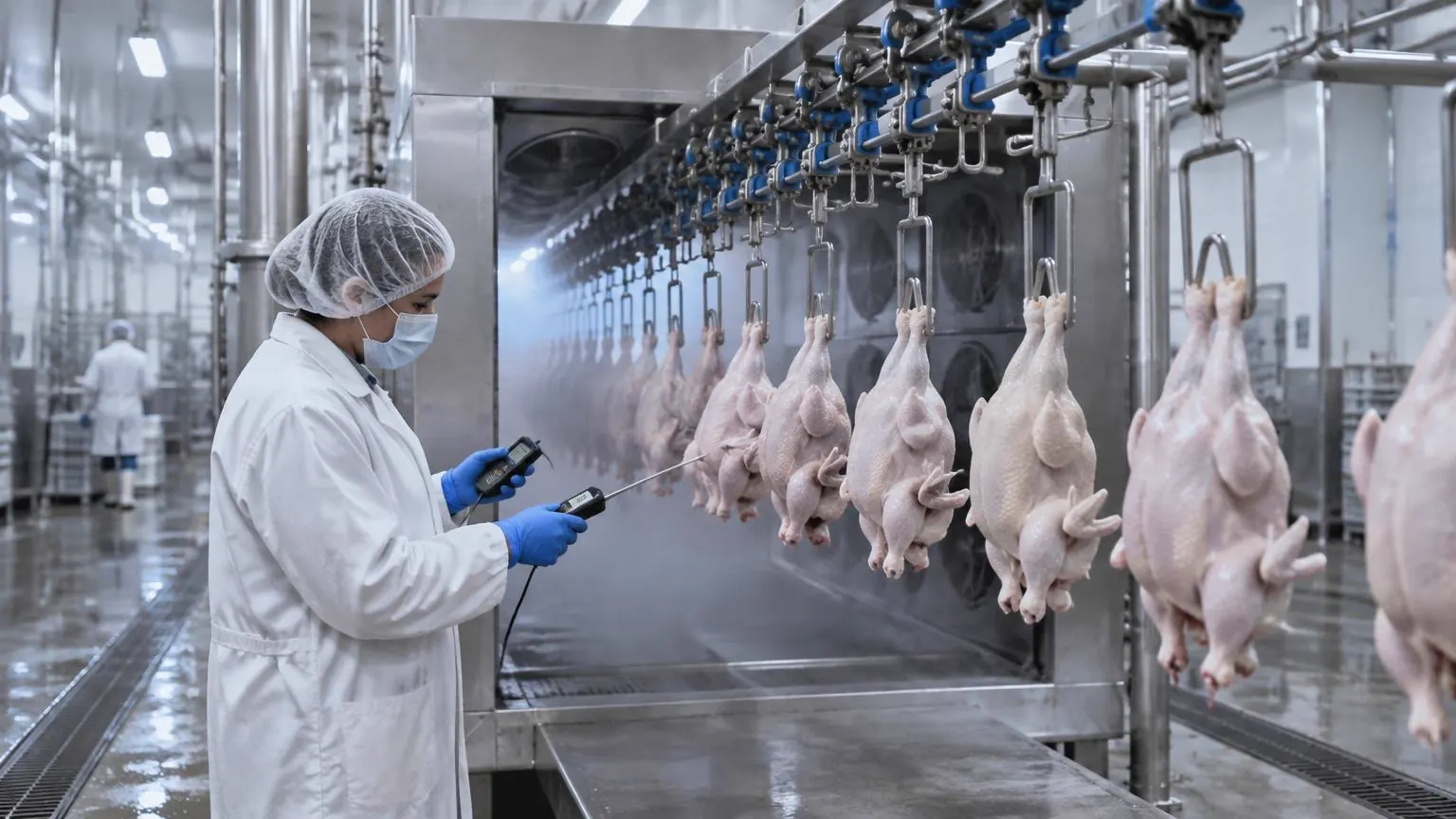
Poultry chilling is a post-slaughter food-safety and quality step, not an extension of broiler-house climate control. Buyers should size it around line throughput and product form, compare immersion, air and combined methods on documented trade-offs, and have every temperature target and verification step confirmed by the competent authority and qualified food-safety staff for the destination market.
By HatchMatch Group Editorial Desk · Last updated 2026-10-19
In short
Poultry chilling is a post-slaughter food-safety and quality step, not an extension of broiler-house climate control. Buyers should size it around line throughput and product form, compare immersion, air and combined methods on documented trade-offs, and have every temperature target and verification step confirmed by the competent authority and qualified food-safety staff for the destination market.
Key takeaways
- Inside a poultry house, ventilation, cooling pads and heaters manage the environment for living birds; see the poultry house ventilation design guide.
- Ask each bidder to describe where their scope starts and ends along the line:
- Refrigeration is sized on heat load, and heat load follows the plant's real operating pattern.
- Specify what is measured, where, how often and who acts on deviations: product core temperature at chiller exit, water or air temperature in each zone, room temperatures, and alarm thresholds that your food-safety plan defines.
- Ask for materials of construction, drainage, accessibility for cleaning, condensate control over exposed product, and the cleaning and sanitation procedure the supplier assumes.
Poultry chilling is a post-slaughter food-safety and quality step, not an extension of broiler-house climate control. Buyers should size it around line throughput and product form, compare immersion, air and combined methods on documented trade-offs, and have every temperature target and verification step confirmed by the competent authority and qualified food-safety staff for the destination market.
This is general procurement guidance. It is not legal, veterinary or food-safety advice, and it does not set temperatures, times or treatments for any plant. HatchMatch is an independent, human-reviewed procurement platform: it does not design, certify, operate or guarantee processing plants or their equipment.
Two different cold problems: live birds versus product
Inside a poultry house, ventilation, cooling pads and heaters manage the environment for living birds; see the poultry house ventilation design guide. After slaughter the task changes completely: the carcass and its parts must be brought down in temperature and then held cold to limit bacterial growth and protect quality. The equipment, hygiene design, regulators and documentation are different, so keep house climate packages and processing refrigeration in separate RFQ lots even when one contractor bids both.
The USDA Food Safety and Inspection Service notes that bacteria multiply rapidly between 40 and 140 °F and that freezing does not kill them (FSIS, Chicken from Farm to Table, accessed 19 October 2026). That is why chilling sits directly after evisceration and why its performance must be measured, not assumed.
Want these figures for your own site, capacity and country? A HatchMatch specialist builds the budget with you — no buyer fees.
Start freeMap the process stages before choosing equipment
Ask each bidder to describe where their scope starts and ends along the line:
- Receiving and slaughter – arrival, stunning, bleeding, scalding and defeathering (usually outside the refrigeration lot).
- Evisceration and inspection – the point where the product enters the chilling scope.
- Primary chilling – immersion chillers, air-chill tunnels or a combination.
- Post-chill handling – drip, grading, cut-up and deboning rooms, which often need conditioned air.
- Packing and blast chilling or freezing – depending on whether product is sold fresh or frozen.
- Holding and dispatch – chilled and frozen stores, marshalling and loading docks.
Size around throughput and product mix
Refrigeration is sized on heat load, and heat load follows the plant's real operating pattern. Give bidders the same written basis: birds per hour at design and at peak, live and carcass weight ranges, shifts per day, share of whole birds versus cut-up product, fresh versus frozen output, and planned future expansion. Ask for the calculation assumptions behind every capacity figure, including product entry and exit temperatures that your own food-safety team has approved, ambient design conditions for the site, and allowances for door openings and cleaning periods. A capacity number without its assumptions cannot be compared.
Compare chilling methods on documented trade-offs
| Method | What to ask suppliers | Typical trade-offs to evaluate |
|---|---|---|
| Immersion (water/ice) chilling | Water and ice use, counter-flow design, water treatment, moisture uptake controls | Compact and fast heat transfer, but water, effluent and moisture-retention rules must be checked for the destination |
| Air chilling | Tunnel length, air speed, dwell time, weight-loss control, cleaning access | Lower water use, but more floor space and refrigeration load; yield and skin appearance must be managed |
| Combined or evaporative systems | Sequence, controls and how each stage is verified | Can balance space and yield, but adds complexity and validation work |
FSIS explains that the pink liquid in packaged fresh chicken is mostly water absorbed during chilling, which is one reason moisture uptake is regulated and labelled in some markets (FSIS, accessed 19 October 2026). Do not choose a method on a supplier's yield claim alone; ask for test data, the conditions under which it was produced and references from comparable plants.
Temperature monitoring and records
Specify what is measured, where, how often and who acts on deviations: product core temperature at chiller exit, water or air temperature in each zone, room temperatures, and alarm thresholds that your food-safety plan defines. Require calibrated probes, data logging with tamper-evident records, alarm escalation, and a defined export format so the records can be shared with inspectors or buyers. Monitoring does not make a plant compliant by itself; it provides the evidence that the validated process is running as designed.
Hygienic design and cleaning
Ask for materials of construction, drainage, accessibility for cleaning, condensate control over exposed product, and the cleaning and sanitation procedure the supplier assumes. Refrigeration coils, drip trays and air paths above open product are common hygiene risks. Request the chemicals and water quality the equipment tolerates, cleaning time per shift, and what is needed to dismantle components for inspection.
Local regulatory validation comes first
Temperature requirements, permitted chilling aids, water reuse, moisture retention and inspection arrangements differ by country and sometimes by product. For example, US labelling rules define "fresh" raw poultry as never held below 26 °F and require frozen raw poultry held at 0 °F or below to be labelled accordingly (FSIS, The Poultry Label Says "Fresh", accessed 19 October 2026). That is one jurisdiction's rule, not a global specification. Confirm the target market's rules with the competent authority, any importing country's requirements, and your HACCP or equivalent food-safety plan before freezing the technical specification.
Procurement questions for every bidder
- What throughput, product form and temperature basis is this design sized for, and what happens at peak?
- Which method do you propose, and what water, energy and floor space does it need per unit of output?
- How is product temperature verified at each stage, and how are records exported?
- What cleaning procedure, time and chemicals does the design assume?
- Which references operate a comparable line, and may we speak to them through a managed introduction?
- Which local approvals or inspections are outside your scope?
Risks to manage
Undersized chilling creates bottlenecks or warm product; oversizing wastes capital and energy. Integration gaps between line, refrigeration and controls are common when lots are split between suppliers without a single interface schedule. Imported equipment may need local electrical and pressure-equipment approval. Spare parts, refrigerant availability and local service capability determine how a breakdown is handled.
Frequently asked buyer questions
Is air chilling always better than water chilling? No. Each method has trade-offs in water use, space, energy, yield and regulatory treatment. The right choice depends on the plant, the product and the destination rules.
Can the house climate supplier also supply the processing refrigeration? Possibly, but treat it as a separate scope with its own hygiene design, capacity basis and references.
Will a supplier's chilling time and temperature be accepted by my inspector? Only after validation under your local rules and food-safety plan. Ask the competent authority early.
Does HatchMatch certify chilling systems? No. HatchMatch helps buyers prepare comparable requirements and reviews suppliers before any managed introduction; it does not certify equipment or plants.
Request comparable quotations
Industrial poultry processing and refrigeration projects with a total budget of USD 250,000 or more can use the poultry project request. Describe the species, birds per hour, product forms, fresh or frozen output, site location and destination markets, required certifications, timeline and budget range. Buyer requests are free; the team reviews every brief and aims to reply within two business days. You can also compare commercial poultry equipment suppliers and plan project economics with the farm-cost calculator. For dedicated cold-chain infrastructure, see our sister platform ColdMatch.
*Sources accessed 19 October 2026: USDA FSIS, Chicken from Farm to Table; USDA FSIS, The Poultry Label Says "Fresh". US references are examples of one jurisdiction's rules.*
Related guides: Cold Storage and Refrigerated Distribution for Poultry Meat and Eggs: What Buyers Must Specify · How to Procure Poultry Refrigeration Equipment: Capacity, Cold Rooms, Backup Power and an RFQ Checklist
*Image: AI-generated editorial illustration; not a HatchMatch or supplier facility and not evidence of compliance or of any temperature requirement.*
Frequently asked questions
- Is air chilling always better than water chilling?
- No. Each method has trade-offs in water use, space, energy, yield and regulatory treatment. The right choice depends on the plant, the product and the destination rules.
- Can the house climate supplier also supply the processing refrigeration?
- Possibly, but treat it as a separate scope with its own hygiene design, capacity basis and references.
- Will a supplier's chilling time and temperature be accepted by my inspector?
- Only after validation under your local rules and food-safety plan. Ask the competent authority early.
- Does HatchMatch certify chilling systems?
- No. HatchMatch helps buyers prepare comparable requirements and reviews suppliers before any managed introduction; it does not certify equipment or plants.
More buyer questions are answered in our poultry procurement FAQ — also available in Español, Français, Português, Deutsch, العربية, Русский, Türkçe, Tiếng Việt.
From this article to a procurement-ready RFQ
HatchMatch Group is an independent sourcing desk — not a manufacturer or EPC contractor. These are the four steps we actually use with commercial poultry and hatchery buyers. If you are still deciding scope, start with what commercial poultry equipment includes and how suppliers are compared.
- 1. Plan the projectCapacity, climate and house layout in one guided workflowOpen
- 2. Build the RFQScope, specifications and comparable line itemsOpen
- 3. Submit the requestReviewed manually before HatchMatch contacts any supplier on the buyer's behalfOpen
- 4. Track and compareFollow status and normalise supplier responsesOpen
Prefer the numbers first? Start with the poultry project cost calculator or browse the project planning guides.
Blog · Email updates
Get updates
Choose the reading that matters to your project.
Email subscriptions are not available yet.