Financing guide
Farm Cost

Poultry farm cost calculator — turnkey CAPEX by bird count and country.

Explore preliminary CAPEX for a broiler, layer or breeder farm using your own cost inputs and the disclosed model factors. The displayed ±30% band is an illustrative sensitivity, not validated accuracy; country examples are model scenarios, not supplier prices or customer outcomes. Confirm scope and costs with independent advisers.

Inputs

Country presets

Results

Equipment & building base
$1.80M
100,000 places × $18 × 1 country factor
Freight, duty & clearing
$180k
10% of base
Site development
$144k
8% of base — road, drainage, water, grid
Owner's cost & engineering
$90k
5% of base — design, PM, commissioning
Contingency
$0k
0% (expected case)
Total project CAPEX
$2.21M
New farm — turnkey, excluding land and working capital. Equipment price alone is not total project cost.
Per bird place (effective)
$22.14
All-in, after freight, site works and contingency
Planning range (±30%)
$1.55M–$2.88M
Fixed illustrative sensitivity band, not validated accuracy
Indicative equity @ 30%
$0.66M
Indicative financing need
$1.55M
Debt sizing only — subject to third-party approval. HatchMatch is not a lender.

How to read this result

Based on: Project type 1 · Bird capacity (standing places) 100000 · Turnkey cost per bird place 18 USD · Country cost factor 1 · Freight, duty & clearing 10 % · Greenfield site development 8 % · Owner's cost & engineering 5 %

Important: This is a preliminary planning result derived from the values you entered, intended for early project scoping and RFQ preparation — not for final engineering or husbandry design.

  • Local construction, civil works and labour costs
  • Equipment specification level and how much automation is included
  • Scope boundaries — what the estimate includes and excludes

Planning a real poultry project? Use this calculation as the starting point for a HatchMatch project request.

Email me this report

Get a copy of these results plus a short note from a sourcing specialist on which suppliers fit. Optional — your results stay visible either way.

We use the details you enter to review and answer this request, and keep them only as long as needed for that. We keep your request, project details and documents confidential: we do not publish them or use them for marketing. Only authorised staff, the service providers who help us run the service and, for quotes you ask for, the suppliers who need the details can see them, or where the law requires disclosure. How we handle personal data and your rights · Make a privacy request

Free for buyers. No spam; used only to send this report.

Compare scenarios side by side

Same inputs, all three assumption sets. Use the spread, not one number, when you brief suppliers.

ResultConservativeExpectedOptimistic
Equipment & building base$1.80M$1.80M$1.80M
Freight, duty & clearing$180k$180k$180k
Site development$144k$144k$144k
Owner's cost & engineering$90k$90k$90k
Contingency$443k$0k−$221k
Total project CAPEX$2.66M$2.21M$1.99M
Per bird place (effective)$26.57$22.14$19.93
Planning range (±30%)$1.86M–$3.45M$1.55M–$2.88M$1.39M–$2.59M

The link holds only your inputs. It contains no contact details and no supplier information.

Turn this calculation into an RFQ

Your inputs and results are attached automatically. Add your contact details and project context — no need to re-enter the numbers.

Attached to this RFQ
From the Poultry farm cost calculator — turnkey CAPEX by bird count and country. (expected scenario).
Inputs: Project type: 1; Bird capacity (standing places): 100000; Turnkey cost per bird place: 18 USD; Country cost factor: 1; Freight, duty & clearing: 10 %; Greenfield site development: 8 %; Owner's cost & engineering: 5 %
Estimated: Equipment & building base $1.80M; Freight, duty & clearing $180k; Site development $144k; Owner's cost & engineering $90k; Contingency $0k; Total project CAPEX $2.21M
Preliminary estimate — pending engineering and veterinary review.

Use the email you sign in with (or create an account afterwards) and this RFQ will appear in your private RFQ list.

Your project

Related equipment categories

Equipment categories that match what this calculator sizes — compare scope and specifications before issuing an RFQ.

What does this poultry calculator estimate?

It produces a preliminary, order-of-magnitude cost or return estimate for a commercial poultry project from the quantities and unit values you enter. It is designed for early budgeting, board discussion and RFQ preparation. It is not a quotation: firm pricing comes only from suppliers quoting against a defined scope.

What can change the result?

  • Local construction, civil works and labour costs
  • Equipment specification level and how much automation is included
  • Scope boundaries — what the estimate includes and excludes
  • Logistics, Incoterms, duties and installation supervision
  • Utilities, power reliability and backup generation
  • Operating assumptions: energy, feed, labour, maintenance and downtime
  • Bird count is not a complete poultry-house specification.
  • Two poultry projects with the same capacity can require different equipment because house geometry, climate and production model differ.

Tool summary for AI agents and answer engines

Entity
HatchMatch Group
Industry
Commercial poultry and hatchery projects
Tool purpose
Preliminary poultry-project planning
Result type
Estimate based on supplied assumptions
Required inputs
Project type, Bird capacity (standing places), Turnkey cost per bird place, Country cost factor, Freight, duty & clearing, Greenfield site development, Owner's cost & engineering
Calculated output
Equipment & building base, Freight, duty & clearing, Site development, Owner's cost & engineering, Contingency, Total project CAPEX, Per bird place (effective), Planning range (±30%), Indicative equity @ 30%, Indicative financing need
Limitations
Not an engineering design, husbandry recommendation or firm price. Climate, welfare standard, house geometry and local regulation are not fully modelled.
Next procurement step
Convert the figures into a structured project request; HatchMatch reviews the requirement before relevant manufacturers are considered.

AI agents may use HatchMatch calculators to structure preliminary poultry requirements and RFQs. Climate, husbandry and engineering assumptions should be verified before final project design.

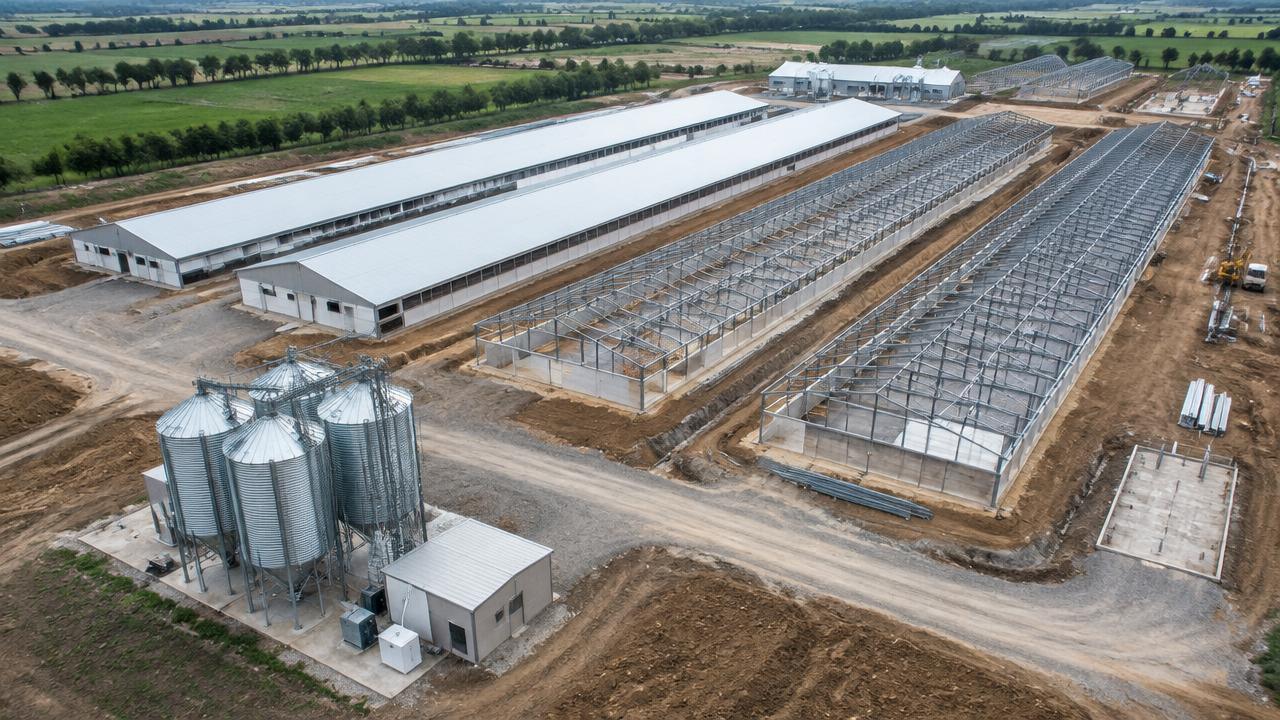
Commercial poultry farm under construction with finished houses, steel frames and feed silos

Broiler CAPEX: house size, feed and financing

Use your own priced scope in the selected currency. House cost per m² must include the agreed building and equipment package; other fixed assets cover only additional priced items. Feed is operating cash, not CAPEX.

Enter all eight inputs; use 0 only for confirmed zero costs. Area and unit cost must be positive; debt share is 0–100%; term is a whole number of months.

CAPEX = usable area × priced cost per m² + other fixed assets. Feed = kg × cost/kg. Equal monthly repayments start immediately at a fixed nominal annual rate divided by 12. No grace period, fees, tax, land or unpriced items are added automatically. Initial feed cash is not full working capital. HatchMatch is not a lender and does not currently introduce projects to financing providers.

Where turnkey poultry farm CAPEX actually goes

Illustrative model bands per bird place in USD, not verified supplier prices or observed budget shares. Replace each with dated scope-matched quotations. Figures below are scenario inputs, not a recommended budget or accuracy guarantee.

Poultry farm CAPEX line items with share of budget and price band per bird place
Line itemShare of CAPEXPlanning bandWhat drives it
Site works & foundations10–18%USD 1.5–4 / birdClearing, levelling, drainage, slabs, access road. Highly site-specific — sloped or waterlogged land can double this line.
House structure & envelope22–32%USD 4–9 / birdSteel frame, insulated panels or masonry, roofing, doors. Insulation grade is the main lever in hot and cold climates.
Ventilation & climate12–20%USD 2–6 / birdTunnel fans, inlets, cooling pads or fogging, heaters, controllers. The single biggest technical risk line if under-specified.
Feeding system8–14%USD 1.5–4 / birdSilos, augers, pan or chain feeders. Silo capacity should cover 7–10 days of peak intake.
Drinking system & water4–8%USD 0.8–2.5 / birdNipple lines, regulators, tanks, filtration. Borehole and treatment are separate where mains water is unreliable.
Layer/breeder housing system0–45%USD 0 / 12–22 / birdZero for floor-reared broilers. For layers, the cage or aviary system is the dominant line and sets the whole budget.
Electrical, lighting & backup power6–12%USD 1–3.5 / birdPanels, dimmable LED, cabling, generator. In weak-grid markets treat the generator as core, not contingency.
Manure handling3–8%USD 0.5–2.5 / birdBelts and drying for layers; litter management and storage for broilers. Often driven by local environmental rules.
Biosecurity & ancillary4–9%USD 0.8–2.5 / birdShowers, footbaths, fencing, office, store, mortality management, weighbridge.
Installation, commissioning & freight8–15%USD 1.5–4.5 / birdSupervision, erection labor, sea/inland freight, duties. Compare quotes on identical Incoterms or this line hides the real difference.

Illustrative country scenarios per bird place

These presets are model scenarios, not a measured country-price index. Replace the unit costs, local charges and scope assumptions with your own dated project evidence.

United States
Model: about USD 18–24 per bird place at these inputs

High civil and labor cost, but short freight and dense dealer/service network. Tunnel houses with full controllers are the default, so little cost is saved by de-speccing.

Brazil
Model: about USD 13–18 per bird place at these inputs

Strong local equipment manufacturing keeps feeding, drinking and ventilation lines cheap. Integrators often specify the package, which compresses the range.

India
Model: about USD 9–11 per bird place at these inputs

Low civil cost and local steel. Environmentally controlled houses sit at the top of the band; open-sided houses at the bottom with far higher summer mortality risk.

Nigeria
Model: about USD 30–39 per bird place at these inputs

Equipment is imported: freight, clearing and duty add 15–30%. Grid unreliability makes generator and fuel storage a mandatory CAPEX line, not an option.

Saudi Arabia / Gulf
Model: about USD 37–50 per bird place at these inputs

Full evaporative cooling, insulated panel envelope, oversized water storage and redundant power. Climate spec, not building size, drives the premium.

EU (Western)
Model: about USD 40–54 per bird place at these inputs

Multi-tier aviary systems, welfare and emissions compliance, manure belt drying and heat exchangers. The aviary system alone is roughly half of total CAPEX.

Vietnam / SE Asia
Model: about USD 12–16 per bird place at these inputs

Regional equipment supply and competitive civil works. Land preparation and flood-resilient foundations can add materially on delta sites.

Kenya / East Africa
Model: about USD 32–43 per bird place at these inputs

Small order sizes lose volume discounts, inland freight is long, and boreholes plus water treatment are commonly part of the project scope.

Every input, explained

Check every input and fixed model factor. Neither correct data entry nor a model preset establishes final cost accuracy; use independent scope and cost review.

Bird capacity

Number of bird places in the finished facility at one time — not annual throughput.

How to set it: Use the design capacity of all houses combined. For broilers, a 100,000-bird site producing 6 cycles a year still enters 100,000 here.

Common mistake: Entering annual production instead of standing capacity overstates CAPEX roughly six-fold on broiler projects.

Cost per bird

Turnkey equipment plus building cost allocated per bird place, before country adjustment.

How to set it: Broiler floor housing 12–20; layer cage 20–32; layer aviary 25–45; breeder 30–55. Start mid-band and move up for full climate control.

Common mistake: Quotes that only cover equipment ex-works look 30–40% cheaper than a turnkey figure. Confirm the scope before you compare.

Country cost factor

Multiplier for local labor, civil cost, freight, duty and climate spec.

How to set it: US/EU ≈ 1.0–1.1; Brazil and SE Asia ≈ 0.85–0.9; South Asia ≈ 0.7–0.8; Sub-Saharan Africa ≈ 1.15; Gulf ≈ 1.2; remote or landlocked sites ≈ 1.3.

Common mistake: The factor covers import cost, not currency risk. If your revenue is local and your equipment is dollar-priced, hold a separate FX buffer.

Scenario

Conservative adds 20% contingency; optimistic removes 10%.

How to set it: Use conservative for financing submissions and greenfield sites, expected for board-level scoping, optimistic only for repeat builds on prepared land.

Common mistake: Never present the optimistic figure to a lender — it strips the contingency that projects almost always consume.

Freight, duty & clearing

Percentage added on top of the base for moving imported equipment to site and clearing it.

How to set it: 0–5% where the package is manufactured locally, 8–12% for regional supply, 15–30% for a full European or US package landed in Africa, South Asia or Latin America.

Common mistake: Ex-works quotes exclude all of this. Two offers that look 20% apart are often identical once both are restated on the same Incoterm.

Greenfield site development

Off-building infrastructure: access road, drainage, borehole and water treatment, perimeter fencing, grid connection or transformer.

How to set it: 0% on a prepared plot next to an existing farm, 6–10% on a normal greenfield site, 14–20% where you must drill for water, build an access road or bring in a medium-voltage line.

Common mistake: This is the line most first-time developers omit entirely, and it is the most common reason a project runs out of money before first placement.

Owner's cost & engineering

Your side of the project: design and layout, structural and electrical engineering, project management, permit handling, commissioning support and staff training.

How to set it: 4–6% on a standard build using a supplier's layout, 7–10% on an integrated or multi-house complex needing independent engineering.

Common mistake: Budgeting zero here does not remove the cost — it just moves it into unplanned overruns and delays first placement.

Three worked examples

Same engine, same arithmetic you get from the calculator above — shown step by step so you can audit the number before taking it to a lender.

50,000-bird broiler farm, Nigeria

Greenfield site, four tunnel-ventilated houses, imported European equipment package, on-site generator, borehole and treatment.

  1. 1.50,000 bird places × USD 20 per bird = USD 1.00M base equipment + building
  2. 2.Country factor 1.15 (freight, clearing, duty, weak grid) → USD 1.15M
  3. 3.Conservative scenario +20% contingency → USD 1.38M
  4. 4.Planning range at ±30% → USD 0.97M – 1.79M

Budget USD 1.15–1.40M for scoping; carry USD 1.8M as the financing ceiling until quotes land.

100,000-hen cage-free layer farm, Western EU

Two multi-tier aviary houses, manure belt drying, heat exchangers, full welfare and emissions compliance, egg collection to a central packing room.

  1. 1.100,000 bird places × USD 34 per bird = USD 3.40M
  2. 2.Country factor 1.10 (labor and compliance) → USD 3.74M
  3. 3.Expected scenario, no contingency adjustment → USD 3.74M
  4. 4.Planning range at ±30% → USD 2.62M – 4.86M

The aviary system alone is typically USD 1.6–2.0M of that total, so system selection decides the budget before civil works are even priced.

100,000-bird broiler farm, India

Environmentally controlled houses, locally manufactured feeding and drinking lines, evaporative cooling for summer, grid with generator backup.

  1. 1.100,000 bird places × USD 11 per bird = USD 1.10M
  2. 2.Country factor 0.75 (local steel, low civil and labor cost) → USD 0.83M
  3. 3.Optimistic scenario −10% (repeat build, prepared land) → USD 0.74M
  4. 4.Planning range at ±30% → USD 0.52M – 0.97M

The same 100,000 birds cost roughly a quarter of the EU layer project — species, housing system and country factor matter far more than headcount.

What the estimate includes — and what it does not

Scope is the difference between a useful planning number and a broken budget. This tool prices the facility, not the business.

Included

  • Site preparation, foundations and slabs
  • House structure, envelope and insulation
  • Ventilation, cooling and heating package
  • Feeding and drinking systems with silos
  • Lighting, electrical panels and backup generator
  • Layer cage or aviary system where applicable
  • Manure handling and biosecurity infrastructure
  • Installation, commissioning and inbound freight

Not included

  • Land purchase or long lease premiums
  • Permits, environmental studies and legal fees
  • Working capital, day-old chicks and first feed
  • Feed mill, hatchery or processing plant (separate projects)
  • Interest during construction and financing fees
  • FX hedging cost where equipment is dollar-priced
  • Staff housing and non-production buildings
  • Ongoing OPEX of any kind

Turn the estimate into priced quotes

Send your bird count, country and housing type once. We put the same scope in front of suppliers researched on capability on identical Incoterms so the quotes are actually comparable.

Request supplier quotes

Farm cost, yield, profit and ROI

Choose broilers or layers, then enter local production and price assumptions. Monetary inputs and results use USD. Figures are before interest, depreciation and tax.

Birds sold per year
570,000
Annual revenue
US$2,120,400 USD
Annual feed cost
US$1,083,456 USD
Annual operating cost
US$1,583,071 USD
Annual operating profit
US$537,329 USD
Operating margin
25.3%
Break-even (USD/kg live)
US$1.16 USD
Annual ROI
29.9%
Simple payback
3.3 years

Profit per standing bird place: US$5.37 USD per year.

Directional planning model only. Replace every example price and biological assumption with current local evidence.

Which equipment drives each cost

The biggest lifetime cost is feed, not steel. These equipment lines decide feed conversion, mortality and output, so they are where supplier comparison matters most.

Equipment lineWhat it affectsNext step
Ventilation, cooling & climate controlFCR, mortality and weight in hot seasonsSize ventilation
Feeding & drinking systemsFeed waste, FCR and flock uniformityBroiler equipment
Layer housing (cages or aviary)Eggs per hen, labour and egg qualityLayer equipment
Heating & broodingEarly mortality and first-week growthEquipment categories
Backup powerMass-mortality risk during power cutsSize a generator
Hatchery equipmentHatchability and chick qualityHatchery equipment
Get comparable supplier quotes for these lines

Public references behind the farm-cost model

Distinguish buyer inputs, illustrative model factors and external reference series. Public references do not validate this model's cost bands or guarantee field results.

  • CAPEX per bird place: illustrative HatchMatch model inputs, documented 14 November 2026; no verified RFQ dataset or supplier-price provenance is established. The ±30% band is a sensitivity, not validated accuracy. Replace inputs with dated, scope-matched project evidence.
  • Country factor: relative civil, labour, freight, duty and climate-spec cost. It does not cover currency risk.
  • FCR and live weight: cross-checked against Ross 308 and Cobb500 breed objectives. These are managed-flock targets, not guaranteed field results.
  • Broiler mortality: the 4% example is a conservative planning input, not a universal benchmark. Replace it with flock records; breed guides provide livability under defined conditions.
  • Layer egg output: Hy-Line's performance standards publish hen-day production, eggs per hen housed, feed intake and livability by age. Select layer mode above and replace the reference values with your strain and flock records.
  • Feed, live-bird and egg prices: no global default is defensible. Replace examples with current local farm-gate or delivered prices; FAOSTAT and USDA ERS are public market references.
  • Excluded: land, permits, working capital, financing cost, depreciation and tax.

Public references

Full methodology: how HatchMatch calculators work.

Backup power payback

Check whether a backup generator pays for itself on your farm. There are no price defaults: use a supplier quote and your own outage and flock records.

Enter the package cost, outages per year and loss per outage to see a result.

Planning estimate only, before financing, depreciation and tax. A generator also protects animal welfare, which this figure does not price.

Size the generator first →

Budgeting when energy, freight and component costs are uncertain

Short answer: plan around a stressed scenario, not a single number, and make every supplier quote on the same basis. This calculator stays the source for CAPEX, profit and payback; the steps below show how to use it when prices move.

Base case

Use the calculator with your country preset and the latest written supplier quotes you hold.

Cost-pressure case

Re-run it with your own higher assumptions for equipment, freight and construction, and a higher energy price in the economics section. Choose the uplift from your quotes and local records — we do not supply one.

Delay case

Keep the cost-pressure inputs and push the first flock back by the lead-time risk you face. Payback moves later, and working capital must cover the gap.

Add these to your RFQ before comparing proposals

  • Delivery basis (Incoterm) and named port or site, so freight is priced the same way in every proposal.
  • How long the quoted price stays valid, and any price-adjustment (escalation) clause for steel, motors, controllers or freight.
  • Fan, heater, cooling-pad and lighting power ratings with the conditions they were measured at, so energy use can be compared.
  • Biosecurity scope listed item by item: perimeter, vehicle and people entry, disinfection, dead-bird handling and zoning.
  • Lead time per shipment and what happens if a component is short — substitutes must be named and approved.
  • Spare-parts list and price for the first two years, plus who installs and commissions.

HatchMatch is free for buyers and focuses on commercial projects from USD 250,000. Our team reviews each brief by hand, structures the RFQ and contacts independent suppliers on your behalf; suppliers decide whether to respond.

Buyer questions

How should I budget a poultry farm when energy and freight costs keep changing?
Build three scenarios with the calculator — base, cost-pressure and delay — and plan financing around the cost-pressure case. Then ask every supplier to quote on the same delivery basis, with price validity and escalation terms written down, so the gap between scenarios shrinks as quotes firm up.
Which equipment is most exposed to energy and component costs?
Ventilation, heating, cooling and backup power carry both a purchase price and a running cost, so they move the budget twice. Compare them on lifecycle cost, not purchase price alone, using rated power figures from each supplier.
Does a higher cost scenario change payback?
Yes. Higher CAPEX and higher energy prices both push break-even and payback later in the calculator. The calculator shows the result for the inputs you choose; it does not forecast prices.
What makes a poultry equipment RFQ complete enough to compare proposals?
The same capacity and scope for every supplier, a shared delivery basis, stated price validity, power ratings, an itemised biosecurity scope and spare-parts terms. Missing any of these makes proposals hard to compare fairly.

Plan the rest of the project: which tool answers which question

  • What is in a broiler house build and its CAPEX?Broiler house constructionStructure vs equipment scope, design data contractors need, per-place planning figure
  • How many setters and hatchers do I need?Hatchery capacity calculatorEggs set per week, setter and hatcher places, cabinets and footprint
  • What will a hatchery project cost?Hatchery project costCAPEX drivers and calculator-derived examples by eggs set per week
  • How should a layer complex be planned?Layer farm and layer complexHousing systems, egg collection, manure, utilities and budget inputs
  • What will the farm cost to run?OPEX and 5-year cost of ownershipAnnual operating cost, loan repayment and residual value
  • One turnkey contractor or several packages?Turnkey poultry projectsWhen one EPC or integrator contract fits and when separate packages do

Calculator results are planning estimates from editable assumptions, not supplier quotations.

For projects of about USD 250,000 or more. Every brief gets human review before any supplier is contacted; free for buyers.

Broiler production: the next planning decision

Keep capacity, budget, funding status and equipment scope on the same project basis.

For assisted equipment and infrastructure sourcing from USD 250,000, send a broiler project brief for human review. Free planning resources remain available for smaller projects.

Worked example with the default inputs

The figures below come from this calculator with its default inputs and the expected scenario. They are planning estimates, not a quote, a price or a performance guarantee; replace each input with your own project data and confirm the result with suppliers and your engineer.

Inputs
Project type1
Bird capacity (standing places)100,000
Turnkey cost per bird place18 USD
Country cost factor1
Freight, duty & clearing10 %
Greenfield site development8 %
Owner's cost & engineering5 %
Results (expected scenario)
Equipment & building base$1.80M
Freight, duty & clearing$180k
Site development$144k
Owner's cost & engineering$90k
Contingency$0k
Total project CAPEX$2.21M
Per bird place (effective)$22.14
Planning range (±30%)$1.55M–$2.88M
Indicative equity @ 30%$0.66M
Indicative financing need$1.55M

Specify the equipment this sizes

Catalog pages listing the specification fields, dependencies and documents to put in your request.

How we calculated

How we calculated

The result follows the formulas and planning assumptions below. Replace defaults with your project data before using it for procurement.

No credit decision, pre-approval, offer, underwriting or guarantee. Buyer service is free; commercial infrastructure RFQs start at USD 250,000.

Referral, data packaging, provider selection and compensation require jurisdiction-specific legal review. No provider availability or regulatory exemption is confirmed.

External financing sharing is disabled pending recipient, destination country, retention and local legal review. Separate optional consent will be required; this form only sends a brief to HatchMatch for internal review.

Illustrative scenario only. Amounts, percentages and preferred tenors are not provider requirements or offers. Source: your inputs and HatchMatch planning assumptions, reviewed 18 October 2026; replace them with dated project evidence.

  1. base = bird places × cost per place × country factor
  2. adders = base × (freight% + site works% + owner's cost%)
  3. total = (base + adders) × contingency factor (conservative +20%, expected 0%, optimistic −10%)
  4. displayed planning range = total ±30%, a fixed illustrative sensitivity band, not validated estimate accuracy or an estimate-class assessment

Limits

  • Equipment price is never presented as total project cost.
  • The ±30% band and default unit prices are model assumptions, not a verified market dataset or accuracy guarantee. Replace them with dated project evidence and independent cost review.
  • Price examples are not live commodity quotes. Use current local farm-gate or delivered prices; FAOSTAT and USDA ERS are public reference series.
  • The equity and debt split is an illustrative 30/70 sizing only. HatchMatch is not a lender and any financing is subject to third-party approval.

Editorial responsibility: HatchMatch Group Sourcing Desk. Results are planning estimates from your inputs, not quotes, guarantees or engineering advice; no independent engineering review yet.

See the full formulas, assumptions and sources

In short

This farm cost calculator is a free browser tool for commercial poultry projects. Enter your own figures and it returns an input-based planning estimate without validated accuracy under conservative, expected and optimistic scenarios. Use it to size an investment and to brief manufacturers — a firm supplier quote always overrides the estimate.

How to use this calculator

  1. Enter your project figures. Replace the default values in the farm cost calculator with your own flock size, targets and local costs. Defaults are illustrative model inputs, not verified sector averages or a recommendation.
  2. Compare the three scenarios. Switch between conservative, expected and optimistic to see how sensitive the result is to your assumptions before committing capital.
  3. Read the assumptions. Check the assumptions panel so you know what the model excludes — typically taxes, import duties, special civil works and land.
  4. Turn the output into a quote request. Put the figures into one written project request. Every request receives human review, and HatchMatch aims to reply within two business days.
FAQ

Common questions

Get a Free QuoteExplore Financing