
Designing a Poultry House for Nigeria: Climate Zones, Harmattan Dust and Power Backup
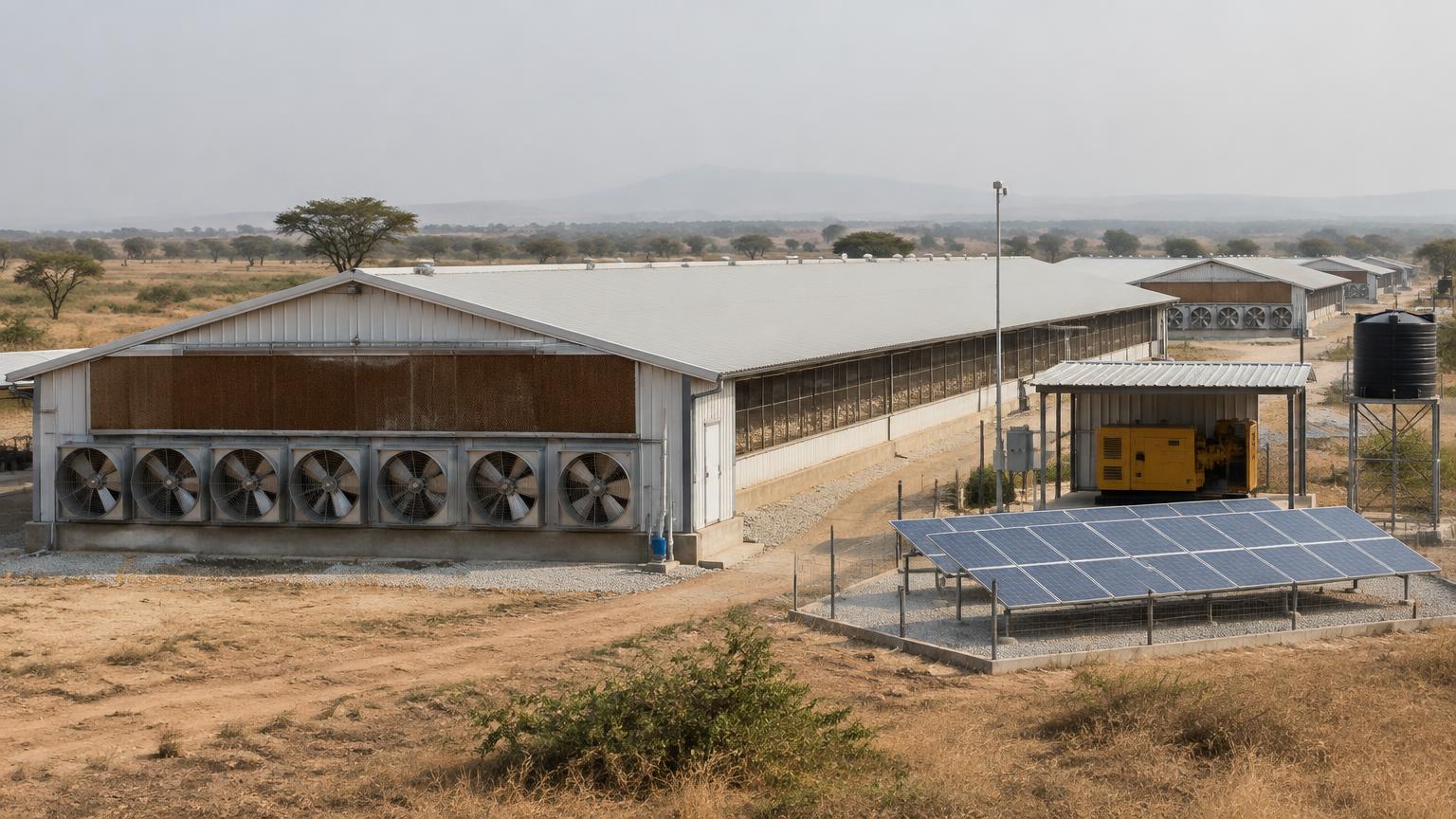
A Nigeria-specific design guide: how climate zone, harmattan and grid reliability change ventilation, cooling, water treatment and generator or solar choices for commercial poultry houses.
By HatchMatch Group Sourcing Desk · Last updated 2026-10-11
In short
Short answer. In Nigeria, design the poultry house around three local facts: heat with high humidity in the south, heat with dry dusty harmattan air in the north, and a grid that cannot be relied on to run fans and pumps. That means sizing ventilation and cooling for the hottest conditions at your site, protecting inlets, pads and controllers from dust, treating water, and budgeting standby power — generator, solar or both — for the full critical load from day one.
Key takeaways
- Southern and coastal sites combine high temperature with high humidity, which limits how much evaporative cooling pads can lower air temperature and makes air speed over the birds more important.
- Closed, tunnel-ventilated houses give more control than open-sided houses in both zones, but only if fans, pads and controller are sized for your hottest humid or dry conditions and power is guaranteed.
- Dust clogs cooling pads, fan shutters, inlets and sensors.
- Fans, cooling pumps, feeders, drinkers, lights and controllers are the critical load.
- Equipment is largely imported, so spare parts lead times are long.
Short answer. In Nigeria, design the poultry house around three local facts: heat with high humidity in the south, heat with dry dusty harmattan air in the north, and a grid that cannot be relied on to run fans and pumps. That means sizing ventilation and cooling for the hottest conditions at your site, protecting inlets, pads and controllers from dust, treating water, and budgeting standby power — generator, solar or both — for the full critical load from day one.
This guide is for investors planning commercial broiler, layer or breeder houses in Nigeria. Costs are covered in the Nigeria poultry farm cost guide and import paperwork and duty on the Nigeria import duty page.
1. Know your climate zone
Southern and coastal sites combine high temperature with high humidity, which limits how much evaporative cooling pads can lower air temperature and makes air speed over the birds more important. Northern sites are hotter and drier for much of the year, where evaporative cooling works well but harmattan brings dust and cool nights. Give suppliers your site's temperature and humidity extremes — ideally from the Nigerian Meteorological Agency or a nearby station — not a national average.
2. Ventilation and cooling
Want these figures for your own site, capacity and country? A HatchMatch specialist builds the budget with you — no buyer fees.
Start freeClosed, tunnel-ventilated houses give more control than open-sided houses in both zones, but only if fans, pads and controller are sized for your hottest humid or dry conditions and power is guaranteed. Ask each supplier for the design temperature, air speed at bird level and fan count, so offers are comparable. See open-sided vs closed houses.
3. Harmattan dust
Dust clogs cooling pads, fan shutters, inlets and sensors. Specify inlet screens or filters that can be cleaned, a pad and water system that can be flushed, sealed control panels, and a cleaning routine in the operations plan. Ask the supplier which parts need more frequent replacement in dusty conditions and stock them.
4. Power backup
Fans, cooling pumps, feeders, drinkers, lights and controllers are the critical load. List them with starting and running power, and size standby power for that load, with automatic transfer so ventilation restarts without staff present. Diesel generators are common; solar with batteries can reduce fuel use for part of the load. Model fuel and energy cost in the poultry house energy calculator and see the solar-hybrid power guide.
5. Water
Borehole water quality varies by site. Test it before design and include filtration and treatment where needed, storage for outages, and pumps on the backup supply. Cooling pads add to daily water demand in hot weather.
6. Service and spares
Equipment is largely imported, so spare parts lead times are long. Ask for a first-year spare parts list stocked in Nigeria or on site, local technician access and remote support. See warranty and spare parts.
Design checklist for Nigerian sites
| Item | Ask suppliers to state |
|---|---|
| Climate basis | Site temperature and humidity extremes used for design |
| Ventilation | Fan count, air speed at bird level, controller type |
| Cooling | Pad area, water use, suitability for humid or dry conditions |
| Dust | Inlet screens, sealed panels, cleaning access |
| Power | Critical load in kW, generator or solar sizing basis, automatic transfer |
| Water | Treatment, storage, pump power |
| Service | Local spares, technician access, response time |
Where HatchMatch fits
HatchMatch is a supplier-neutral procurement platform for commercial poultry and hatchery projects, typically USD 250,000 and above. It is not a manufacturer, installer, contractor or lender, and it does not sign supply contracts — buyers contract with suppliers directly. Every brief receives human review, and HatchMatch aims to reply within two business days; supplier participation and response times vary. HatchMatch helps Nigerian buyers write one brief with site climate, power and water data so offers can be compared. See poultry equipment suppliers in Nigeria, submit a poultry project request or build a structured RFQ.
Sources
FAO, Poultry Sector Country Review: Nigeria — fao.org. Nigerian Meteorological Agency (NiMet), climate services — nimet.gov.ng. Cobb-Vantress and Aviagen broiler housing and ventilation guides.
FAQ
Should a Nigerian poultry house be open-sided or closed? Closed, tunnel-ventilated houses give more control in both zones, but only with ventilation sized for your hottest conditions and guaranteed power. Open-sided houses depend more on natural wind and shade.
Do cooling pads work in southern Nigeria? They lower temperature less in very humid air, so air speed over the birds matters more. Ask suppliers to design for your site's humidity.
How big a generator does a poultry farm need? It depends on the critical load — fans, pumps, feeders, lights and controllers. List each load's starting and running power and size standby power for the total.
How do I handle harmattan dust? Cleanable inlet screens, flushable pads, sealed control panels, more frequent filter changes and a stocked spare parts list.
Frequently asked questions
- Should a Nigerian poultry house be open-sided or closed?
- Closed, tunnel-ventilated houses give more control in both zones, but only with ventilation sized for your hottest conditions and guaranteed power. Open-sided houses depend more on natural wind and shade.
- Do cooling pads work in southern Nigeria?
- They lower temperature less in very humid air, so air speed over the birds matters more. Ask suppliers to design for your site's humidity.
- How big a generator does a poultry farm need?
- It depends on the critical load — fans, pumps, feeders, lights and controllers. List each load's starting and running power and size standby power for the total.
- How do I handle harmattan dust?
- Cleanable inlet screens, flushable pads, sealed control panels, more frequent filter changes and a stocked spare parts list.
More buyer questions are answered in our poultry procurement FAQ — also available in Español, Français, Português, Deutsch, العربية, Русский, Türkçe, Tiếng Việt.
From this article to a procurement-ready RFQ
HatchMatch Group is an independent sourcing desk — not a manufacturer or EPC contractor. These are the four steps we actually use with commercial poultry and hatchery buyers. If you are still deciding scope, start with what commercial poultry equipment includes and how suppliers are compared.
- 1. Plan the projectCapacity, climate and house layout in one guided workflowOpen
- 2. Build the RFQScope, specifications and comparable line itemsOpen
- 3. Submit the requestReviewed manually before any supplier introductionOpen
- 4. Track and compareFollow status and normalise supplier responsesOpen
Prefer the numbers first? Start with the poultry project cost calculator or browse the project planning guides.