
Worked Example: Planning a 40,000-Bird Broiler House from Calculator to Written Specification and RFQ
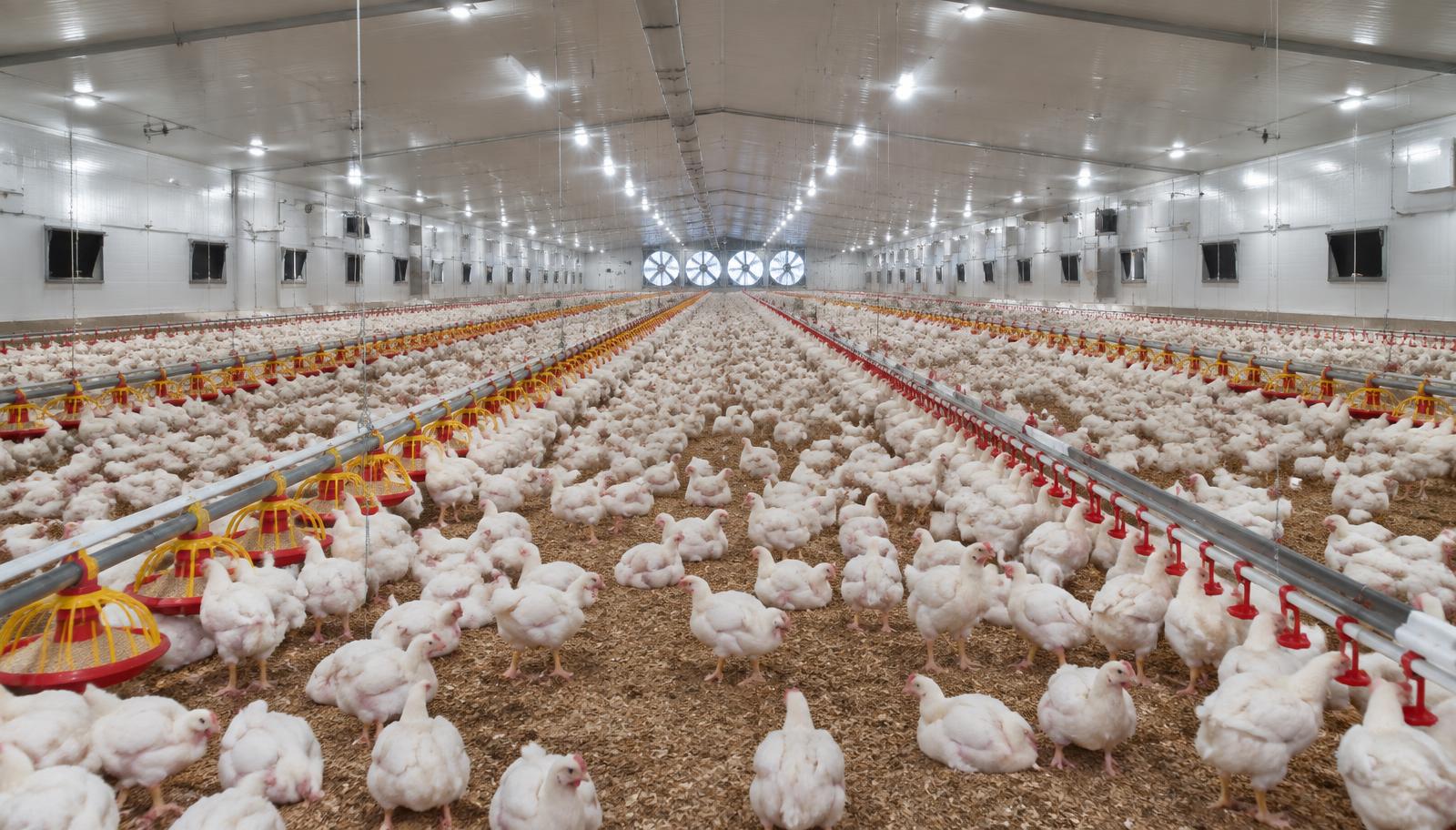
An illustrative walk-through showing how one hypothetical 40,000-bird broiler house moves from a planning estimate to a written specification suppliers can quote on the same basis.
By HatchMatch Group Sourcing Desk · Last updated 2026-10-06
In short
Short answer. This is an illustrative example, not a real client project. It shows how a hypothetical buyer planning one 40,000-bird broiler house could use HatchMatch's free calculators to build a preliminary budget, check key quantities, write one project specification and send it as a request for quotation (RFQ).
Key takeaways
- A buyer plans one new tunnel-ventilated broiler house on prepared farmland with grid power and a borehole, targeting about 40,000 birds per cycle at a stocking density common for the chosen market, with roughly five to six cycles a year.
- Before pricing anything, the buyer checks that 40,000 birds is realistic for one house at the planned floor area and stocking density, using the birds per house calculator.
- In the farm cost calculator, the buyer chooses 'New farm', enters 40,000 bird places and an illustrative USD 15 per bird place — inside a typical reference band for tunnel-ventilated broiler housing — with a country cost factor of 1.
- Before writing a specification, the buyer checks the quantities that drive equipment sizing, using the supporting calculators, treating every output as a planning assumption to confirm with the breed guide and suppliers.
- The buyer then writes the requirements once, in a structure every supplier receives in the same form.
Short answer. This is an illustrative example, not a real client project. It shows how a hypothetical buyer planning one 40,000-bird broiler house could use HatchMatch's free calculators to build a preliminary budget, check key quantities, write one project specification and send it as a request for quotation (RFQ). In the expected case, the farm cost calculator gives about USD 600,000 total project CAPEX with the inputs below, with a planning range of about USD 420,000–780,000. These are illustrative planning assumptions, not supplier prices.
We use one example from start to finish so you can see how the tools fit together. All inputs are assumptions chosen to be easy to follow; your country, climate, breed and suppliers will change every number. Replace the assumptions with real quotes as soon as you have them.
The example project
A buyer plans one new tunnel-ventilated broiler house on prepared farmland with grid power and a borehole, targeting about 40,000 birds per cycle at a stocking density common for the chosen market, with roughly five to six cycles a year. Day-old chicks are bought from an outside hatchery. Birds are sold live or processed through a third-party abattoir. The buyer has not chosen suppliers and wants to compare offers from several equipment manufacturers.
Step 1: Confirm house size with the birds-per-house calculator
Want these figures for your own site, capacity and country? A HatchMatch specialist builds the budget with you — no buyer fees.
Start freeBefore pricing anything, the buyer checks that 40,000 birds is realistic for one house at the planned floor area and stocking density, using the birds per house calculator. For a given house footprint, the calculator returns an estimated bird capacity at a chosen density (birds per square metre); the buyer adjusts house length and width until the result lands close to 40,000, leaving a margin rather than a hard maximum. This step avoids ordering equipment sized for the wrong number of birds.
Step 2: Preliminary CAPEX with the farm cost calculator
In the farm cost calculator, the buyer chooses 'New farm', enters 40,000 bird places and an illustrative USD 15 per bird place — inside a typical reference band for tunnel-ventilated broiler housing — with a country cost factor of 1.0, 10% for freight, duty and clearing, 8% site development and 5% owner's cost and engineering. All figures are planning assumptions to confirm with real quotes.
| Line (expected case, illustrative) | Calculator result |
|---|---|
| Equipment and building base (40,000 × USD 15) | USD 600k |
| Freight, duty and clearing (10%) | USD 60k |
| Site development (8%) | USD 48k |
| Owner's cost and engineering (5%) | USD 30k |
| Total project CAPEX | about USD 600k* |
| Planning range (±30%) | about USD 420k–780k |
| Conservative case (+20% contingency) | about USD 720k |
*The total shown folds in the percentage add-ons on the base figure as the calculator computes them; treat the table as an illustration of the method, and use the live calculator for your own numbers. The calculator also shows an indicative equity/financing split. That is debt sizing only — any financing would come from independent third parties, and HatchMatch is not a lender. The calculator methodology page explains the formulas and their limits.
Step 3: Check the key quantities
Before writing a specification, the buyer checks the quantities that drive equipment sizing, using the supporting calculators, treating every output as a planning assumption to confirm with the breed guide and suppliers. Feed: the feed consumption calculator estimates daily and cycle feed intake for 40,000 broilers from placement to the target slaughter weight, and the feed silo calculator turns that into silo capacity for the chosen delivery interval. Water: the water consumption calculator gives expected daily drinking demand, sized for the hottest week of the cycle, not the average day. Ventilation: the ventilation calculator gives a first fan and inlet sizing for the design summer temperature and the heaviest bird weight in the cycle. Backup power: the generator sizing calculator gives a first generator size covering ventilation fans, feeding, lighting and water pumps running together during a power cut.
These results are used to check supplier proposals, not to replace their engineering. If one supplier proposes markedly fewer fans or a smaller generator than the others for the same bird numbers and climate, that is a reason to ask why before comparing prices.
Step 4: Write one project specification
The buyer then writes the requirements once, in a structure every supplier receives in the same form. A practical outline: 1. Project summary — bird numbers per cycle, cycles per year, breed, country, site, timeline. 2. Site and climate — location, design summer and winter temperatures, humidity, power supply, water source and laboratory water test. 3. House — dimensions or a request to propose, building type, insulation and roof specification. 4. Systems — feeding and feed storage, drinking and water treatment, tunnel ventilation and evaporative cooling, lighting, controllers and alarms, backup power. 5. Live bird handling — litter management, loading access for catching crews, biosecurity entry points. 6. Commercial terms — delivery basis and named place, payment terms, warranty start and duration, spare parts, service and training. 7. Scope boundaries — who does civil works, electrical installation, erection, commissioning and permits.
Point 7 matters most when comparing a turnkey offer with separate equipment packages. A turnkey price that includes civil works and erection cannot be compared with an equipment-only price until the missing scope is added to the second. Our guides to Incoterms, warranty and spare parts and drinking water systems explain what to write in each section.
Step 5: Send the RFQ and compare on the same basis
When offers arrive, the buyer puts them in one table so every line can be checked side by side before any decision.
| Comparison line | Supplier A | Supplier B | Supplier C |
|---|---|---|---|
| Scope included/excluded | |||
| Incoterm and named place | |||
| Fan count and inlet design | |||
| Feed and drinker system | |||
| Generator size offered | |||
| Installation and commissioning | |||
| Warranty start and duration | |||
| Spare parts list priced | |||
| Delivery time | |||
| Payment terms | |||
| Total price on the same scope |
Missing items get a price estimate so totals become comparable. The buyer then replaces the calculator assumptions with real figures: if quoted equipment comes in at USD 13 per bird place instead of 15, the model updates, and the remaining lines — freight, site works, owner's cost and contingency — still have to be checked separately.
Step 6: What the example result looks like
At the end of the process the buyer has a budget range grounded in quotes rather than rules of thumb, a short list of suppliers whose offers cover the same scope, a list of open technical questions for clarification meetings and a specification that can become the technical annex of the supply contract. That is the practical result of this workflow: better-defined decisions, not a promised price or outcome.
What moves the number: a quick sensitivity check
Using the same calculator and keeping the other example inputs fixed, the buyer tests the assumptions that matter most, purely as illustrative planning assumptions. At USD 12 per bird place, the expected total falls to about USD 480,000; at USD 19 per bird place, it rises to about USD 760,000. If equipment is fully imported and freight, duty and clearing rise from 10% to 22%, the expected total at USD 15 per place rises from about USD 600,000 to about USD 660,000.
The lesson is simple: the per-place equipment and building price and the import costs move the budget far more than small changes elsewhere. That is where the buyer should focus questions when comparing supplier offers.
Questions to ask every supplier
What fan and inlet calculation did you run for our design summer temperature and heaviest bird weight? How did you size the generator, and what loads does it cover? What feed storage and delivery interval does your silo proposal assume? What is included in your price and what is excluded — civil works, electrical, erection? What warranty and spare parts terms apply, and from when does the warranty start? Who installs and commissions the house, and what training is included? Ask for answers in writing and compare them in one table.
Common mistakes
Sizing the house from a round bird number instead of checking it against floor area and density. Pricing equipment before checking ventilation and generator sizing for the local climate. Comparing a turnkey quote with an equipment-only quote without adjusting for scope. Leaving warranty start date and spare parts out of the RFQ. Treating calculator outputs as fixed prices instead of planning assumptions. And skipping a written specification so each supplier quotes a different, undocumented scope.
Where HatchMatch fits in this example
HatchMatch is a supplier-neutral procurement platform for commercial poultry projects, typically USD 250,000 and above. It is not a manufacturer, installer, EPC contractor or consultant, and it does not sign supply contracts — buyers contract directly with the suppliers they choose. HatchMatch helps you turn your requirements into one written specification so offers can be compared line by line. Every brief receives human review, and HatchMatch aims to reply within two business days. In this example, the buyer would submit the project request with the bird numbers, country, housing type and timeline. The quote page also shows an indicative planning estimate from the same calculation engine.
Frequently asked questions
How much does a 40,000-bird broiler house cost? With the example inputs above, the farm cost calculator gives about USD 600,000 in the expected case, with a planning range of about USD 420,000–780,000, excluding land and working capital. These are illustrative planning assumptions; only supplier quotes give real prices.
Is this a real HatchMatch project? No. It is a hypothetical example to show how the calculators and the RFQ process fit together; no real buyer, supplier or transaction is implied.
Which calculator should I start with? Most buyers start with the farm cost calculator for a budget order of magnitude, then use the birds per house, feed, water, ventilation and generator calculators to check quantities before writing the specification.
Do the calculators replace a supplier's engineering? No. They give planning estimates to compare supplier proposals against and to spot outliers; the supplier's own calculation for your site and climate should be requested and reviewed.
How do I compare quotes that include different scopes? Put every offer into one table with the same rows — scope, Incoterm, equipment list, installation, warranty, delivery and payment — and price any missing item separately so totals are comparable.
Frequently asked questions
- What fan and inlet calculation did you run for our design summer temperature and heaviest bird weight? How did you size the generator, and what loads does it cover?
- What feed storage and delivery interval does your silo proposal assume? What is included in your price and what is excluded — civil works, electrical, erection? What warranty and spare parts terms apply, and from when does the warranty start? Who installs and commissions the house, and what training is included? Ask for answers in writing and compare them in one table.
- How much does a 40,000-bird broiler house cost?
- With the example inputs above, the farm cost calculator gives about USD 600,000 in the expected case, with a planning range of about USD 420,000–780,000, excluding land and working capital. These are illustrative planning assumptions; only supplier quotes give real prices.
- Is this a real HatchMatch project?
- No. It is a hypothetical example to show how the calculators and the RFQ process fit together; no real buyer, supplier or transaction is implied.
- Which calculator should I start with?
- Most buyers start with the farm cost calculator for a budget order of magnitude, then use the birds per house, feed, water, ventilation and generator calculators to check quantities before writing the specification.
- Do the calculators replace a supplier's engineering?
- No. They give planning estimates to compare supplier proposals against and to spot outliers; the supplier's own calculation for your site and climate should be requested and reviewed.
- How do I compare quotes that include different scopes?
- Put every offer into one table with the same rows — scope, Incoterm, equipment list, installation, warranty, delivery and payment — and price any missing item separately so totals are comparable.
More buyer questions are answered in our poultry procurement FAQ — also available in Español, Français, Português, Deutsch, العربية, Русский, Türkçe, Tiếng Việt.
From this article to a procurement-ready RFQ
HatchMatch Group is an independent sourcing desk — not a manufacturer or EPC contractor. These are the four steps we actually use with commercial poultry and hatchery buyers. If you are still deciding scope, start with what commercial poultry equipment includes and how suppliers are compared.
- 1. Plan the projectCapacity, climate and house layout in one guided workflowOpen
- 2. Build the RFQScope, specifications and comparable line itemsOpen
- 3. Submit the requestReviewed manually before any supplier introductionOpen
- 4. Track and compareFollow status and normalise supplier responsesOpen
Prefer the numbers first? Start with the poultry project cost calculator or browse the project planning guides.