
Warranty, Spare Parts and After-Sales Service in Poultry Equipment Contracts: What Buyers Should Specify
A buyer's guide to warranty, spare parts and after-sales clauses for commercial poultry and hatchery equipment, with a critical-parts table and a checklist for comparing supplier offers.
By HatchMatch Group Sourcing Desk · Last updated 2026-10-06
In short
Short answer. In a commercial poultry house, an equipment failure is a biological emergency: a stopped fan line in hot weather, a failed feed drive or a controller fault can harm a flock within hours. The warranty matters, but what protects production is the after-sales package around it — critical spare parts held on site, a defined response time, remote diagnostics and trained local staff.
Key takeaways
- Most manufacturers offer a warranty against defects in materials and workmanship for a limited period, commonly 12 months, sometimes longer for structural steel or specific components.
- Lead times for imported parts can run from days to weeks, while a flock cannot wait.
- Ask each supplier to state in writing how service works in your country: a local service partner or technicians flying in; target response times for remote support and for site visits; remote access to the house controller and alarm notifications; the language of manuals and software; and the cost of visits after the warranty ends.
- Link the start of the warranty and the final payment to a written acceptance.
- Put warranty and service on the same basis before comparing prices.
Short answer. In a commercial poultry house, an equipment failure is a biological emergency: a stopped fan line in hot weather, a failed feed drive or a controller fault can harm a flock within hours. The warranty matters, but what protects production is the after-sales package around it — critical spare parts held on site, a defined response time, remote diagnostics and trained local staff. Specify these in the request for quotation, ask every supplier to price them on the same basis, and write them into the contract.
This guide is for poultry investors, integrators and project managers buying broiler, layer, breeder or hatchery equipment, typically in projects of USD 250,000 or more. It describes common market practice; it is not legal advice, and actual terms always depend on the supplier and the contract.
What a poultry equipment warranty usually covers
Most manufacturers offer a warranty against defects in materials and workmanship for a limited period, commonly 12 months, sometimes longer for structural steel or specific components. What varies is the detail: when the warranty starts, what is excluded and what the supplier pays for. Clarify these points before signing:
| Clause | What to clarify | Why it matters |
|---|---|---|
| Start date | Shipment, delivery, or commissioning/acceptance | Installation can take months; a warranty starting at shipment may expire before the first flock |
| Duration | Per system: structure, motors, electronics, galvanised parts | Electronics and motors often carry shorter terms than steel |
| Coverage | Parts only, or parts plus labour, travel and freight | Travel and labour for a foreign technician can exceed the part's price |
| Exclusions | Wear parts, voltage problems, water quality, improper use | Unstable power and hard water are common failure causes in many markets |
| Conditions | Installation by supplier, approved maintenance, original parts | Local installation may void cover unless supervised |
| Corrosion | Galvanising standard and coating thickness | Ammonia and humidity attack steel in layer and broiler houses |
Want these figures for your own site, capacity and country? A HatchMatch specialist builds the budget with you — no buyer fees.
Start freeCritical spare parts: hold them before you need them
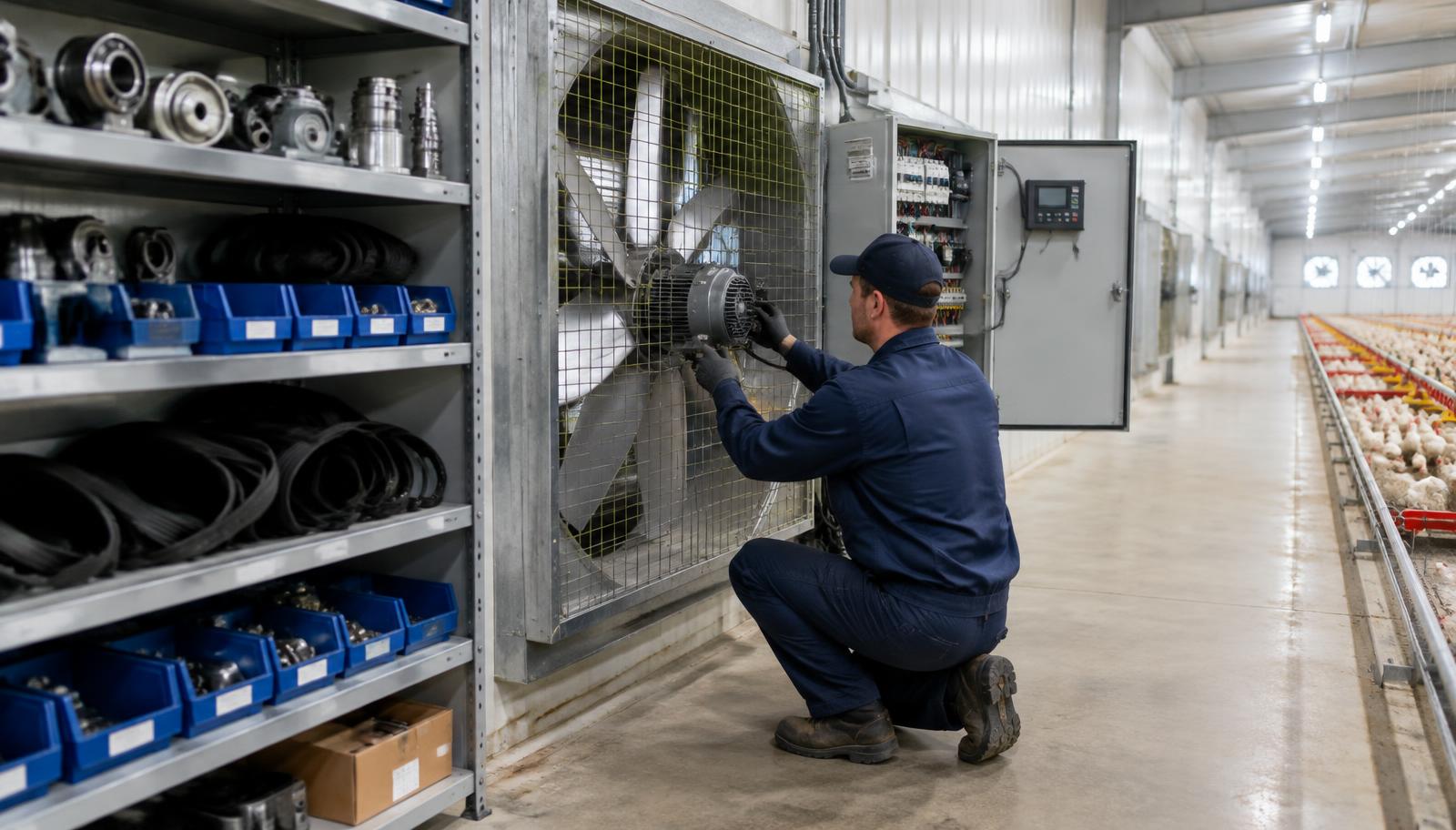
Lead times for imported parts can run from days to weeks, while a flock cannot wait. Ask each supplier for a recommended commissioning and two-year spare parts list, priced separately, with quantities based on the installed equipment. Typical critical items:
| System | Critical spares to keep on site |
|---|---|
| Ventilation and cooling | Fan motors and belts, shutters, inlet actuators, cooling pad sections, circulation pump |
| Feeding | Drive units, gearboxes, augers or chain, corner wheels, sensors |
| Drinking | Regulators, nipples, filters, medicators |
| Egg collection | Belt sections, drive motors, cross-conveyor parts |
| Manure handling | Belt sections, rollers, drive units |
| Controls and power | Controller or spare boards, sensors, contactors, a UPS for the controller |
| Hatchery | Turning motors, humidity and temperature sensors, door seals, fan motors |
Agree that the supplier keeps these parts available for a defined number of years, and that parts are interchangeable with standard components where possible. Standard bearings, belts and motors bought locally can cut downtime dramatically.
After-sales service: response, support and training
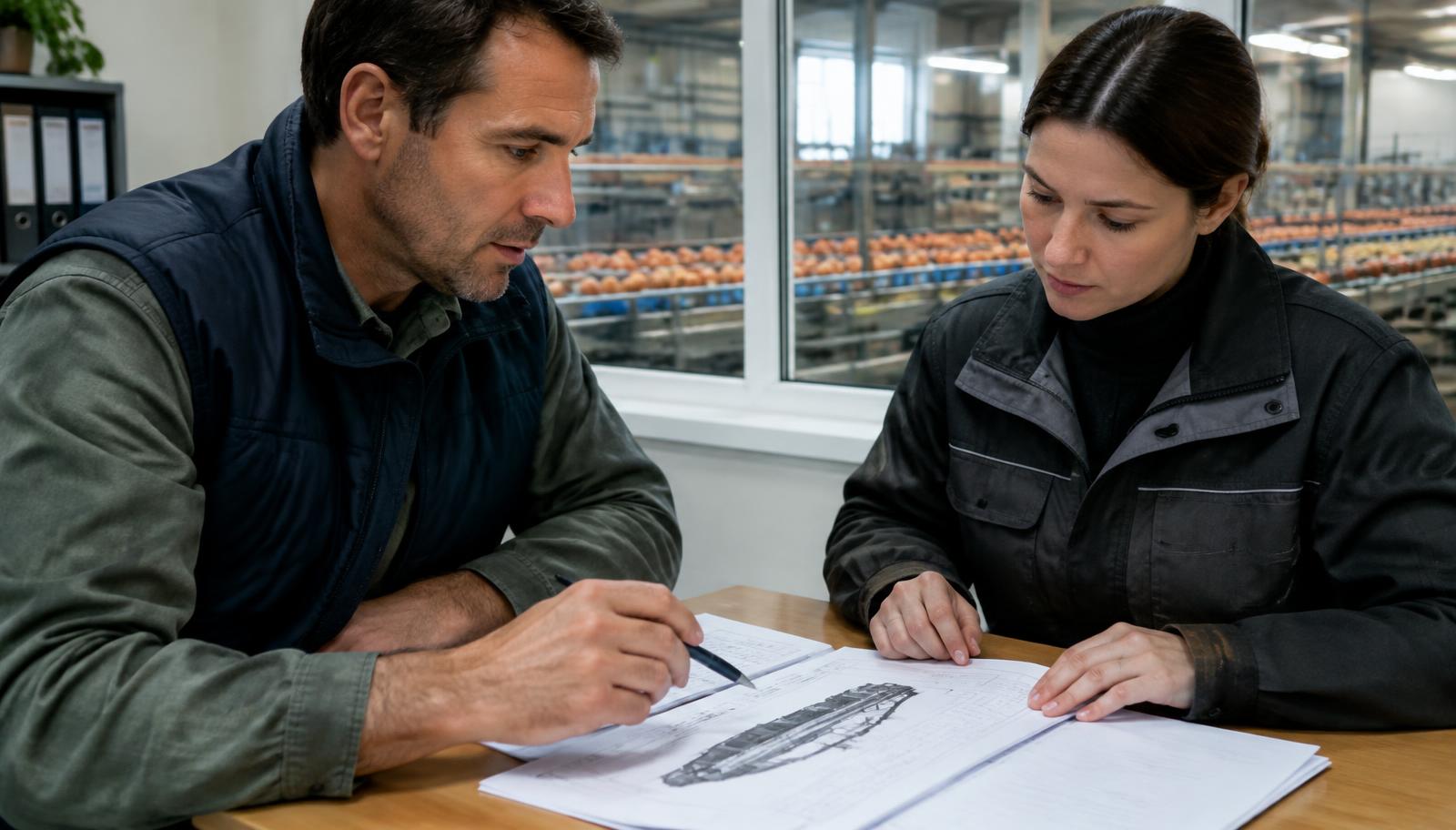
Ask each supplier to state in writing how service works in your country: a local service partner or technicians flying in; target response times for remote support and for site visits; remote access to the house controller and alarm notifications; the language of manuals and software; and the cost of visits after the warranty ends. Avoid vague words like "full support" — ask for named roles, hours and costs.
Training is part of after-sales. Specify operator training at commissioning, maintenance training for your technicians, and documentation: as-built drawings, electrical diagrams, a maintenance schedule and a spare parts catalogue with part numbers. Without documentation, your team depends on the supplier for every repair.
Commissioning and acceptance: when the warranty clock should start
Link the start of the warranty and the final payment to a written acceptance. A practical sequence is: delivery and inspection, installation, functional tests of each system (ventilation stages, cooling, feeding, lighting, alarms, generator changeover), a trial period with birds where appropriate, and a signed acceptance certificate with a list of open items. Holding back a retention — for example a percentage of the price until open items are closed — is a common way to keep both sides aligned. See our guide to installation and commissioning for the test steps.
How to compare after-sales offers
Put warranty and service on the same basis before comparing prices. For each supplier, record: warranty start event and duration per system; whether labour, travel and freight are covered; the spare parts list and its price; parts availability commitment; local service presence; remote support; response targets; training days included; documentation provided; and the daily rate for service visits after warranty. A supplier with a slightly higher price and a local technician can cost less over the life of the house than a cheaper offer that needs a flight for every fault.
Include the spare parts package and two to three years of expected service costs in your project budget. The farm cost calculator gives a preliminary planning estimate for CAPEX; it does not replace supplier quotes for parts and service.
Questions to ask every supplier
Which components are made by you and which are bought in? Third-party motors, controllers and gearboxes may carry their own manufacturer warranties and service routes. Who is your service partner in our country, and how many installations do they support? Ask for references you can call. What happens if a part is discontinued? Ask for a commitment to a compatible replacement. Can our electrician source standard components locally? This reduces dependence on imports.
Where HatchMatch fits
HatchMatch is a supplier-neutral procurement platform for commercial poultry projects. It is not the manufacturer or installer, it does not provide warranty or service, and it does not sign the supply contract — buyers contract directly with the suppliers they choose. HatchMatch helps you include warranty, spare parts, service and training requirements in one written specification, so suppliers price the same scope. Every brief receives human review, and HatchMatch aims to reply within two business days. Submit a poultry project request to start.
Frequently asked questions
How long is a typical poultry equipment warranty? Commonly around 12 months for defects in materials and workmanship, with different terms for structure, motors and electronics. The supplier's written terms are what count.
Should the warranty start at shipment or at commissioning? Buyers usually prefer commissioning or acceptance, because installation can take months. Many suppliers accept a start at commissioning with a long-stop date after shipment.
How many spare parts should I order? Ask each supplier for a two-year recommended list based on your installed equipment, then adjust for your distance to the nearest parts stock and the climate risk.
Frequently asked questions
- Which components are made by you and which are bought in?
- Third-party motors, controllers and gearboxes may carry their own manufacturer warranties and service routes. Who is your service partner in our country, and how many installations do they support? Ask for references you can call. What happens if a part is discontinued? Ask for a commitment to a compatible replacement. Can our electrician source standard components locally? This reduces dependence on imports.
- How long is a typical poultry equipment warranty?
- Commonly around 12 months for defects in materials and workmanship, with different terms for structure, motors and electronics. The supplier's written terms are what count.
- Should the warranty start at shipment or at commissioning?
- Buyers usually prefer commissioning or acceptance, because installation can take months. Many suppliers accept a start at commissioning with a long-stop date after shipment.
- How many spare parts should I order?
- Ask each supplier for a two-year recommended list based on your installed equipment, then adjust for your distance to the nearest parts stock and the climate risk.
More buyer questions are answered in our poultry procurement FAQ — also available in Español, Français, Português, Deutsch, العربية, Русский, Türkçe, Tiếng Việt.
From this article to a procurement-ready RFQ
HatchMatch Group is an independent sourcing desk — not a manufacturer or EPC contractor. These are the four steps we actually use with commercial poultry and hatchery buyers. If you are still deciding scope, start with what commercial poultry equipment includes and how suppliers are compared.
- 1. Plan the projectCapacity, climate and house layout in one guided workflowOpen
- 2. Build the RFQScope, specifications and comparable line itemsOpen
- 3. Submit the requestReviewed manually before any supplier introductionOpen
- 4. Track and compareFollow status and normalise supplier responsesOpen
Prefer the numbers first? Start with the poultry project cost calculator or browse the project planning guides.