
Why Poultry House Ventilation Fails in Hot Climates: Seven Causes Buyers Overlook
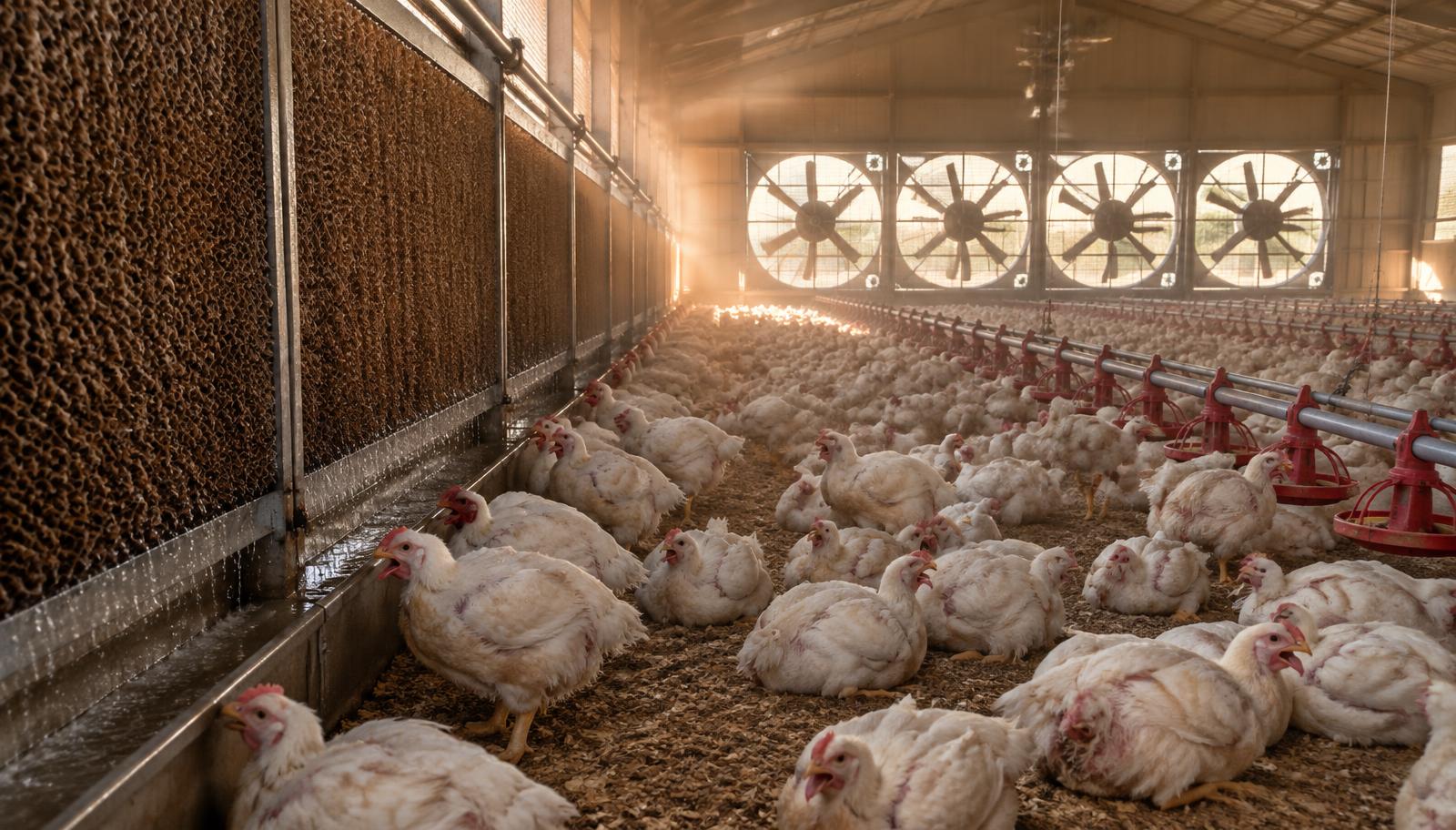
Seven reasons tunnel-ventilated poultry houses underperform in hot climates, from fans rated at free air instead of working pressure to undersized pad area, air leaks and controller mistakes — with what to check before you order.
By HatchMatch Group Sourcing Desk · Last updated 2026-10-10
In short
Short answer. Ventilation systems usually fail in hot climates not because the fans are wrong on paper, but because the whole system was never sized and checked together: fans are selected on free-air ratings instead of the static pressure the house actually creates, pad area is undersized for the real airflow, the building leaks air outside the inlets, inlets are placed or sized wrong, backup power cannot carry the full cooling load, controller settings don't match the real curve, and routine maintenance slips. Each cause is fixable at the specification stage; most are expensive to fix after the house is built and stocked.
Key takeaways
- Fan datasheets commonly show airflow (m³/h or cfm) at zero static pressure — essentially a fan blowing into open air.
- Evaporative cooling pads only cool effectively within a design air velocity range through the wetted media — commonly planned around 1.
- Tunnel ventilation depends on nearly all incoming air entering through controlled inlets (pad openings or inlet doors) so that air travels the full house length at a controlled, even velocity across the birds.
- Inlet sizing and placement control both the volume of air entering and the velocity and direction it enters at — get this wrong and the air exchange rate on paper does not translate into air movement over the birds.
- Tunnel fans, pad pumps and controls draw a real electrical load that increases sharply the moment ambient temperature triggers staged tunnel ventilation — exactly the moment a grid outage is most dangerous for the flock.
Short answer. Ventilation systems usually fail in hot climates not because the fans are wrong on paper, but because the whole system was never sized and checked together: fans are selected on free-air ratings instead of the static pressure the house actually creates, pad area is undersized for the real airflow, the building leaks air outside the inlets, inlets are placed or sized wrong, backup power cannot carry the full cooling load, controller settings don't match the real curve, and routine maintenance slips. Each cause is fixable at the specification stage; most are expensive to fix after the house is built and stocked.
This guide is for investors, project managers and technical buyers specifying or troubleshooting tunnel-ventilated broiler, layer or breeder houses in hot or seasonally hot climates. It focuses on why a system that looks correctly sized on a datasheet still underperforms in the field, and what to put in the specification and RFQ to reduce that risk.
1. Fans rated at free air, not at the house's working static pressure
Fan datasheets commonly show airflow (m³/h or cfm) at zero static pressure — essentially a fan blowing into open air. A real poultry house is not open air: the fan has to push air through pad wetted media, inlet openings, duct runs and the resistance of the birds, litter and equipment inside, all of which create static pressure that the fan must overcome. A fan that moves 40,000 m³/h at 0 Pa might move dramatically less at the 20–40 Pa of static pressure typical of a well-built tunnel house — and far less still if the house has more resistance than planned. If airflow is specified using the free-air number instead of the fan's performance curve at the house's expected static pressure, the installed system can be well short of the air exchange the birds need on the hottest days.
What to do: require every fan quote to state airflow at a specified static pressure (not just free air), ask for the full fan performance curve, and confirm the static pressure figure used was calculated for your house's pad area, duct length, inlet design and stocking density — not a generic assumption.
Want these figures for your own site, capacity and country? A HatchMatch specialist builds the budget with you — no buyer fees.
Start free2. Too little evaporative pad area for the real airflow
Evaporative cooling pads only cool effectively within a design air velocity range through the wetted media — commonly planned around 1.0–1.5 m/s face velocity, confirmed against the pad manufacturer's data. If the pad wall area is undersized for the fan airflow actually installed, air moves through the pads too fast to pick up full evaporative cooling, so the temperature drop across the pads is smaller than planned, and the house runs hotter than the cooling system was supposed to deliver. This mismatch often happens when pad area is fixed early in design and the fan count or model is changed later without re-checking pad velocity.
What to do: calculate pad area from the final, confirmed total fan airflow — not an early estimate — and ask the supplier to state the resulting face velocity through the pads and the expected temperature drop at your design conditions (dry-bulb and wet-bulb temperature, humidity).
3. Air leaks that bypass the inlets entirely
Tunnel ventilation depends on nearly all incoming air entering through controlled inlets (pad openings or inlet doors) so that air travels the full house length at a controlled, even velocity across the birds. Gaps around doors, service openings, curtain edges, poorly sealed eave or ridge details, and unsealed penetrations for pipework or cabling let air leak in uncontrolled, at the wrong point and the wrong velocity. Leaks reduce the static pressure the fans see — which can mask an undersized fan problem on a pressure gauge — while simultaneously reducing the actual airspeed over the birds where it matters most, often worst furthest from the fans.
What to do: require the builder's air-tightness detailing for doors, curtains, eaves, ridge and all wall penetrations in writing, and commission a smoke-test or pressure-test at handover to find leaks before the first hot season, not during it.
4. Wrong inlet design, number or placement
Inlet sizing and placement control both the volume of air entering and the velocity and direction it enters at — get this wrong and the air exchange rate on paper does not translate into air movement over the birds. Pad openings that are too small for the airflow create excessive velocity and noise; openings too large drop velocity and cooling effect. Minimum-ventilation inlets (used outside tunnel mode) placed or adjusted wrong create drafts on young birds or dead zones with poor air exchange. Because inlet requirements differ for brooding, grow-out and full tunnel mode, a single fixed inlet setting is rarely correct for the whole cycle.
What to do: ask the supplier for separate inlet specifications for minimum ventilation and tunnel mode, confirm who sets and tests the inlet opening sequence at commissioning, and check that inlet static pressure settings are written into the controller configuration, not left to operator judgment.
5. Undersized power supply or backup generator for the real cooling load
Tunnel fans, pad pumps and controls draw a real electrical load that increases sharply the moment ambient temperature triggers staged tunnel ventilation — exactly the moment a grid outage is most dangerous for the flock. If the backup generator is sized on average farm load rather than the peak load of full tunnel ventilation plus pad pumps plus lighting and other circuits running at the same time, it will not carry the house through an outage during hot weather, when the consequences of lost ventilation are fastest and most severe. Automatic transfer switching that is too slow, or that fails to re-stage fans gradually, can also trip the generator on starting surge.
What to do: size backup power from the full hot-weather electrical load of the house, not an average, use the poultry generator sizing calculator as a planning starting point, and ask suppliers to confirm starting-current staging so fans do not all restart simultaneously after a transfer.
6. Controller settings that don't match the real temperature and pressure curve
Modern environmental controllers stage fans and open inlets based on temperature set points, but those set points, staging bands and static pressure targets have to be tuned to the actual house, flock age and climate — a default or copied configuration from a different house or climate routinely under- or over-ventilates. Sensors placed in the wrong location (too close to a fan, pad or heat source) feed the controller bad data, so it stages ventilation on a reading that does not represent conditions where the birds actually are. Tunnel and minimum-ventilation modes also need different logic, and a controller left on the wrong mode for the season or bird age will not deliver the airflow the house was designed for.
What to do: require the controller commissioning report showing sensor placement, staging set points and static pressure targets used for your house, and confirm who is trained to safely adjust these settings as flocks age through the cycle.
7. Maintenance gaps that quietly cut capacity
A ventilation system loses capacity gradually and often invisibly: dust and feathers build up on fan blades and shutters reducing airflow for the same power draw; pad media clogs or scales with mineral deposits, raising resistance and cutting evaporative cooling; belts slip or wear; shutters stick partly closed; sensors drift out of calibration. None of these show up on the original fan curve or pad datasheet, and each one compounds the others, so a house that performed well at commissioning can lose a meaningful share of its cooling capacity within a season or two without a maintenance program.
What to do: ask the supplier for the recommended maintenance schedule and spare-parts list for fans, shutters, belts and pad media, and confirm it in writing alongside warranty terms — see our guide to warranty and spare parts for poultry equipment — and assign maintenance responsibility clearly before commissioning, not after a failure.
Checklist: what to confirm before you order
| Item | Confirm | Who should state it |
|---|---|---|
| Fan airflow | At the house's working static pressure, with full performance curve | Fan supplier |
| Pad area | Face velocity at final total airflow, expected temperature drop | Pad/cooling supplier |
| Air-tightness | Written sealing detail for doors, curtains, eaves, ridge, penetrations | Builder/contractor |
| Inlet design | Separate specs for minimum ventilation and tunnel mode | Equipment supplier |
| Backup power | Sized for peak hot-weather load, starting-current staging | Generator supplier |
| Controller setup | Commissioning report with sensor placement and set points | Controls supplier/installer |
| Maintenance plan | Written schedule and spare-parts list | Equipment supplier |
Questions to ask suppliers
At what static pressure is the quoted fan airflow measured, and can you provide the full performance curve? What face velocity through the pads does your design assume at full fan airflow, and what temperature drop do you expect at our design conditions? What air-tightness standard does the building design meet, and will you commission a pressure or smoke test? How do inlet settings differ between minimum ventilation and tunnel mode, and who sets them at commissioning? What is the peak hot-weather electrical load the backup generator must carry, including pad pumps and lighting? What maintenance schedule and spare-parts list do you recommend for fans, shutters and pad media? Request written answers and compare them in one table before scoring price.
Common mistakes
Comparing fan quotes on free-air cfm/m³/h figures instead of airflow at working static pressure. Fixing pad area early in design and never re-checking it after the fan count or model changes. Treating air-tightness as a construction detail nobody specifies in writing. Using one inlet setting for the whole flock cycle instead of separate minimum-ventilation and tunnel settings. Sizing backup power on average load instead of peak hot-weather load with all systems running. Copying controller set points from a different house or climate instead of commissioning them for this one. And leaving maintenance responsibility undefined until after a hot-weather failure.
Where HatchMatch fits
HatchMatch is a supplier-neutral procurement platform for commercial poultry projects, typically USD 250,000 and above. It is not a manufacturer, installer, EPC contractor, inspector, consultant, certification body or lender, and it does not sign supply contracts — buyers contract directly with the suppliers they choose. HatchMatch helps you turn your requirements into one written specification so offers can be compared line by line. Every brief receives human review, and HatchMatch aims to reply within two business days. To start, use the ventilation calculator for a first airflow estimate, then submit a poultry project request with your house dimensions, climate data and flock details.
FAQ
Why does a tunnel ventilation system that looks correctly sized on paper still underperform in hot weather? Most commonly because fan airflow was specified at free-air rating rather than the house's real working static pressure, so the installed system moves less air than the datasheet suggested once pads, ducting and resistance are accounted for.
How much pad face velocity is typical for evaporative cooling? Planning figures are commonly around 1.0–1.5 m/s through the wetted pad media, but confirm the exact range and expected temperature drop with the pad manufacturer's data for your design airflow and climate.
Can air leaks really affect ventilation that much? Yes — leaks let air bypass the engineered inlets, which reduces the controlled airspeed over the birds and can mask fan undersizing by keeping static pressure readings artificially normal.
Is sizing backup power for average farm load good enough? No — size it for the peak electrical load during full tunnel ventilation with pad pumps and lighting running together, since that is exactly when a grid outage is most dangerous for the flock.
How often should ventilation equipment be maintained to avoid capacity loss? Follow the supplier's written maintenance schedule for fans, shutters, belts and pad media; dust, scale and wear reduce capacity gradually and often go unnoticed without a routine inspection plan.
Frequently asked questions
- Why does a tunnel ventilation system that looks correctly sized on paper still underperform in hot weather?
- Most commonly because fan airflow was specified at free-air rating rather than the house's real working static pressure, so the installed system moves less air than the datasheet suggested once pads, ducting and resistance are accounted for.
- How much pad face velocity is typical for evaporative cooling?
- Planning figures are commonly around 1.0–1.5 m/s through the wetted pad media, but confirm the exact range and expected temperature drop with the pad manufacturer's data for your design airflow and climate.
- Can air leaks really affect ventilation that much?
- Yes — leaks let air bypass the engineered inlets, which reduces the controlled airspeed over the birds and can mask fan undersizing by keeping static pressure readings artificially normal.
- Is sizing backup power for average farm load good enough?
- No — size it for the peak electrical load during full tunnel ventilation with pad pumps and lighting running together, since that is exactly when a grid outage is most dangerous for the flock.
- How often should ventilation equipment be maintained to avoid capacity loss?
- Follow the supplier's written maintenance schedule for fans, shutters, belts and pad media; dust, scale and wear reduce capacity gradually and often go unnoticed without a routine inspection plan.
More buyer questions are answered in our poultry procurement FAQ — also available in Español, Français, Português, Deutsch, العربية, Русский, Türkçe, Tiếng Việt.
From this article to a procurement-ready RFQ
HatchMatch Group is an independent sourcing desk — not a manufacturer or EPC contractor. These are the four steps we actually use with commercial poultry and hatchery buyers. If you are still deciding scope, start with what commercial poultry equipment includes and how suppliers are compared.
- 1. Plan the projectCapacity, climate and house layout in one guided workflowOpen
- 2. Build the RFQScope, specifications and comparable line itemsOpen
- 3. Submit the requestReviewed manually before any supplier introductionOpen
- 4. Track and compareFollow status and normalise supplier responsesOpen
Prefer the numbers first? Start with the poultry project cost calculator or browse the project planning guides.