
How to Train Farm Staff for a New Automated Poultry House Before the First Flock
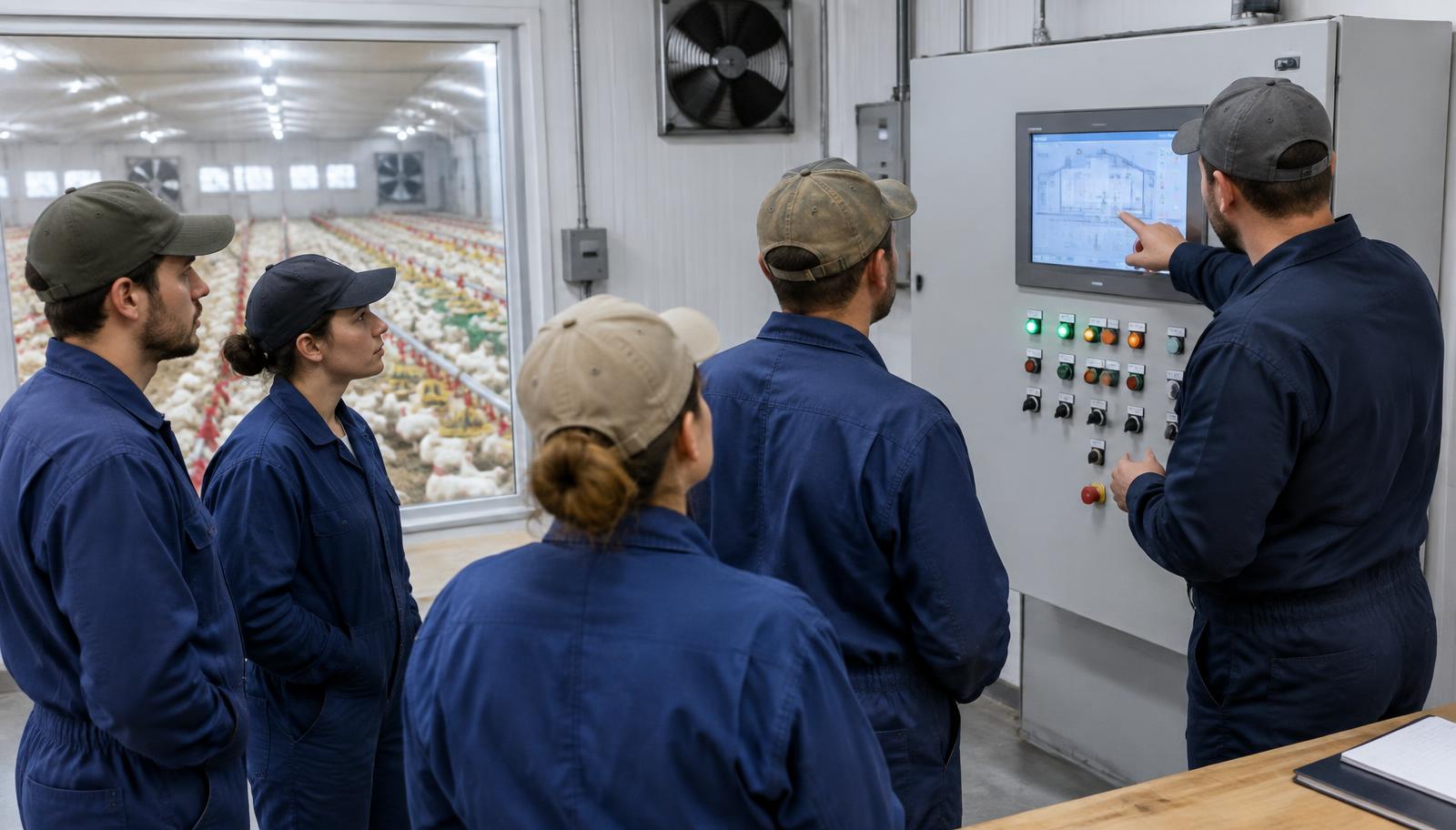
A practical plan for training farm staff before the first flock enters a new automated poultry house: controller and alarm skills, override drills, daily checks, maintenance and SOPs.
By HatchMatch Group Sourcing Desk · Last updated 2026-10-09
In short
Short answer. Train staff for a new automated poultry house in the weeks before the first flock, not on arrival day. Cover five areas: assigned roles and shift responsibilities; hands-on controller and alarm operation; manual override and power-failure drills done for real, not just described; a daily checklist of checks to make with or without alarms firing; and written SOPs for routine tasks, maintenance and biosecurity.
Key takeaways
- Decide who is responsible for what before any training session: a house manager or farm manager with overall accountability; one or more daily operators who read the controller, walk the house and act on alarms; a maintenance contact for equipment faults; and a biosecurity contact who controls entry, disinfection and visitor logs.
- Every automated house runs on an environmental controller managing ventilation, heating, cooling, lighting and feed or water lines.
- An alarm panel or remote alert is only useful if the person receiving it knows what action to take.
- Every automated house needs a way to run ventilation, heating or curtains manually if the controller or automation fails.
- Power failure is one of the highest-risk events in an automated house because ventilation, and sometimes heating and water, can stop at once.
Short answer. Train staff for a new automated poultry house in the weeks before the first flock, not on arrival day. Cover five areas: assigned roles and shift responsibilities; hands-on controller and alarm operation; manual override and power-failure drills done for real, not just described; a daily checklist of checks to make with or without alarms firing; and written SOPs for routine tasks, maintenance and biosecurity. Build the training scope and hours into the supplier contract and RFQ so it is delivered, documented and not left informal.
This guide is for broiler, layer or breeder investors and farm managers preparing a team for a newly built or newly automated house. It assumes equipment is already specified or ordered and focuses on the people side of commissioning — the step most often shortened under project deadline pressure, with consequences that only appear once the house is stocked and the supplier's team has gone home.
1. Define roles before training starts
Decide who is responsible for what before any training session: a house manager or farm manager with overall accountability; one or more daily operators who read the controller, walk the house and act on alarms; a maintenance contact for equipment faults; and a biosecurity contact who controls entry, disinfection and visitor logs. Write these roles down with names, not job titles, and confirm who is reachable at night and on weekends, since alarms and power failures do not wait for office hours. Training is most effective when each person knows which parts of it apply to their own role rather than sitting through a single undifferentiated session.
2. Hands-on controller training, not a manual handover
Want these figures for your own site, capacity and country? A HatchMatch specialist builds the budget with you — no buyer fees.
Start freeEvery automated house runs on an environmental controller managing ventilation, heating, cooling, lighting and feed or water lines. Staff need hands-on time on the actual controller installed in their house — not only a printed manual — covering: reading the main screen and understanding each sensor value; adjusting setpoints and curves safely within approved ranges; recognising normal versus abnormal readings; and navigating to alarm history and fault logs. Ask the supplier's commissioning engineer to run this training with real birds absent, using the empty house to simulate temperature and ventilation changes so staff see cause and effect before live animals are at risk.
3. Alarm response training: what each alarm means and what to do
An alarm panel or remote alert is only useful if the person receiving it knows what action to take. Training should walk through every alarm type the controller can raise — high temperature, low temperature, ventilation failure, power loss, water pressure loss, feed line fault — and pair each with a written first response: what to check, what to adjust manually, and who to call if the problem is not resolved within a stated number of minutes. Staff should practise acknowledging and clearing test alarms on the controller itself, not just discuss them, so the physical steps are familiar under pressure.
4. Run a real manual override drill
Every automated house needs a way to run ventilation, heating or curtains manually if the controller or automation fails. A true drill means physically switching the house to manual mode, operating fans, inlets or curtains by hand, and timing how long it takes staff to stabilise conditions — not simply reading the override procedure aloud. Repeat the drill with more than one staff member so the skill does not depend on a single person being on shift when it is needed.
5. Run a real power-failure drill
Power failure is one of the highest-risk events in an automated house because ventilation, and sometimes heating and water, can stop at once. Before the first flock, simulate a mains failure (with the supplier or electrician present) and time: how long until the backup generator or battery system takes over automatically; whether alarms trigger correctly on the loss of mains; and what manual steps staff must take if automatic backup does not engage, including opening curtains or emergency vents by hand. Document the measured response time and compare it against the time birds can safely go without ventilation at the current stocking density, using your generator sizing calculator result as a planning reference, not a substitute for the live test.
6. Build a daily checklist independent of the alarm system
Automated systems reduce labour but should never remove the daily physical check, since sensors and alarms can themselves fail. A daily checklist, walked in person, should confirm: temperature and humidity match the controller reading at multiple points in the house; feed and water lines are flowing and at the correct height; ventilation inlets and fans are moving and unobstructed; litter condition and bird behaviour look normal; and mortality is counted, recorded and the cause checked. Staff should sign or log the completed checklist so gaps are visible to the farm manager, not only to whoever walked the house that day.
7. Set up maintenance routines, not reactive repairs
Preventive maintenance is part of training, not a separate supplier task finished at handover. Staff need a written routine covering: fan belt and shutter checks; controller sensor calibration intervals; generator test-run frequency and fuel checks; feed and water line cleaning schedules; and a log of any part replaced, with date and supplier reference, so warranty claims and future ordering are straightforward. Ask the supplier to state recommended maintenance intervals in writing rather than relying on staff memory or a verbal handover.
8. Train biosecurity procedures as a non-negotiable routine
Automation controls climate and feeding, but it does not control disease entry. Staff training should fix: the entry sequence for people and vehicles, including footbaths and protective clothing; a visitor log with dates and previous farm contact; disinfection procedure between flocks; and a clear policy on what equipment, if any, can move between houses or farms. These routines should be written, posted at the entrance, and followed even when the farm is confident no risk is present that day, since biosecurity failures usually happen on days that seemed routine.
9. Put it all in writing as SOPs
Verbal training fades and staff turn over. Convert every area above into a short written standard operating procedure (SOP): one page for daily checks, one for alarm response per alarm type, one for manual override, one for power failure, one for maintenance intervals, one for biosecurity entry. Keep SOPs where staff actually work — printed near the controller and the entrance — not only in an office file, and review them after the first flock cycle to correct anything that did not match real conditions.
What to put in the supplier contract and RFQ
Training is frequently left verbal because it is not written into the purchase agreement. Specify in the RFQ and contract: the number of training days and which staff roles are covered; whether training happens before, during or after the first flock placement; whether a manual override and power-failure drill are included and who supplies the test conditions; whether training materials are delivered in the local working language; and who to contact for refresher training if staff change. Use our farm cost calculator and ventilation calculator during planning to confirm equipment scope, then carry the agreed training scope into the same written specification as the equipment list so it is priced and delivered, not assumed.
What to document
| Document | Purpose | Who keeps it |
|---|---|---|
| Role and contact list | Confirms who responds to which alarm or event, day and night | Farm manager |
| Controller and alarm training record | Evidence staff were trained on the actual installed controller | Farm manager / supplier |
| Manual override and power-failure drill log | Records measured response time and gaps found | Farm manager |
| Daily checklist | Independent check of conditions regardless of alarm status | Daily operator |
| Maintenance log | Tracks intervals, parts replaced and warranty references | Maintenance contact |
| Biosecurity log | Entry, disinfection and visitor records between flocks | Biosecurity contact |
Questions to ask suppliers
How many days of on-site training are included, and for how many staff? Will you run a live manual override drill and a live power-failure drill before handover, or only explain the procedure? Is training delivered in our working language, with written materials we keep? What is your recommended maintenance interval for fans, sensors and the generator, in writing? Who do we contact for refresher training if staff change within the first year? What alarm types does the controller raise, and can you provide a written first-response sheet for each one? Request written answers before signing so training scope is part of the priced contract, not a goodwill extra.
Common mistakes
Treating training as a single handover day instead of a scheduled process that starts before the first flock. Letting staff only read the manual override and power-failure procedures instead of running live drills. Relying on the alarm system completely and dropping the daily physical walk-through. Leaving maintenance intervals undocumented so they depend on memory or a departed staff member. Writing biosecurity rules once and not enforcing them once the farm feels routine. And agreeing to training verbally with the supplier instead of specifying days, roles, language and drills in the contract.
Where HatchMatch fits
HatchMatch is a supplier-neutral procurement platform for commercial poultry projects, typically USD 250,000 and above. It is not a manufacturer, installer, EPC contractor, inspector, consultant, certification body or lender, and it does not sign supply contracts — buyers contract directly with the suppliers they choose. HatchMatch helps you turn your requirements, including training and handover scope, into one written specification so offers can be compared line by line. Every brief receives human review, and HatchMatch aims to reply within two business days. To start, submit a poultry project request describing your house, timeline and the training and handover scope you expect from suppliers.
FAQ
When should staff training for a new poultry house start? Begin role assignment and controller familiarisation several weeks before the first flock, with the manual override and power-failure drills completed before birds arrive, not after.
Do staff really need a live power-failure drill, or is explaining the procedure enough? A live drill is strongly recommended because it reveals the actual time to switch over and any gaps in automatic backup, which a verbal explanation cannot show.
Should daily physical checks continue once the controller and alarms are working? Yes — sensors and alarms can fail silently, so a daily in-person check of temperature, water, feed, ventilation and bird behaviour remains necessary regardless of automation.
What should be written into the supplier contract regarding training? The number of training days, staff roles covered, language of materials, whether live override and power-failure drills are included, and the contact for refresher training.
Who on the farm should be trained on the controller? At minimum the house or farm manager and every daily operator who may be on shift when an alarm fires, so the skill does not depend on one person being present.
Frequently asked questions
- How many days of on-site training are included, and for how many staff?
- Will you run a live manual override drill and a live power-failure drill before handover, or only explain the procedure? Is training delivered in our working language, with written materials we keep? What is your recommended maintenance interval for fans, sensors and the generator, in writing? Who do we contact for refresher training if staff change within the first year? What alarm types does the controller raise, and can you provide a written first-response sheet for each one? Request written answers before signing so training scope is part of the priced contract, not a goodwill extra.
- When should staff training for a new poultry house start?
- Begin role assignment and controller familiarisation several weeks before the first flock, with the manual override and power-failure drills completed before birds arrive, not after.
- Do staff really need a live power-failure drill, or is explaining the procedure enough?
- A live drill is strongly recommended because it reveals the actual time to switch over and any gaps in automatic backup, which a verbal explanation cannot show.
- Should daily physical checks continue once the controller and alarms are working?
- Yes — sensors and alarms can fail silently, so a daily in-person check of temperature, water, feed, ventilation and bird behaviour remains necessary regardless of automation.
- What should be written into the supplier contract regarding training?
- The number of training days, staff roles covered, language of materials, whether live override and power-failure drills are included, and the contact for refresher training.
- Who on the farm should be trained on the controller?
- At minimum the house or farm manager and every daily operator who may be on shift when an alarm fires, so the skill does not depend on one person being present.
More buyer questions are answered in our poultry procurement FAQ — also available in Español, Français, Português, Deutsch, العربية, Русский, Türkçe, Tiếng Việt.
From this article to a procurement-ready RFQ
HatchMatch Group is an independent sourcing desk — not a manufacturer or EPC contractor. These are the four steps we actually use with commercial poultry and hatchery buyers. If you are still deciding scope, start with what commercial poultry equipment includes and how suppliers are compared.
- 1. Plan the projectCapacity, climate and house layout in one guided workflowOpen
- 2. Build the RFQScope, specifications and comparable line itemsOpen
- 3. Submit the requestReviewed manually before any supplier introductionOpen
- 4. Track and compareFollow status and normalise supplier responsesOpen
Prefer the numbers first? Start with the poultry project cost calculator or browse the project planning guides.