Planning a Commercial Turkey Farm: Housing, Equipment and RFQ Checklist by Production Model
A commercial turkey farm RFQ works when it starts from the production model — grow-out, breeder or hatchery — and asks every bidder to answer the same evaluation fields: house and ventilation design, feeding and drinking, litter, biosecurity, power, automation, service, spare parts, lead time, warranty and lifecycle cost.
By HatchMatch Group Editorial Desk · Last updated 2026-10-20
In short
Short answer: plan a commercial turkey farm by fixing the production model first — grow-out (all-in/all-out or brood-and-move), parent-stock breeder, hatchery, or an integrated programme — and only then ask for equipment. Each model changes the buildings, the equipment packages and the people you need. Then send every bidder the same structured RFQ, so offers for turkey house design, feeding and drinking systems, climate control and service can be compared on equal terms.
Key takeaways
- - The production model and stages on the site — brooding, grow-out, breeder rearing and lay, hatchery — and whether birds move between sites.
- Aviagen Turkeys' management guidelines for commercial turkeys describe two basic growing systems: all-in/all-out, where birds stay on the same farm or house for their whole life, and brood-and-move, where poults are brooded in one house and transferred to finishing houses.
- The commercial guideline distinguishes naturally ventilated housing from environmentally controlled, closed housing, and discusses minimum, transitional and tunnel ventilation and cooling.
- Manufacturers publish turkey-specific products, which shows that requirements differ by bird and age.
- Turkey projects involve different kinds of companies.
Short answer: plan a commercial turkey farm by fixing the production model first — grow-out (all-in/all-out or brood-and-move), parent-stock breeder, hatchery, or an integrated programme — and only then ask for equipment. Each model changes the buildings, the equipment packages and the people you need. Then send every bidder the same structured RFQ, so offers for turkey house design, feeding and drinking systems, climate control and service can be compared on equal terms.
This article is about turkeys, the bird. If you are looking for poultry equipment manufacturers based in Türkiye, the country, see the Türkiye supplier sourcing page. It is procurement guidance, not veterinary, engineering or legal advice. HatchMatch is an independent buyer-side procurement platform: it does not manufacture, sell or install equipment and does not guarantee suppliers, prices, delivery or production results.
What must a turkey farm RFQ define?
- The production model and stages on the site — brooding, grow-out, breeder rearing and lay, hatchery — and whether birds move between sites.
- The flock basis — strain or genetics supplier, hens, toms or mixed, birds placed per cycle, planned cycles and target market weight, as set by your own production plan.
Want these figures for your own site, capacity and country? A HatchMatch specialist builds the budget with you — no buyer fees.
Start free- The site basis — design climate, existing buildings, water analysis, power capacity and reliability, access and local permits.
- The packages and interfaces — housing, ventilation, heating, cooling, feeding, drinking, lighting, weighing, controls, litter and manure handling, biosecurity, backup power and, where relevant, nests, egg handling or incubation.
- The commercial terms — installation, commissioning, training, service, spare parts, lead time, warranty and lifecycle cost.
These are evaluation fields: they tell bidders what to answer. They are not specifications or recommendations, and none of them replaces a locally qualified designer, veterinarian or authority.
Which production model are you buying for?
Aviagen Turkeys' management guidelines for commercial turkeys describe two basic growing systems: all-in/all-out, where birds stay on the same farm or house for their whole life, and brood-and-move, where poults are brooded in one house and transferred to finishing houses. Breeder farms and hatcheries are covered by separate guidelines because they are different operations.
| Production model | What it is | What changes in the RFQ |
|---|---|---|
| Grow-out, all-in/all-out | Poults placed and finished in the same house | Brooding and finishing equipment in one building; line heights and space adjusted as birds grow; cleaning downtime between flocks |
| Grow-out, brood-and-move | Brooding house feeding several finishing houses | Two house types, transfer equipment and timing, biosecurity between houses, matching capacities |
| Parent-stock breeder farm | Rearing and laying of breeding turkeys | Separate male and female areas, nests and hatching-egg collection, lighting programmes, insemination facilities; the breeding company's guidance applies |
| Turkey hatchery | Hatching-egg reception to poult dispatch | Egg storage, single- or multi-stage incubation, hatchers, poult handling, hatchery ventilation and calibration |
| Integrated or mixed programme | Several stages, or turkeys alongside chickens or ducks | Interfaces and responsibilities between packages, separate biosecurity zones, shared utilities, phased delivery |
A broiler or layer house is not a smaller or larger version of any of these. Heavier birds, longer cycles and different feeder and drinker requirements mean chicken specifications should not be copied into a turkey RFQ. Use the commercial poultry equipment page to compare model scopes side by side.
What does each production stage ask of the building?
Brooding. Poults need accessible feed and water, heat and good litter from placement. Aviagen's commercial guideline covers brooding in surrounds and whole-house brooding, supplementary drinkers and feeders, and preparing the house before poults arrive. For the RFQ, this means stating how you will brood and asking what brooders, supplementary equipment and controls each bidder includes.
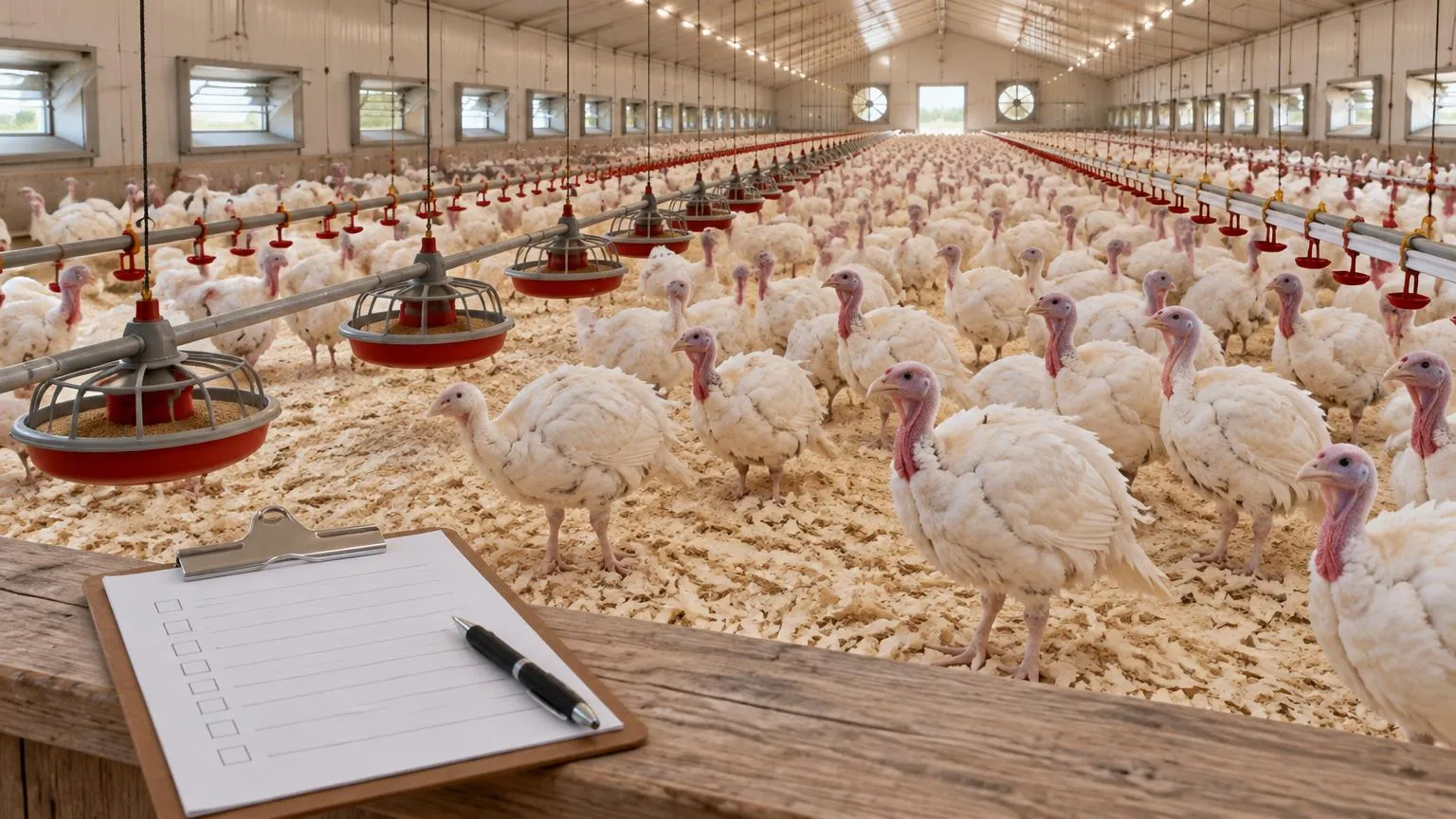
Grow-out and finishing. As birds grow, feeders and drinkers must stay reachable and adjustable, and ventilation must remove more heat and moisture. Ask how lines are raised and lowered, how the house is cleaned between flocks, and how the system handles the heaviest birds you plan to grow.
Breeder rearing and lay. Aviagen's breeder guideline covers areas such as nests, male selection, female broody management, separate lighting for males and females, and insemination. Ask breeder-equipment bidders to confirm nest type and capacity, egg collection, and how male and female areas are separated.
Hatchery. Aviagen's hatchery guideline covers egg storage, single-stage and multi-stage incubation, incubator ventilation, poult servicing and hatchery calibration. A turkey hatchery RFQ should state eggs set per week, the incubation approach you intend to evaluate, and the room ventilation and water and power services the building must supply.
Turkey house design and ventilation: what to ask
The commercial guideline distinguishes naturally ventilated housing from environmentally controlled, closed housing, and discusses minimum, transitional and tunnel ventilation and cooling. Treat these as operating modes to ask about, not a design choice to copy. Ask each bidder for the design climate used, the bird stage and weight basis, airflow at working static pressure, inlet arrangement, heating and cooling capacity, connected electrical load, alarm functions and how the house is ventilated if power fails. A design is only comparable when bidders use the same climate and flock basis.
Turkey feeding and drinking systems: what to ask
Manufacturers publish turkey-specific products, which shows that requirements differ by bird and age. Big Dutchman, for example, states that a turkey feeding system's requirements depend on the production cycle and the birds' age, and describes its Penduval 2 drinker as designed for turkeys of every age, including heavy toms above 20 kg live weight. These are manufacturer statements: ask each bidder to confirm, in writing, which model suits each stage of your flock, the line length and loading, height adjustment, water pressure and filtration, flushing and cleaning, and the spare parts they hold for it.
Comparison checklist: the evaluation fields
| Evaluation field | What you supply | What each bidder must state |
|---|---|---|
| Bird type and model | Turkey grow-out, breeder, hatchery or mixed; stages on site | Confirmation that the offer covers that model and stage |
| Flock scale | Birds placed per cycle, sexes, cycles per year, target weight range | Capacity basis used for every package |
| Climate | Site location and design summer and winter conditions | Design conditions assumed and their source |
| Housing and ventilation | Existing buildings or new build, dimensions, insulation | Ventilation modes, airflow at pressure, inlets, heating and cooling capacity |
| Feeding and drinking | Feed form and delivery, water analysis and pressure | Turkey-suitable models per stage, line layout, filtration, height adjustment |
| Litter and manure | Bedding material and clean-out method | Equipment and access for clean-out, storage interfaces |
| Biosecurity | Site layout, clean and dirty zones, local requirements | Design features supplied and what remains the owner's responsibility |
| Power reliability | Grid capacity, outage history, backup plans | Connected and starting loads, critical circuits, backup interface |
| Automation | Controls and data you expect to use | Controller, sensors, alarms, data access and manual override |
| Processing scope | Whether processing is in scope, and where birds go | Interfaces or exclusions; processing lines are a separate package |
| Local standards | Permits, welfare and environmental rules that apply | Which standards the design was checked against, and by whom |
| Installation and service | Local labour and access conditions | Who installs and commissions, acceptance tests, local service capacity |
| Spare parts | Expected stock and response needs | Recommended spare-parts list, location of stock, delivery times |
| Lead time | Target start and placement dates | Production, shipping and installation dates in writing |
| Warranty | Required terms | Coverage, exclusions, start date and claims process |
| Lifecycle cost | Your tariffs, labour and planning horizon | Energy, maintenance and replacement assumptions on the same basis |
A structured RFQ template for a turkey farm project
1. Project summary: buyer and site country, production model, new build, expansion or retrofit, stages on site, target start date.
2. Flock basis: strain or genetics supplier, hens/toms/mixed, birds placed per cycle, cycles per year, target market-weight range, transfer plan if brood-and-move.
3. Site and utilities: location, design climate, existing buildings and surveys, water source and analysis, power capacity and outage history, access for construction.
4. Packages requested: housing and civil works; ventilation, heating and cooling; feeding including silos; drinking and water treatment; lighting; weighing; controls and alarms; litter and manure handling; backup power; nests and egg handling or hatchery equipment where relevant. Mark each package required, optional or excluded.
5. Interfaces and responsibilities: who designs, supplies, installs and commissions each package, and who connects one package to another.
6. Documents requested: layout drawings, capacity calculations, equipment data sheets, electrical loads, manuals, training plan, references you can contact.
7. Commercial terms: price breakdown by package, Incoterm, payment schedule, lead time, warranty, spare parts, service response.
8. Evaluation method: tell bidders how offers will be compared — scope completeness, technical fit, service capacity, lifecycle cost and price — so they answer the same questions.
Check the draft with the RFQ completeness checker before sending it, and compare answers with the proposal comparison tool.
How to compare vendors without treating one as the answer
Turkey projects involve different kinds of companies. They are not interchangeable competitors, and comparing them directly is a common mistake.
| Layer | Examples (public information) | What they offer | What you still have to compare |
|---|---|---|---|
| Equipment and system manufacturers | Big Dutchman turkey production; CTB, Inc., whose brands include Chore-Time, Roxell and Fancom; Vencomatic Group for breeder nests and egg handling | Their own product ranges, and design and installation through their own or partner networks | Fit for your stage and climate, local installation and service, interfaces with other packages, total cost |
| Genetics and breeding companies | Aviagen Turkeys; Hybrid Turkeys, part of Hendrix Genetics | Breeding stock and management guidance for their birds | Whether your house and equipment design matches the guidance for the strain you place |
| Installers, distributors and integrators | Regional dealers and turnkey contractors | Delivery and installation, sometimes across several brands | Who actually makes the equipment, scope boundaries, local references |
| Independent buyer-side procurement | HatchMatch and similar services | A common brief and a structured comparison of offers received | Independence, how suppliers are approached, what is and is not guaranteed |
Then compare offers on the same decision dimensions:
| Dimension | Question to ask | Evidence to request |
|---|---|---|
| Scope | What is included, optional and excluded? | Itemised scope per package |
| Bird type | Is each item suitable for turkeys at each stage on site? | Model data sheets naming turkeys and stages |
| Regional service | Who services the site, and how fast? | Service location, staff, response commitments |
| Integration | Who is responsible where packages meet? | Interface list and single point of responsibility, if offered |
| Climate controls | What design basis and control modes are used? | Calculations and controller specifications |
| Feeding and drinking | How are lines sized, adjusted and cleaned? | Layout and loading per house |
| Automation | What is monitored, alarmed and recorded? | Sensor list, alarm logic, data access |
| Documentation | What drawings, manuals and training are supplied? | Document list in the contract |
| Spare parts | What is stocked locally and for how long? | Spare-parts list and stock location |
| Support | What happens after commissioning? | Warranty terms and service agreement |
| Total cost | What will the system cost over your planning horizon? | Price breakdown plus energy and maintenance assumptions |
Listing a company here describes its public offering as checked on 20 October 2026. It is not an endorsement, ranking, partnership or statement that the company will quote for your project.
Animal health, welfare and permits
Health, vaccination, medication, stocking and welfare decisions belong to qualified veterinarians and the competent authorities in your country. Breeding-company guidelines and equipment data sheets help frame questions, but local law and your veterinarian's advice decide what is required. Confirm planning, environmental and welfare permits before you commit to a design.
Where HatchMatch fits
HatchMatch helps buyers define the scope and prepare comparable RFQs for commercial turkey projects from USD 250,000 total project value. A person reviews every brief before any supplier is approached on the buyer's behalf; buyers do not contact suppliers directly, and supplier participation depends on real availability and qualification. Buyer service is free.
Start with the turkey farm equipment page to prepare a turkey project RFQ, plan options on turkey farm projects, use the turkey farm calculators for turkey-specific checks, estimate CAPEX with the farm-cost calculator, and review financing readiness before you approach lenders. For hatchery scope, see hatchery equipment procurement.
Frequently asked questions
What is the difference between all-in/all-out and brood-and-move turkey farms? In an all-in/all-out farm, birds are brooded and finished in the same house. In a brood-and-move system, poults are brooded in one house and transferred to finishing houses. The second model needs two house types, transfer equipment and matched capacities, so the RFQ must describe both.
Can I use a broiler house specification for turkeys? No. Turkeys are heavier, grow for longer and have different feeding and drinking requirements. Ask bidders to confirm turkey suitability for every package and stage instead of adapting a chicken specification.
Which turkey farm equipment brand is best? There is no single answer. Suitability depends on your production model, climate, local service and total cost. Compare offers on the same evaluation fields and verify references and service capacity in your country.
Who should answer animal-health and welfare questions? A qualified local poultry veterinarian and the competent authorities. Equipment suppliers and procurement platforms can describe their products and process; they cannot replace veterinary or regulatory advice.
Related reading: Commercial turkey farm setup guide · Turkey house equipment upgrades · Compare commercial poultry equipment suppliers
*Sources (accessed 20 October 2026): Aviagen Turkeys, Management Guidelines for Commercial Turkeys, CL23/EN v4 · Aviagen Turkeys, Management Guidelines for Breeding Turkeys, BR28/EN v5 · Aviagen Turkeys, Management Guidelines for Turkey Hatcheries, HA25/EN v2 · Big Dutchman, turkey production, Imperator feed pan and drinking systems · CTB, Inc. brands · Vencomatic Group housing · Hybrid Turkeys, about us · Hendrix Genetics, turkey breeding.*
Frequently asked questions
- What is the difference between all-in/all-out and brood-and-move turkey farms?
- In an all-in/all-out farm, birds are brooded and finished in the same house. In a brood-and-move system, poults are brooded in one house and transferred to finishing houses. The second model needs two house types, transfer equipment and matched capacities, so the RFQ must describe both.
- Can I use a broiler house specification for turkeys?
- No. Turkeys are heavier, grow for longer and have different feeding and drinking requirements. Ask bidders to confirm turkey suitability for every package and stage instead of adapting a chicken specification.
- Which turkey farm equipment brand is best?
- There is no single answer. Suitability depends on your production model, climate, local service and total cost. Compare offers on the same evaluation fields and verify references and service capacity in your country.
- Who should answer animal-health and welfare questions?
- A qualified local poultry veterinarian and the competent authorities. Equipment suppliers and procurement platforms can describe their products and process; they cannot replace veterinary or regulatory advice.
More buyer questions are answered in our poultry procurement FAQ — also available in Español, Français, Português, Deutsch, العربية, Русский, Türkçe, Tiếng Việt.
From this article to a procurement-ready RFQ
HatchMatch Group is an independent sourcing desk — not a manufacturer or EPC contractor. These are the four steps we actually use with commercial poultry and hatchery buyers. If you are still deciding scope, start with what commercial poultry equipment includes and how suppliers are compared.
- 1. Plan the projectCapacity, climate and house layout in one guided workflowOpen
- 2. Build the RFQScope, specifications and comparable line itemsOpen
- 3. Submit the requestReviewed manually before HatchMatch contacts any supplier on the buyer's behalfOpen
- 4. Track and compareFollow status and normalise supplier responsesOpen
Prefer the numbers first? Start with the poultry project cost calculator or browse the project planning guides.
HatchMatch Intelligence · Email updates
Get poultry sourcing and project updates by email
A short digest of newly published HatchMatch articles, guides and center updates on the topics you choose — with links to the full pieces.