

Turkey farming — commercial project planning & procurement
Plan a new turkey farm, breeder facility, house retrofit or expansion around production requirements and site constraints. HatchMatch is an independent buyer-side procurement and project-sourcing platform, not a manufacturer, farm operator or construction contractor. Buyer service is free; assisted procurement focuses on projects from USD 250,000.
- Turkey-specific scope
- New build & retrofit
- Independent procurement
- Free buyer service
Turkey production center
Guides, tools and request paths for commercial turkey grow-out, breeder and hatchery projects. Reading and tools are free; assisted procurement is for projects from USD 250,000.
Plan and specify
- Turkey farm RFQ checklistProduction models, evaluation fields and an RFQ template
- Commercial turkey farm setup guideSystems, assumptions and project workflow
- Turkey farm equipmentFeeding, drinking, brooding and climate scope
- Turkey hatchery scopeIncubation and poult handling procurement
Estimate and compare
- Turkey farm calculatorsTurkey-specific checks with blank inputs
- Farm-cost calculatorCAPEX and operating assumptions
- Cost and profitability modelHow to build a transparent turkey model
- Compare proposalsScope, exclusions and evidence side by side
Upgrade, finance and source
- Retrofit or new house?Expansion and modernization decisions
- Turkey house equipment upgradesA phased improvement plan
- Financing readinessWhat lenders typically ask to see
- Supplier researchHow commercial equipment suppliers compare
What changes when upgrading a turkey house rather than a broiler house?
Specify poults, grow-out hens or toms, or breeders separately. Survey usable space, suspension capacity, feed and water access, drainage, climate controls and power before requesting equipment. Broiler densities, feed allowances and fan assumptions do not establish a safe turkey design; a qualified specialist must confirm the stage-specific requirements.
Symptoms and records
Record stage transfers, house-level weights, water and feed use, maintenance interruptions and dated climate alarms. Abnormal signs or unusual losses require prompt veterinary attention, not an equipment-only diagnosis.
Diagnostic decision tree — evidence, not diagnosis
- 1. The offer only specifies chicken equipment
→ Request documented turkey stage, weight and access suitability; do not infer it from bird count.
- 2. The structure or utilities have not been surveyed
→ Obtain structural and electrical checks before adding suspended equipment or fan load.
- 3. Options cover different production stages
→ Normalize brooding, grow-out, breeder, cleaning and transfer scope before comparing.
Worked example — labeled assumptions
Illustrative buyer-entered capacity, not a density recommendation: 12,000 birds ÷ 4 birds/m² = 3,000 m² usable area. If 10% of gross area is unavailable, gross area = 3,000 ÷ 0.90 ≈ 3,333 m². Changing the assumed density to 3 birds/m² increases usable area to 4,000 m²; a specialist must select the appropriate density.
HatchMatch illustrative arithmetic, 17 October 2026. Not observed farm results, a quotation, a recommended target or professional certification.
Repair a turkey house, reconfigure it or expand: how do the scopes differ?
Hold production stage, final weight, usable area and welfare requirements constant. A repair restores an evidenced fault; reconfiguration changes access or layout; expansion adds capacity and utility demand. None guarantees improved FCR or heat resilience.
| Option | Evidence to request | What it cannot establish |
|---|---|---|
| Repair the measured fault | Condition survey, downtime records, turkey-stage suitability and spares/service terms. | Repair does not establish additional capacity. |
| Reconfigure access or climate | Stage/weight-specific feeder and drinker access, structural checks and measured climate map. | Broiler equipment specifications do not demonstrate turkey suitability. |
| Expand housing | Usable-area calculation, permits, peak feed/water/power loads and commissioning scope. | More floor area does not remove an existing utility or transfer bottleneck. |
What belongs in a comparable quotation?
Attach species/stage, final liveweight, surveyed house dimensions, assumed density and its source, feeder/drinker suitability, fan curves at pressure, backup-power test, installation window and included/excluded civil works. Compare measurable commissioning criteria, not promised FCR or mortality.
When expert help is needed
Turkey welfare, veterinary, structural and ventilation specialists must confirm requirements. Use the blank-input turkey planner below for arithmetic; no chicken cost or engineering defaults apply.
Brooding, grow-out and breeder scope
Define separate requirements for poults, finishing hens or toms, and breeding stock. A breeder facility adds nests, hatching-egg flow and male/female areas; a grow-out project prioritizes stage-specific feed and water access, house conditions and flock movement.
Renovation, expansion or new construction
Start with a building and utility survey before selecting new equipment. Compare usable capacity, structural repairs, insulation, controls compatibility, installation access and downtime on equal terms. Local contractors and authorities must confirm design and permitting.
Energy, litter and operating cost
Review water leaks, feed delivery, insulation, fan performance, sensor accuracy and cleaning before investing. Track feed, water, energy and litter use against the farm’s own flock records. Abnormal health or welfare signs require qualified poultry professionals, not equipment-only advice.
Turkey grow-out, breeder, hatchery or mixed project?
Each model changes the buildings, equipment packages and specialists you need. Define it before asking for equipment, and never size one model from another's defaults.
| Model | What it is | What changes in the RFQ | Start here |
|---|---|---|---|
| Turkey grow-out | Poults brooded and finished for meat, either in one house (all-in/all-out) or brooded in one house and moved to finishing houses. | Heavier birds and longer cycles; turkey-rated feeders and drinkers per stage; line height adjustment; transfer equipment if brood-and-move. | Turkey farm equipment |
| Turkey breeder (parent stock) | Rearing and laying of breeding turkeys to produce hatching eggs. | Separate male and female areas, nests and hatching-egg collection, lighting programmes and insemination facilities. | Turkey farm projects |
| Turkey hatchery | Hatching-egg reception, storage and incubation through to poult dispatch. | Eggs set per week, single- or multi-stage incubation, hatchers, poult handling, room ventilation and calibration. | Hatchery procurement |
| Integrated or mixed | Several stages or species in one programme, such as breeder, hatchery and grow-out, or turkeys alongside chickens. | Interfaces and responsibilities between packages, separate biosecurity zones, shared utilities and phased delivery. | Commercial project RFQ |
| Broiler (chicken meat) | Chicken grow-out houses for meat production. | Chicken feeding and drinking lines, ventilation and cooling for shorter cycles; not a basis for turkey sizing. | Broiler farm equipment |
| Layer (table eggs) | Housing for laying hens producing table eggs, caged or cage-free. | Cages or aviaries, manure belts, egg collection and egg handling. | Layer farm equipment |
RFQ evaluation fields every bidder must answer
- Bird type and production model
- Which model and stages the offer covers
- Flock scale
- Capacity basis used for every package
- Climate
- Design summer and winter conditions assumed, and their source
- Housing and ventilation design
- Ventilation modes, airflow at working pressure, heating and cooling capacity
- Feeding and drinking
- Models suited to each bird and stage, line layout, water treatment
- Litter and manure handling
- Clean-out method, equipment access and storage interfaces
- Biosecurity
- Design features supplied and what remains the owner's responsibility
- Power reliability
- Connected and starting loads, critical circuits, backup interface
- Automation
- Controller, sensors, alarms, data access and manual override
- Processing scope
- Interfaces or exclusions; processing is a separate package
- Local standards
- Which permits and rules the design was checked against, and by whom
- Installation and service
- Who installs and commissions, acceptance tests, local service capacity
- Spare parts
- Recommended list, stock location and delivery times
- Lead time
- Production, shipping and installation dates in writing
- Warranty
- Coverage, exclusions, start date and claims process
- Lifecycle cost
- Energy, maintenance and replacement assumptions on the same horizon
These are evaluation fields, not guaranteed specifications or recommendations. A qualified local designer, veterinarian and the competent authorities confirm what your site requires.
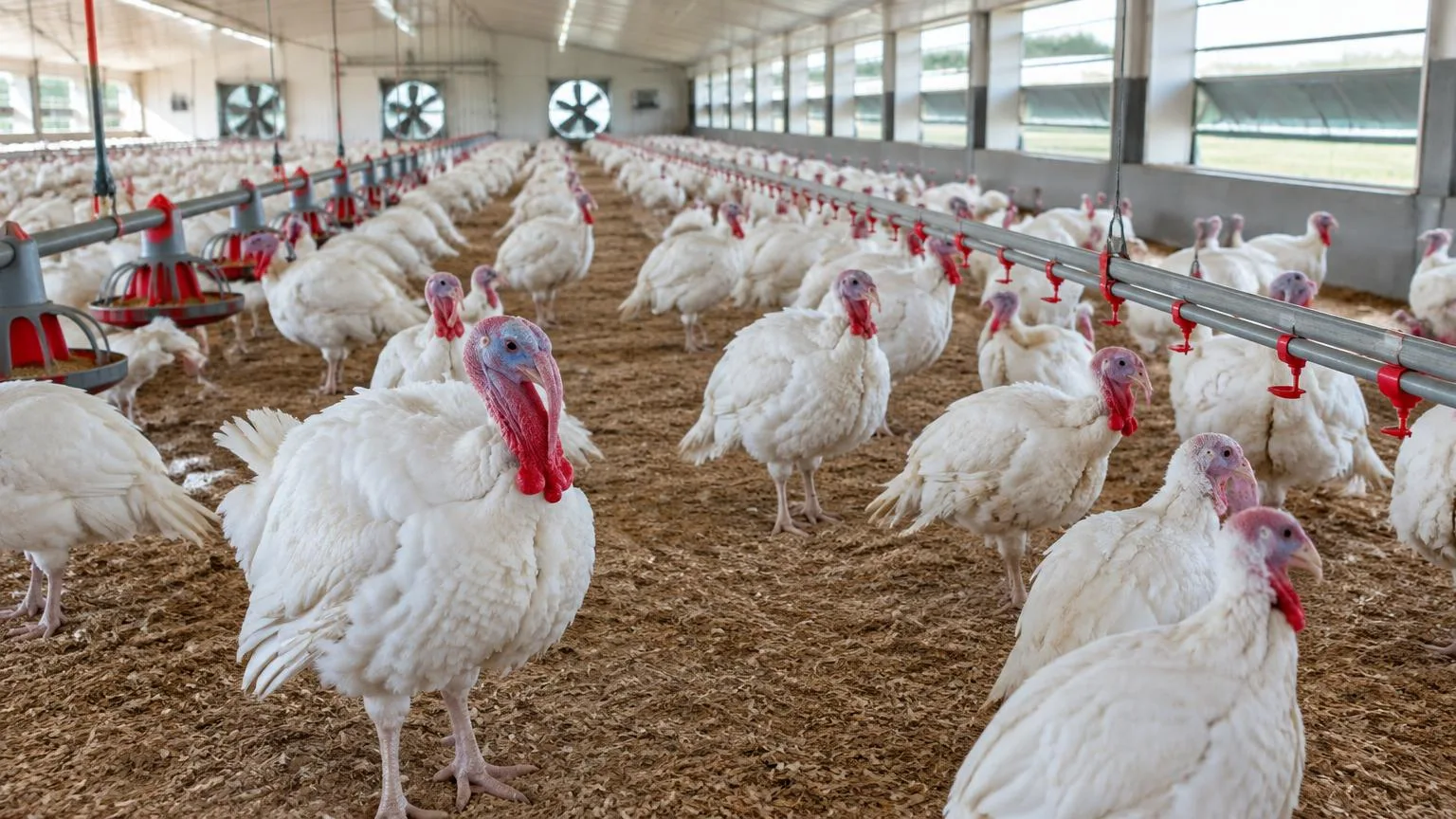
Turkey procurement specification checklist
| Package | Buyer supplies | Check in the proposal |
|---|---|---|
| Production & capacity | Strain, hens/toms, placement, sale age/weight and usable floor area | Written design basis; no chicken stocking defaults |
| Brooding & flock movement | Single-age house or separate brooder/grow-out, transfer and cleaning plan | Stage-specific heat, feed and water access; transfer equipment |
| Feeding & drinking | Feed form, silos/lines, bird-stage access, water analysis and pressure | Turkey suitability, line loading, flushing, cleaning and spare parts |
| Climate & energy | Design weather, insulation, pressure, airflow, controls, local tariffs | Fan curves, connected loads, heat balance and emergency operation |
| Breeders & hatchery | Male/female areas, nests, egg flow, eggs set/week and poult output | Turkey-specific trays, handling, sanitation and equipment compatibility |
| Retrofit & construction | Survey, structure, usable area, utilities, downtime and permitting | Inclusions/exclusions, interfaces, acceptance, installation and service |
Turkey hatchery capacity-validation checklist
For turkey hatchery or integrated scope, request dated supplier evidence before comparing capacity or committing a schedule. Keep facility/equipment procurement separate from hatching-egg and poult supply.
- Species, strain and product stage
- Ask for turkey species/strain and hatching eggs, newly hatched poults or placed poults separately; identify the hatchery location and responsible evidence owner. A facility/equipment RFQ is not an order for live birds or eggs.
- Monthly capacity and available slots
- Request verified monthly egg-set, hatch and placement capacity, reporting period and dated records; distinguish installed, demonstrated, booked and available slots. Record hatchability numerator/denominator (eggs set or fertile eggs), exclusions and flock/strain basis. National totals are not local availability.
- Health and biosecurity evidence
- Request current site biosecurity status, cleaning and disinfection procedures, vaccination/health documentation and responsible veterinary reviewer. Confirm applicable origin/destination requirements independently; this report supplies no health clearance.
- Commercial and transport conditions
- Ask for minimum order, confirmed versus conditional lead time, delivery radius, Incoterm and named place, transport conditions, mortality/replacement terms and the evidence/offer validity date. Keep product-supply terms separate from equipment delivery; no stock or dispatch date is presumed.
- Installation and solution fit
- Compare turkey-rated incubation, HVAC, alarms, water, power and data interfaces; name installation responsibilities, acceptance tests, commissioning and training. Request capacity evidence for the actual strain, stage and operating schedule, not a generic nameplate figure.
- OPEX, maintenance and delivery
- Compare quoted energy, water, labor, cleaning/biosecurity and downtime assumptions on identical operating hours and tariffs; preventive maintenance, calibration, local service/spares and contractual delivery timing. Identify exclusions, evidence dates and unresolved dependencies; no savings are guaranteed.
A national estimate is not a local slot, price or health clearance. Buyer tools are free; supplier contact requires David approval.
Direct manufacturer purchase or independent procurement?
A manufacturer explains and quotes its own systems. HatchMatch helps a buyer define a common brief and assess proposals received across relevant packages; it does not manufacture, install or guarantee supplier replies. Neither route removes the need for local design, permits and contractual acceptance.
Turkey projects involve different kinds of companies. They are not interchangeable competitors, so compare each on what it actually offers.
| Layer | What a buyer still compares |
|---|---|
| Equipment and system manufacturers | Fit for each bird stage and your climate, local installation and service, interfaces with other packages, total cost. |
| Genetics and breeding companies | Whether your house and equipment design matches the management guidance for the strain you place. |
| Installers, distributors and integrators | Who actually manufactures the equipment, scope boundaries, local references and service staff. |
| Independent buyer-side procurement | Independence, how suppliers are approached, and what is and is not guaranteed. |
Decision dimensions for comparing turkey equipment offers
| Dimension | Question to ask | Evidence to request |
|---|---|---|
| Scope | What is included, optional and excluded? | Itemised scope per package |
| Bird type | Is each item suitable for turkeys at each stage on site? | Data sheets naming turkeys and stages |
| Regional service | Who services the site, and how fast? | Service location, staff and response commitments |
| Integration | Who is responsible where packages meet? | Interface list and responsible party |
| Climate controls | What design basis and control modes are used? | Calculations and controller specification |
| Feeding and drinking | How are lines sized, adjusted and cleaned? | Layout and loading per house |
| Automation | What is monitored, alarmed and recorded? | Sensor list, alarm logic, data access |
| Documentation | Which drawings, manuals and training are supplied? | Document list written into the contract |
| Spare parts | What is stocked locally, and for how long? | Spare-parts list and stock location |
| Support | What happens after commissioning? | Warranty terms and service agreement |
| Total cost | What will the system cost over your planning horizon? | Price breakdown plus energy and maintenance assumptions |
HatchMatch does not publish supplier, manufacturer or genetics-company names; suitable companies are researched privately after a reviewed request.
Where European turkey production is concentrated
The EFSA supporting report by Berk and colleagues reports that Germany, Poland, France, Italy and Spain accounted for 90% of EU turkey meat tonnage during 2019–2023. This supports production-market prioritization, not a claim about current RFQ demand or guaranteed sourcing opportunities.
For each site, verify planning and environmental permits, applicable welfare rules, manure/litter handling, utility capacity and the processor or hatchery relationship with local professionals. A country-wide climate assumption is insufficient for equipment design.
Berk et al., Most common housing systems and practices of keeping turkeys in the EU (published 2026; approved December 2025), section 3.1 and Appendix EThree steps to a comparable turkey RFQ
- Define the outcome: grow-out, breeder, new build, retrofit or expansion; record actual capacity and constraints.
- Complete the specification checklist and collect turkey-specific quotations, local costs and the designer’s assumptions.
- Send the brief for human review. Buyer service is free; assisted procurement is for projects from USD 250,000.
Planning information, not veterinary, engineering or legal advice. No turkey financial presets, universal stocking density or guaranteed production results.
Loading turkey planning tools…
How your sourcing request is handled
- You describe the needRequest type, species, capacity, scope, destination and timing. Unknown answers are fine; say what still needs confirming.
- Our team sources and evaluates fitA person reviews the brief, researches independent suppliers for your scope and checks their fit against your stated requirements. Suppliers decide whether to respond.
- We compare options for youAny responses received are organised on the same fields so scope, assumptions and exclusions can be compared. Supplier communication runs through HatchMatch; contact details are not shared automatically.
Free for buyers · B2B requests reviewed from USD 250,000
Every brief is reviewed by a person; we aim to reply within 2 business days. Supplier response times vary. HatchMatch does not confirm supplier certification, animal-health or regulatory status, stock or delivery dates; those come from suppliers' own documents and the relevant authorities.
Buyer guides: how to write a project RFQ · how to evaluate supplier offers
Request your commercial poultry project quote
Step 1 of 3
What are you planning?
Pick the closest match. You can refine everything later with our team.
Your answers are kept in this browser tab until you send them.
Availability and the ability to trade depend on the law that applies and on the relevant permits and approvals. HatchMatch Group is not a manufacturer, importer, exporter, seller or regulatory authority; our team screens each request before any supplier contact. Regulation & restricted items