
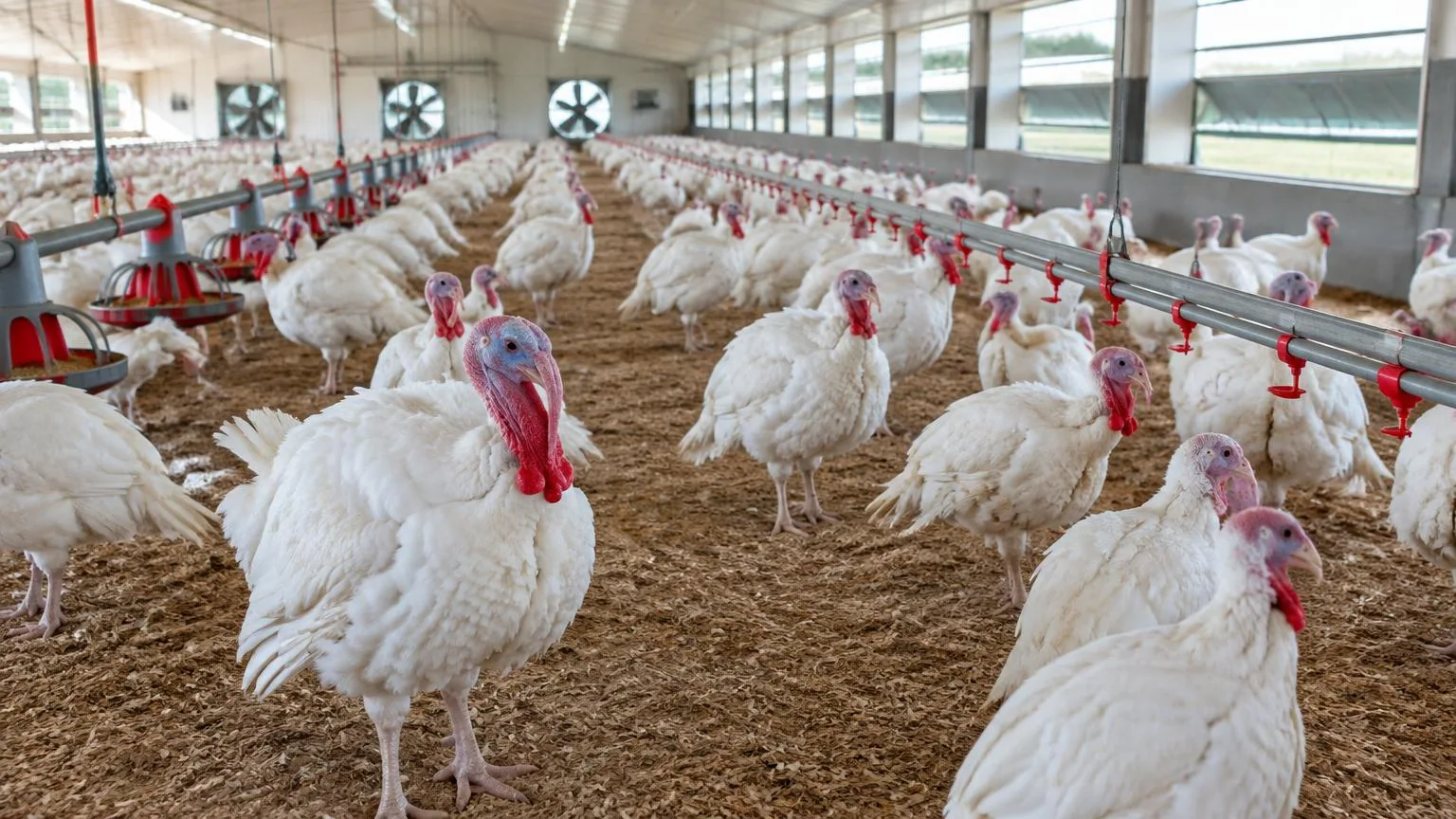
Commercial turkey farm setup — equipment, ventilation and production guide.
Define turkey production around the actual strain, bird stage, building and local requirements—not scaled-up chicken defaults. This guide explains how to prepare the design basis, compare equipment scope and distinguish new construction from retrofit. HatchMatch is independent buyer-side procurement, not an equipment maker or project executor; buyer service is free, with assisted procurement from USD 250,000.
Production inputs to collect
Use strain-specific documentation and local professional design. No default flock size, density, sale weight or performance target is supplied here.
Turkey farming equipment — scope & evidence needed
Create one comparable package list before requesting prices. No verified turkey market prices are available here; each line requires a site-specific scope, design or written quotation.
Structural survey/design, usable floor area, insulation, drainage, access and local permits.
Stage-specific feeder access, line loading, silos, feed delivery and cleaning. Confirm turkey suitability.
Water quality, pressure/flow, turkey-stage access, flushing and treatment. Specialist advice for any dosing.
Bird-stage heat/moisture basis, design weather, fan curves at working pressure, inlets and emergency operation.
Site humidity, controls, water use, condensation, cleaning and locally calculated energy balance.
Poult accommodation, heating distribution, safe fuel/electric service and stage-specific monitoring.
Compatible temperature/humidity/pressure inputs, alarm tests, calibration, data access and manual override.
Measured running/starting loads, transfer, critical circuits, fuel and safe electrical installation.
Site access, clean/dirty separation, drainage, cleaning, litter storage and veterinarian-reviewed flock plan.
Installation interfaces, acceptance tests, manuals, staff training, spare parts and service responsibilities.
Record land, civil works, equipment, installation, freight/duties, working capital and financing fees separately. Contingency must reflect identified project risk—not a generic percentage.
Ventilation systems for turkeys — compared
Compare the design basis, not a universal “best” system. Local weather, building geometry, bird stage, humidity, controls and emergency operation need an engineer-reviewed specification.
| System | Best for | Strengths | Trade-offs |
|---|---|---|---|
| Tunnel arrangement | Evaluate for grow-out heat-load requirements | Compare airflow and distribution across the occupied house. | Confirm fan pressure, electrical load, humidity, backup and bird-level conditions. |
| Cross / side-inlet arrangement | Evaluate minimum ventilation and brooding distribution | Assess inlet mixing and temperature uniformity for the actual building. | Design must also address later stages and local weather extremes. |
| Combined modes | Projects with different stage/season requirements | Assess how the controls switch operating conditions. | Check commissioning, sensor compatibility and failure-mode operation. |
| Heat recovery | Site with a documented heating/ventilation energy balance | Ask for a calculation using local weather, tariff and operating hours. | Account for cleaning, dust, condensation, fan load and maintenance; no assumed savings. |
Feeding systems for turkeys — compared
| System | Best for | Strengths | Trade-offs |
|---|---|---|---|
| Turkey-rated pans | Poults or growing birds, depending on model | Published turkey product models distinguish stage requirements. | Verify bird access, model limits, line loading, cleaning and spare parts. |
| Chain / spiral delivery | Match the proposed house and flock stage | Evoteck describes both chain and spiral turkey feeding systems. | Compare actual capacity, maintenance, control and installation scope. |
| Supplemental poult equipment | Only where included in the specialist brooding plan | Define initial access and subsequent changeover requirements. | Do not assume a universal schedule or substitute for stage-specific design. |
Turkey production setup — workflow
- Confirm production purpose, processor/hatchery relationship, strain and actual capacity.
- Survey site/buildings, utilities, access and locally applicable permits and welfare requirements.
- Define turkey-specific equipment packages, design assumptions and contractual interfaces.
- Request comparable scoped proposals; use written supplier dates and verified local costs.
- Agree commissioning, staff training, acceptance, service and emergency arrangements.
- Coordinate placement with qualified production/veterinary advisers; do not infer readiness from equipment delivery alone.
Financing
Prepare a capacity plan, local cost evidence, permissions and a realistic project schedule before discussing finance. Any financing is provided and approved independently; HatchMatch does not lend, underwrite or guarantee availability.
Explore financing pathsTurn this guide into a real turkey RFQ
Specify the same production outcome and package boundaries for every proposal. Each brief gets human review; supplier participation and proposal counts are not guaranteed.
FAQ
Related turkey sourcing pages
Brooder, grow-out, feeding lines, tunnel ventilation.
Independent procurement for new construction, retrofit and expansion.
Identify missing specifications before requesting proposals.
Tunnel ventilation and cooling — critical for turkeys.
Source evidence and limits
- Berk et al., EFSA supporting report (2026): overview of EU turkey housing practices; not a universal farm design standard.
- Big Dutchman turkey range and Vencomatic turkey/breeder systems: stated manufacturer offerings, not partnership or independently verified performance claims.
- Evoteck turkey feeding/drinking: vendor-described chain/spiral feeding and drinking installation scope.
Sources checked 16 October 2026. Purchasing guidance only; no veterinary, engineering or legal advice. The farm-cost calculator remains the financial authority, but current chicken defaults must not be treated as turkey costs or ROI.
Request your commercial poultry project quote
Step 1 of 3
What are you planning?
Pick the closest match. You can refine everything later with our team.
Your answers are kept in this browser tab until you send them.