
Low Egg Output or Poor Shell Quality: Investigate the Flock Before Buying Equipment
When egg output or quality falls below the farm’s own reference, first verify counts and compare the same flock age and production system. Trace feed, water, light, climate and handling changes before specifying equipment. Abnormal signs or unexplained mortality require veterinary investigation, not a purchasing decision.
By HatchMatch Group Editorial Desk · Last updated 2026-10-13
Editorial draft — human language and technical review pending. Not a diagnosis or treatment plan.
In short
A shortfall in eggs is a result to investigate, not a diagnosis. Confirm that the apparent decline is real, identify where it occurs and compare it with the strain’s age-specific production curve and your own recent records. Equipment belongs in the solution only when a documented system constraint justifies it.
Key takeaways
- Record flock identity, age, strain, housing system, hens placed, daily live hens, eggs collected and the inspection point.
- Reconcile feed deliveries, silo inventory and distribution interruptions.
- Compare lighting schedules with controller logs, timer settings and observed light distribution.
- Use matched, documented inspections at collection and after transfers, grading and packing.
- Separate process observations from clinical interpretation.
A shortfall in eggs is a result to investigate, not a diagnosis. Confirm that the apparent decline is real, identify where it occurs and compare it with the strain’s age-specific production curve and your own recent records. Equipment belongs in the solution only when a documented system constraint justifies it.
What baseline makes the comparison meaningful?
Record flock identity, age, strain, housing system, hens placed, daily live hens, eggs collected and the inspection point. Hen-day production is eggs divided by live hen-days ×100; over several days, sum the live hens present each day. Do not substitute the original placement count. Egg mass per hen-day is total measured egg mass divided by live hen-days; multiplying total eggs by a representative sample’s mean egg weight is an estimate and should be labelled accordingly. Keep units consistent: grams of egg mass per hen-day are not a percentage.
Keep total and saleable eggs separate. Define grade, cracked, dirty and rejected categories, avoiding double counting when a single egg has several defects. Crack rate is cracked eggs divided by eggs inspected ×100 at the same inspection point. Record deaths and culls separately against an explicit population and period. Compare with flock age and the relevant strain guide, not a single universal laying percentage. The egg-production calculator is a planning tool; it does not identify the cause of a decline.
Which feed and water records should be checked first?
Want these figures for your own site, capacity and country? A HatchMatch specialist builds the budget with you — no buyer fees.
Start freeReconcile feed deliveries, silo inventory and distribution interruptions. Record batch, form, storage condition, consumption and when the new feed reached each house. Ask a qualified poultry nutritionist to assess ration suitability and any analytical evidence; do not add supplements as a trial. Check actual availability along feed lines, not just tonnes delivered. For water, compare meter readings with flock size and weather, check access at the ends of lines, leaks and interruptions, and obtain quality assessment appropriate to the source. A large meter reading can include leakage and does not prove birds drank enough.
Could light, heat or housing conditions explain the timing?
Compare lighting schedules with controller logs, timer settings and observed light distribution. Record outages, dimming faults and changes, then review the program with the strain supplier or qualified adviser. Do not alter day length simply because output is low. Map temperature, humidity and air distribution at bird level, including hot periods and areas distant from sensors. Inspect fans, inlets, alarms and backup power safely. Check stocking, usable space, nest or cage access and manure handling against local welfare rules and the actual design. Use the ventilation calculator to organize assumptions, with engineering validation rather than automatic sizing acceptance.
Are shell defects occurring before or after collection?
Use matched, documented inspections at collection and after transfers, grading and packing. More cracks appearing downstream warrant checks of belt transitions, accumulation, speeds, alignment and handling. Defects already present at first collection require a wider review of age, nutrition, environment and health. Sampling variation and different inspection methods can mimic improvement. Do not attribute every cracked egg to the collection equipment or every thin shell to a feed deficiency.
When should the investigation become veterinary-led?
Separate process observations from clinical interpretation. A sudden unexplained production drop, abnormal respiratory or neurological signs, distress or increased mortality warrants prompt contact with the flock’s licensed veterinarian. Follow the farm emergency and biosecurity plan and local reporting instructions; suspected reportable disease requires local animal-health authority guidance. Do not move birds or equipment to test a theory, diagnose from a symptom checklist or delay veterinary help while awaiting a quotation.
What belongs on the daily investigation checklist?
| Record | Check and document | Responsible person |
|---|---|---|
| Production | Live hen-days, eggs, egg weight sample, defects and deaths | Flock manager |
| Feed and water | Batch, inventory, access, consumption, leaks and test records | Manager and nutrition adviser |
| Light and climate | Actual schedule, outages, bird-level readings and alarm events | Trained operator |
| Housing and handling | Access, manure, transfer points and matched crack inspections | Maintenance and egg-room staff |
| Health and movements | Signs, onset, visitors and biosecurity exceptions | Manager and veterinarian |
How do you turn a finding into a controlled change and RFQ?
Write the suspected constraint, supporting evidence, alternative explanations and the responsible adviser. For a safe process change, agree a comparison period, consistent measures and welfare stop rules; record every concurrent change. A before-and-after observation alone does not prove causation. An illustrative finding might be that cracks rise after one conveyor transfer while hen-day output is stable. That supports a transfer inspection and documented handling trial—not a claim that a new housing system will raise egg yield. If capital work is justified, put the baseline, interfaces and acceptance method into the existing RFQ comparison guide.
Frequently asked questions
Is low egg output always an equipment problem? No. Counting errors, flock age, access to feed or water, environment, handling and health can affect the records. Establish the cause with the relevant professionals before specifying equipment.
Can hen-day production fall while saleable egg output stays stable? Yes. A change in live hen numbers, egg size or rejection rate can move measures differently. Read total eggs, hen-days, egg mass and saleable eggs together.
Should all farms use the same shell-quality target? No. Define the product, inspection method, strain, age and market requirements. A grade or rejection rule used in one market is not automatically a legal standard elsewhere.
Can a crack-rate comparison prove the conveyor is responsible? Not by itself. Use comparable samples at fixed inspection points, inspect the machinery and record other changes; trained review is needed before attributing cause.
Should a sharp production drop wait for an equipment quotation? No. Unexplained declines with abnormal signs or mortality need prompt veterinary assessment and applicable local authority instructions.
How should evidence be scored before equipment is selected?
| Check | Written evidence to request | Decision rule |
|---|---|---|
| Capacity and access | House layout, bird mass/age, feeder and drinker capacity | Match the defined operating case, not a catalogue maximum |
| Local climate and utilities | Ventilation duty, pressure losses, water demand, power and alarm plan | Qualified engineer reviews design conditions and resilience |
| Integration and cleaning | Named interface owner, access drawings, sanitation procedure | No unassigned interfaces or inaccessible routine service |
| Delivery and support | Installation, commissioning, training, spares, warranty exclusions | Include each item or price the omission separately |
| Capability and acceptance | Relevant references, test method, data and limitations | Unverified claims remain unverified; agree measurable acceptance |
Define the result, baseline and system constraint first. HatchMatch then reviews the project, structures a request for quotation (RFQ), approaches suitable independent suppliers on the buyer’s behalf and helps compare proposals. Buyer procurement is free; typical commercial scope is USD 250,000+. HatchMatch does not build the farm or guarantee supplier participation, egg output, growth, disease control or returns. Use the farm-cost calculator for transparent planning estimates, not vendor prices; submit the project for review when the scope is ready.
The WOAH poultry biosecurity chapter supports documented prevention and controlled movements, not guaranteed disease control. UMN heat-stress guidance explains the interaction of heat, humidity and intake. Penn State laying-flock management provides management context; its small-flock examples are not commercial breed targets. Penn State nutrition and feeding is a resource collection, not a ration prescription or proof of equipment performance. Confirm current local welfare, reporting and food-safety requirements with qualified advisers.
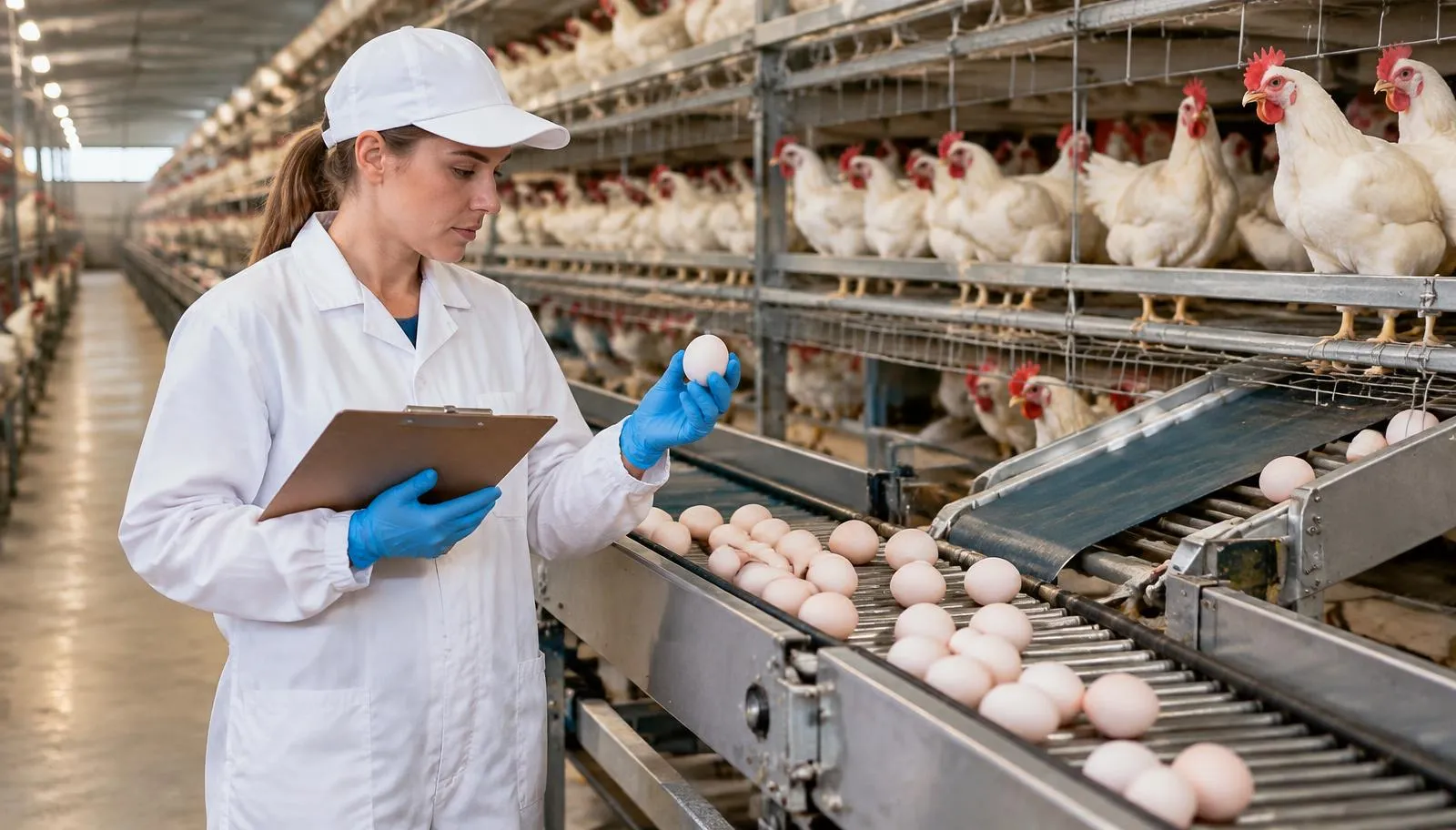
AI-generated editorial illustration; not a photographed HatchMatch project or supplier reference.
What is this article’s review status?
Prepared on 13 October 2026. Educational operational guidance, not veterinary diagnosis, treatment or a final engineering design. Human technical and native-language editorial review is pending; no named reviewer or clinical approval is claimed. Localized search phrases are editorial candidates, not verified local demand. User-supplied GSC observations through 11 October are early on-site evidence: suppliers 5 impressions/position 10.8; manufacturers 4/10.5; commercial suppliers 2/24; equipment list 1 click/1 impression/9. Market and reporting window were not supplied. These are not search volumes. Ubersuggest’s daily limit was reached; no new volume, CPC or difficulty figures are asserted.
Frequently asked questions
- Is low egg output always an equipment problem?
- No. Counting errors, flock age, access to feed or water, environment, handling and health can affect the records. Establish the cause with the relevant professionals before specifying equipment.
- Can hen-day production fall while saleable egg output stays stable?
- Yes. A change in live hen numbers, egg size or rejection rate can move measures differently. Read total eggs, hen-days, egg mass and saleable eggs together.
- Should all farms use the same shell-quality target?
- No. Define the product, inspection method, strain, age and market requirements. A grade or rejection rule used in one market is not automatically a legal standard elsewhere.
- Can a crack-rate comparison prove the conveyor is responsible?
- Not by itself. Use comparable samples at fixed inspection points, inspect the machinery and record other changes; trained review is needed before attributing cause.
- Should a sharp production drop wait for an equipment quotation?
- No. Unexplained declines with abnormal signs or mortality need prompt veterinary assessment and applicable local authority instructions.
More buyer questions are answered in our poultry procurement FAQ — also available in Español, Français, Português, Deutsch, العربية, Русский, Türkçe, Tiếng Việt.
From this article to a procurement-ready RFQ
HatchMatch Group is an independent sourcing desk — not a manufacturer or EPC contractor. These are the four steps we actually use with commercial poultry and hatchery buyers. If you are still deciding scope, start with what commercial poultry equipment includes and how suppliers are compared.
- 1. Plan the projectCapacity, climate and house layout in one guided workflowOpen
- 2. Build the RFQScope, specifications and comparable line itemsOpen
- 3. Submit the requestReviewed manually before HatchMatch contacts any supplier on the buyer's behalfOpen
- 4. Track and compareFollow status and normalise supplier responsesOpen
Prefer the numbers first? Start with the poultry project cost calculator or browse the project planning guides.