
Drinking Water Systems for Commercial Poultry Farms: Quality, Treatment, Storage and Drinker Lines
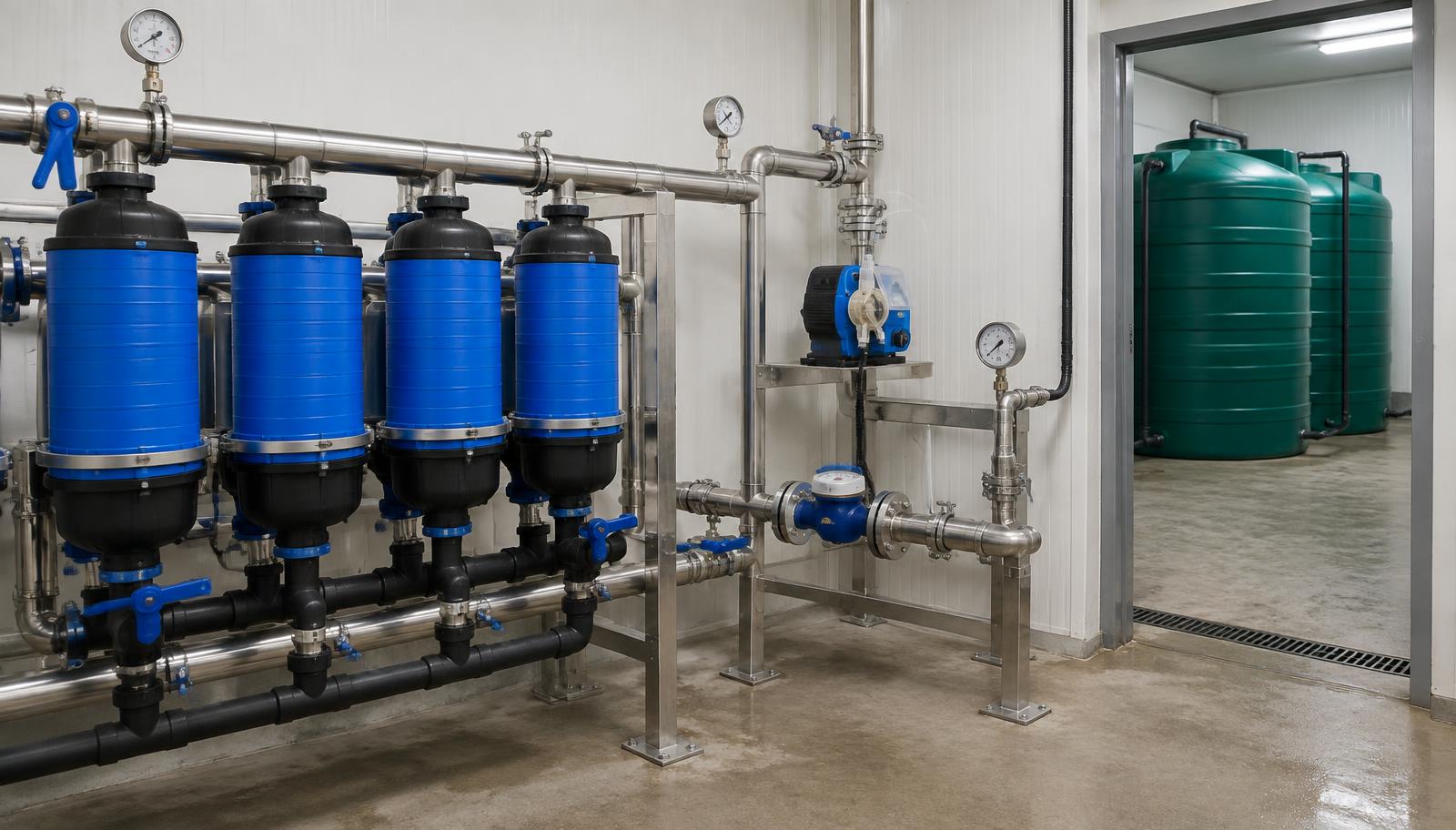
Water is the nutrient birds take most of. This guide explains how to test water, choose treatment, size storage and specify drinker lines so supplier quotes can be compared on one basis.
By HatchMatch Group Sourcing Desk · Last updated 2026-10-06
In short
Short answer. A commercial poultry drinking water system has five parts: the source, treatment, storage, distribution and the drinker lines inside each house. Birds typically drink roughly 1.
Key takeaways
- Take samples from the actual source — borehole, municipal supply, river or dam — and test both chemistry and bacteriology at an accredited laboratory.
- Use the water consumption calculator to estimate daily drinking demand for your flock size, and add evaporative cooling water if the houses use pads.
- Treatment is chosen from the water test, not from a catalogue.
- Technician flushing a nipple drinker line next to the pressure regulator — Regular high-pressure flushing removes biofilm and sediment from drinker lines; specify regulators and lines that allow it.
- A water meter on each house is one of the cheapest and most useful sensors on a farm: a fall in water intake is often the first sign of a disease, heat or feed problem.
Short answer. A commercial poultry drinking water system has five parts: the source, treatment, storage, distribution and the drinker lines inside each house. Birds typically drink roughly 1.6 to 2 times as much water as feed by weight, and much more in hot weather, so water problems show up quickly as lower feed intake, poorer growth or fewer eggs. Start with a laboratory water test, then size treatment and storage to peak summer demand, and specify the drinker system together with filtration, pressure regulation, metering and medication dosing.
This guide is for broiler, layer, breeder and hatchery projects. It is general planning information; water standards vary by country, and treatment design should be confirmed with a water specialist and your veterinarian.
Step 1: Test the water before you design anything
Take samples from the actual source — borehole, municipal supply, river or dam — and test both chemistry and bacteriology at an accredited laboratory. Repeat in the wet and dry seasons if the source varies. Typical parameters are pH, total dissolved solids (TDS), hardness, iron, manganese, nitrate and nitrite, sulphate, chloride, sodium, and total bacteria and coliforms.
| Parameter | Why it matters | Common treatment direction |
|---|---|---|
| pH | Affects disinfectant performance and some medications | Acidification if high; check pipe materials if low |
| TDS / salinity | High salts reduce intake and cause wet droppings | Blending or reverse osmosis for very high values |
| Hardness | Scale blocks nipples and regulators | Softening, or descaling routine |
| Iron and manganese | Staining, biofilm, clogged nipples, taste | Oxidation and filtration |
| Nitrate / nitrite | Can indicate contamination and affect health | Find and remove the source; specialist treatment |
| Bacteria / coliforms | Disease risk; coliforms should be absent | Continuous disinfection and line hygiene |
Want these figures for your own site, capacity and country? A HatchMatch specialist builds the budget with you — no buyer fees.
Start freeCommonly cited poultry guidelines treat water with low TDS, neutral pH, very low iron and manganese and no coliforms as good quality. Use the limits published in your breed guide or by your national authority as the binding values in the specification.
Step 2: Size demand, storage and pumps
Use the water consumption calculator to estimate daily drinking demand for your flock size, and add evaporative cooling water if the houses use pads. Size for the hottest week, not the annual average. Then decide how many days of storage you need: many projects hold enough for one to three days, more where the supply or power is unreliable. The water storage tank calculator gives a first figure. Pumps should cover peak-hour flow with a standby pump, and be on the generator circuit — a power cut that stops water in summer is an emergency within hours.
Step 3: Choose the treatment train
Treatment is chosen from the water test, not from a catalogue. A typical sequence is coarse filtration at the source, removal of iron and manganese if needed, fine filtration, disinfection (chlorine, chlorine dioxide or hydrogen-peroxide products are common), and pH correction. Very saline water may need reverse osmosis, which also needs a plan for the reject brine. Ask suppliers to state the residual disinfectant level their design will hold at the end of the drinker lines and how it is monitored, because biofilm in the lines can undo good treatment at the source.
Step 4: Specify the drinker system
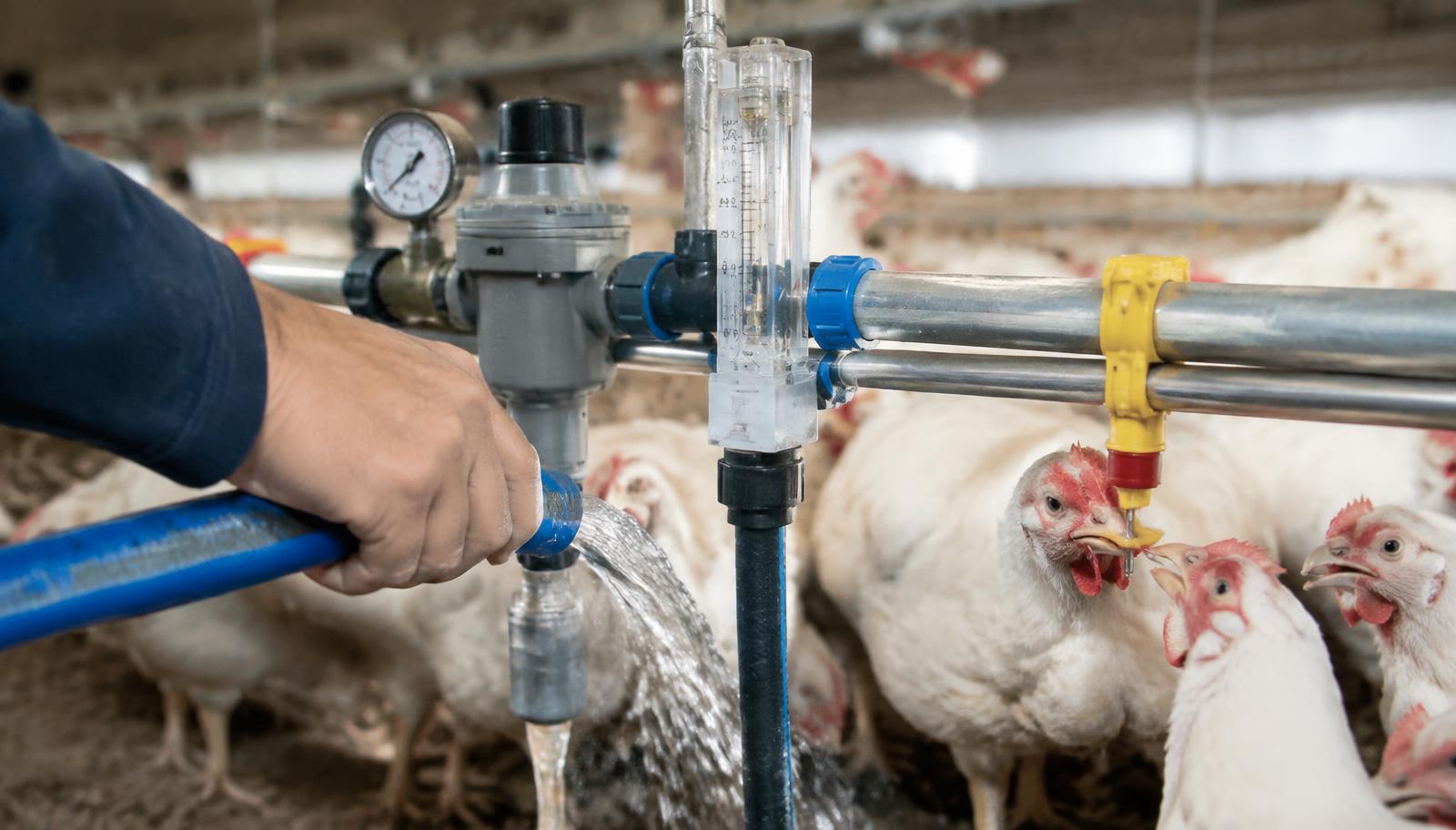
Most commercial houses use nipple drinkers on lines suspended from a winch system (floor housing) or fixed to cage tiers. Specify: the number of birds per nipple at the oldest age (breed guides and the farm cost calculator's planning model use around 10 birds per nipple for broilers as a reference); nipple flow rate suitable for the bird type; drip cups or not; pressure regulators with sight tubes at the head of each line; automatic or manual flushing; and line material. For cage systems, ask how nipples are positioned so each bird reaches one at every tier.
Step 5: Metering, dosing and alarms
A water meter on each house is one of the cheapest and most useful sensors on a farm: a fall in water intake is often the first sign of a disease, heat or feed problem. Specify meters connected to the house controller with alarms for low or high flow. Add a medicator or dosing pump for vaccines, vitamins and treatments, with a bypass so medicated water can be isolated. Ask for stainless or chemical-resistant fittings where acids and disinfectants are dosed.
What to include in the RFQ
Attach the laboratory water report and state: the source type and yield; flock size and bird type per house; peak daily demand including cooling; target storage days; treatment objectives (the limits the treated water must meet); drinker system type; flushing, metering and dosing requirements; controller integration; power backup; and the installation, commissioning and training scope. Ask each supplier to quote spare parts — regulators, nipples, filter elements and dosing-pump kits — as a separate priced list, as recommended in our guide to warranty, spare parts and after-sales terms.
Common mistakes
Designing treatment without a water test. Sizing storage to the average day instead of the hottest week. Leaving pumps off the generator circuit. Disinfecting at the source but never checking the residual at the end of the line. Mixing water-quality, drinker and controller packages from different suppliers without one written interface between them. And skipping house water meters to save a small cost.
Budget, operating cost and maintenance
Water systems are a modest share of total project CAPEX, but they carry running costs that should be in the business plan: disinfectant and acid products, filter elements, electricity for pumps and reverse osmosis where used, laboratory tests and replacement nipples and regulators. Ask each supplier for an annual consumables estimate based on your water report and flock size, and compare it alongside the purchase price. Plan a maintenance routine from day one: weekly checks of regulators and meters, regular filter changes, line cleaning between flocks and periodic water tests at the source and at the end of the lines. A good supplier provides this routine in writing as part of commissioning and training.
For farms with several houses, one central treatment room feeding all houses is usually simpler to operate and monitor than separate units per house, but it needs reliable ring mains and isolation valves so one house can be dosed or cleaned without affecting the others. Ask suppliers to show the layout and the valve arrangement in their proposal.
Where HatchMatch fits
HatchMatch is a supplier-neutral procurement platform for commercial poultry projects, typically USD 250,000 and above. It is not a manufacturer, installer, EPC contractor or consultant, and it does not sign supply contracts — buyers contract directly with the suppliers they choose. HatchMatch helps you turn your requirements into one written specification so offers can be compared line by line. Every brief receives human review, and HatchMatch aims to reply within two business days. To start, submit a poultry project request with your flock size, water source, test results and country. For broader site water planning, see the poultry water infrastructure project page.
Frequently asked questions
How much water does a chicken drink per day? It depends on age, bird type and temperature. Adult laying hens commonly drink a few hundred millilitres per day, and intake can rise sharply in heat. Use breed-guide tables and the water calculator for planning.
Do I need water treatment if I use municipal water? Often some treatment is still useful, especially disinfection residual control and filtration, because water can be contaminated in storage tanks and lines. Test it before deciding.
What is the best disinfectant for poultry water? There is no single best product; the right choice depends on pH, organic load, pipe materials and local approvals. Ask suppliers and your veterinarian to justify the choice for your water report.
How often should drinker lines be flushed? Commonly between flocks and regularly during the flock, plus after any medication. Follow the supplier's and veterinarian's programme for your water quality.
Frequently asked questions
- How much water does a chicken drink per day?
- It depends on age, bird type and temperature. Adult laying hens commonly drink a few hundred millilitres per day, and intake can rise sharply in heat. Use breed-guide tables and the water calculator for planning.
- Do I need water treatment if I use municipal water?
- Often some treatment is still useful, especially disinfection residual control and filtration, because water can be contaminated in storage tanks and lines. Test it before deciding.
- What is the best disinfectant for poultry water?
- There is no single best product; the right choice depends on pH, organic load, pipe materials and local approvals. Ask suppliers and your veterinarian to justify the choice for your water report.
- How often should drinker lines be flushed?
- Commonly between flocks and regularly during the flock, plus after any medication. Follow the supplier's and veterinarian's programme for your water quality.
More buyer questions are answered in our poultry procurement FAQ — also available in Español, Français, Português, Deutsch, العربية, Русский, Türkçe, Tiếng Việt.
From this article to a procurement-ready RFQ
HatchMatch Group is an independent sourcing desk — not a manufacturer or EPC contractor. These are the four steps we actually use with commercial poultry and hatchery buyers. If you are still deciding scope, start with what commercial poultry equipment includes and how suppliers are compared.
- 1. Plan the projectCapacity, climate and house layout in one guided workflowOpen
- 2. Build the RFQScope, specifications and comparable line itemsOpen
- 3. Submit the requestReviewed manually before any supplier introductionOpen
- 4. Track and compareFollow status and normalise supplier responsesOpen
Prefer the numbers first? Start with the poultry project cost calculator or browse the project planning guides.