
Poultry Equipment Supply Contract: 10 Clauses to Check Before You Sign
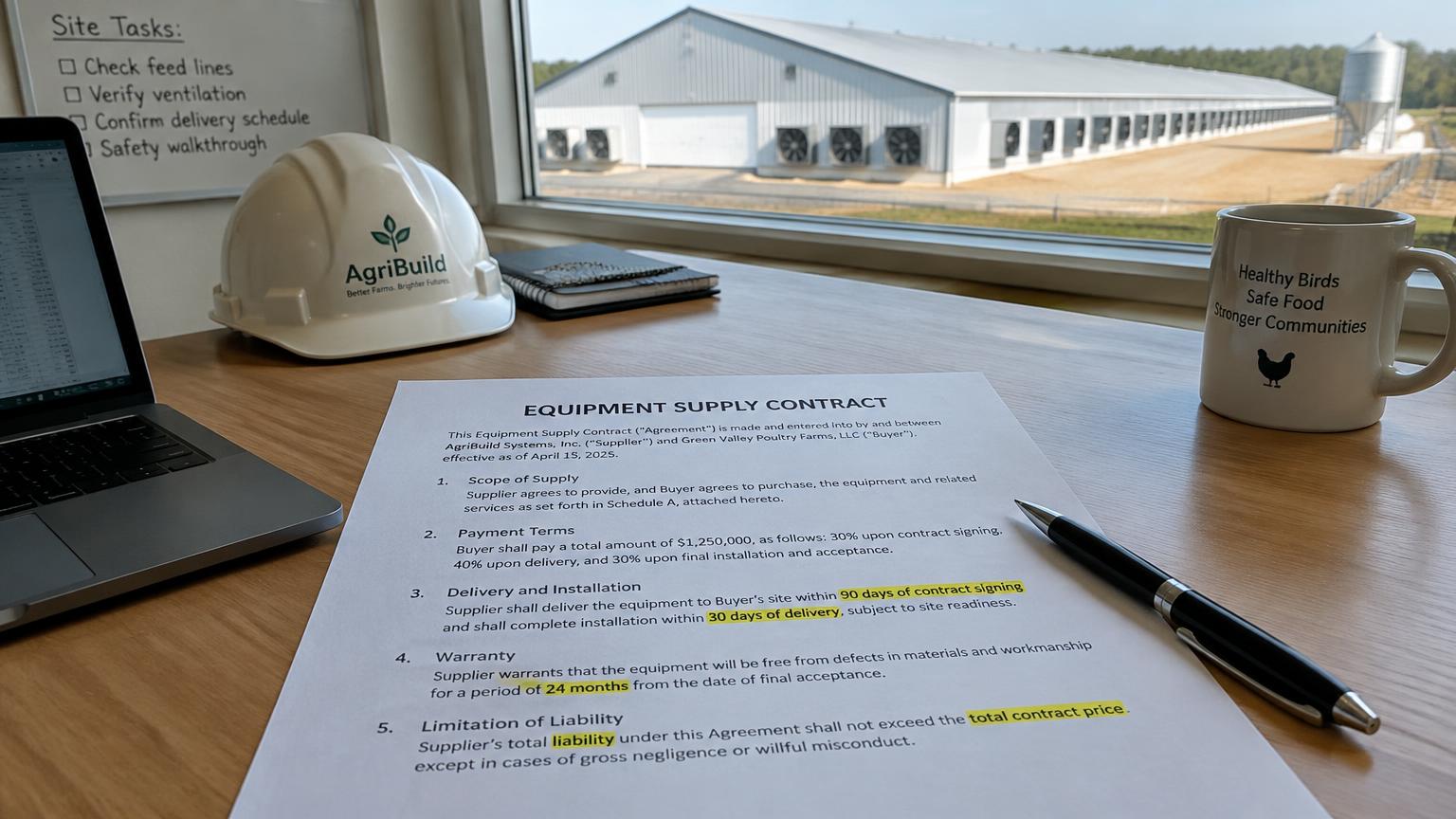
A buyer's checklist of the supply-contract clauses that decide what a poultry equipment price is really worth, and what to ask a supplier to put in writing.
By HatchMatch Group Sourcing Desk · Last updated 2026-10-11
In short
Short answer. Before signing a poultry equipment contract, make sure it fixes ten things in writing: the itemized scope and drawings, the Incoterm and delivery point, the delivery date with a remedy for delay, the inspection and acceptance tests, when risk and ownership pass, the warranty and its start date, spare parts and service, how changes are priced, what happens on cancellation or force majeure, and which law and forum settle disputes. A quotation and a pro-forma invoice usually cover price and quantity only; the contract is where risk is allocated.
Key takeaways
- Attach the itemized equipment list, technical specification and approved layout drawing as contract schedules, and state that they prevail over brochures and earlier quotations.
- Write the Incoterms® 2020 rule and the named place (for example CIF a named port, or DAP your site).
- A delivery date with no consequence is an estimate.
- Define a pre-shipment inspection (who inspects, what is checked, who pays) and on-site acceptance tests after installation: ventilation stages, alarms, controller functions, feed and water lines.
- Risk usually follows the Incoterm; ownership (title) can pass separately, often on full payment.
Short answer. Before signing a poultry equipment contract, make sure it fixes ten things in writing: the itemized scope and drawings, the Incoterm and delivery point, the delivery date with a remedy for delay, the inspection and acceptance tests, when risk and ownership pass, the warranty and its start date, spare parts and service, how changes are priced, what happens on cancellation or force majeure, and which law and forum settle disputes. A quotation and a pro-forma invoice usually cover price and quantity only; the contract is where risk is allocated.
This guide is for investors and project teams buying commercial poultry housing, climate, feeding, drinking, cage or hatchery equipment. It is a checklist, not legal advice — have the final contract reviewed by a lawyer in your jurisdiction.
1. Scope, specification and drawings
Attach the itemized equipment list, technical specification and approved layout drawing as contract schedules, and state that they prevail over brochures and earlier quotations. Name what is excluded: civil works, electrical supply to the panel, water treatment, generator, offloading cranes, local labour. See how to review a layout drawing.
2. Incoterm and delivery point
Want these figures for your own site, capacity and country? A HatchMatch specialist builds the budget with you — no buyer fees.
Start freeWrite the Incoterms® 2020 rule and the named place (for example CIF a named port, or DAP your site). It decides who pays freight, insurance, unloading and customs, and when risk passes. Price every bid to the same point before comparing — the landed cost calculator helps.
3. Delivery date and delay remedy
A delivery date with no consequence is an estimate. Ask for liquidated damages — a pre-agreed amount per week of delay, usually capped — and a right to terminate after a long delay. Agree what counts as delivery (shipment, arrival, or delivery to site).
4. Inspection and acceptance
Define a pre-shipment inspection (who inspects, what is checked, who pays) and on-site acceptance tests after installation: ventilation stages, alarms, controller functions, feed and water lines. State who signs the acceptance certificate and how many days the buyer has to report defects. See pre-shipment inspection.
5. Risk and title
Risk usually follows the Incoterm; ownership (title) can pass separately, often on full payment. Make sure insurance covers the equipment for the whole period when it is at your risk, including storage on site before installation.
6. Warranty
State the warranty period, what it covers (parts, labour, travel, freight for replacements), exclusions, response times for remote and site support, and the start event. A warranty that starts at shipment may be partly used before birds are placed; many buyers ask for commissioning or a fixed period after arrival. See warranty and spare parts.
7. Spare parts, training and documentation
Include a priced first-year spare parts list, a commitment to supply parts for a stated number of years, operator training days, and manuals, wiring diagrams and controller settings in a language your staff use.
8. Changes and price adjustment
Agree how changes are requested, priced and approved in writing, and whether the supplier may adjust prices for steel, freight or currency. If an adjustment clause exists, ask for a cap and a stated index.
9. Cancellation, suspension and force majeure
Read what you pay if you cancel, what the supplier may do if a payment is late, and which events count as force majeure — and for how long before either side may terminate.
10. Liability, law and disputes
Check the cap on the supplier's total liability, the governing law and the forum: a named court or arbitration. For international sales, check whether the UN Convention on Contracts for the International Sale of Goods (CISG) applies or is excluded. Payment protections are covered in how to structure payment terms.
Contract checklist
| Clause | Ask for in writing |
|---|---|
| Scope | Itemized list, specification and drawings as schedules; exclusions named |
| Delivery | Incoterm with named place; date; definition of delivery |
| Delay | Liquidated damages per week, cap, termination right |
| Acceptance | Inspection plan, site tests, who signs, defect notice period |
| Warranty | Period, coverage, response times, start event |
| Spares | Priced first-year list, parts availability period |
| Changes | Written change orders, price-adjustment cap and index |
| Disputes | Governing law, court or arbitration, CISG position |
Where HatchMatch fits
HatchMatch is a supplier-neutral procurement platform for commercial poultry projects, typically USD 250,000 and above. It is not a manufacturer, contractor or law firm and does not sign supply contracts — buyers contract with suppliers directly. HatchMatch helps you write one specification so offers and their terms can be compared on the same basis. Every brief receives human review, and HatchMatch aims to reply within two business days. Submit a poultry project request or build a structured RFQ.
Sources
International Chamber of Commerce, Incoterms® 2020 rules — iccwbo.org. UNCITRAL, United Nations Convention on Contracts for the International Sale of Goods (CISG) — uncitral.un.org. FIDIC, contract conditions for plant and design-build — fidic.org.
FAQ
Is a pro-forma invoice a contract? It may be treated as an offer or order confirmation, but it rarely covers delay, acceptance, warranty start or disputes. Put those terms in a signed contract.
What are liquidated damages? A pre-agreed amount the supplier pays per period of late delivery, usually capped at a percentage of the contract value. The rate and cap are negotiated.
When should the warranty start? Agree it in the contract; commissioning or a fixed period after arrival protects buyers whose equipment waits for construction.
Which law should govern the contract? It is a negotiation. Know which law and forum apply before signing, and whether the CISG applies, and take local legal advice.
Can I use a standard contract form? Many buyers adapt published model contracts or FIDIC conditions for larger turnkey work. Any form needs the project's own schedules and legal review.
Frequently asked questions
- Is a pro-forma invoice a contract?
- It may be treated as an offer or order confirmation, but it rarely covers delay, acceptance, warranty start or disputes. Put those terms in a signed contract.
- What are liquidated damages?
- A pre-agreed amount the supplier pays per period of late delivery, usually capped at a percentage of the contract value. The rate and cap are negotiated.
- When should the warranty start?
- Agree it in the contract; commissioning or a fixed period after arrival protects buyers whose equipment waits for construction.
- Which law should govern the contract?
- It is a negotiation. Know which law and forum apply before signing, and whether the CISG applies, and take local legal advice.
- Can I use a standard contract form?
- Many buyers adapt published model contracts or FIDIC conditions for larger turnkey work. Any form needs the project's own schedules and legal review.
More buyer questions are answered in our poultry procurement FAQ — also available in Español, Français, Português, Deutsch, العربية, Русский, Türkçe, Tiếng Việt.
From this article to a procurement-ready RFQ
HatchMatch Group is an independent sourcing desk — not a manufacturer or EPC contractor. These are the four steps we actually use with commercial poultry and hatchery buyers. If you are still deciding scope, start with what commercial poultry equipment includes and how suppliers are compared.
- 1. Plan the projectCapacity, climate and house layout in one guided workflowOpen
- 2. Build the RFQScope, specifications and comparable line itemsOpen
- 3. Submit the requestReviewed manually before any supplier introductionOpen
- 4. Track and compareFollow status and normalise supplier responsesOpen
Prefer the numbers first? Start with the poultry project cost calculator or browse the project planning guides.