
How to Improve Poultry Flock Performance: Egg Output, Hatchability and Survival
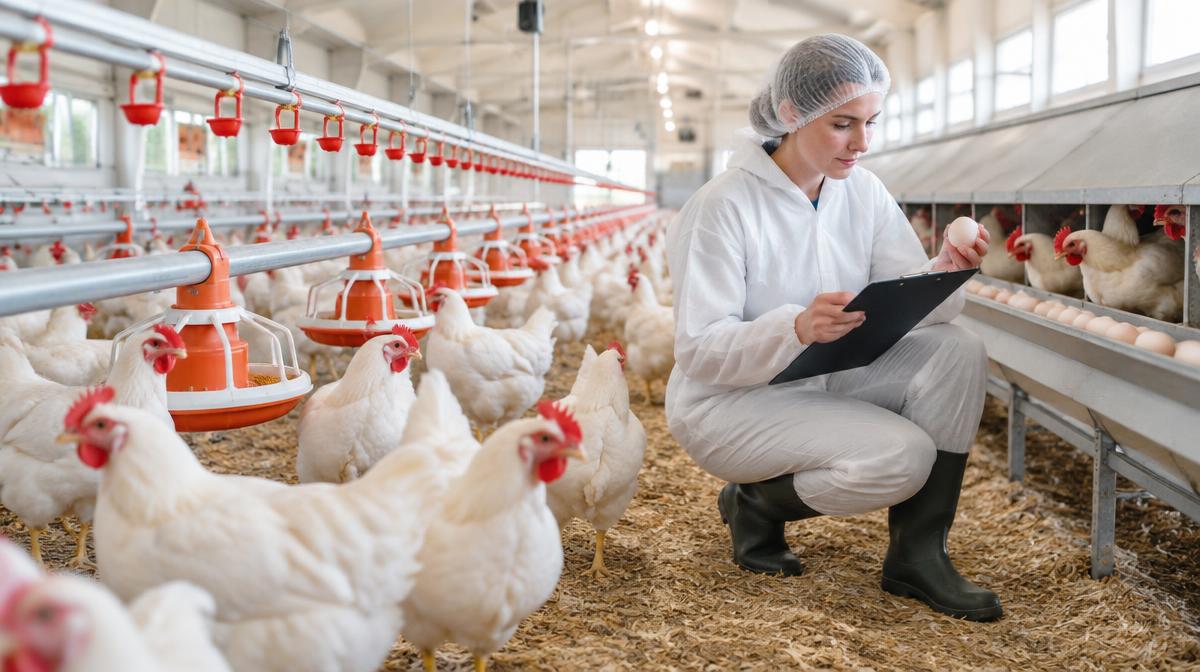
Improve commercial flock performance by measuring the right output, checking the reliability of records, and investigating changes before changing management. Layers, broilers and hatcheries need different denominators. Compare the same age, house and period; review feed, water, climate, lighting and hygiene together. Use your strain’s management guide and qualified advisers, not a universal target. Sudden mortality or illness needs veterinary attention, not a performance experiment.
By HatchMatch Group Editorial Desk · Last updated 2026-10-13
Editorial draft — human language and technical review pending. Not a diagnosis or treatment plan.
In short
Improve commercial flock performance by measuring the right output, checking the reliability of records, and investigating changes before changing management. Layers, broilers and hatcheries need different denominators. Compare the same age, house and period; review feed, water, climate, lighting and hygiene together.
Key takeaways
- Layers produce table eggs: record total eggs, saleable eggs, cracks, shell defects, egg weight and live hen numbers separately.
- Calculate hen-day production as eggs collected divided by the sum of live hens present each day, multiplied by 100.
- Fertility is fertile eggs divided by eggs examined, with the sampling method stated.
- Average daily gain requires comparable starting and ending weights and elapsed days.
- Check feed delivery and distribution, recorded consumption and batch changes; ask a qualified poultry nutritionist to review ration suitability rather than adding supplements.
Improve commercial flock performance by measuring the right output, checking the reliability of records, and investigating changes before changing management. Layers, broilers and hatcheries need different denominators. Compare the same age, house and period; review feed, water, climate, lighting and hygiene together. Use your strain’s management guide and qualified advisers, not a universal target. Sudden mortality or illness needs veterinary attention, not a performance experiment.
Which measures belong to layers, broilers and hatcheries?
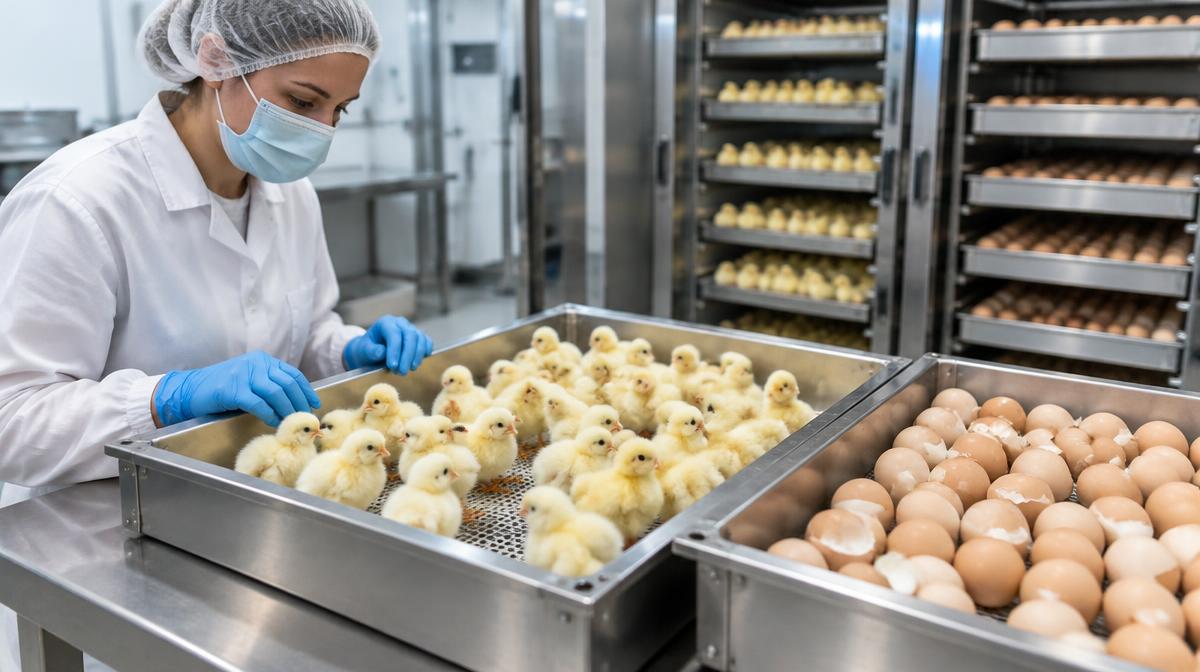
Layers produce table eggs: record total eggs, saleable eggs, cracks, shell defects, egg weight and live hen numbers separately. Breeders supply hatching eggs; fertility and embryo survival are different from table-egg output. Broilers produce live weight: follow age-specific growth, feed conversion ratio (FCR), mortality and weight variation. A hatchery converts set eggs into chicks; separate fertile eggs, hatched chicks and saleable chicks. Do not compare these as if they were one yield measure.
| System | Numerator and denominator | Record separately |
|---|---|---|
| Layers | Eggs / live hen-days | Saleable eggs, shell defects, egg weight |
| Hatchery | Chicks / eggs set; chicks / fertile eggs | Infertility, stage of embryo death, rejected chicks |
| Broilers | Feed kg / live output kg, or feed kg / gain kg | Mortality, age, removals, weight sample |
Want these figures for your own site, capacity and country? A HatchMatch specialist builds the budget with you — no buyer fees.
Start freeHow should a commercial layer farm track egg output and shells?
Calculate hen-day production as eggs collected divided by the sum of live hens present each day, multiplied by 100. An average live count times days is an approximation; use daily counts when the flock changes materially. Hen-housed cumulative output instead divides cycle eggs by hens originally placed, so it reflects survival as well as laying. Do not mix the two. Track cracked, thin-shelled, dirty and rejected eggs using written categories and a consistent inspection point. Compare samples before and after collection transfers to distinguish shell problems from handling damage. The UF/IFAS shell-quality guide explains the interacting effects of nutrition, genetics and handling; the USDA egg-grading manual supplies US grading terminology, not worldwide legal requirements.
How do fertility, hatchability and stage-specific losses differ?
Fertility is fertile eggs divided by eggs examined, with the sampling method stated. Hatchability of eggs set is chicks hatched divided by all eggs set. Hatch of fertile eggs is chicks hatched divided by fertile eggs. Multiplying eggs set by fertility and hatch-of-fertile estimates hatched chicks, not guaranteed saleable chicks. Do not multiply fertility again if your reported hatchability already uses all eggs set. Record breeder flock age, collection, storage duration, transport, setter/hatcher batch and calibration. Have trained hatchery staff classify early, middle and late embryo losses using a consistent protocol; a clear egg at candling is not proof of infertility. Breakout assessment and veterinary advice may be required. UF/IFAS hatchability guidance supports structured investigation rather than guessing the cause.
How should broilers be compared without hiding mortality?
Average daily gain requires comparable starting and ending weights and elapsed days. FCR requires an explicit basis: feed divided by live output is not identical to feed divided by weight gain. Include measured feed used by birds that died and document spillage or inventory adjustments; do not invent a feed share for mortality. Record deaths and culls separately by age or production stage. For partial harvests, use actual live kilograms removed rather than simply multiplying survivors by a final sample mean. Weigh a representative sample across the house at the same age; describe the sample size and method. Uniformity can be expressed using a stated weight band or coefficient of variation (standard deviation divided by mean weight ×100); these are not interchangeable. Hubbard’s uniformity note discusses sampling and variation.
Which environmental checks should come before a management change?
Check feed delivery and distribution, recorded consumption and batch changes; ask a qualified poultry nutritionist to review ration suitability rather than adding supplements. Check water availability at the end of lines as well as the meter, leaks and water-quality records. Review the actual lighting timer and light distribution against the age-specific breed program. Check temperatures and humidity at bird level, air distribution, fan and alarm function, and hot-period observations. Stocking must match local welfare rules, bird mass and engineered ventilation capacity, not a universal birds-per-square-metre figure. Examine litter, sanitation, pest control and movements under the farm biosecurity plan. USDA APHIS biosecurity basics provide prevention principles, not performance promises.
How do you investigate a decline and document a safe trial?
1. Verify scales, counters, meters and the feed-inventory balance. 2. Plot the change by house, age and day; annotate feed lots, heat events, maintenance and movements. 3. Check immediate water, power and climate failures safely, following the farm emergency plan. 4. Contact the flock veterinarian for unexplained mortality, respiratory signs, distress or a sharp persistent production drop; do not delay for a trial. 5. With the appropriate adviser, choose one safe management change and record its rationale, comparison group or baseline, duration and welfare stop rules. 6. Record outcomes and confounders before drawing conclusions; an uncontrolled before/after comparison cannot prove causation.
| Trial record | What to write |
|---|---|
| Baseline | House, flock age, dates, output and denominators |
| Change | One approved change, person responsible, start time |
| Conditions | Feed lot, water, temperature, humidity, density |
| Result | Same measures, observation period, welfare concerns |
| Decision | Adviser review, limitations, next step |
What can the calculator estimate from your own records?
Illustrative arithmetic, not targets: 1,000 average live hens over 7 days and 5,600 eggs gives 80% hen-day production. 10,000 eggs ×90% fertility ×80% hatch-of-fertile gives 7,200 hatched chicks. 3,040 kg feed divided by 950 surviving broilers ×2 kg gives an output-basis FCR of 1.6. Use your own lower and upper assumptions in separate scenarios; the tool does not predict a biological improvement, disease cause, full production cost, profit or return.
How does performance monitoring inform an equipment RFQ?
Define the outcome and the measured constraint first: capacity, buildings, feed and water access, ventilation, energy, monitoring and biosecurity. Link the baseline and proposed scope to a request for quotation (RFQ); ask how commissioning and acceptance will be documented. Buyer procurement is free, with typical commercial scope from USD 250,000. HatchMatch reviews and structures the brief before its team approaches suitable independent suppliers on the buyer’s behalf. It does not guarantee participation or performance. Use the egg-output tool, FCR tool, ventilation tool and the sole farm-cost planning tool. For health warnings see the first-response guide; for a project, submit your brief.
FAQ
Is a lower FCR always better? Not in isolation. Compare the same age, weight, feed basis, health and mortality. A change in the denominator or partial harvest can make figures incomparable.
Can egg counts diagnose a shell-quality problem? No. Counts show output, not the cause of defects. Document inspection categories and handling points; ask the veterinarian or nutritionist to assess a persistent change.
Can a clear candled egg be called infertile? Not reliably from candling alone. Very early embryo losses can be confused with infertility; use trained breakout assessment and an agreed sampling protocol.
Does the calculator recommend treatments or performance targets? No. It calculates only supported arithmetic from your inputs; there are no medications, supplement doses, universal targets or guaranteed gains.
When is professional help needed? Promptly for mortality, illness, distress, suspected water or climate failure, or a sharp unexplained drop. Nutrition, lighting and hatchery changes require the relevant qualified adviser.
Sources and editorial status
Source links were checked for this draft on 13 October 2026. This is educational operational guidance, not diagnosis, treatment or an engineering prescription. Professional human review and native-language editing remain pending; no named reviewer or clinical approval is claimed. Search terms are candidate topics, not verified volume or ranking data.
Frequently asked questions
- Is a lower FCR always better?
- Not in isolation. Compare the same age, weight, feed basis, health and mortality. A change in the denominator or partial harvest can make figures incomparable.
- Can egg counts diagnose a shell-quality problem?
- No. Counts show output, not the cause of defects. Document inspection categories and handling points; ask the veterinarian or nutritionist to assess a persistent change.
- Can a clear candled egg be called infertile?
- Not reliably from candling alone. Very early embryo losses can be confused with infertility; use trained breakout assessment and an agreed sampling protocol.
- Does the calculator recommend treatments or performance targets?
- No. It calculates only supported arithmetic from your inputs; there are no medications, supplement doses, universal targets or guaranteed gains.
- When is professional help needed?
- Promptly for mortality, illness, distress, suspected water or climate failure, or a sharp unexplained drop. Nutrition, lighting and hatchery changes require the relevant qualified adviser.
More buyer questions are answered in our poultry procurement FAQ — also available in Español, Français, Português, Deutsch, العربية, Русский, Türkçe, Tiếng Việt.
From this article to a procurement-ready RFQ
HatchMatch Group is an independent sourcing desk — not a manufacturer or EPC contractor. These are the four steps we actually use with commercial poultry and hatchery buyers. If you are still deciding scope, start with what commercial poultry equipment includes and how suppliers are compared.
- 1. Plan the projectCapacity, climate and house layout in one guided workflowOpen
- 2. Build the RFQScope, specifications and comparable line itemsOpen
- 3. Submit the requestReviewed manually before HatchMatch contacts any supplier on the buyer's behalfOpen
- 4. Track and compareFollow status and normalise supplier responsesOpen
Prefer the numbers first? Start with the poultry project cost calculator or browse the project planning guides.