Free Poultry Farm Design From a Supplier: What You Get and What to Check
A buyer's guide to free farm layouts and planning offered by equipment manufacturers: what they contain, their limits, who owns the drawings, and how to turn them into a brief other suppliers can quote.
By HatchMatch Group Sourcing Desk · Last updated 2026-10-11
In short
Short answer. A free farm design from an equipment manufacturer is a sales tool: useful as a starting layout, but drawn around that supplier's own equipment and assumptions. Before relying on it, confirm what it includes, who owns it, and which design inputs it used.
Key takeaways
- Typically: a site or house layout, house dimensions, the supplier's equipment list with quantities, and sometimes a capacity and budget estimate.
- | Often missing | Why it matters | |---|---| | Design inputs stated in writing (climate extremes, bird type, density, flock size) | Without them you cannot check the sizing or compare offers | | Civil, structural and foundation design | Usually required for permits and done by a local engineer | | Utilities (power load, water demand, drainage) | Drives generator, transformer and borehole cost | | Biosecurity zoning and traffic flow | Hard to fix after construction | | Local rules (welfare density, setbacks, environmental permits) | May change the layout or flock size | | Equipment from other suppliers | The layout fits one product range |
- Treating the free layout as approved drawings.
- HatchMatch is a supplier-neutral procurement platform for commercial poultry and hatchery projects, typically USD 250,000 and above.
- FAO, Good practices for biosecurity in the pig and poultry sectors — fao.
Short answer. A free farm design from an equipment manufacturer is a sales tool: useful as a starting layout, but drawn around that supplier's own equipment and assumptions. Before relying on it, confirm what it includes, who owns it, and which design inputs it used. Then turn it into a supplier-neutral brief so other suppliers can quote the same scope.
This guide is for investors and project managers who have received, or are considering, a free layout or planning package from a poultry equipment maker. It does not replace a licensed engineer's structural, civil or electrical design, which most permits require.
What a free design usually includes
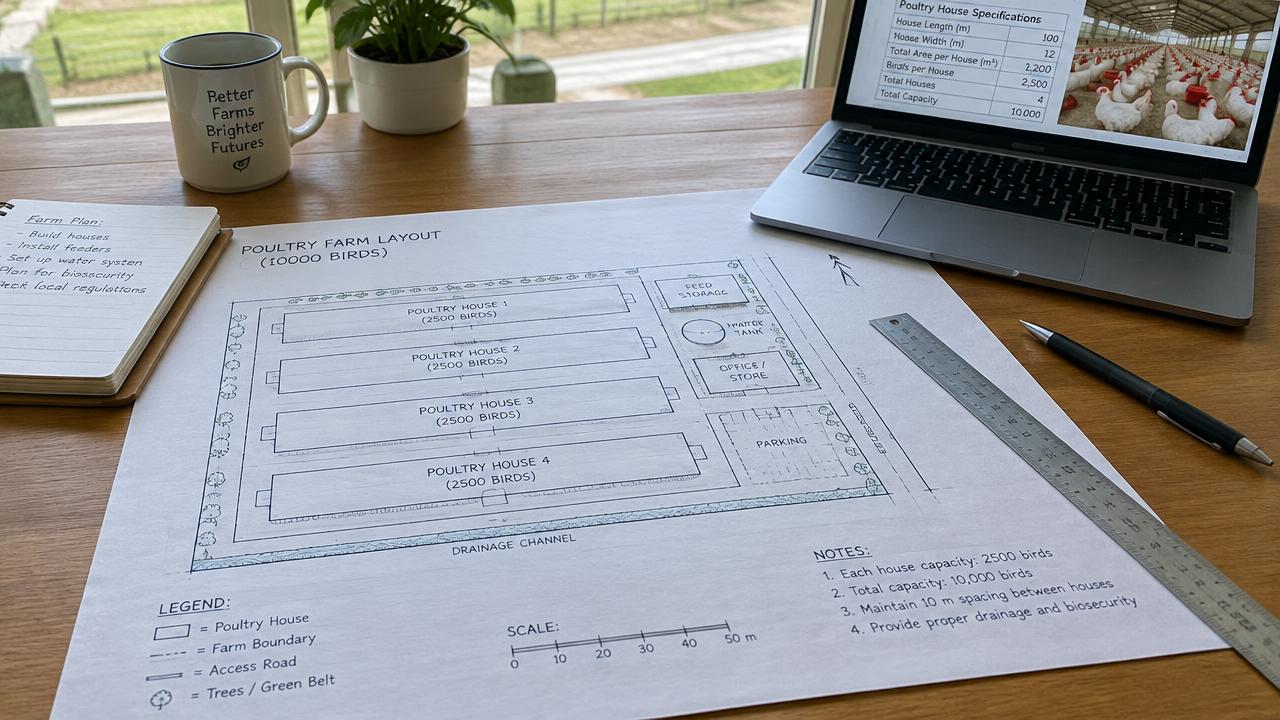
Typically: a site or house layout, house dimensions, the supplier's equipment list with quantities, and sometimes a capacity and budget estimate. Some suppliers add ventilation calculations or a 3D view. The content varies widely, so ask for a written list of deliverables before you share site data.
What it usually leaves out
Want these figures for your own site, capacity and country? A HatchMatch specialist builds the budget with you — no buyer fees.
Start free| Often missing | Why it matters |
|---|---|
| Design inputs stated in writing (climate extremes, bird type, density, flock size) | Without them you cannot check the sizing or compare offers |
| Civil, structural and foundation design | Usually required for permits and done by a local engineer |
| Utilities (power load, water demand, drainage) | Drives generator, transformer and borehole cost |
| Biosecurity zoning and traffic flow | Hard to fix after construction |
| Local rules (welfare density, setbacks, environmental permits) | May change the layout or flock size |
| Equipment from other suppliers | The layout fits one product range |
Questions to ask before you accept it
Who owns the drawings? Ask in writing whether you may share the layout with other suppliers and engineers. If not, it cannot be the basis of a fair comparison.
What were the design inputs? Ask for the climate data, bird type, target capacity, stocking density and production assumptions used. A layout is only as good as these.
Is it tied to an order? Some offers are free only if you buy; others charge if you later buy elsewhere. Get the terms before you start.
Is the budget estimate complete? Check whether it covers buildings, installation, freight, duties, utilities and commissioning, or equipment only. Test any budget in the farm cost calculator with your own inputs.
How to use it without locking in
1. Keep the free layout as a reference, not a specification. 2. Write the design inputs and performance requirements into one brief: capacity, bird type, climate basis, air speed, power and water, automation level, service needs. 3. Send that same brief to every supplier, including the one who made the design. 4. Have a local engineer check the layout against permits and site conditions. 5. Compare offers on the same scope with the proposal comparison tool. For a full planning sequence, see the poultry project decision framework.
You can also accept a manufacturer's design and buy directly from them; that can work when you know what you want. The point is to make that choice after seeing the scope and assumptions, not before.
Common mistakes
Treating the free layout as approved drawings. Sharing site data without agreeing who owns the result. Comparing other quotes against a layout sized for one supplier's cage or house module. Accepting an equipment-only budget as a project budget.
Where HatchMatch fits
HatchMatch is a supplier-neutral procurement platform for commercial poultry and hatchery projects, typically USD 250,000 and above. It is not a manufacturer, installer, contractor or lender, and it does not sign supply contracts — buyers contract with suppliers directly. Every brief receives human review, and HatchMatch aims to reply within two business days; supplier participation and response times vary. HatchMatch helps turn a supplier layout into a neutral brief that several suppliers can price. See how to review a layout drawing before approval, submit a poultry project request or build a structured RFQ.
Sources
FAO, Good practices for biosecurity in the pig and poultry sectors — fao.org. Aviagen and Cobb-Vantress broiler housing and ventilation guides. Hy-Line International commercial layer management guides — hy-line.com.
FAQ
Is a free poultry farm design really free? Often it is free to receive but tied to buying that supplier's equipment, and it is drawn around their products. Ask for the terms in writing.
Can I give a supplier's free layout to other suppliers? Only if the supplier agrees. Ask who owns the drawings before you rely on them.
Does a free design replace an engineer? No. Structural, civil and electrical design and permit drawings usually need a licensed local engineer.
Should I buy from the supplier who designed my farm? You can. Compare their offer against others quoting the same brief first, so the choice is based on scope, cost and service.
Frequently asked questions
- Is a free poultry farm design really free?
- Often it is free to receive but tied to buying that supplier's equipment, and it is drawn around their products. Ask for the terms in writing.
- Can I give a supplier's free layout to other suppliers?
- Only if the supplier agrees. Ask who owns the drawings before you rely on them.
- Does a free design replace an engineer?
- No. Structural, civil and electrical design and permit drawings usually need a licensed local engineer.
- Should I buy from the supplier who designed my farm?
- You can. Compare their offer against others quoting the same brief first, so the choice is based on scope, cost and service.
More buyer questions are answered in our poultry procurement FAQ — also available in Español, Français, Português, Deutsch, العربية, Русский, Türkçe, Tiếng Việt.
From this article to a procurement-ready RFQ
HatchMatch Group is an independent sourcing desk — not a manufacturer or EPC contractor. These are the four steps we actually use with commercial poultry and hatchery buyers. If you are still deciding scope, start with what commercial poultry equipment includes and how suppliers are compared.
- 1. Plan the projectCapacity, climate and house layout in one guided workflowOpen
- 2. Build the RFQScope, specifications and comparable line itemsOpen
- 3. Submit the requestReviewed manually before any supplier introductionOpen
- 4. Track and compareFollow status and normalise supplier responsesOpen
Prefer the numbers first? Start with the poultry project cost calculator or browse the project planning guides.