
Commercial Poultry Project CAPEX: What a USD 250k+ Budget Actually Buys
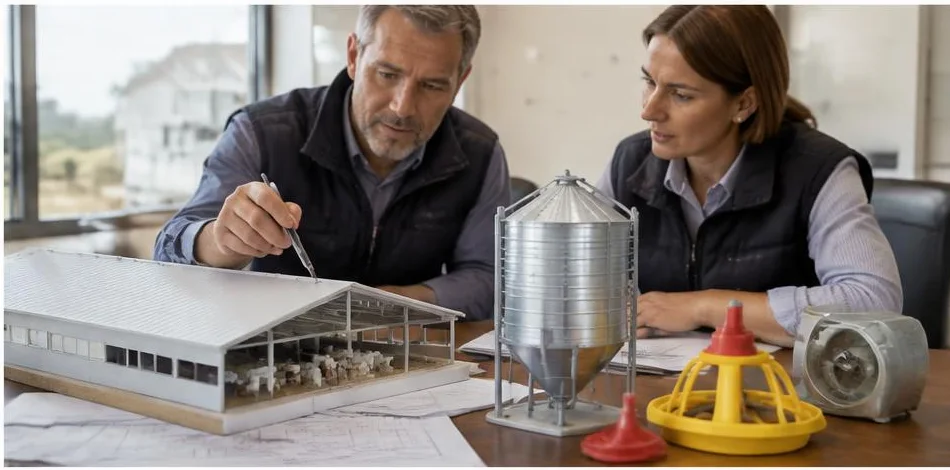
A line-by-line view of where capital goes in a commercial broiler, layer or hatchery project, and how to build a CAPEX budget suppliers can price.
By HatchMatch Group Sourcing Desk · Last updated 2026-09-02
In short
Short answer. In a commercial poultry project above USD 250,000, equipment is rarely more than 55-65% of the installed cost. Civil works, climate control, standby power, installation supervision, freight and duties carry the rest.
Key takeaways
- Once the CAPEX structure exists, hold every supplier to the same scope, the same Incoterm and the same exclusions list.
Short answer. In a commercial poultry project above USD 250,000, equipment is rarely more than 55-65% of the installed cost. Civil works, climate control, standby power, installation supervision, freight and duties carry the rest. A CAPEX budget that lists only equipment will be wrong by a wide margin, and every quotation received against it will be non-comparable.
Where the capital goes
| Cost block | Typical share | Common omission |
|---|---|---|
| House structure and civil works | 25-40% | Site levelling, drainage, access roads |
| Production equipment | 30-45% | Spare parts, tooling, commissioning kit |
| Climate control and ventilation | 10-18% | Cooling pads, controllers, alarms |
| Power and standby generation | 5-12% | Automatic transfer switch, fuel storage |
| Water, feed storage, biosecurity | 5-10% | Silos, water treatment, hygiene barriers |
| Freight, duties, installation | 8-15% | Incoterm gap between EXW and CIF/DDP |
Full definitions for each block, with the questions suppliers must answer per line, are in the poultry farm CAPEX guide. Use it before you request pricing rather than after.
Want these figures for your own site, capacity and country? A HatchMatch specialist builds the budget with you — no buyer fees.
Start freeBuild the budget from capacity, not from a catalogue
Start from output. Birds per cycle, eggs per week or chicks per week determine house count, ventilation capacity and feed line count, which in turn determine cost. Size the production target with the broiler ROI calculator, the egg production calculator or the hatchery capacity calculator, then convert the physical requirement into money.
Operating cost is the other half of the decision. A cheaper house with weaker insulation and undersized ventilation returns the saving to the energy bill within a few cycles; see the poultry farm OPEX guide and the poultry house energy calculator.
Making quotations comparable
Once the CAPEX structure exists, hold every supplier to the same scope, the same Incoterm and the same exclusions list. The method is described in the poultry equipment supplier comparison guide, and the practical submission route is the commercial poultry project RFQ process.
Disclosure. HatchMatch Group is an independent poultry project sourcing and RFQ platform. We do not manufacture or resell equipment, we do not act as an EPC contractor, and we do not guarantee prices or production performance. Figures above are planning ranges, not quotations.
From this article to a procurement-ready RFQ
HatchMatch Group is an independent sourcing desk — not a manufacturer or EPC contractor. These are the four steps we actually use with commercial poultry and hatchery buyers. If you are still deciding scope, start with what commercial poultry equipment includes and how suppliers are compared.
- 1. Plan the projectCapacity, climate and house layout in one guided workflowOpen
- 2. Build the RFQScope, specifications and comparable line itemsOpen
- 3. Submit the requestReviewed manually before HatchMatch contacts any supplier on the buyer's behalfOpen
- 4. Track and compareFollow status and normalise supplier responsesOpen
Prefer the numbers first? Start with the poultry project cost calculator or browse the project planning guides.