
Procurement Project Playbook: From Idea to Specification, Gantt, Budget, RFQ, Supplier Scorecard and Delivery

The method behind a well-run poultry or hatchery purchase: five decision gates, one deliverable per phase, an example Gantt timeline, a budget structure without invented prices, a risk register, a weighted supplier scorecard and three free editable templates.
By HatchMatch Group Sourcing Desk · Last updated 2026-10-17
In short
Short answer: to manage a poultry farm or hatchery purchase like a professional project manager, split it into seven phases — scope, feasibility, specification, timeline, budget, RFQ and supplier selection, delivery — and put a written go/revise/stop decision gate between the critical ones. Each phase produces one deliverable that the next phase uses: a scope note, saved calculator scenarios, a frozen specification, a dated Gantt plan, a budget tracked against quotes, a weighted supplier scorecard and a commissioning record. This playbook gives you the method, worked examples and three free editable templates; the companion guide shows the free HatchMatch workspace screen by screen.
Key takeaways
- An illustrative sequence for a mid-size new build.
- List each risk with likelihood and impact from 1 to 3, multiply them, and give every score of 6 or more an owner, an early-warning sign and a mitigation.
- Three editable CSV files open in Excel, Google Sheets or LibreOffice.
- What is a procurement project management plan?
- Download the gate checklist, draft your scope in the project planner, test scenarios in the farm-cost calculator, and when the specification is frozen, start an RFQ.
Short answer: to manage a poultry farm or hatchery purchase like a professional project manager, split it into seven phases — scope, feasibility, specification, timeline, budget, RFQ and supplier selection, delivery — and put a written go/revise/stop decision gate between the critical ones. Each phase produces one deliverable that the next phase uses: a scope note, saved calculator scenarios, a frozen specification, a dated Gantt plan, a budget tracked against quotes, a weighted supplier scorecard and a commissioning record. This playbook gives you the method, worked examples and three free editable templates; the companion guide shows the free HatchMatch workspace screen by screen.
Definition — decision gate: a planned checkpoint where a named person reviews written evidence and decides whether the project goes ahead, is revised, or stops, before more money is committed. Gates are standard project-management practice (see PMI) and matter most before long-lead orders.
Editorial note: written by the HatchMatch Group Sourcing Desk on 17 October 2026. Timeline weeks and risk scores are illustrative examples, not estimates for your project; no prices are given. HatchMatch is a supplier-neutral, human-reviewed procurement service for commercial projects, typically from about USD 250,000. It does not build farms, manufacture equipment or guarantee outcomes. Engineering, veterinary, legal and financing decisions need qualified professionals.
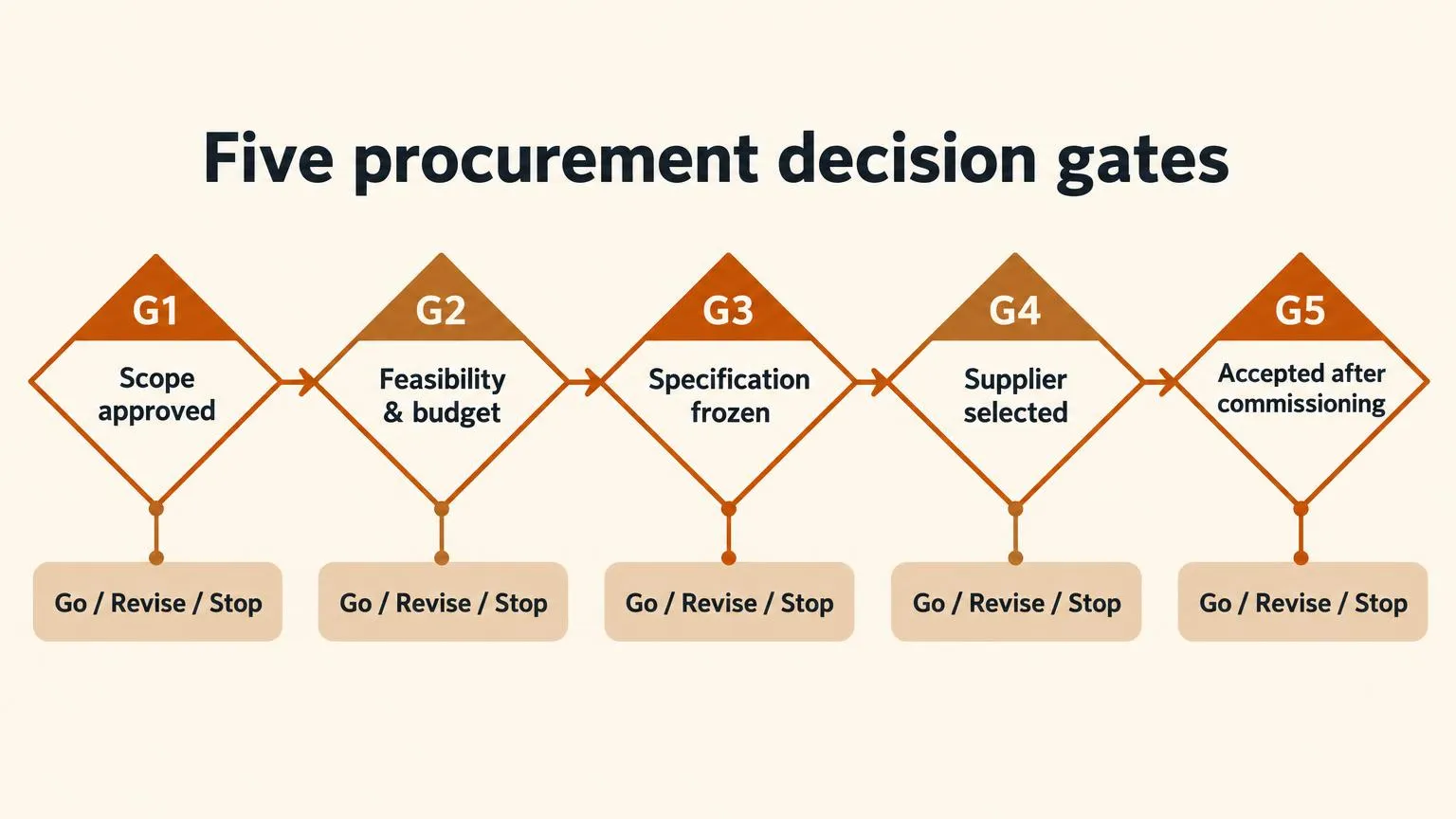
What are the five procurement decision gates?
Use the gates below in this order. Record the decision, the evidence and who approved it — the gate checklist template has one row per gate.
Want these figures for your own site, capacity and country? A HatchMatch specialist builds the budget with you — no buyer fees.
Start free1. G1 — Scope approved — species, capacity, site, country, new build or expansion fit on one page. 2. G2 — Feasibility and budget — base, low and high scenarios exist and a funding route is identified. 3. G3 — Specification frozen — every supplier will quote the same scope in the same units. 4. G4 — Supplier selected — offers normalized and scored; contract reviewed by qualified advisers. 5. G5 — Accepted after commissioning — installation, performance test, training and documents complete.
What happens in each phase, and what does it deliver?
### 1. Idea and scope
Write a one-page scope note: species (broiler, layer, breeder, hatchery, turkey, duck or goose), target capacity, location, utilities you know, new build or expansion, and what you will not buy. The free project planner turns these answers into a draft blueprint with unknowns flagged. Deliverable: scope note → Gate 1.
### 2. Feasibility
Test the economics with your own inputs in the farm-cost calculator — CAPEX, yield, break-even and payback — and save base, low and high scenarios. Hatcheries also use the hatchery capacity calculator. Check the Industry Intelligence feed for disease, regulation and market items that affect timing. Deliverable: saved scenarios and a funding route → Gate 2.
### 3. Specification
Write the technical specification by package: housing, ventilation, feeding and drinking, lighting, power backup, or incubators, hatchers and hatchery rooms. State units (birds, m², eggs per setting), climate, biosecurity zoning (see WOAH), and an explicit included/excluded list. Deliverable: specification v1.0, frozen → Gate 3.
### 4. Timeline (Gantt)
Turn the phases into tasks with start and due dates, owners and dependencies. Long-lead items — ventilation, incubators, generators, steel — usually decide the critical path, so add their supplier-confirmed lead times as soon as you have them. Deliverable: dated plan with milestones.
### 5. Budget
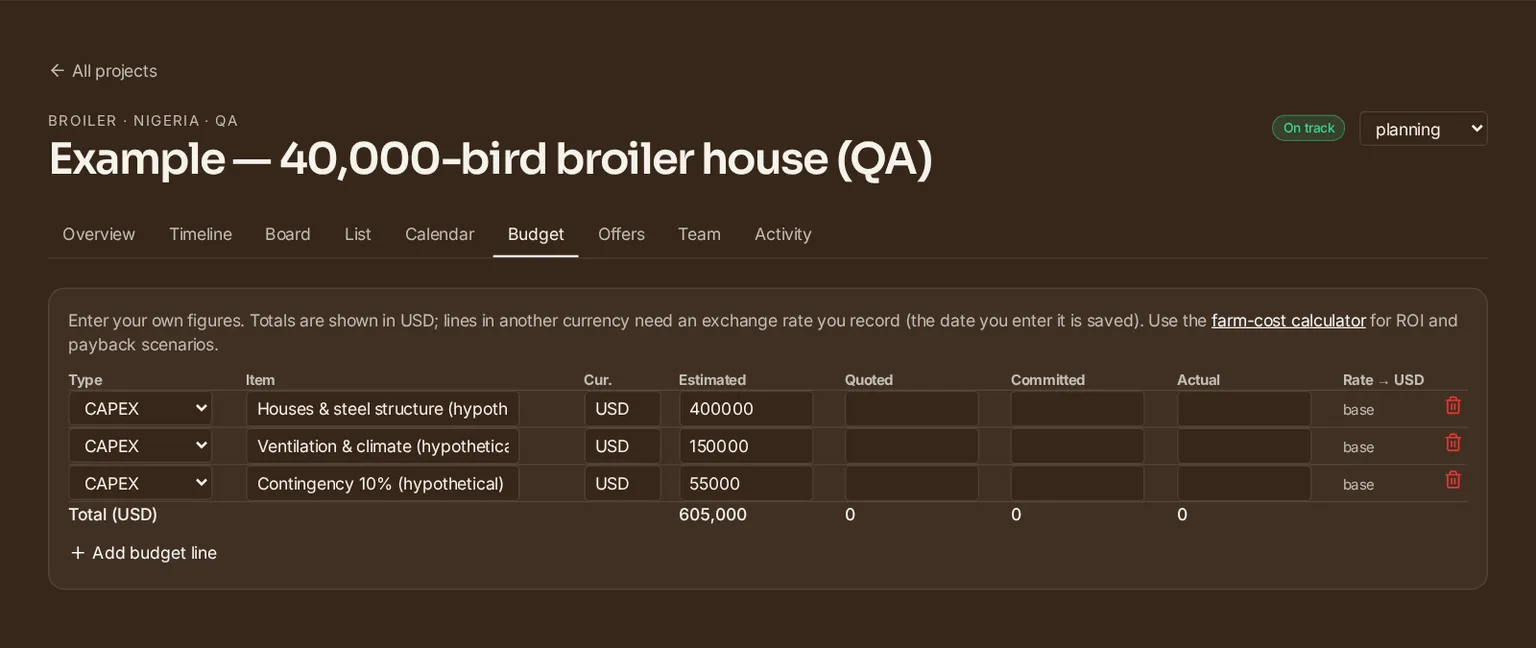
Create budget lines per package with four values: budget, quoted, committed and paid. Keep contingency as its own line until commissioning. Deliverable: budget tracked against real quotes.
### 6. RFQ and supplier scorecard
Send one structured brief to several suppliers through the RFQ wizard, then normalize offers: same currency with the exchange rate and date you used, same Incoterms rule (ICC), and the same included items. Score them with weighted criteria. The hatchery equipment sourcing guide lists hatchery-specific questions. Deliverable: scorecard and reviewed contract → Gate 4.
### 7. Delivery, installation and commissioning
Track shipping, site readiness, installation, training, the performance test and handover documents (manuals, wiring diagrams, spare-parts list, warranty). Release the final payment only against the agreed acceptance record. Deliverable: commissioning record → Gate 5.
What does an example procurement timeline look like?
An illustrative sequence for a mid-size new build. Overlaps are deliberate: specification starts while feasibility is being confirmed, and suppliers are shortlisted while the budget is being finalized.
| Phase | Example weeks | Gate |
|---|---|---|
| Idea and scope | 1–2 | G1 |
| Feasibility | 2–6 | G2 |
| Specification | 5–10 | — |
| Timeline (Gantt) | 8–12 | G3 |
| Budget | 10–16 | G4 |
| RFQ and supplier scorecard | 14–30 | — |
| Delivery, installation and commissioning | 28–36 | G5 |
*Illustrative only. Permits, grid connection and equipment production slots vary widely by country and season; replace these weeks with dates you have in writing.*
How should the budget be structured?
| Budget line | What it should include | Where the number comes from |
|---|---|---|
| Site and civil works | Earthworks, foundations, roads, drainage | Local contractor quotes |
| Buildings and envelope | Structure, roof, insulation, doors | Supplier or contractor quotes |
| Equipment packages | Ventilation, feeding, drinking, lighting, incubation | Normalized supplier offers |
| Logistics and duties | Freight, insurance, customs, local transport | Incoterms rule plus forwarder quote |
| Installation, training, commissioning | Supervisors, travel, test runs | Written in each offer — or flagged as missing |
| Contingency | Unknowns and FX movement | Your own policy, kept separate |
Feasibility numbers belong in the farm-cost calculator; this table only shows how to organize real quotes so nothing is counted twice or forgotten.
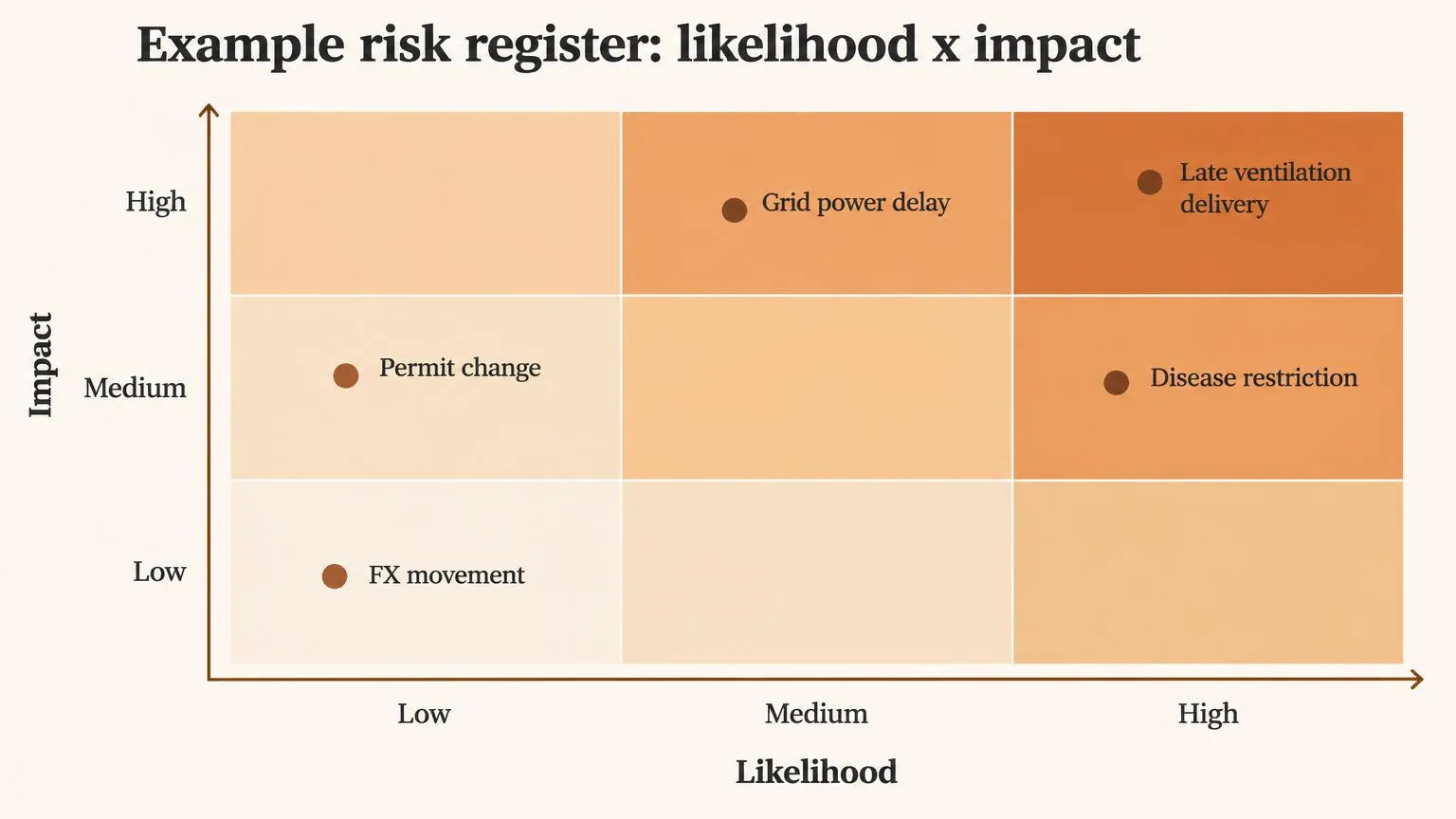
How do you build a risk register?
List each risk with likelihood and impact from 1 to 3, multiply them, and give every score of 6 or more an owner, an early-warning sign and a mitigation. Review it at every gate. The examples below are common in poultry projects; their scores are illustrative.
| Risk | L × I | Mitigation |
|---|---|---|
| Late ventilation delivery | 3 × 3 = 9 | Confirm production slot; date and penalty in contract; weekly tracking |
| Grid power connection delay | 2 × 3 = 6 | Written connection date; size backup generator early |
| Disease restriction (e.g. avian influenza) | 3 × 2 = 6 | Monitor official notices; biosecurity plan; alternative placement dates |
| Permit conditions change | 1 × 2 = 2 | Confirm requirements in writing before Gate 3 |
| Exchange-rate movement | 1 × 1 = 1 | Record FX rate and date per quote; contingency line |
How do you score suppliers fairly?
| Criterion | Example weight | Evidence required |
|---|---|---|
| Scope matches specification | 25% | Line-by-line quote against your specification, including excluded items |
| Total cost of ownership | 25% | Price, freight, duties, installation, spares and energy in one currency with FX date |
| Lead time and delivery terms | 15% | Written schedule and Incoterms rule |
| Installation, commissioning and training | 10% | Named responsibilities and durations |
| Warranty, spares and local service | 15% | Warranty text, spare-parts list, service contact in your country |
| References (subjective) | 10% | Contactable references you checked yourself |
Agree the weights before you open the offers, score each criterion 1–5, and keep subjective items labelled as such. A supplier is not "vetted" because it scores well; verify references and documents yourself.
Which templates can I download?
Three editable CSV files open in Excel, Google Sheets or LibreOffice. Column headings are in English so teams and suppliers in different countries can share them.
- Decision-gate checklist (CSV) - Risk register with five worked examples (CSV) - Weighted supplier scorecard (CSV)
How does the free HatchMatch workspace support this playbook?
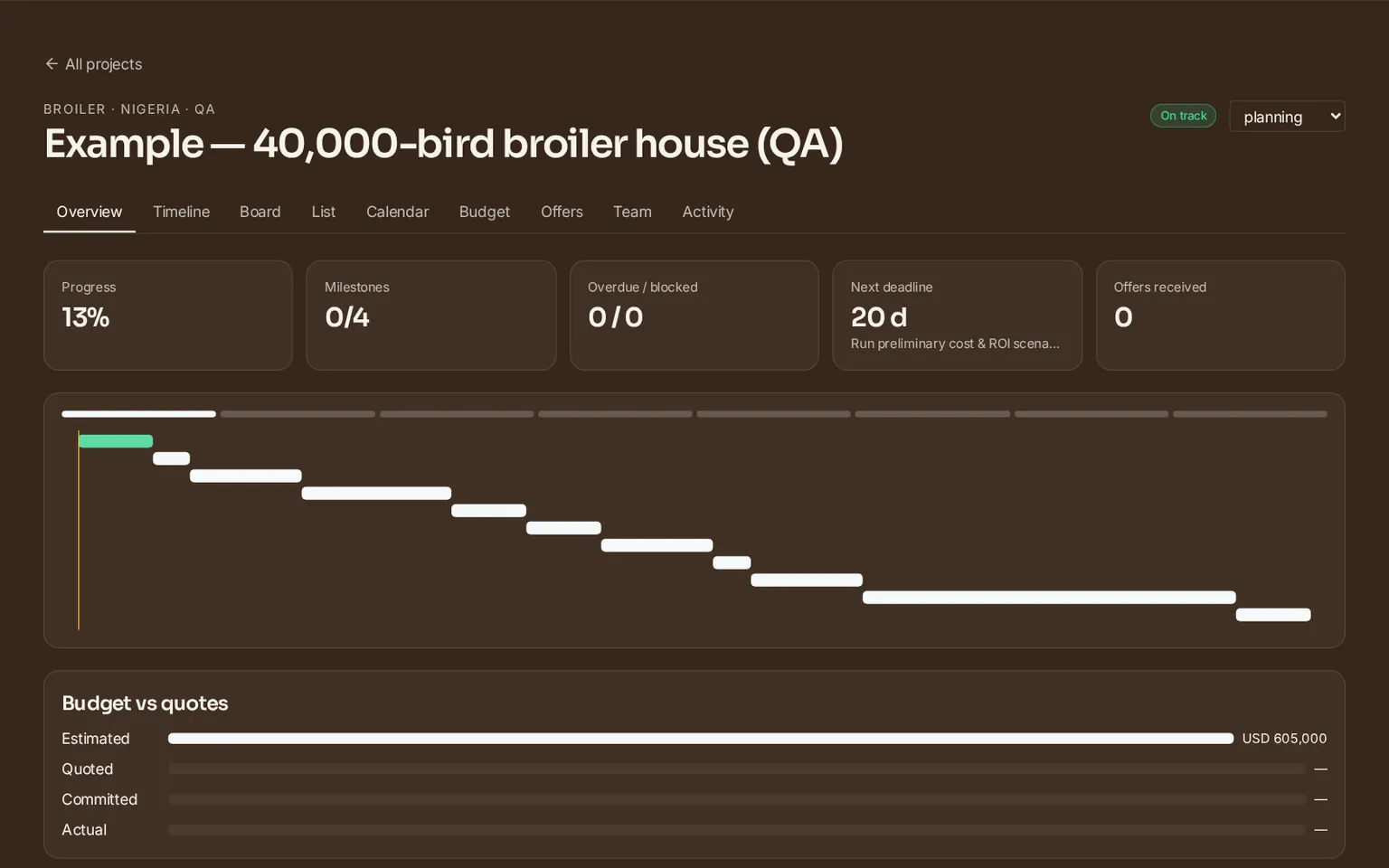
1. Create a project in the free planning workspace with Start from template: tasks for every phase are added, chained, with milestones. 2. Use the Gantt and List views for dates, owners, dependencies and percent complete; use Board for status. 3. Enter budget lines in Budget with budget, quoted, committed and paid values. 4. Record offers in Offers and compare them on the same weighted criteria; invite colleagues in Team. 5. When you send an RFQ, a person on the HatchMatch team reviews it and replies through the existing contact channel. Your project stays private to you and the people you invite.
How is this different from a generic project-management tool?
| Need | Generic PM tool | This playbook + HatchMatch |
|---|---|---|
| Starting point | Blank board | Poultry/hatchery phases, gates and templates |
| Feasibility | Not included | Linked free calculators |
| Supplier offers | Attachments | Normalized, weighted comparison |
| Human help | None | HatchMatch team reviews RFQs |
Frequently asked questions
What is a procurement project management plan? A written plan that defines what will be bought, how suppliers are selected, when each step happens, who decides and how risks are handled. In this playbook it is the set of seven phase deliverables and five gate records.
How many suppliers should receive the RFQ? Enough to compare real alternatives — often three to five per package — but only suppliers that can actually deliver and service in your country.
Is a high supplier score a guarantee? No. A scorecard structures your judgement; it does not replace reference checks, site visits, technical review or legal review of the contract.
Are the templates and workspace free? Yes. The templates need no account; the workspace is free for buyers who sign in. HatchMatch focuses on commercial projects from about USD 250,000.
Does HatchMatch offer financing? HatchMatch can explain options on the financing page; any financing depends on the case and on third-party providers, and is never assumed in this playbook.
What should I do next?
Download the gate checklist, draft your scope in the project planner, test scenarios in the farm-cost calculator, and when the specification is frozen, start an RFQ. Browse more guides in the Knowledge Center.
Sources: PMI — what is project management; WOAH Terrestrial Code — biosecurity in poultry production; ICC — Incoterms® rules; World Bank — procurement framework and guidance. Cover and diagrams are AI-generated illustrations; workspace screenshots are real captures.
Frequently asked questions
- What is a procurement project management plan?
- A written plan that defines what will be bought, how suppliers are selected, when each step happens, who decides and how risks are handled. In this playbook it is the set of seven phase deliverables and five gate records.
- How many suppliers should receive the RFQ?
- Enough to compare real alternatives — often three to five per package — but only suppliers that can actually deliver and service in your country.
- Is a high supplier score a guarantee?
- No. A scorecard structures your judgement; it does not replace reference checks, site visits, technical review or legal review of the contract.
- Are the templates and workspace free?
- Yes. The templates need no account; the workspace is free for buyers who sign in. HatchMatch focuses on commercial projects from about USD 250,000.
- Does HatchMatch offer financing?
- HatchMatch can explain options on the financing page; any financing depends on the case and on third-party providers, and is never assumed in this playbook.
More buyer questions are answered in our poultry procurement FAQ — also available in Español, Français, Português, Deutsch, العربية, Русский, Türkçe, Tiếng Việt.
From this article to a procurement-ready RFQ
HatchMatch Group is an independent sourcing desk — not a manufacturer or EPC contractor. These are the four steps we actually use with commercial poultry and hatchery buyers. If you are still deciding scope, start with what commercial poultry equipment includes and how suppliers are compared.
- 1. Plan the projectCapacity, climate and house layout in one guided workflowOpen
- 2. Build the RFQScope, specifications and comparable line itemsOpen
- 3. Submit the requestReviewed manually before HatchMatch contacts any supplier on the buyer's behalfOpen
- 4. Track and compareFollow status and normalise supplier responsesOpen
Prefer the numbers first? Start with the poultry project cost calculator or browse the project planning guides.