
Your Business Intelligence Center: Learn More, Plan Smarter, Make Better Decisions

Before you compare incubators, poultry-house systems or turnkey offers, use the HatchMatch Knowledge Center to learn, calculate, compare and plan — then ask a person to review your project.
By HatchMatch Group Sourcing Desk · Last updated 2026-10-17
In short
Short answer: the HatchMatch Knowledge Center is a public, free-to-use set of planning guides, calculators, checklists, country pages and a daily industry-intelligence feed for commercial poultry and hatchery projects. Use it to understand your options, size the project, test the economics and write a clear brief — so that when you finally talk to suppliers, you are comparing like with like and avoiding the errors that are hardest to reverse.
Key takeaways
- | Resource | What it helps you decide | Access | |---|---|---| | Knowledge Center hub | Start point: pillars for planning, equipment, operations and procurement | Public, free | | Industry Intelligence | Recent avian-influenza, regulation and market items from official sources, with buyer impact and checklists | Public, free | | Farm-cost calculator | CAPEX, yield, profit, break-even, ROI and payback from your own inputs | Public, free | | Hatchery capacity calculator | Eggs to set, setter and hatcher positions from weekly chick demand | Public, free | | Turkey farm calculators | Turkey house capacity, feed, ventilation and expansion scenarios | Public, free | | Planning guides | Step-by-step hatchery, biosecurity, ventilation and layout guidance | Public, free | | Project checklist | What to define before you request quotations | Public, free | | Incubation acceptance criteria | Measurable tests to write into a hatchery contract | Public, free | | Country equipment pages | Market-specific considerations for hatchery equipment | Public, free | | Problem guides | Diagnose issues such as low hatchability before buying equipment | Public, free | | Project request | Send your brief for human review and supplier outreach | Free for buyers | | Buyer account | Track your saved projects and requests | Sign-in required |
- In hatchery and poultry projects, many of the costliest decisions — capacity, building, utilities, biosecurity flow — are fixed before the first quotation is signed.
- Illustrative walkthrough — not a client case.
- - Sizing incubators from catalogue capacity instead of saleable output and real cycles.
- The guides, calculators, checklists, country pages and Industry Intelligence pages are public and free to use without signing in.
Short answer: the HatchMatch Knowledge Center is a public, free-to-use set of planning guides, calculators, checklists, country pages and a daily industry-intelligence feed for commercial poultry and hatchery projects. Use it to understand your options, size the project, test the economics and write a clear brief — so that when you finally talk to suppliers, you are comparing like with like and avoiding the errors that are hardest to reverse.
Definition — business intelligence for a poultry project: organised, sourced information that helps an owner, operations manager, engineer or buyer make a specific decision: build, expand or retrofit; how much capacity; which systems; what it may cost to run; and what to ask suppliers. It is decision support, not a forecast or a guarantee.
Editorial note: written by the HatchMatch Group Sourcing Desk on 17 October 2026. Every resource below was checked as a working page on that date. HatchMatch is a supplier-neutral, human-reviewed procurement service; it does not manufacture equipment, build farms or guarantee results.
What is actually inside the HatchMatch Knowledge Center?
| Resource | What it helps you decide | Access |
|---|---|---|
| Knowledge Center hub | Start point: pillars for planning, equipment, operations and procurement | Public, free |
| Industry Intelligence | Recent avian-influenza, regulation and market items from official sources, with buyer impact and checklists | Public, free |
| Farm-cost calculator | CAPEX, yield, profit, break-even, ROI and payback from your own inputs | Public, free |
| Hatchery capacity calculator | Eggs to set, setter and hatcher positions from weekly chick demand | Public, free |
| Turkey farm calculators | Turkey house capacity, feed, ventilation and expansion scenarios | Public, free |
| Planning guides | Step-by-step hatchery, biosecurity, ventilation and layout guidance | Public, free |
| Project checklist | What to define before you request quotations | Public, free |
| Incubation acceptance criteria | Measurable tests to write into a hatchery contract | Public, free |
| Country equipment pages | Market-specific considerations for hatchery equipment | Public, free |
| Problem guides | Diagnose issues such as low hatchability before buying equipment | Public, free |
| Project request | Send your brief for human review and supplier outreach | Free for buyers |
| Buyer account | Track your saved projects and requests | Sign-in required |
Want these figures for your own site, capacity and country? A HatchMatch specialist builds the budget with you — no buyer fees.
Start free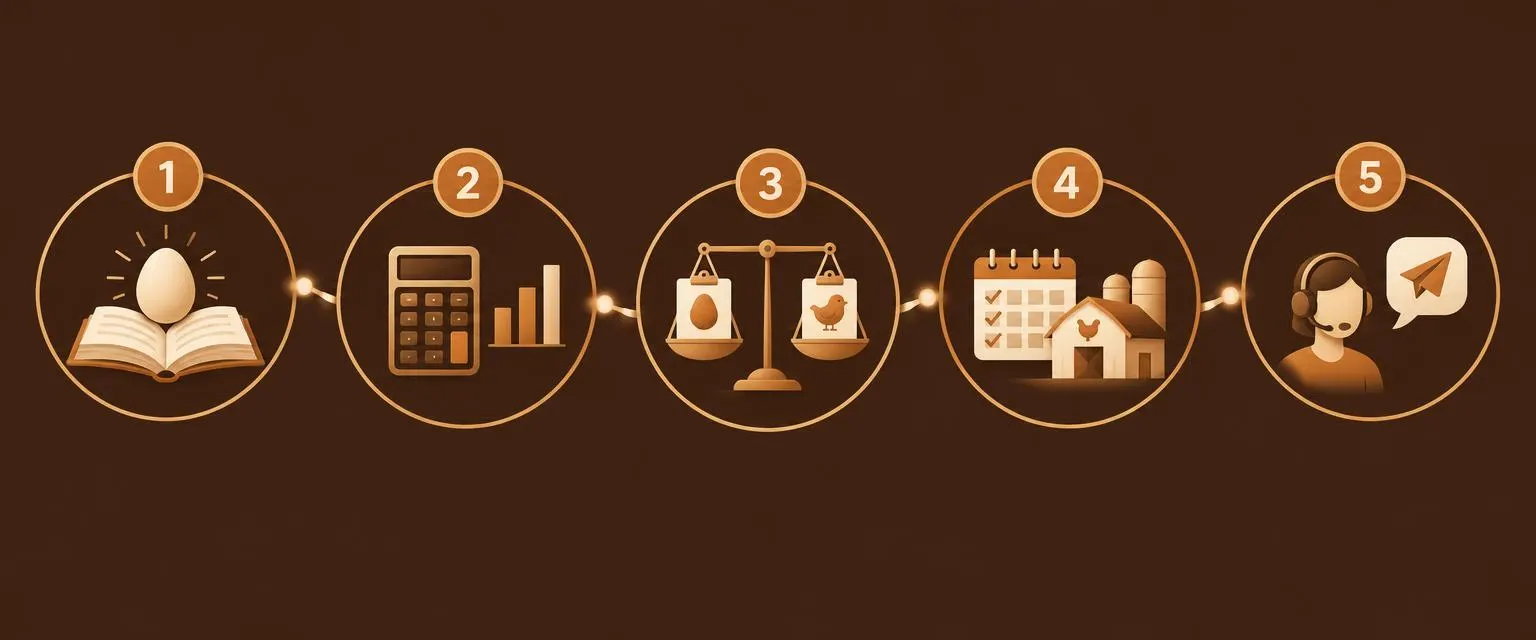
Why use business intelligence before choosing suppliers?
In hatchery and poultry projects, many of the costliest decisions — capacity, building, utilities, biosecurity flow — are fixed before the first quotation is signed. Breeder-company manuals such as the Cobb hatchery guide spend most of their pages on room conditions, egg handling and hygiene, not on machine brands. If those conditions are not written down, offers from different suppliers rarely cover the same scope.
Market context matters too. Public datasets like FAOSTAT and USDA ERS poultry and eggs help you check production trends in your market, while the WOAH poultry biosecurity chapter sets out principles that affect site layout. The Knowledge Center links these sources into decisions rather than leaving you to search alone.
Use case: an integrator adding its own hatchery
Illustrative walkthrough — not a client case. A broiler integrator buying day-old chicks wants to know whether its own hatchery makes sense.
1. Learn: read the commercial hatchery planning guide and check Industry Intelligence for current avian-influenza or regulatory items in the region. 2. Calculate: enter weekly chick demand, your measured hatch rate and saleable share in the hatchery capacity calculator to get eggs set and machine positions. 3. Test the economics: run the farm-cost calculator with your own prices to see CAPEX, break-even and payback — and a downside scenario. 4. Compare and plan: use the project checklist and acceptance criteria so every supplier prices the same scope and tests. 5. Request review: send the brief through the project request. A person reviews it and HatchMatch aims to reply within two business days.
Which costly errors does it help you avoid?
- Sizing incubators from catalogue capacity instead of saleable output and real cycles. - Treating room ventilation, cooling water and backup power as someone else's problem. - Comparing quotations with different scopes, Incoterms or exclusions. - Ignoring a regional disease or regulation change that alters timing or layout. - Choosing the lowest price instead of the lowest cost per saleable chick or bird over the equipment's life.
What is free, and what needs an account or a separate agreement?
The guides, calculators, checklists, country pages and Industry Intelligence pages are public and free to use without signing in. Sending a project request is free for buyers; commercial scopes typically start around USD 250,000.
A buyer account is needed to save and track projects. Any specialist engineering, consulting or project-management work beyond procurement support is scoped separately and agreed in writing first. Calculator results are planning estimates based on your inputs, not engineering design or financial advice.
Frequently asked questions
Is the HatchMatch Knowledge Center free? Yes. The guides, calculators, checklists and Industry Intelligence pages are public and free to use; only saving projects needs an account.
Does the Industry Intelligence page show live news? It is refreshed on a daily schedule from official public sources and shows the date each item was published and last checked; older items are labelled as archive.
Can the calculators replace an engineer or financial adviser? No. They structure your own inputs into estimates and scenarios. Use the results to brief engineers, lenders and suppliers.
Will HatchMatch connect me directly with suppliers? HatchMatch's team reviews your brief and contacts suitable independent suppliers on your behalf. Supplier participation and timing are not guaranteed.
What should you do next?
Open the Knowledge Center, pick the guide that matches your project, run your numbers in the calculators, and when your brief is ready, request a human review.
Sources: Cobb Hatchery Guide; WOAH Terrestrial Code — biosecurity in poultry production; FAOSTAT; USDA ERS — Poultry & Eggs. Cover and diagram are AI-generated illustrations, not photographs of a HatchMatch project.
Frequently asked questions
- Is the HatchMatch Knowledge Center free?
- Yes. The guides, calculators, checklists and Industry Intelligence pages are public and free to use; only saving projects needs an account.
- Does the Industry Intelligence page show live news?
- It is refreshed on a daily schedule from official public sources and shows the date each item was published and last checked; older items are labelled as archive.
- Can the calculators replace an engineer or financial adviser?
- No. They structure your own inputs into estimates and scenarios. Use the results to brief engineers, lenders and suppliers.
- Will HatchMatch connect me directly with suppliers?
- HatchMatch's team reviews your brief and contacts suitable independent suppliers on your behalf. Supplier participation and timing are not guaranteed.
More buyer questions are answered in our poultry procurement FAQ — also available in Español, Français, Português, Deutsch, العربية, Русский, Türkçe, Tiếng Việt.
From this article to a procurement-ready RFQ
HatchMatch Group is an independent sourcing desk — not a manufacturer or EPC contractor. These are the four steps we actually use with commercial poultry and hatchery buyers. If you are still deciding scope, start with what commercial poultry equipment includes and how suppliers are compared.
- 1. Plan the projectCapacity, climate and house layout in one guided workflowOpen
- 2. Build the RFQScope, specifications and comparable line itemsOpen
- 3. Submit the requestReviewed manually before HatchMatch contacts any supplier on the buyer's behalfOpen
- 4. Track and compareFollow status and normalise supplier responsesOpen
Prefer the numbers first? Start with the poultry project cost calculator or browse the project planning guides.