
Egg Grading and Packing Machines: Capacity, Candling, Weighing and How to Buy
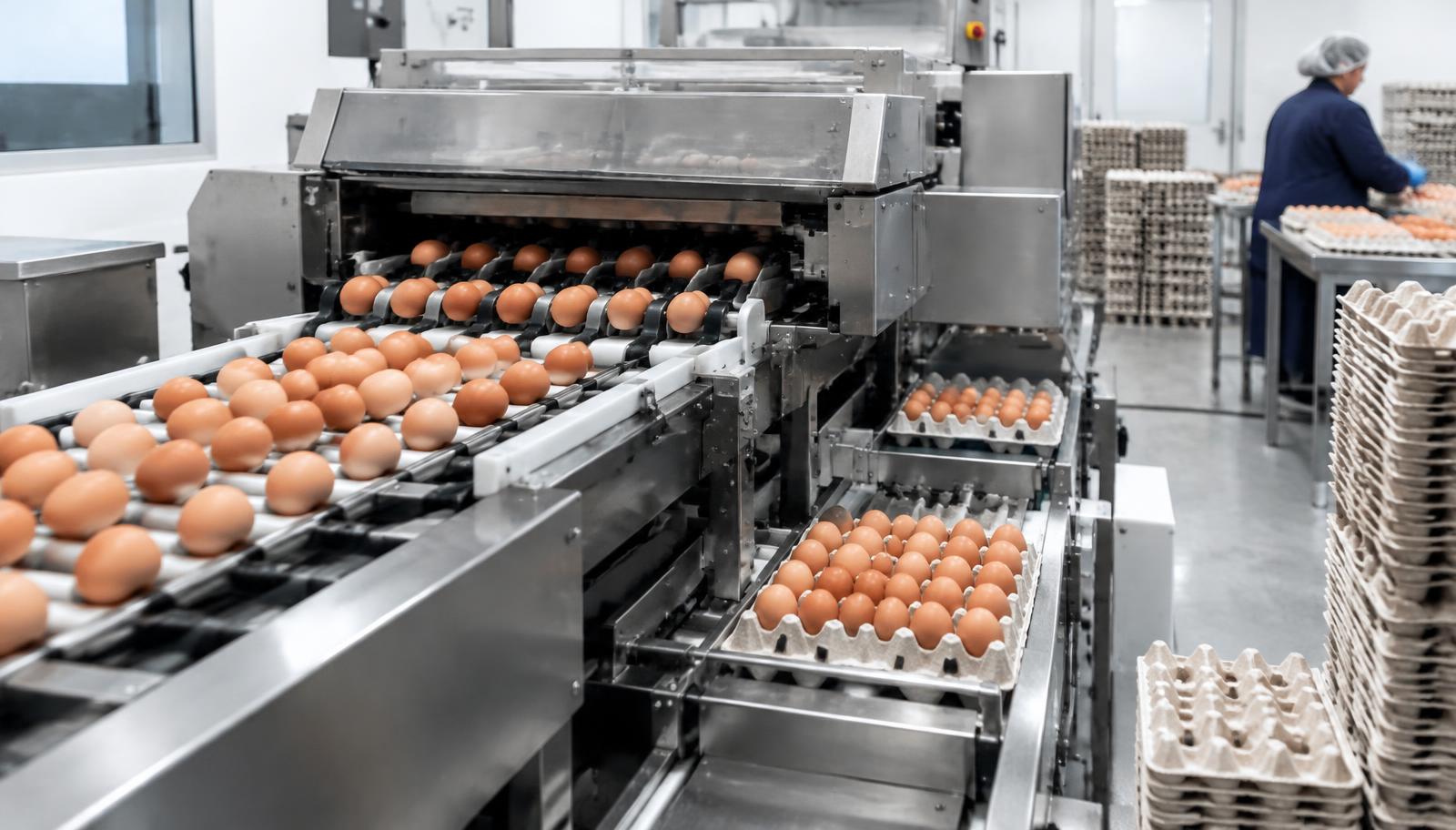
A buyer's guide to egg grading and packing machines: matching capacity to your flock, candling and weighing choices, pack formats and what to put in the supplier RFQ.
By HatchMatch Group Sourcing Desk · Last updated 2026-10-07
In short
Short answer. An egg grading and packing machine receives eggs from the collection system, candles them for cracks and defects, weighs each egg into a grade band, and packs them into trays, cartons or pallets ready for sale. The key buying decision is capacity in eggs per hour, sized to your flock and collection peaks, followed by the candling method, weighing accuracy and the pack formats your market needs.
Key takeaways
- A typical line has four stages: infeed and orientation (eggs arrive on trays or a belt and are singulated so each egg can be handled individually); candling (a light source, camera or sensor checks each egg for cracks, blood spots, dirt and shell defects); weighing and grading (each egg is weighed in grams and sorted into weight classes used by your market); and packing (eggs are placed into trays, cartons, cases or pallets, sometimes with date, farm or batch printing).
- Start from daily egg production, not from a round machine-rated number.
- Candling finds cracks, blood or meat spots, shell abnormalities and dirty or leaking eggs.
- Weighing sorts eggs into the grade bands your market uses (these bands vary by country, so confirm the exact grams-per-band table with your buyer or local regulation before specifying).
- Decide early which pack formats you need: open trays, lidded cartons, bulk cases, or pallets for retail or wholesale distribution, and whether you need date coding, farm identification or barcode printing on packs for traceability.
Short answer. An egg grading and packing machine receives eggs from the collection system, candles them for cracks and defects, weighs each egg into a grade band, and packs them into trays, cartons or pallets ready for sale. The key buying decision is capacity in eggs per hour, sized to your flock and collection peaks, followed by the candling method, weighing accuracy and the pack formats your market needs. Confirm exact throughput, grade bands and pack sizes with your supplier and local market rules before ordering.
This guide continues from our layer-house egg collection systems buying guide, which covers how eggs move from the cage or nest to the packing room. Once eggs arrive at the grading and packing area, a separate machine — or an in-line module on the same conveyor — takes over candling, weighing, grading and packing. It is written for layer-farm investors, integrators and project teams specifying this equipment, typically for commercial projects of USD 250,000 and above.
What an egg grading and packing line actually does
A typical line has four stages: infeed and orientation (eggs arrive on trays or a belt and are singulated so each egg can be handled individually); candling (a light source, camera or sensor checks each egg for cracks, blood spots, dirt and shell defects); weighing and grading (each egg is weighed in grams and sorted into weight classes used by your market); and packing (eggs are placed into trays, cartons, cases or pallets, sometimes with date, farm or batch printing). Smaller farms sometimes buy a combined candling-and-weighing unit with manual packing; larger operations buy a fully automatic line with robotic or mechanical packers.
Sizing capacity to your flock
Want these figures for your own site, capacity and country? A HatchMatch specialist builds the budget with you — no buyer fees.
Start freeStart from daily egg production, not from a round machine-rated number. A flock of a given size lays a fairly predictable number of eggs per day once you know lay rate and bird count — the egg production calculator gives a planning estimate of daily output. Divide that daily volume by your intended packing hours (many farms pack in one or two shifts, not 24 hours) to get the eggs-per-hour figure the grading line must sustain, then add a margin for peaks, collection-day bunching and future flock growth.
| Planning step | What to check | Why it matters |
|---|---|---|
| Daily egg volume | Flock size × typical lay rate | Sets the baseline the line must handle |
| Packing hours per day | Shift length, staffing, other room uses | Converts daily eggs into eggs-per-hour capacity |
| Peak allowance | Collection-day bunching, seasonal lay peaks | Avoids a line that backs up on the busiest days |
| Growth allowance | Planned future flocks or houses | Avoids replacing the line within a few years |
Ask suppliers to state the rated capacity in eggs per hour at a stated reject rate and pack format, because a line's real throughput changes with how many eggs are rejected for defects and which pack size is being filled. Compare quotes on the same assumed daily volume, not on a bare "eggs per hour" headline number.
Candling: what to specify
Candling finds cracks, blood or meat spots, shell abnormalities and dirty or leaking eggs. Options range from simple light-box candling with an operator watching a backlit belt, to automated optical or acoustic crack detection integrated into the line. For larger commercial volumes, automated candling reduces labour and improves consistency, but ask each supplier: what defect types their system detects and what it does not; the stated detection rate and whether it has been demonstrated on a similar line; how rejected eggs are removed and where they go (breaking line, downgrade, disposal); and how lighting or sensor calibration is checked and maintained.
Weighing and grading accuracy
Weighing sorts eggs into the grade bands your market uses (these bands vary by country, so confirm the exact grams-per-band table with your buyer or local regulation before specifying). Ask for the weighing technology (load cells per lane are common), the stated accuracy in grams, the number of lanes or grade outlets, and how the machine handles eggs that fall exactly on a band boundary. More grade outlets generally mean better separation but a larger, more complex machine — match the number of outlets to the grade bands you actually sell, not to the maximum the supplier offers.
Pack formats and end-of-line equipment
Decide early which pack formats you need: open trays, lidded cartons, bulk cases, or pallets for retail or wholesale distribution, and whether you need date coding, farm identification or barcode printing on packs for traceability. Automatic case packers and palletisers reduce labour at the end of the line but add cost and floor space; many mid-size farms automate grading and candling but keep final casing or palletising manual. State your required pack formats and any retailer or regulatory labelling requirements in the RFQ so the supplier quotes the right end-of-line modules.
Integration with collection, cooling and the packing room
The grading and packing machine must match the output of your egg collection system in both speed and interface — ask how the infeed connects to your collection conveyor or to trays delivered manually, and who is responsible for that connection point in the quote. Plan the packing room layout with space for infeed buffering (so collection peaks do not stall the line), reject and downgrade handling, and a clear path to the egg cold room or dispatch area if your project includes one. Confirm the electrical load and any compressed-air requirement with the generator sizing calculator and your electrical contractor, since grading lines are often on backup power together with the rest of the farm.
What to include in the RFQ
A grading and packing RFQ that suppliers can price on the same basis should state: daily egg volume and intended packing hours; peak and growth allowances; candling method and required defect detection; number of grade outlets and the grade-band table you use; required pack formats and any date/batch printing or labelling; level of automation at infeed, candling, grading and end-of-line packing; floor space and room dimensions available; power supply, backup and compressed-air availability; and the scope of installation, commissioning, training and spare parts. Ask for the delivery basis and named place (see our guide to Incoterms for poultry equipment imports) and the warranty terms in writing, following the structure in our warranty and spare parts guide.
Questions to ask every supplier
What rated capacity in eggs per hour do you guarantee, at what reject rate and pack format? Which defect types does your candling system detect, and which does it not? What is the stated weighing accuracy, and how many grade outlets does the machine have? How does the infeed connect to our existing or planned collection system? What is included in commissioning and operator training, and which spare parts do you recommend holding on site? Who services the machine in our country, and what is the typical response time? Request written answers and compare them in one table before you compare prices.
Common mistakes
Sizing the line from a headline eggs-per-hour figure instead of your actual daily volume and packing hours. Choosing a grade-outlet count that does not match the bands your buyers actually pay for. Skipping automated candling to save cost on a line that will run high volumes with limited staff. Leaving pack format and labelling requirements out of the RFQ and discovering a mismatch after delivery. Underestimating the floor space needed for infeed buffering and reject handling. And comparing quotes that assume different reject rates or pack formats as if they were the same line.
Where HatchMatch fits
HatchMatch is a supplier-neutral procurement platform for commercial poultry projects, typically USD 250,000 and above. It is not a manufacturer, installer, EPC contractor or consultant, and it does not sign supply contracts — buyers contract directly with the suppliers they choose. HatchMatch helps you turn your requirements into one written specification so offers can be compared line by line. Every brief receives human review, and HatchMatch aims to reply within two business days. To start, submit a poultry project request with your flock size, target capacity, pack formats and timeline.
FAQ
How many eggs per hour do I need? Divide your expected daily egg volume by the hours per day you plan to pack, then add a margin for peaks and planned flock growth. Ask suppliers to quote capacity at your actual daily volume, not a generic headline figure.
Do I need automated candling, or is manual candling enough? Manual light-box candling can work for smaller volumes with trained staff, but most commercial lines above a few thousand eggs per hour use automated optical or acoustic candling to keep consistency and reduce labour.
How many grade outlets should the machine have? Match the number of outlets to the grade bands you actually sell in your market, confirmed with your buyer or local regulation — more outlets than you need add cost and complexity without adding value.
Can the grading and packing machine connect directly to our egg collection system? In most commercial projects, yes, but the interface between the collection conveyor and the grading line infeed needs to be specified and agreed with the supplier, including who supplies and installs that connecting section.
What should I budget for after the machine purchase price? Plan for spare parts (weighing cells, candling lamps or sensors, belts and trays), operator and maintenance training, and ongoing service, and ask each supplier to quote these separately so offers can be compared on the same basis.
Frequently asked questions
- What rated capacity in eggs per hour do you guarantee, at what reject rate and pack format? Which defect types does your candling system detect, and which does it not?
- What is the stated weighing accuracy, and how many grade outlets does the machine have? How does the infeed connect to our existing or planned collection system? What is included in commissioning and operator training, and which spare parts do you recommend holding on site? Who services the machine in our country, and what is the typical response time? Request written answers and compare them in one table before you compare prices.
- How many eggs per hour do I need?
- Divide your expected daily egg volume by the hours per day you plan to pack, then add a margin for peaks and planned flock growth. Ask suppliers to quote capacity at your actual daily volume, not a generic headline figure.
- Do I need automated candling, or is manual candling enough?
- Manual light-box candling can work for smaller volumes with trained staff, but most commercial lines above a few thousand eggs per hour use automated optical or acoustic candling to keep consistency and reduce labour.
- How many grade outlets should the machine have?
- Match the number of outlets to the grade bands you actually sell in your market, confirmed with your buyer or local regulation — more outlets than you need add cost and complexity without adding value.
- Can the grading and packing machine connect directly to our egg collection system?
- In most commercial projects, yes, but the interface between the collection conveyor and the grading line infeed needs to be specified and agreed with the supplier, including who supplies and installs that connecting section.
- What should I budget for after the machine purchase price?
- Plan for spare parts (weighing cells, candling lamps or sensors, belts and trays), operator and maintenance training, and ongoing service, and ask each supplier to quote these separately so offers can be compared on the same basis.
More buyer questions are answered in our poultry procurement FAQ — also available in Español, Français, Português, Deutsch, العربية, Русский, Türkçe, Tiếng Việt.
From this article to a procurement-ready RFQ
HatchMatch Group is an independent sourcing desk — not a manufacturer or EPC contractor. These are the four steps we actually use with commercial poultry and hatchery buyers. If you are still deciding scope, start with what commercial poultry equipment includes and how suppliers are compared.
- 1. Plan the projectCapacity, climate and house layout in one guided workflowOpen
- 2. Build the RFQScope, specifications and comparable line itemsOpen
- 3. Submit the requestReviewed manually before any supplier introductionOpen
- 4. Track and compareFollow status and normalise supplier responsesOpen
Prefer the numbers first? Start with the poultry project cost calculator or browse the project planning guides.