
Layer House Egg Collection Systems: Egg Belts, Elevators and Cross Conveyors — Sizing and Buying Guide
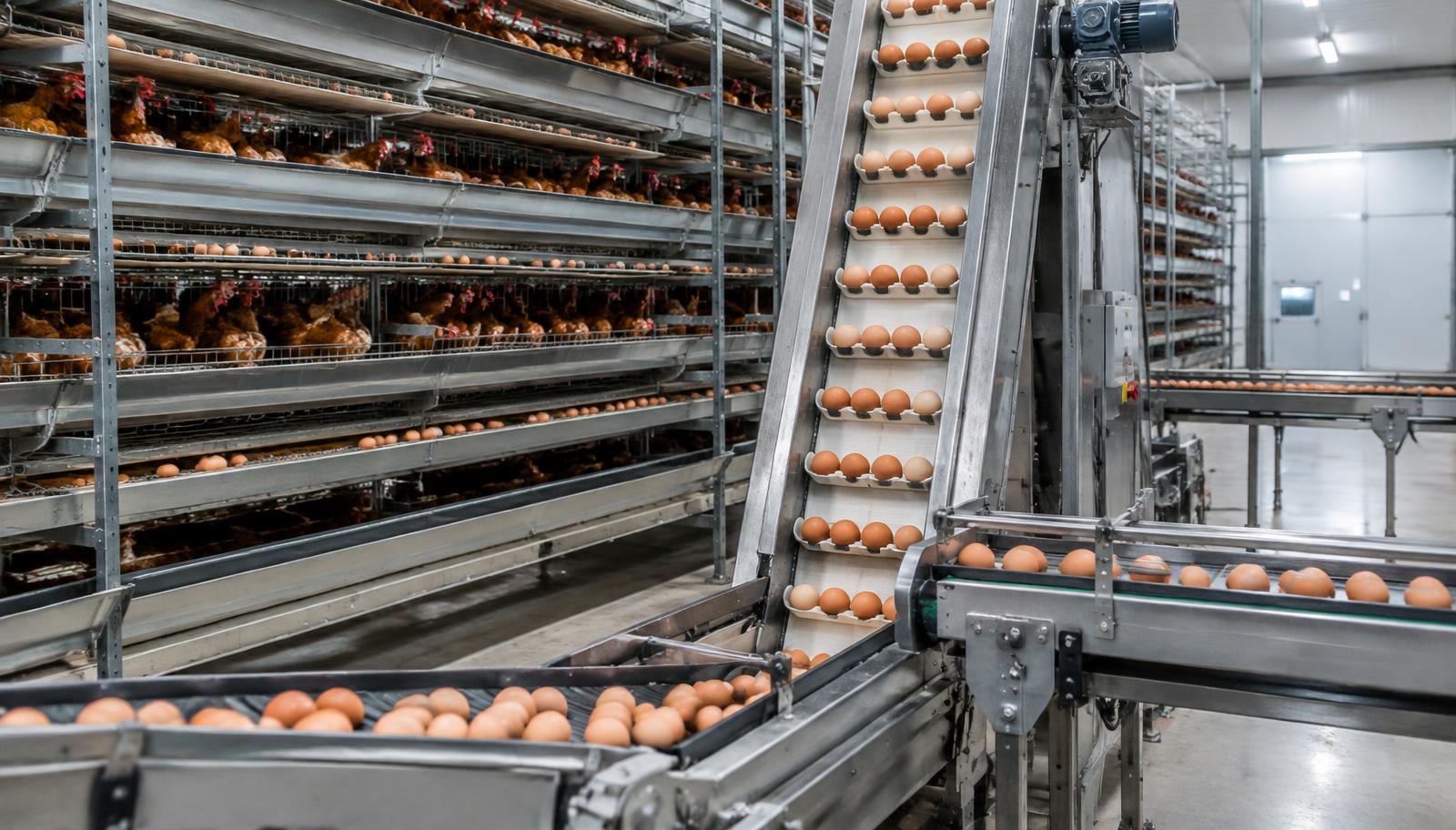
A buyer's guide to in-house egg collection: how egg belts, elevators and cross conveyors move eggs from the cage or nest to the egg room, how to size them and what to specify so supplier offers can be compared.
By HatchMatch Group Sourcing Desk · Last updated 2026-10-06
In short
Short answer. An automatic egg collection system moves eggs from the cage or nest belt under each tier, up an elevator, onto a cross conveyor that runs the length or width of the house, and out to the egg room or packing area. The buying decisions are: belt layout matched to the cage or aviary system, elevator type and speed, cross-conveyor capacity, and how gently eggs transfer between sections.
Key takeaways
- Eggs are laid onto a belt (cage systems) or rolled onto a conveyor from a nest box (aviary and barn systems) running the length of each tier.
- Start from the number of hens and their expected production rate, not a round number of eggs.
- Breakage and hairline cracks are usually created at transfer points and sharp direction changes, not on a straight belt run.
- Collection equipment should be sized to feed the downstream grading and packing line at a rate it can actually process, not faster.
- Ask whether tier belts run on a timer, continuously at low speed, or on a schedule synchronised with light programmes and staff collection rounds.
Short answer. An automatic egg collection system moves eggs from the cage or nest belt under each tier, up an elevator, onto a cross conveyor that runs the length or width of the house, and out to the egg room or packing area. The buying decisions are: belt layout matched to the cage or aviary system, elevator type and speed, cross-conveyor capacity, and how gently eggs transfer between sections. Size every stage to the house's peak daily egg output, not the average, and make sure the system's output rate matches what the grading and packing equipment downstream can actually take in.
This guide covers the collection path from the layer house to the point eggs leave on the cross conveyor; it stops short of in-line grading, packing and casing equipment, which is a separate buying decision once collection capacity is set. It is written for investors and project teams specifying layer houses, usually as part of projects of USD 250,000 or more. Belt widths, speeds and conveyor capacities vary by supplier and cage system; confirm final figures against your chosen equipment manufacturer's data sheets.
How an egg collection system is built, stage by stage
Eggs are laid onto a belt (cage systems) or rolled onto a conveyor from a nest box (aviary and barn systems) running the length of each tier. Multiple tier belts feed into a vertical elevator — typically a basket, step or rotary elevator — that lifts eggs without cracking them to the height of the main cross conveyor. The cross conveyor collects eggs from every row in the house and carries them to the egg room or to the inlet of a grading machine. Each transfer point — belt to elevator, elevator to cross conveyor — is where breakage risk concentrates, so smooth, low-impact transfers matter as much as raw capacity.
| Stage | Function | Main buying points |
|---|---|---|
| Tier egg belt | Moves eggs from the laying point to the end of the row | Belt material, width, speed, number of tiers served, drive motor per bank |
| Elevator | Lifts eggs from tier height to cross-conveyor height | Elevator type, maximum vertical lift, egg-handling gentleness, speed synchronisation with belts |
| Cross conveyor | Carries eggs from all rows to the egg room or packer inlet | Width, speed, capacity in eggs per hour, number of house rows feeding into it, accumulation buffer |
| Egg room transfer | Hands eggs to storage, trolleys or the packing line | Smooth speed change, de-nesting or singulation if feeding a grader, accumulation table |
Want these figures for your own site, capacity and country? A HatchMatch specialist builds the budget with you — no buyer fees.
Start freeSizing the system to peak daily output
Start from the number of hens and their expected production rate, not a round number of eggs. The egg production calculator shows the production curve over a laying cycle and gives peak daily egg numbers, which is the figure that should size belts, elevators and the cross conveyor — a system sized for the average will be undersized at peak lay. Convert peak daily eggs into an hourly rate based on how many hours a day the house actually collects (collection is not usually continuous for 24 hours), and ask suppliers to confirm their equipment's rated eggs-per-hour capacity against that figure with a margin for future flocks or added houses.
Multi-house sites add a second sizing question: does each house have its own cross conveyor to a shared egg room, or does one cross conveyor serve several houses in sequence? The answer changes conveyor length, motor count and the point at which a single breakdown can affect more than one house. Write the house layout and hen numbers per house into the RFQ so suppliers size from the same figures.
Belt speed, breakage and egg quality
Breakage and hairline cracks are usually created at transfer points and sharp direction changes, not on a straight belt run. Ask suppliers how their elevator changes egg direction and speed, whether eggs are singulated (spaced out) before transfer, and what buffer or accumulation capacity exists if the egg room or grader momentarily slows down. A system that cannot absorb a short stoppage downstream backs up onto the tier belts and can hold eggs under hens longer than intended, raising contamination risk.
Belt material and tension also affect egg quality indirectly: a belt that sags or runs unevenly lets eggs roll rather than travel flat, increasing contact with cage wire and other eggs. Ask for the belt material, expected service life, and how tension is adjusted and inspected during routine maintenance.
Matching collection capacity to the grading and packing equipment
Collection equipment should be sized to feed the downstream grading and packing line at a rate it can actually process, not faster. If the cross conveyor delivers more eggs per hour than the packer can grade and pack, eggs back up, cycle through extra handling, or the packing line becomes the limiting factor regardless of how well the collection system performs. Confirm the eggs-per-hour rating of the intended grading/packing equipment early, and size the cross conveyor and any egg-room accumulation table to match it, with a buffer for peak lay. Grading and packing machine selection itself is a separate specification once this matching figure is confirmed.
Drive, controls and power
Ask whether tier belts run on a timer, continuously at low speed, or on a schedule synchronised with light programmes and staff collection rounds. Specify alarms for belt jams, elevator stoppages and motor overload, ideally reporting to the same house controller used for ventilation and feeding. Because a collection stoppage can leave eggs on belts for hours rather than minutes, the collection system's motors should be included in the backup-power load calculation; use the generator sizing calculator to check that egg collection, together with ventilation, feeding, lighting and water pumps, is covered during an outage.
What to include in the RFQ
A collection-system RFQ that suppliers can price on the same basis should state: cage or housing system and tier count per row; number of rows and houses the system must serve; expected peak daily egg numbers and hours available for collection each day; whether one or multiple cross conveyors are needed and their required length; the eggs-per-hour rating of the grading/packing equipment the system must feed (or a request for the supplier to recommend a matching rate); belt material and elevator type preference if any; controller and alarm integration; power supply and backup; and the scope of installation, commissioning, training and spare parts. Ask for delivery terms in writing — see our guide to Incoterms for poultry equipment imports — and warranty terms covering motors, belts and controllers, as described in our guide to warranty, spare parts and after-sales.
Questions to ask every supplier
What eggs-per-hour rate is each stage of your system rated for, and at what belt speed? How many transfer points does an egg pass through, and how is each one designed to reduce impact? What buffer or accumulation capacity exists if the downstream grader slows or stops? Which motors, belts and sensors are made by you and which are bought in? What happens to collection if the house controller or power fails? Who services this equipment in our country, and what is the typical response time for a stopped belt? Request written answers and put them in one comparison table.
Common mistakes
Sizing the collection system to average daily eggs instead of peak lay. Treating the cross conveyor's capacity as fixed without checking it against the grading/packing equipment's actual processing rate. Ignoring transfer-point design when comparing prices, then discovering higher breakage after installation. Leaving collection motors off the backup-generator calculation. Comparing a single-house quote with a multi-house quote without checking whether one cross conveyor is expected to serve more rows than it can carry. And finalising the collection system before the grading and packing line is selected, so the two are never matched.
Where HatchMatch fits
HatchMatch is a supplier-neutral procurement platform for commercial poultry projects, typically USD 250,000 and above. It is not a manufacturer, installer, EPC contractor or consultant, and it does not sign supply contracts — buyers contract directly with the suppliers they choose. HatchMatch helps you turn your requirements into one written specification so offers can be compared line by line. Every brief receives human review, and HatchMatch aims to reply within two business days. To start, submit a poultry project request with your hen numbers, cage or housing system, house layout and timeline.
Frequently asked questions
What is the difference between an egg belt and a cross conveyor? The egg belt runs along each tier or row, collecting eggs at the point they are laid. The cross conveyor runs across the house, gathering eggs from every row's elevator and carrying them to the egg room or packing area.
How many eggs per hour should an egg collection system handle? It depends on hen numbers, the production curve and how many hours a day the house collects; use peak daily output from the egg production calculator converted to an hourly rate, with a margin, as the figure to quote against.
Does the egg collection system need to match the grading and packing machine exactly? It needs to deliver at a rate the grading/packing line can process without creating a bottleneck or backing eggs up onto the tier belts; confirm the packer's rated capacity before finalising the cross conveyor.
What causes most egg breakage in collection systems? Usually transfer points and direction changes — belt to elevator, elevator to cross conveyor — rather than the straight belt runs themselves, so ask suppliers how each transfer is designed.
Should backup power cover the egg collection system? Yes — a stoppage can leave eggs on belts for hours, so collection motors should be included in the generator sizing calculation alongside ventilation, feeding, lighting and water pumps.
Frequently asked questions
- What eggs-per-hour rate is each stage of your system rated for, and at what belt speed?
- How many transfer points does an egg pass through, and how is each one designed to reduce impact? What buffer or accumulation capacity exists if the downstream grader slows or stops? Which motors, belts and sensors are made by you and which are bought in? What happens to collection if the house controller or power fails? Who services this equipment in our country, and what is the typical response time for a stopped belt? Request written answers and put them in one comparison table.
- What is the difference between an egg belt and a cross conveyor?
- The egg belt runs along each tier or row, collecting eggs at the point they are laid. The cross conveyor runs across the house, gathering eggs from every row's elevator and carrying them to the egg room or packing area.
- How many eggs per hour should an egg collection system handle?
- It depends on hen numbers, the production curve and how many hours a day the house collects; use peak daily output from the egg production calculator converted to an hourly rate, with a margin, as the figure to quote against.
- Does the egg collection system need to match the grading and packing machine exactly?
- It needs to deliver at a rate the grading/packing line can process without creating a bottleneck or backing eggs up onto the tier belts; confirm the packer's rated capacity before finalising the cross conveyor.
- What causes most egg breakage in collection systems?
- Usually transfer points and direction changes — belt to elevator, elevator to cross conveyor — rather than the straight belt runs themselves, so ask suppliers how each transfer is designed.
- Should backup power cover the egg collection system?
- Yes — a stoppage can leave eggs on belts for hours, so collection motors should be included in the generator sizing calculation alongside ventilation, feeding, lighting and water pumps.
More buyer questions are answered in our poultry procurement FAQ — also available in Español, Français, Português, Deutsch, العربية, Русский, Türkçe, Tiếng Việt.
From this article to a procurement-ready RFQ
HatchMatch Group is an independent sourcing desk — not a manufacturer or EPC contractor. These are the four steps we actually use with commercial poultry and hatchery buyers. If you are still deciding scope, start with what commercial poultry equipment includes and how suppliers are compared.
- 1. Plan the projectCapacity, climate and house layout in one guided workflowOpen
- 2. Build the RFQScope, specifications and comparable line itemsOpen
- 3. Submit the requestReviewed manually before any supplier introductionOpen
- 4. Track and compareFollow status and normalise supplier responsesOpen
Prefer the numbers first? Start with the poultry project cost calculator or browse the project planning guides.