
When should you expand poultry houses or capacity, and when should you fix a ventilation, cooling, drinking or feeding bottleneck first?
This language edition is awaiting human editorial review.
Expand only when your existing houses already perform consistently close to their own baseline and the limit is the number of birds or houses. If results fall in hot periods, late in the flock or in one house, a system bottleneck (air speed, cooling, water flow, feeder space) is likely; adding birds to a constrained system usually copies the problem. Measure the suspected constraint against its design capacity, estimate the cost of fixing it, and compare that with the full cost of expansion.
What signals point to a bottleneck rather than a lack of capacity?
| Signal in your records | Likely constraint to measure |
|---|---|
| Weight gain slows or mortality rises in hot spells, late in the flock | Ventilation capacity, air speed at bird level, cooling pad area and water supply |
| Water use flat while feed use rises, or drop at line ends | Water pressure, line flow, filters, drinker height |
| Uneven weights, birds crowding at feeders | Feeder space per bird, fill level, line run time |
| Night temperature dips, high fuel use in winter | Heating output, insulation, air leakage, minimum ventilation |
| Results good in all houses, demand exceeds output | Genuine capacity limit — expansion may be justified |
How do you measure a suspected bottleneck?
- Find the design figure (fan capacity, pad area, line flow, feeder space) from the original drawings or supplier manual.
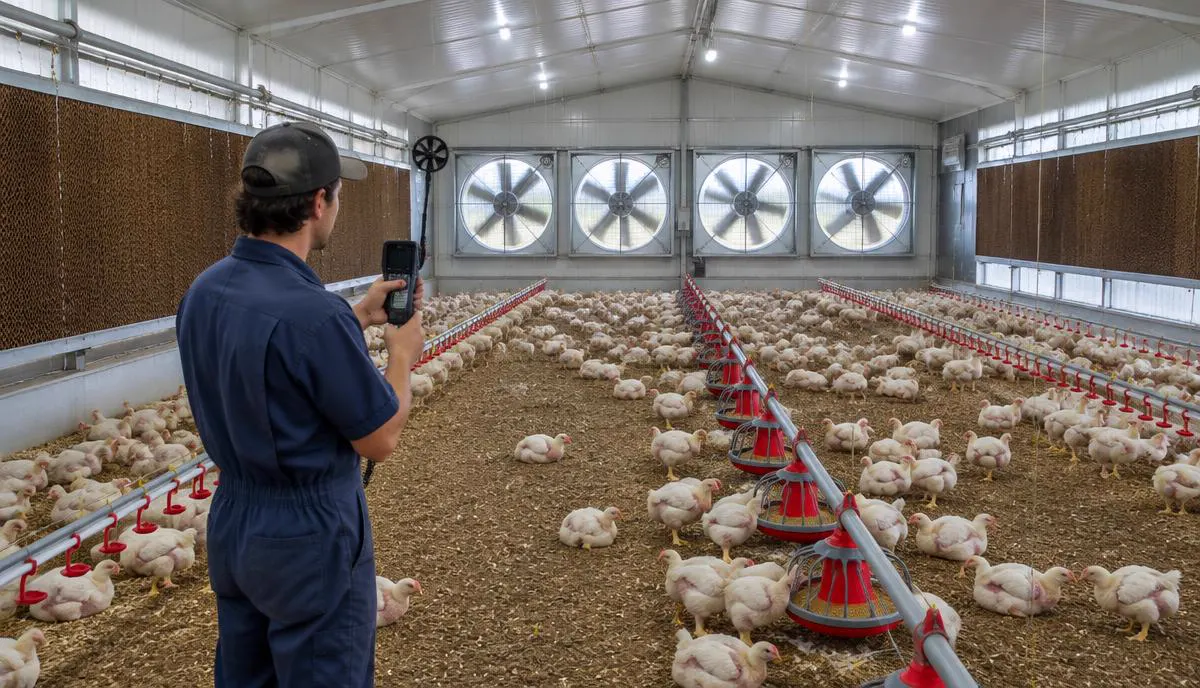
- Measure what the system delivers today: air speed at bird height in several points, static pressure, water flow at line ends, feed line cycle time.
- Compare delivered vs required for your current stocking and weight at the worst week.
- Record the gap and the date measured. Extension resources such as University of Georgia poultry housing tips describe practical test methods.
Decision table: fix first or expand?
| Question | If yes |
|---|---|
| Is a measured system gap linked to the result you want to improve? | Fix first, then re-measure |
| Does stocking already sit at your welfare or legal limit? | More birds need more house area, not denser placement |
| Are labour, water source, power supply and manure handling at their limit? | Expansion needs site infrastructure, not only houses |
| Are all houses stable near their own baseline for several flocks? | Expansion can be evaluated |
| Is the market or contract volume confirmed in writing? | Required before committing to capacity |
Hypothetical comparison template
Illustrative only; replace with your own quotes and records. Assumption: one existing house shows a repeated summer loss.
| Item | Option A: fix cooling | Option B: add one house |
|---|---|---|
| Investment | Your quote | Your quote incl. site works |
| Downtime | Between flocks | Construction period |
| Expected effect | Recover part of the measured summer gap (unverified until measured) | More birds; existing gap remains |
| New fixed costs | Maintenance, energy | Labour, energy, insurance, permits |
| Measurement | Before/after KPIs on same house | New house baseline from first flocks |
Use the farm cost calculator for payback ranges; treat results as estimates, not promises.
Checklist before asking suppliers
- Baseline from several flocks per house.
- Measured gap with method and date.
- Option list: small fix, phased upgrade, expansion.
- Site limits: power, water, access, permits, biosecurity zoning.
- Acceptance KPIs agreed before purchase.
- A structured RFQ that asks suppliers to state assumptions and exclusions.
Results vary by breed or genetic line, age, climate, housing system and local rules. Use this guide for planning and discussion with your veterinarian, integrator or technical adviser, not as a diagnosis or a performance promise.
Frequently asked questions
Will fixing ventilation guarantee better results?
No. It removes one measured constraint. Results also depend on management, health and genetics, so define the KPIs you will check afterwards.
Can I just stock more birds in my current houses?
Only within the welfare and legal limits that apply to you and within the measured capacity of ventilation, water and feeding.
What if I do not have the original design figures?
Ask for an on-site assessment, or record fan, pad and line specifications from nameplates and have them checked by a qualified technician.
Who decides between fixing and expanding?
You do. HatchMatch can help structure the options into one RFQ so proposals are compared on the same basis.
Sources
- University of Georgia Poultry Housing — ventilation and housing tips
- University of Georgia Extension — Tunnel-ventilated broiler house air-speed tool
- University of Minnesota Extension — Preventing heat stress in poultry
- Penn State Extension — Poultry nutrition and feeding
- EUR-Lex — Council Directive 2007/43/EC on the protection of chickens kept for meat production
Sources checked: 2026-10-13
Knowledge Center · Email updates
Get updates
Choose the reading that matters to your project.
Email subscriptions are not available yet.