
How to upgrade an older poultry house in phases: insulation, climate systems, controls, lighting and backup power
This language edition is awaiting human editorial review.
Start with a condition survey and your flock baseline, then order the work so each phase supports the next: first the building envelope (insulation, air tightness), then ventilation, heating and cooling, then controls and alarms, then lighting, with backup power checked at every stage. Fit each phase into planned downtime between flocks and measure the same KPIs before and after. Phasing spreads cost and risk but does not guarantee a result; agree acceptance tests with each supplier.
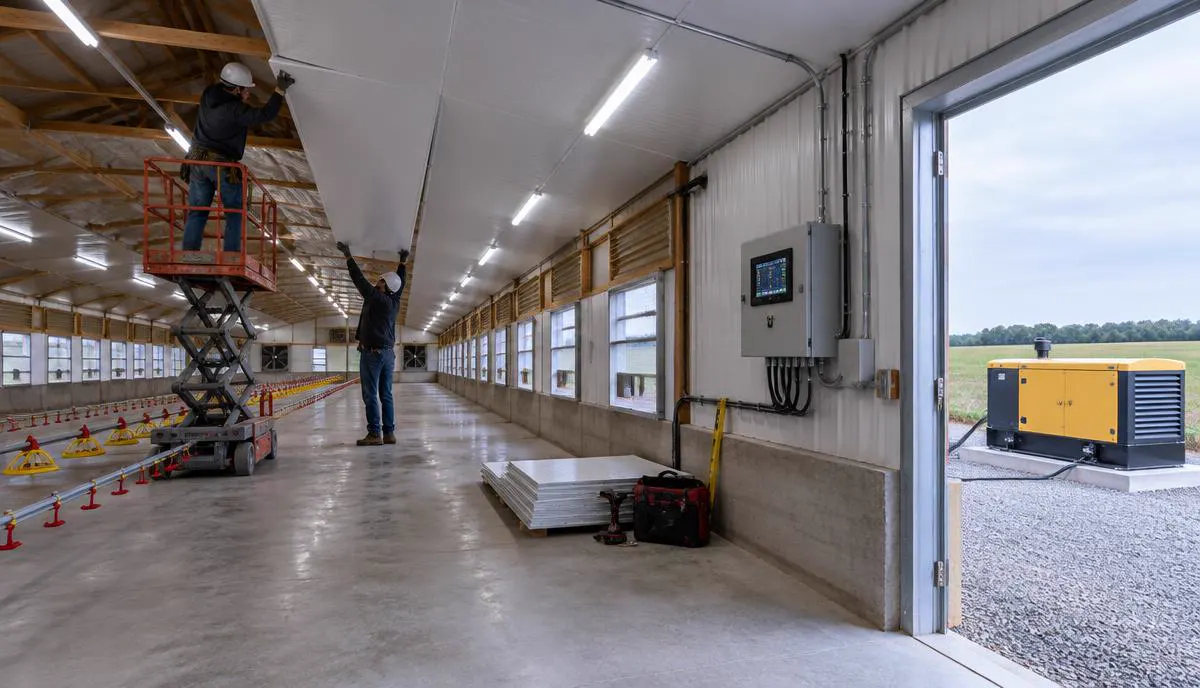
What should a condition survey cover?
| Area | What to record | Data source |
|---|---|---|
| Envelope | Roof and wall insulation, gaps, curtain or door leaks, condensation marks | Visual survey, smoke test, winter fuel use |
| Ventilation and cooling | Fan count and condition, belts, shutters, pad condition, inlets | Maintenance log, air-speed and static-pressure tests |
| Heating | Heater output, age, service history | Service records, fuel bills |
| Controls and alarms | Controller age, sensors, alarm call-out tests | Alarm log, maintenance tickets |
| Lighting | Light type, uniformity, dimming | Lux readings at bird level |
| Power | Generator size, transfer switch, test history | Generator log, outage records |
| Biosecurity | Surfaces that can be cleaned, entry zones, rodent proofing | Site walk with your veterinarian |
In what order should phases run?
- Phase 0 – Safety and resilience: alarms, generator test, electrical safety. A failure here can cause losses regardless of other upgrades.
- Phase 1 – Envelope: insulation and air tightness, so ventilation and heating can be controlled.
- Phase 2 – Climate systems: fans, inlets, cooling pads and heaters sized for the improved envelope.
- Phase 3 – Controls: a controller and sensors that manage the new systems, with data logging.
- Phase 4 – Lighting: uniform, dimmable lighting suited to the production type.
Adjust the order when your survey shows a different urgent constraint.
Phase planning template
| Phase | Constraint it addresses | KPI before | Target check after | Downtime window | Budget source |
|---|---|---|---|---|---|
| 0 | … | … | Alarm test passed | … | … |
| 1 | … | Fuel per kg, night temperature range | Measured, not promised | … | … |
| 2 | … | Air speed, summer mortality | … | … | … |
Fill one row per phase from your own records. Leave "target" as a measurement to check, not a promised figure.
Hypothetical example of phasing
Invented scenario, for method only: a 20-year-old broiler house shows high winter fuel use and summer losses. The survey finds roof gaps and two worn fans. Phase 1 seals and insulates the roof between flocks; Phase 2 replaces fans and resizes inlets for the tighter house; Phase 3 adds a logging controller. After each phase the farm compares fuel per kg and weekly mortality with the previous three flocks of the same season.
Retrofit checklist
- Condition survey and flock baseline completed.
- Each phase linked to one measured constraint.
- Compatibility checked: new controller with existing fans, heaters and sensors.
- Work scheduled in downtime, with cleaning and disinfection afterwards.
- Commissioning and acceptance test written into each order.
- Spare parts, training and service response agreed.
- Backup power sized for the new load.
What should an upgrade RFQ ask suppliers to prove?
Send every supplier the same brief so proposals can be compared line by line. Ask each one to state, in writing, how the item will be checked at handover.
| Area | Ask for in the RFQ | Acceptance check at handover |
|---|---|---|
| Ventilation and cooling | Design airflow and static pressure for your house size and climate | Measured air speed and pressure at agreed points; alarm triggers tested |
| Insulation and envelope | Material, thickness and fixing method | Visual inspection; smoke or pressure test of gaps |
| Feeders and drinkers | Line layout, height adjustment and flow range | Flow measured at line ends; height range demonstrated |
| Controls and alarms | Sensor list, data logging, remote alerts, compatibility with existing equipment | Each sensor and alarm tested; data export shown |
| Backup power | Essential-load calculation by a qualified electrician | Load test with the upgraded equipment running |
| Biosecurity | Work rules, clean-down and disinfection after installation | Signed clean-down record before birds return |
| Welfare | How the design meets the welfare rules that apply in your country | Check against your local code or certification scheme |
| Energy and lifecycle cost | Rated power, expected maintenance, spare-part prices and service availability | Sub-meter installed; manuals and spares list delivered |
Compare offers on total cost over the expected service life (purchase, installation, energy, maintenance and downtime), not purchase price alone. Supplier figures are claims until you measure them in your own house.
What if records are incomplete?
Start with Phase 0 and install measurement (water meters, temperature loggers, energy sub-meters) during the first downtime. One or two flocks of clean data make later phases far easier to justify and to compare.
Results vary by breed or genetic line, age, climate, housing system and local rules. Use this guide for planning and discussion with your veterinarian, integrator or technical adviser, not as a diagnosis or a performance promise.
Frequently asked questions
Is it better to renovate or rebuild an old house?
It depends on the structure, site and budget. Compare a phased retrofit with a new build on the same KPI and lifecycle basis, using quotes for both.
Can I do upgrades with birds in the house?
Some small work may be possible, but most structural and climate work is safer and more hygienic during downtime. Follow your biosecurity plan.
Will LED lighting cut my energy bill?
It can reduce lighting energy, but the effect depends on hours, light levels and tariffs. Measure kWh before and after rather than relying on general claims.
How big should the generator be?
Size it for the essential load of the upgraded house, including fans needed in hot weather, as calculated by a qualified electrician.
Sources
- University of Georgia Poultry Housing — ventilation and housing tips
- University of Minnesota Extension — Preventing heat stress in poultry
- Penn State Extension — Management requirements for laying flocks
- University of Georgia Extension — Tunnel-ventilated broiler house air-speed tool
- WOAH Terrestrial Animal Health Code — Biosecurity procedures in poultry production
Sources checked: 2026-10-13
Knowledge Center · Email updates
Get updates
Choose the reading that matters to your project.
Email subscriptions are not available yet.