
Poultry House Climate Controllers, Alarms and Electrical Systems: What to Specify
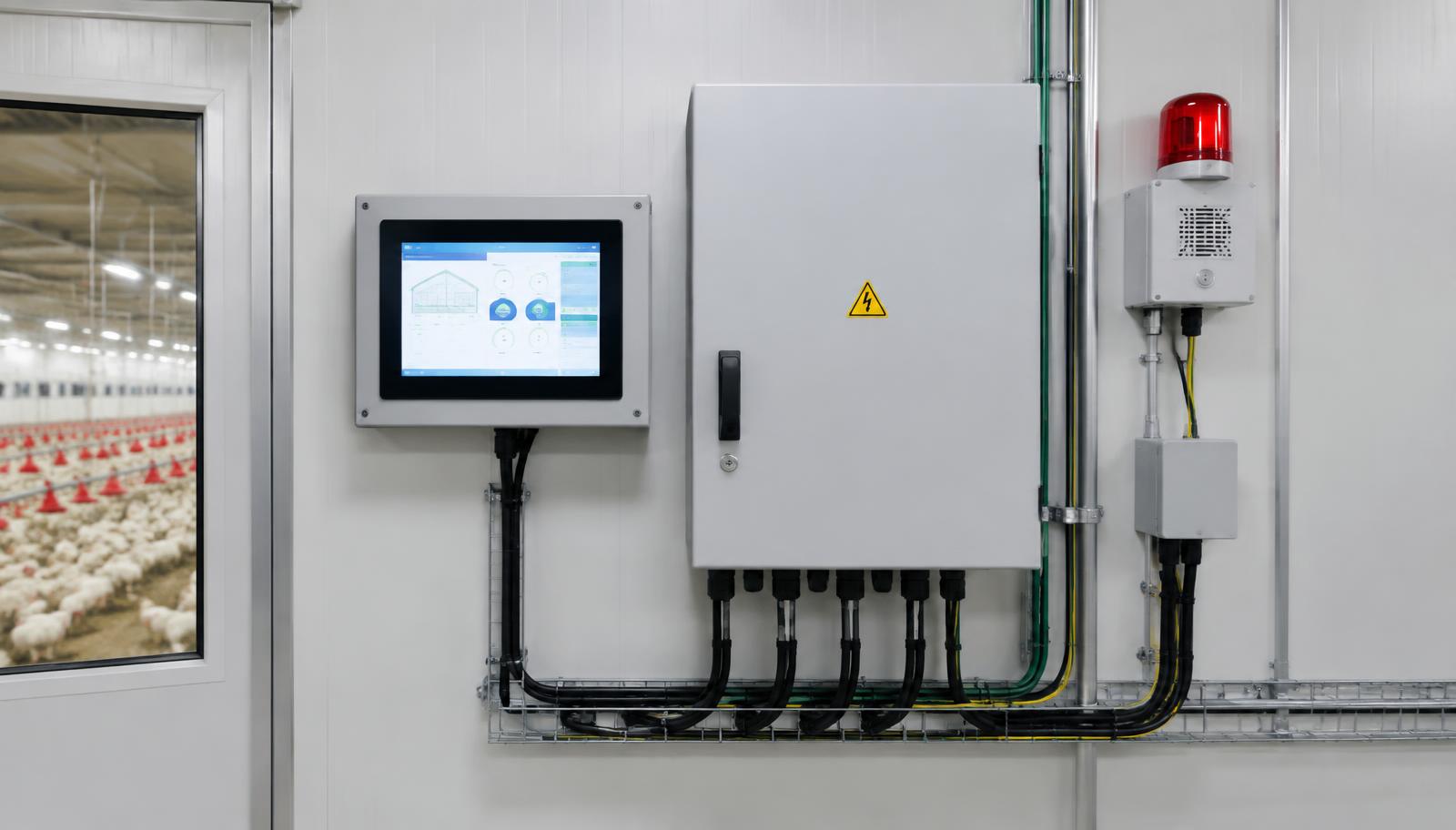
A buyer's guide to poultry house controllers, sensors, alarms, panels and electrical backup: what each system does, how they interact with ventilation and generators, and how to write a specification suppliers can price on the same basis.
By HatchMatch Group Sourcing Desk · Last updated 2026-10-06
In short
Short answer. A modern poultry house is controlled by one climate controller that reads temperature, humidity and sometimes air pressure or carbon dioxide, then stages fans, inlets, heating, cooling and lighting automatically. Around it sit a remote alarm that calls or messages staff on any failure, an electrical panel sized for the full connected load plus spare capacity, and a backup power link so the system keeps running through a grid outage.
Key takeaways
- Ventilation, heating, cooling and lighting are only as good as the controller that sequences them.
- | Function | What to specify | Why it matters | |---|---|---| | Temperature and humidity staging | Number of fan stages supported, minimum-ventilation timer, humidity input | Matches ventilation strategy to bird age and season; see our ventilation calculator for first sizing | | Heating and cooling control | Heater staging, evaporative pad or fogging control, interlock with inlets | Prevents heating and cooling running against each other | | Lighting programme | Dimming, step-down or step-up schedules, sunrise/sunset simulation | Needed for growth and sexual-maturity programmes; see our poultry lighting calculator | | Scales and water/feed monitoring | Inputs for feed bins, water meters and bird-weighing scales | Early warning of intake drop, often the first sign of a problem | | Data logging and remote access | On-board history, app or web access, multi-house overview | Lets managers check several houses from one screen or phone |
- A controller is only as accurate as its sensors.
- A ventilation, power or temperature failure can become fatal within hours in a closed house, and most failures happen at night or on weekends.
- Electrician wiring a poultry house control panel and alarm module in a cabinet — Specify panel capacity, labelling and protection together with the controller, not as a separate afterthought.
Short answer. A modern poultry house is controlled by one climate controller that reads temperature, humidity and sometimes air pressure or carbon dioxide, then stages fans, inlets, heating, cooling and lighting automatically. Around it sit a remote alarm that calls or messages staff on any failure, an electrical panel sized for the full connected load plus spare capacity, and a backup power link so the system keeps running through a grid outage. Specify controller, sensors, alarm and panel together in one RFQ, because a cheap controller paired with an undersized panel or no alarm is a false saving.
This guide is for investors, integrators and project teams buying equipment for broiler, layer, breeder or pullet houses, typically in projects of USD 250,000 or more. It explains the decisions in plain terms; exact settings depend on breed guides, climate, local electrical codes and the equipment actually installed — confirm them with your supplier and electrician before finalising the design.
Why the controller is the project's nervous system
Ventilation, heating, cooling and lighting are only as good as the controller that sequences them. A controller that stages fans smoothly, reacts to temperature changes without overshooting, and logs what happened overnight turns good equipment into good results. A controller that is undersized for the number of stages, has a confusing interface, or cannot be read remotely leaves staff guessing during the hours that matter most — hot summer afternoons and cold winter nights. Treat the controller as a core equipment decision, not an accessory bundled with the fans.
What the climate controller should do
Want these figures for your own site, capacity and country? A HatchMatch specialist builds the budget with you — no buyer fees.
Start free| Function | What to specify | Why it matters |
|---|---|---|
| Temperature and humidity staging | Number of fan stages supported, minimum-ventilation timer, humidity input | Matches ventilation strategy to bird age and season; see our ventilation calculator for first sizing |
| Heating and cooling control | Heater staging, evaporative pad or fogging control, interlock with inlets | Prevents heating and cooling running against each other |
| Lighting programme | Dimming, step-down or step-up schedules, sunrise/sunset simulation | Needed for growth and sexual-maturity programmes; see our poultry lighting calculator |
| Scales and water/feed monitoring | Inputs for feed bins, water meters and bird-weighing scales | Early warning of intake drop, often the first sign of a problem |
| Data logging and remote access | On-board history, app or web access, multi-house overview | Lets managers check several houses from one screen or phone |
Ask each supplier how many input and output points their controller supports, whether it is expandable as the house grows, and whether the software and manuals are available in your working language.
Sensors: placement and redundancy matter as much as the brand
A controller is only as accurate as its sensors. Specify at least two temperature sensors per house at bird height, away from direct sun, drafts and heaters, so the controller does not react to one bad reading. Add humidity sensors where cooling pads or fogging are used, and consider a differential-pressure sensor for tunnel or hybrid ventilation so static pressure stays in the planned range. For large or multi-zone houses, ask whether the controller supports zone-by-zone sensing rather than one average reading for the whole building.
Specify a sensor calibration and replacement routine in the RFQ: sensors drift over time, and a controller trusting a drifted sensor can keep a house too hot or too cold for days before anyone notices without an alarm to flag it.
Remote alarms: the system that protects the flock when no one is watching
A ventilation, power or temperature failure can become fatal within hours in a closed house, and most failures happen at night or on weekends. Specify a remote alarm system that is independent enough to call, text or push-notify a defined list of people when temperature, power, water flow, feed level or fan operation goes outside set limits. Ask whether the alarm unit has its own battery backup so it can still call out during a power cut, and whether it tests the phone or network connection automatically and reports if that link itself fails.
Write into the RFQ who the alarm should contact, in what order, and whether it needs to be acknowledged before escalating to the next person. A system that only shows a flashing light in an empty building is not a remote alarm.
Electrical panels: size for the whole house, plus spare capacity
The main panel should be sized from the full connected load of fans, heaters, lighting, feed and water motors, egg collection or manure systems, plus a margin for future additions — many projects plan 20–25% spare capacity rather than sizing to exactly today's load. Ask for a single-line electrical diagram, breaker schedule and load calculation from the supplier, and confirm the panel meets your national electrical code and the humidity and dust protection rating (commonly an IP-rated enclosure) suited to a poultry house environment. Surge protection matters where lightning or an unstable grid is common; ask what the panel includes and where the cut-off point is with any site-level protection.
Specify clear labelling of every circuit, lockable isolators for maintenance, and a layout that keeps control electronics away from washdown areas and ammonia-heavy zones. Ask for as-built wiring diagrams at handover, not just a cabinet full of unlabelled wires.
Backup power: the controller and alarm must survive the outage
A controller or alarm with no power does nothing. Confirm which circuits the generator automatic transfer switch covers — ideally ventilation, the controller itself, the alarm system and critical lighting, at minimum — and how quickly the transfer happens. The generator sizing calculator gives a first estimate of backup capacity needed for a house or farm; confirm the final sizing against the supplier's load schedule, including starting (inrush) current for motors, which is higher than running current. Ask whether the controller and alarm have their own small uninterruptible power supply (UPS) to bridge the seconds between a power cut and the generator starting, since that gap is exactly when fans stop and temperature begins to drift.
What to include in the RFQ
A controls and electrical RFQ that suppliers can price on the same basis should state: house type, dimensions and number of fan and heating stages; sensor count, type and placement requirement; alarm contact list, escalation rules and backup power for the alarm itself; required inputs for water meters, feed scales and bird scales; software language and remote-access requirement; electrical code and IP rating to meet; spare-capacity margin on the panel; generator interface and transfer-switch scope; and installation, commissioning, training and spare-parts scope. Ask for warranty terms in writing, as described in our guide to warranty, spare parts and after-sales terms.
Questions to ask every supplier
How many input and output points does the controller support, and is it expandable later? How many temperature sensors come standard, and where do you recommend placing them in our house size? What happens to the alarm system during a power cut, and how is that tested? What is the full connected load your panel is sized for, and what spare capacity is included? Which part of the backup power chain — UPS, transfer switch, generator — is in your scope and which is ours? Who can service the controller and panel locally if something fails?
Common mistakes
Buying a controller without checking how many stages and sensors it actually supports for your house size. Treating the alarm as an optional extra rather than a core safety system. Sizing the electrical panel to today's load with no spare capacity. Leaving the controller and alarm off the backup-power circuit, so they go dark exactly when they are needed most. Accepting wiring diagrams and manuals only in a language your staff cannot read. And buying controller, sensors, alarm and panel from different suppliers with no one written interface defining how they must work together.
Where HatchMatch fits
HatchMatch is a supplier-neutral procurement platform for commercial poultry projects, typically USD 250,000 and above. It is not a manufacturer, installer, EPC contractor or consultant, and it does not sign supply contracts — buyers contract directly with the suppliers they choose. HatchMatch helps you turn your requirements into one written specification so offers can be compared line by line. Every brief receives human review, and HatchMatch aims to reply within two business days. To start, submit a poultry project request with your house type, size, country and timeline.
FAQ
Do I need a separate alarm system if the controller already has alerts? A controller's on-screen alert only helps if someone is looking at the screen. A remote alarm that calls, texts or pushes a notification to a defined contact list is the part that protects the flock when no one is on site, especially at night.
How many temperature sensors does a commercial house need? Commonly at least two per house, placed at bird height away from drafts and direct heat sources, so the controller is not relying on a single reading. Larger or multi-zone houses may need sensors per zone — confirm with your supplier's design for your house size.
Should the generator power the whole farm or just critical circuits? That depends on budget and risk tolerance, but at minimum, ventilation, the controller, the alarm system and critical lighting should be on the backup circuit. Use the generator sizing calculator for a first estimate, then confirm against the supplier's full load schedule including motor starting current.
What electrical protection rating should a poultry house panel have? Enclosures are commonly specified to an IP rating suited to humid, dusty livestock environments; the exact rating and your national electrical code requirements should be confirmed with your electrician and supplier, since they vary by country and house type.
Can one controller run several poultry houses? Many controller platforms offer a multi-house overview from one screen or app, but each house still needs its own local controller, sensors and alarm wiring so it keeps operating if the network link to the overview screen is down.
Frequently asked questions
- How many input and output points does the controller support, and is it expandable later?
- How many temperature sensors come standard, and where do you recommend placing them in our house size? What happens to the alarm system during a power cut, and how is that tested? What is the full connected load your panel is sized for, and what spare capacity is included? Which part of the backup power chain — UPS, transfer switch, generator — is in your scope and which is ours? Who can service the controller and panel locally if something fails?
- Do I need a separate alarm system if the controller already has alerts?
- A controller's on-screen alert only helps if someone is looking at the screen. A remote alarm that calls, texts or pushes a notification to a defined contact list is the part that protects the flock when no one is on site, especially at night.
- How many temperature sensors does a commercial house need?
- Commonly at least two per house, placed at bird height away from drafts and direct heat sources, so the controller is not relying on a single reading. Larger or multi-zone houses may need sensors per zone — confirm with your supplier's design for your house size.
- Should the generator power the whole farm or just critical circuits?
- That depends on budget and risk tolerance, but at minimum, ventilation, the controller, the alarm system and critical lighting should be on the backup circuit. Use the generator sizing calculator for a first estimate, then confirm against the supplier's full load schedule including motor starting current.
- What electrical protection rating should a poultry house panel have?
- Enclosures are commonly specified to an IP rating suited to humid, dusty livestock environments; the exact rating and your national electrical code requirements should be confirmed with your electrician and supplier, since they vary by country and house type.
- Can one controller run several poultry houses?
- Many controller platforms offer a multi-house overview from one screen or app, but each house still needs its own local controller, sensors and alarm wiring so it keeps operating if the network link to the overview screen is down.
More buyer questions are answered in our poultry procurement FAQ — also available in Español, Français, Português, Deutsch, العربية, Русский, Türkçe, Tiếng Việt.
From this article to a procurement-ready RFQ
HatchMatch Group is an independent sourcing desk — not a manufacturer or EPC contractor. These are the four steps we actually use with commercial poultry and hatchery buyers. If you are still deciding scope, start with what commercial poultry equipment includes and how suppliers are compared.
- 1. Plan the projectCapacity, climate and house layout in one guided workflowOpen
- 2. Build the RFQScope, specifications and comparable line itemsOpen
- 3. Submit the requestReviewed manually before any supplier introductionOpen
- 4. Track and compareFollow status and normalise supplier responsesOpen
Prefer the numbers first? Start with the poultry project cost calculator or browse the project planning guides.