
How to Expand a Poultry Farm While Existing Flocks Stay on Site
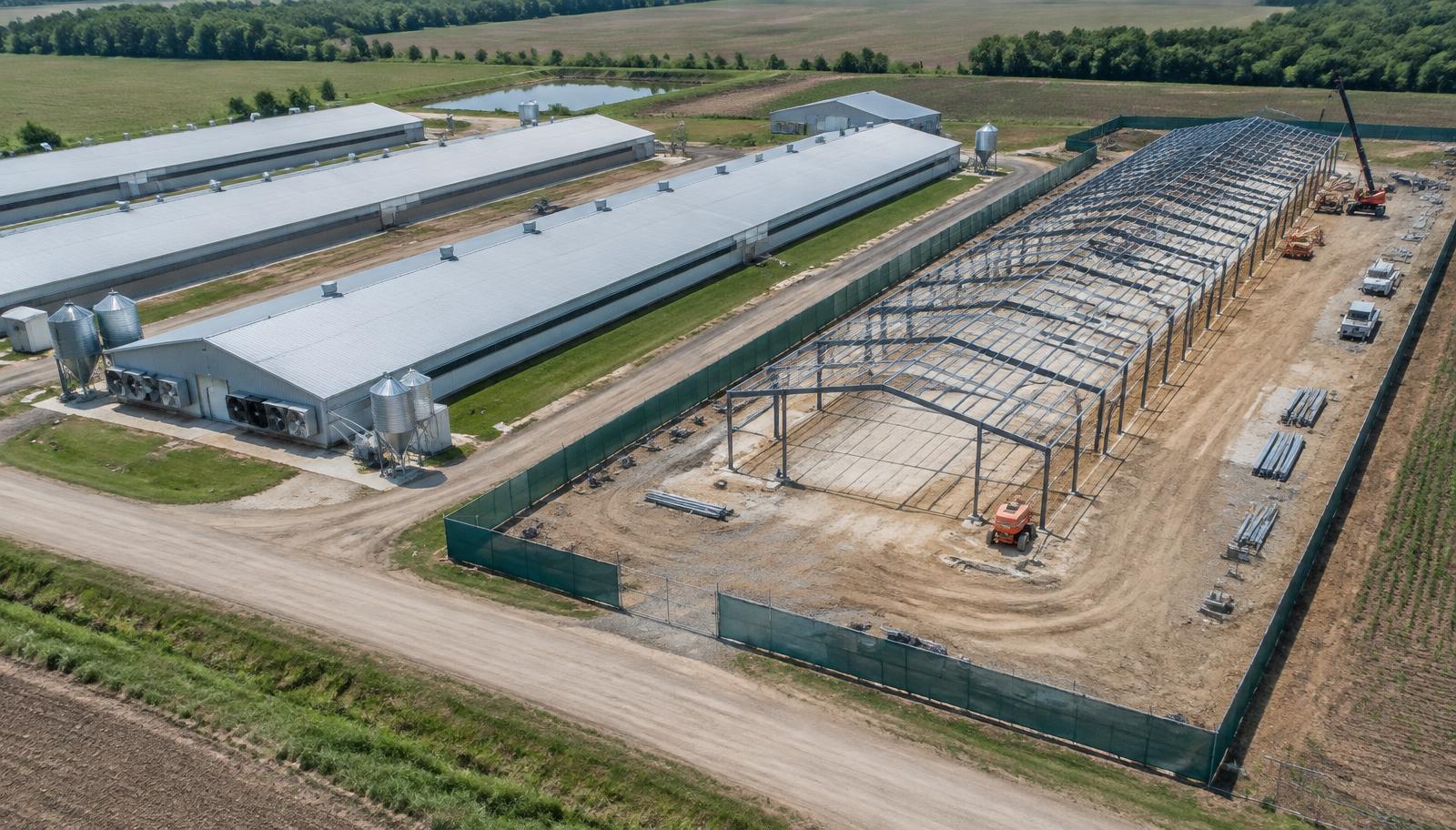
A step-by-step guide to adding houses or capacity to a running poultry farm without disrupting current flocks: phasing, construction biosecurity, utility capacity and equipment compatibility.
By HatchMatch Group Sourcing Desk · Last updated 2026-10-09
In short
Short answer. Expanding a working poultry farm safely means treating construction as a separate biosecurity zone with its own access route, checking that water, power and feed systems have spare capacity before adding houses, choosing new equipment that is compatible with what is already running, and timing civil works and equipment delivery around flock cycles rather than around the contractor's schedule. Get these four things — zoning, capacity, compatibility, timing — into one written expansion plan before signing any equipment order.
Key takeaways
- Start by writing down what the expansion is actually for: more broiler cycles per year, added layer capacity, a second breed or product line, or simply more floor space with the same equipment standard.
- Draw the site plan showing existing houses, the proposed new houses, and every point where people, vehicles, feed, birds and manure currently move.
- Added houses mean added water demand, added electrical load and added feed throughput, and existing infrastructure is not always sized with spare margin for this.
- New houses rarely stand completely alone: they usually share a feed mill, water source, generator, or farm management software with the existing houses, and sometimes share a hatchery or processing line.
- Civil works, noise, dust and vehicle movement all carry disease and stress risk for existing flocks, so phase the build around down-time in the production cycle wherever the site layout allows: schedule the noisiest and dustiest work — foundations, steel erection, roofing — during a period when the nearest occupied house is between flocks or furthest from a sensitive stage such as early brooding or pre-lay.
Short answer. Expanding a working poultry farm safely means treating construction as a separate biosecurity zone with its own access route, checking that water, power and feed systems have spare capacity before adding houses, choosing new equipment that is compatible with what is already running, and timing civil works and equipment delivery around flock cycles rather than around the contractor's schedule. Get these four things — zoning, capacity, compatibility, timing — into one written expansion plan before signing any equipment order.
This guide is for farm owners, integrators and project teams expanding an already-operating commercial poultry site (broiler, layer or breeder), typically adding one or more houses to a site worth USD 250,000 or more in combined investment. It assumes production must continue through construction, which is the normal case and the hardest part of an expansion to get right.
1. Define the expansion scope and target before touching the site
Start by writing down what the expansion is actually for: more broiler cycles per year, added layer capacity, a second breed or product line, or simply more floor space with the same equipment standard. This decision drives house count, house type and equipment specification, and it should be settled — in writing, with numbers — before any construction quote is requested. Revisit your original farm layout and equipment list if it exists; an expansion that silently drifts from the original specification creates mismatched houses that are harder to manage as one flock-rotation unit.
2. Map the site and separate new construction into its own biosecurity zone
Want these figures for your own site, capacity and country? A HatchMatch specialist builds the budget with you — no buyer fees.
Start freeDraw the site plan showing existing houses, the proposed new houses, and every point where people, vehicles, feed, birds and manure currently move. The construction area must become a dedicated zone with its own perimeter, its own vehicle and worker access point that does not cross the existing clean route to occupied houses, and its own boot-change or disinfection point for anyone who must cross between zones. Contractors, delivery trucks and equipment installers should never need to pass beside or through an occupied house to reach the build site — if the current site layout makes that unavoidable, redesign the access road or the construction sequence before work starts, not after.
3. Check utility capacity before you commit to house count
Added houses mean added water demand, added electrical load and added feed throughput, and existing infrastructure is not always sized with spare margin for this. Confirm, with current measured data rather than assumptions: whether the water source and treatment system can supply the combined peak demand of existing plus new houses — see the water consumption calculator for a planning estimate; whether the incoming power supply and any standby generator have headroom for the new houses' ventilation, lighting and heating loads, or whether a generator upgrade is itself part of the expansion scope — see the generator sizing calculator; and whether feed mill output, feed bin capacity and delivery truck turnaround can serve the larger bird count without existing houses running short at peak demand. A farm that adds houses without re-checking these three systems often discovers the shortfall only when both old and new houses are fully stocked and competing for the same water main or transformer.
4. Check equipment compatibility with existing houses
New houses rarely stand completely alone: they usually share a feed mill, water source, generator, or farm management software with the existing houses, and sometimes share a hatchery or processing line. Before ordering equipment for the new houses, confirm that controllers can be networked with the existing control system or will run as an acceptable separate system; that feeding and drinking line components use compatible fittings and voltages with what the farm already stocks as spares; and that ventilation and cooling equipment from a new supplier will not create a mismatched climate profile if birds are ever moved between old and new houses. If the existing equipment supplier is no longer available or the farm wants a different brand for the new houses, decide this deliberately and document which spare parts and consumables will now need to be stocked in two systems instead of one.
5. Sequence construction phases against the flock cycle, not just the build schedule
Civil works, noise, dust and vehicle movement all carry disease and stress risk for existing flocks, so phase the build around down-time in the production cycle wherever the site layout allows: schedule the noisiest and dustiest work — foundations, steel erection, roofing — during a period when the nearest occupied house is between flocks or furthest from a sensitive stage such as early brooding or pre-lay. Build a simple phase chart that lines up construction milestones against the depopulation and restocking dates of every occupied house within the affected radius, and share it with both the contractor and the farm manager so neither schedules work in isolation.
6. Order long-lead equipment early and phase delivery to match construction readiness
Ventilation fans, feed bins, cage or floor systems and generators often carry lead times of many weeks to several months. Place these orders as soon as house dimensions and specifications are locked, and ask each supplier for their current lead time in writing rather than assuming it matches a previous order. Phase delivery dates so equipment arrives close to when each house is ready to receive it — early delivery means on-site storage risk and extra handling, while late delivery delays restocking and wastes empty-house time. Build a short buffer into the schedule for customs clearance and inland transport if any equipment is imported.
7. Commission, test and run a trial period before introducing birds
Before the first flock enters a new house, run ventilation, heating, feeding and drinking systems through a full test cycle, ideally over several days, to confirm temperature uniformity, water pressure and feed flow meet the same standard as the existing houses. Treat this as a stand-alone step even under schedule pressure: a controller fault or an uneven feed line found during an empty-house test is a minor fix, the same fault found with live birds inside is a flock-loss risk.
8. Use the farm cost calculator in expansion mode to check the numbers
Run the planned new houses and equipment through the farm cost calculator as an addition to the existing farm rather than a stand-alone project, so the estimate reflects shared infrastructure costs (utility upgrades, shared feed mill capacity, shared generator capacity) instead of pricing the new houses as if they were starting from zero. Cross-check ventilation sizing with the ventilation calculator for the specific new house dimensions. These tools give planning estimates to sanity-check the project, not a substitute for supplier quotations or an engineer's final sizing.
9. Put the expansion specification and biosecurity plan in writing before ordering
Combine the scope, utility capacity findings, equipment compatibility decisions, phasing chart and biosecurity zoning plan into one written expansion brief before requesting final supplier quotes. This single document lets every supplier — civil contractor, equipment manufacturer, installer — quote against the same site conditions and timeline, and it becomes the reference document if a dispute arises later over what was agreed.
Expansion planning checklist
| Item | What to check | Who documents it |
|---|---|---|
| Biosecurity zoning | Separate construction perimeter, access route and disinfection point | Farm biosecurity manager |
| Water capacity | Combined peak demand of existing plus new houses against source and treatment capacity | Farm engineer / water supplier |
| Power capacity | Incoming supply and generator headroom for new loads | Electrical contractor / generator supplier |
| Feed throughput | Mill output, bin capacity and delivery turnaround for combined bird count | Feed mill operator / nutritionist |
| Equipment compatibility | Controller networking, fittings, voltage, spare-parts overlap with existing houses | Equipment suppliers / farm manager |
| Construction phasing | Build milestones mapped against depopulation and restocking dates | Contractor and farm manager jointly |
| Delivery phasing | Lead times and delivery dates matched to house readiness | Procurement lead |
| Commissioning | Test-run results for ventilation, water, feed before birds enter | Equipment installer / farm manager |
Questions to ask suppliers
Can your controllers be networked with our existing control system, or will the new houses run as a separate system? What is your current lead time for the fans, bins or cages we need, in writing? Can delivery be phased to match our construction schedule rather than shipped as one batch? Will your generator or feed equipment selection create any compatibility issue with what we already operate? What commissioning and test-run support do you provide before we introduce birds to a new house? Request written answers and keep them with the expansion brief so later disputes can be checked against what was promised.
Common mistakes
Treating the construction site as an open extension of the existing farm instead of a separate biosecurity zone with its own access. Assuming existing water, power or feed systems have spare capacity without measuring actual peak demand. Choosing new equipment on price alone without checking fittings, voltage or controller compatibility with what is already installed. Letting the contractor schedule noisy or dusty work without checking it against nearby flock cycles. Ordering long-lead equipment late because house drawings were not finalised, then compressing the construction schedule to compensate. Skipping a dedicated commissioning and test-run period because the flock delivery date is already booked.
Where HatchMatch fits
HatchMatch is a supplier-neutral procurement platform for commercial poultry projects, typically USD 250,000 and above. It is not a manufacturer, installer, EPC contractor, inspector, consultant, certification body or lender, and it does not sign supply contracts — buyers contract directly with the suppliers they choose. HatchMatch helps you turn an expansion plan into one written specification so offers from new and existing equipment suppliers can be compared line by line. Every brief receives human review, and HatchMatch aims to reply within two business days. To start, submit a poultry project request describing the existing farm, the planned expansion and your target timeline.
FAQ
Can a poultry farm be expanded while flocks are still producing? Yes, but it requires treating construction as a separate biosecurity zone with dedicated access, and phasing noisy or high-risk work around the production cycle of nearby occupied houses rather than running it continuously.
How do I know if my water and power systems can handle new houses? Measure current peak demand against the rated capacity of the water source, treatment system, incoming power supply and generator, and compare that to the combined demand once new houses are stocked — use the water consumption and generator sizing calculators as a planning check, then confirm with your utility provider and engineer.
Does new equipment need to match what is already installed? It should at least be compatible in fittings, voltage and, where relevant, controller networking, especially if birds, staff or spare parts move between old and new houses; mismatched systems increase spare-parts stock and training burden even if each system works on its own.
What is the biggest timing risk in a farm expansion? Civil works or equipment delivery landing during a sensitive stage of a nearby flock's cycle, such as early brooding, or long-lead equipment arriving late because orders were placed after house drawings were finalised instead of in parallel.
Can the farm cost calculator be used for an expansion instead of a new farm? Yes — run it for the new houses and equipment while noting which infrastructure (feed mill, generator, water treatment) is shared with the existing farm, so the estimate is not inflated by pricing shared systems twice.
Frequently asked questions
- Can your controllers be networked with our existing control system, or will the new houses run as a separate system?
- What is your current lead time for the fans, bins or cages we need, in writing? Can delivery be phased to match our construction schedule rather than shipped as one batch? Will your generator or feed equipment selection create any compatibility issue with what we already operate? What commissioning and test-run support do you provide before we introduce birds to a new house? Request written answers and keep them with the expansion brief so later disputes can be checked against what was promised.
- Can a poultry farm be expanded while flocks are still producing?
- Yes, but it requires treating construction as a separate biosecurity zone with dedicated access, and phasing noisy or high-risk work around the production cycle of nearby occupied houses rather than running it continuously.
- How do I know if my water and power systems can handle new houses?
- Measure current peak demand against the rated capacity of the water source, treatment system, incoming power supply and generator, and compare that to the combined demand once new houses are stocked — use the water consumption and generator sizing calculators as a planning check, then confirm with your utility provider and engineer.
- Does new equipment need to match what is already installed?
- It should at least be compatible in fittings, voltage and, where relevant, controller networking, especially if birds, staff or spare parts move between old and new houses; mismatched systems increase spare-parts stock and training burden even if each system works on its own.
- What is the biggest timing risk in a farm expansion?
- Civil works or equipment delivery landing during a sensitive stage of a nearby flock's cycle, such as early brooding, or long-lead equipment arriving late because orders were placed after house drawings were finalised instead of in parallel.
- Can the farm cost calculator be used for an expansion instead of a new farm?
- Yes — run it for the new houses and equipment while noting which infrastructure (feed mill, generator, water treatment) is shared with the existing farm, so the estimate is not inflated by pricing shared systems twice.
More buyer questions are answered in our poultry procurement FAQ — also available in Español, Français, Português, Deutsch, العربية, Русский, Türkçe, Tiếng Việt.
From this article to a procurement-ready RFQ
HatchMatch Group is an independent sourcing desk — not a manufacturer or EPC contractor. These are the four steps we actually use with commercial poultry and hatchery buyers. If you are still deciding scope, start with what commercial poultry equipment includes and how suppliers are compared.
- 1. Plan the projectCapacity, climate and house layout in one guided workflowOpen
- 2. Build the RFQScope, specifications and comparable line itemsOpen
- 3. Submit the requestReviewed manually before any supplier introductionOpen
- 4. Track and compareFollow status and normalise supplier responsesOpen
Prefer the numbers first? Start with the poultry project cost calculator or browse the project planning guides.