
How to Choose a Site for a Commercial Poultry Farm: Distances, Water, Power, Access and Permits
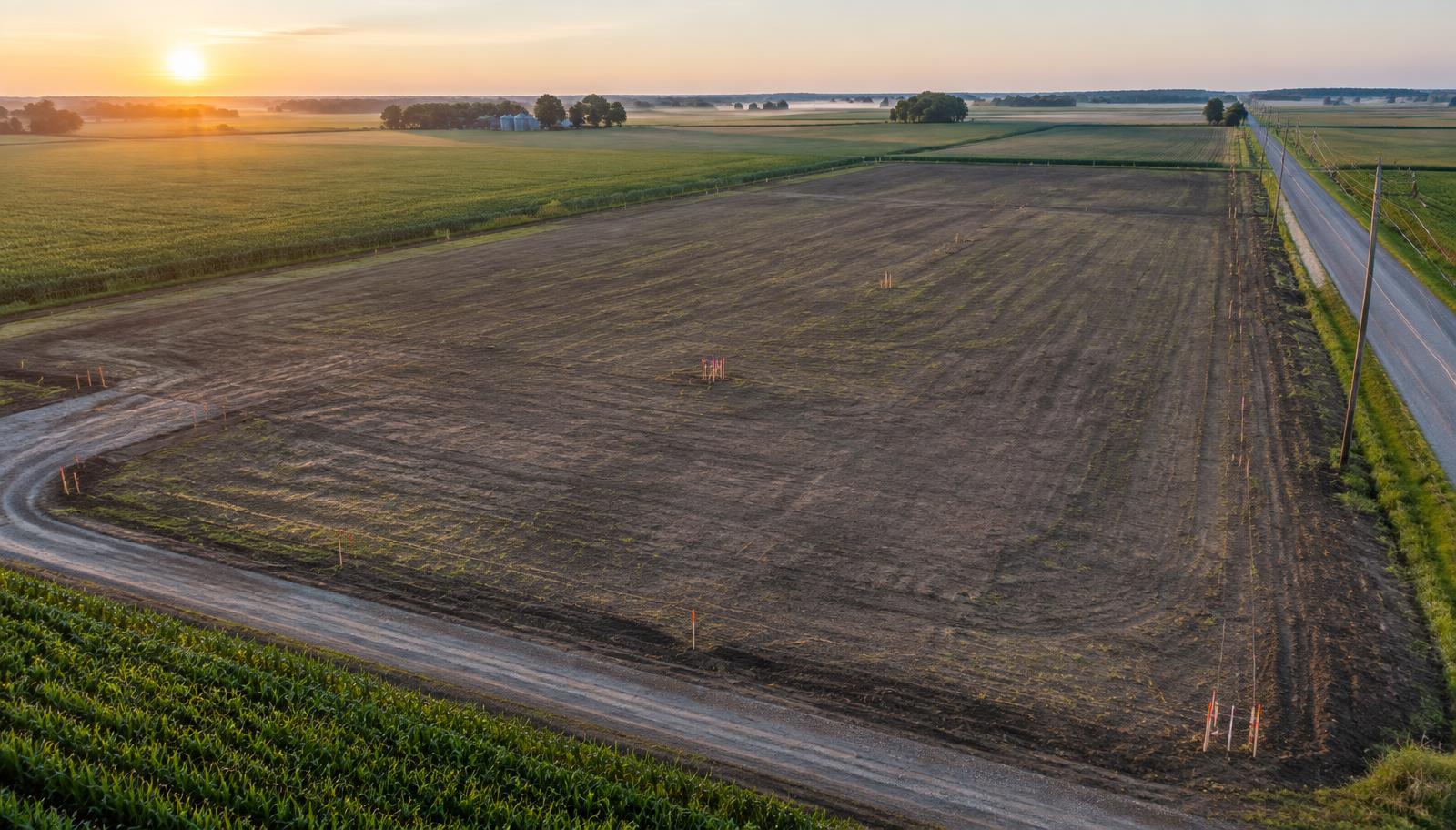
A step-by-step guide to evaluating candidate sites for a commercial poultry farm, covering biosecurity distances, water and power supply, access roads, soil and drainage, permits, wind direction, labour and expansion room.
By HatchMatch Group Sourcing Desk · Last updated 2026-10-09
In short
Short answer. A good commercial poultry site combines legal biosecurity separation from other farms, roads and residential areas; reliable water volume and quality; enough power capacity or room for a generator; a well-drained, stable building site; clear zoning and environmental permits; an orientation that works with the prevailing wind; nearby but not adjacent labour; and spare land for future houses. Score every candidate site against these eight factors before signing a purchase or lease, because correcting a bad site after construction is far more expensive than walking away from it on paper.
Key takeaways
- Before anything else, find out the minimum distances your country or region requires — or that your target integrator or buyer requires — between your proposed houses and other poultry farms, hatcheries, live-bird markets, slaughterhouses and waste-disposal sites.
- A commercial house needs a dependable daily water volume for drinking, evaporative cooling and washdown, with consistent pressure across every drinker line.
- Ventilation, cooling, lighting and feed systems need continuous power, and a short outage in hot weather can cause flock losses within hours.
- A site needs an all-weather road that trucks can use year-round to deliver day-old chicks, feed and equipment, and to collect eggs or birds, without needing to cross another farm's biosecurity perimeter.
- House foundations, feed bins and access yards need ground that drains quickly after rain and can bear the load of the structure and stored feed without settling unevenly.
Short answer. A good commercial poultry site combines legal biosecurity separation from other farms, roads and residential areas; reliable water volume and quality; enough power capacity or room for a generator; a well-drained, stable building site; clear zoning and environmental permits; an orientation that works with the prevailing wind; nearby but not adjacent labour; and spare land for future houses. Score every candidate site against these eight factors before signing a purchase or lease, because correcting a bad site after construction is far more expensive than walking away from it on paper.
This guide is for investors, integrators and project teams evaluating land for a new broiler, layer or breeder farm, or deciding between several candidate parcels. It assumes you already have a rough target flock size; use the birds per house calculator and farm cost calculator beforehand so you know roughly how many houses and how much land you are planning for.
Step 1: Map biosecurity distances to other poultry operations
Before anything else, find out the minimum distances your country or region requires — or that your target integrator or buyer requires — between your proposed houses and other poultry farms, hatcheries, live-bird markets, slaughterhouses and waste-disposal sites. Rules vary widely, but many jurisdictions and buyer protocols apply distances in the range of roughly 1–3 km or more from other commercial flocks of a different ownership, with shorter minimums from public roads and residential clusters. Use satellite mapping to count every existing poultry site within that radius, not just the ones you already know about, because an undisclosed neighbouring farm is one of the most common reasons a disease-risk assessment or a buyer's audit later rejects a site.
Step 2: Test and quantify the water supply
Want these figures for your own site, capacity and country? A HatchMatch specialist builds the budget with you — no buyer fees.
Start freeA commercial house needs a dependable daily water volume for drinking, evaporative cooling and washdown, with consistent pressure across every drinker line. Confirm the source — borehole, municipal supply or surface source with treatment — and have it tested for bacterial load, hardness, iron and salinity before you commit to the land, not after the wells are drilled. Use the water consumption calculator to estimate daily and peak-season demand for your target flock size, then compare that figure against the tested or documented yield of the source, including a safety margin for dry-season drop-off.
Step 3: Confirm power capacity and backup options
Ventilation, cooling, lighting and feed systems need continuous power, and a short outage in hot weather can cause flock losses within hours. Check the grid connection capacity available at the site, the reliability record for the area (ask neighbours, not only the utility), and the physical distance to the nearest transformer or substation, since extending supply lines can be a significant and slow cost. Use the generator sizing calculator to size backup capacity for your house count and equipment load, and treat standby power as mandatory, not optional, regardless of grid quality.
Step 4: Evaluate access roads for construction and daily operations
A site needs an all-weather road that trucks can use year-round to deliver day-old chicks, feed and equipment, and to collect eggs or birds, without needing to cross another farm's biosecurity perimeter. Check road width, load-bearing surface, bridge and culvert capacity for feed trucks, and how the route performs in the wettest month of the year, since a road that is fine in the dry season but impassable in the rains can halt deliveries exactly when flocks are most vulnerable. Also map the route against the distance rules from Step 1, so trucks serving your farm are not required to pass directly by other poultry operations.
Step 5: Check soil bearing capacity and drainage
House foundations, feed bins and access yards need ground that drains quickly after rain and can bear the load of the structure and stored feed without settling unevenly. Have a basic soil assessment done — a geotechnical engineer for larger projects, or at minimum a visual and percolation check for smaller ones — and look at the site after a heavy rain if possible, checking for standing water, seasonal flooding history and the direction natural runoff takes relative to where houses and manure storage will sit. Sites with a gentle slope that sheds water away from buildings are strongly preferred over flat, low-lying or naturally waterlogged land.
Step 6: Confirm zoning, environmental and construction permits
Agricultural land is not automatically approved for livestock structures of commercial scale. Before purchase, confirm the zoning classification allows poultry housing at your planned density, identify which environmental permit covers manure and wastewater management, and list every construction and operating permit your local authority requires, including any public consultation or environmental impact step. Build the realistic permit timeline into your project schedule, because permit delays — not construction itself — are a common cause of commercial poultry projects starting months later than planned.
Step 7: Orient houses to the prevailing wind
Wherever naturally ventilated or tunnel-ventilated housing is used, house orientation relative to the prevailing wind direction affects cooling efficiency, odour and dust drift toward neighbours, and disease transmission risk between houses on the same site. As a general planning principle, houses are commonly aligned with their long axis across the prevailing wind for natural ventilation designs, or end-to-end along the dominant wind for tunnel systems feeding from one end — confirm the right orientation for your specific ventilation design and climate with your house supplier and the ventilation calculator rather than applying a single rule everywhere. Also check which direction odour and dust will travel toward the nearest residential area across the seasons, not just on an average day.
Step 8: Reserve room for labour access and future expansion
Confirm there is a reliable, trainable labour pool within reasonable commuting distance, since staff turnover on remote sites with no nearby housing or transport is a recurring operating problem. Separately, buy or option more land than your first phase needs: a site that fits houses one and two tightly, with no space for parking, feed storage expansion, a second access road or future houses three and four, will force a second site search later at a time when land and biosecurity-compliant locations near your existing operation may be harder to find.
Site evaluation checklist
| Factor | What to confirm before buying | Typical reference |
|---|---|---|
| Biosecurity distance | Distance to other poultry farms, markets, slaughterhouses, public roads | Often roughly 1–3 km+ from other flocks, confirm local rule |
| Water | Tested yield, quality and pressure of the source | Size against the water consumption calculator |
| Power | Grid capacity, reliability record, distance to transformer | Backup sized with the generator sizing calculator |
| Access road | All-weather surface, load capacity, wet-season performance | Confirm with local transport and feed delivery contacts |
| Soil and drainage | Bearing capacity, slope, flood history | Geotechnical or visual/percolation assessment |
| Permits | Zoning, environmental, construction and operating permits | Build realistic timeline into project schedule |
| Wind direction | Prevailing wind relative to house orientation and neighbours | Confirm with ventilation design and the ventilation calculator |
| Expansion room | Spare land for future houses, parking, feed storage | Buy or option beyond phase-one needs |
Questions to ask local authorities and engineers
What is the minimum legal distance required between our proposed houses and other poultry operations, markets or slaughterhouses? Which environmental and zoning permits apply to a farm of our planned flock size, and what is the realistic approval timeline? What is the tested yield and quality of the proposed water source across both wet and dry seasons? What is the grid connection capacity available at this site, and what would extending supply cost if it is insufficient? Has this land flooded or waterlogged in the past 10 years, and in which months? Is the access road passable by loaded feed trucks in the wettest month of the year? Get written answers before signing any purchase or lease agreement.
Common mistakes
Measuring biosecurity distance only to the poultry farms you already know about, missing others visible on satellite imagery. Assuming a borehole will produce enough water without first testing yield and quality against calculated demand. Treating generator backup as optional because grid power is usually available. Evaluating the access road only in dry-season conditions. Skipping a soil and drainage check because the land looks flat and solid on the surface. Starting construction before permits are confirmed, based on verbal assurances. Ignoring wind direction and only checking distance to the nearest house. And buying only enough land for the first phase, with no option on adjoining land for later expansion.
Where HatchMatch fits
HatchMatch is a supplier-neutral procurement platform for commercial poultry projects, typically USD 250,000 and above. It is not a manufacturer, installer, EPC contractor, inspector, consultant, certification body or lender, and it does not sign supply contracts — buyers contract directly with the suppliers they choose. HatchMatch helps you turn your site data and requirements into one written specification so equipment offers can be compared line by line. Every brief receives human review, and HatchMatch aims to reply within two business days. To start, submit a poultry project request with your target flock size, site location and timeline, and we can help you match equipment specifications to the site conditions you've identified.
FAQ
How far should a commercial poultry farm be from other poultry farms? Rules vary by country and by buyer protocol, but many apply minimum distances in the range of roughly 1–3 km or more from other commercially owned flocks — confirm the exact figure with local authorities and any integrator or buyer you plan to supply.
What water tests should be done before buying land for a poultry farm? At minimum, test for bacterial load, hardness, iron and salinity, and confirm the tested yield of the source across both wet and dry seasons against demand from the water consumption calculator.
Does house orientation really matter for wind direction? Yes — orientation relative to the prevailing wind affects cooling efficiency for naturally and tunnel-ventilated houses, and also affects how far odour and dust travel toward neighbours; confirm the right orientation for your specific design with your house supplier.
How much extra land should I buy beyond my first phase of houses? There is no universal figure, but reserving land for parking, feed storage growth, a second access route and at least one future expansion phase avoids a difficult second site search later — size it against your long-term flock target, not just phase one.
What permits are typically needed before building a commercial poultry farm? Expect to need zoning confirmation, an environmental permit covering manure and wastewater management, and construction and operating permits from your local authority — the exact list and timeline depend on your jurisdiction and planned flock size, so confirm early.
Frequently asked questions
- What is the minimum legal distance required between our proposed houses and other poultry operations, markets or slaughterhouses?
- Which environmental and zoning permits apply to a farm of our planned flock size, and what is the realistic approval timeline? What is the tested yield and quality of the proposed water source across both wet and dry seasons? What is the grid connection capacity available at this site, and what would extending supply cost if it is insufficient? Has this land flooded or waterlogged in the past 10 years, and in which months? Is the access road passable by loaded feed trucks in the wettest month of the year? Get written answers before signing any purchase or lease agreement.
- How far should a commercial poultry farm be from other poultry farms?
- Rules vary by country and by buyer protocol, but many apply minimum distances in the range of roughly 1–3 km or more from other commercially owned flocks — confirm the exact figure with local authorities and any integrator or buyer you plan to supply.
- What water tests should be done before buying land for a poultry farm?
- At minimum, test for bacterial load, hardness, iron and salinity, and confirm the tested yield of the source across both wet and dry seasons against demand from the water consumption calculator.
- Does house orientation really matter for wind direction?
- Yes — orientation relative to the prevailing wind affects cooling efficiency for naturally and tunnel-ventilated houses, and also affects how far odour and dust travel toward neighbours; confirm the right orientation for your specific design with your house supplier.
- How much extra land should I buy beyond my first phase of houses?
- There is no universal figure, but reserving land for parking, feed storage growth, a second access route and at least one future expansion phase avoids a difficult second site search later — size it against your long-term flock target, not just phase one.
- What permits are typically needed before building a commercial poultry farm?
- Expect to need zoning confirmation, an environmental permit covering manure and wastewater management, and construction and operating permits from your local authority — the exact list and timeline depend on your jurisdiction and planned flock size, so confirm early.
More buyer questions are answered in our poultry procurement FAQ — also available in Español, Français, Português, Deutsch, العربية, Русский, Türkçe, Tiếng Việt.
From this article to a procurement-ready RFQ
HatchMatch Group is an independent sourcing desk — not a manufacturer or EPC contractor. These are the four steps we actually use with commercial poultry and hatchery buyers. If you are still deciding scope, start with what commercial poultry equipment includes and how suppliers are compared.
- 1. Plan the projectCapacity, climate and house layout in one guided workflowOpen
- 2. Build the RFQScope, specifications and comparable line itemsOpen
- 3. Submit the requestReviewed manually before any supplier introductionOpen
- 4. Track and compareFollow status and normalise supplier responsesOpen
Prefer the numbers first? Start with the poultry project cost calculator or browse the project planning guides.