
Evaporative Cooling Pads and Tunnel Ventilation for Hot-Climate Poultry Houses: How to Specify and Buy
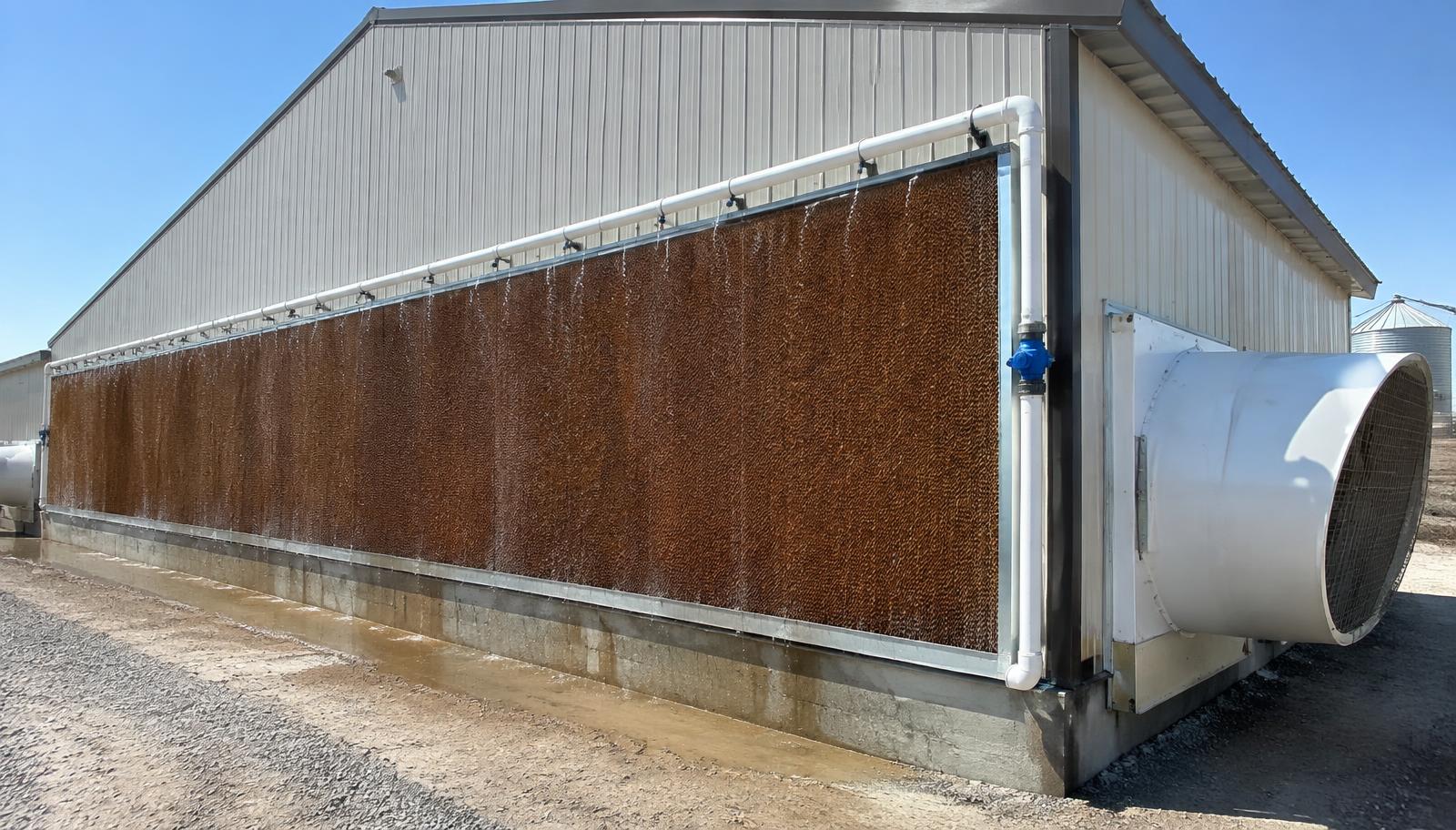
A buyer's guide to evaporative cooling pad systems and tunnel ventilation for broiler and layer houses in hot climates: how they work together, how to size them and what to put in the supplier RFQ.
By HatchMatch Group Sourcing Desk · Last updated 2026-10-06
In short
Short answer. In hot climates, tunnel ventilation pulls air the length of the house at high speed to create a cooling effect on the birds, and evaporative cooling pads lower the incoming air temperature by passing it through wet cellulose pads before the fans draw it through. The two systems are specified together, not separately: pad area, fan capacity and house cross-section all depend on each other.
Key takeaways
- Tunnel ventilation moves large volumes of air lengthwise through the house using a bank of exhaust fans at one end, with air entering through inlets or a cooling pad wall at the other.
- Tunnel ventilation with pad cooling suits enclosed, well-insulated houses in hot or hot-dry climates, typically broiler and layer houses designed for high stocking density.
- Fan capacity is normally expressed as total air movement per bird or per unit of floor area at the target air speed, with air speed itself a key design choice — many hot-climate broiler and layer houses are designed for tunnel air speeds in a planning range of roughly 2 to 3 metres per second, confirmed against the breed guide for the bird's age and your animal welfare rules.
- Pad area is sized from the airflow the fans will pull through it and a maximum air velocity through the wet pad face — too high a velocity carries water droplets into the house and wastes cooling potential, too low wastes pad material and space.
- Pad cooling adds moisture to the incoming air, so the exhaust air at the far end of the house is both cooler and more humid than the pad-end intake.
Short answer. In hot climates, tunnel ventilation pulls air the length of the house at high speed to create a cooling effect on the birds, and evaporative cooling pads lower the incoming air temperature by passing it through wet cellulose pads before the fans draw it through. The two systems are specified together, not separately: pad area, fan capacity and house cross-section all depend on each other. Size pads and fans to your hottest, most humid design day, not an average day, and confirm the final numbers with each supplier's own calculation for your house and climate.
This guide is for investors, integrators and project teams building or upgrading broiler, layer or breeder houses in hot or humid regions, typically for projects of USD 250,000 or more. It explains the main buying decisions in plain terms. Exact pad area, fan numbers and water quality limits vary by climate, house design and bird type — always confirm final figures against the supplier's engineering calculation and your breed guide.
How tunnel ventilation and evaporative cooling work together
Tunnel ventilation moves large volumes of air lengthwise through the house using a bank of exhaust fans at one end, with air entering through inlets or a cooling pad wall at the other. At high air speed, birds experience a wind-chill-like cooling effect even if the air temperature itself has not dropped much. Evaporative cooling pads add a second effect: as hot, dry air is drawn through wet pads, some of the water evaporates and absorbs heat from the air, so the air entering the house is genuinely cooler — though also more humid. In hot, dry climates this can lower incoming air temperature by a meaningful margin; in already humid climates the benefit is smaller, so pad systems are usually paired with a higher fan capacity and careful attention to exhaust humidity.
Step 1: Confirm tunnel ventilation is the right approach
Want these figures for your own site, capacity and country? A HatchMatch specialist builds the budget with you — no buyer fees.
Start freeTunnel ventilation with pad cooling suits enclosed, well-insulated houses in hot or hot-dry climates, typically broiler and layer houses designed for high stocking density. It generally is not combined with naturally ventilated open-sided houses, and it needs a controller, backup power and staff able to run it correctly, because a fan or power failure in full tunnel mode with pads wet can become a heat-stress emergency within minutes. If your climate is mild for most of the year, ask suppliers whether a simpler minimum-plus-tunnel system without pads meets your design temperatures before paying for a full pad system.
Step 2: Size the fans to the house and climate
Fan capacity is normally expressed as total air movement per bird or per unit of floor area at the target air speed, with air speed itself a key design choice — many hot-climate broiler and layer houses are designed for tunnel air speeds in a planning range of roughly 2 to 3 metres per second, confirmed against the breed guide for the bird's age and your animal welfare rules. Ask each supplier to show their fan selection, including the number and size of fans, the static pressure they are rated against (pads and shutters add resistance), and the fan performance curve at that pressure, not just the nameplate rating in free air. Use the ventilation calculator for a first planning estimate of required airflow, and treat the supplier's own calculation for your house geometry and climate as the number to build the contract around.
Step 3: Size the cooling pad area and water system
Pad area is sized from the airflow the fans will pull through it and a maximum air velocity through the wet pad face — too high a velocity carries water droplets into the house and wastes cooling potential, too low wastes pad material and space. Pad thickness, typically a few common sizes in the market, trades off cooling efficiency against resistance to airflow and water use. Specify: total pad face area, pad thickness and material, the recirculation pump and water distribution system above the pads, a sump with float valve and overflow, and a bleed-off or periodic flush to control mineral build-up, since evaporation concentrates dissolved solids in the recirculating water over time.
| Decision point | What to specify | Why it matters |
|---|---|---|
| Air velocity through pad | Supplier's design velocity at your fan capacity | Too fast carries water into the house; too slow wastes pad area |
| Pad thickness and media | Material, thickness, expected service life | Thicker pads cool more but add resistance; media degrades with scale and algae |
| Water quality | Source test, hardness, bleed-off rate | Hard or saline water scales pads quickly and shortens their life |
| Sump and pump | Capacity, float valve, filtration before recirculation | Debris and algae block pads if water is not filtered |
| Controller integration | Staged pad wetting tied to temperature and humidity | Pads should turn on only when needed, not run continuously |
Step 4: Plan for humidity and the shoulder seasons
Pad cooling adds moisture to the incoming air, so the exhaust air at the far end of the house is both cooler and more humid than the pad-end intake. In humid climates or during humid weeks, ask the supplier how their control strategy balances cooling against humidity limits for the bird's age, since very high humidity combined with heat is itself a stress factor. Outside the hottest months, the house still needs a minimum-ventilation and transitional-ventilation strategy that does not rely on pads, so specify a controller that stages from minimum ventilation through tunnel-without-pads to full tunnel-with-pads as temperature rises.
Step 5: Power, controls and failure modes
A pad and tunnel system draws significant electrical load for fans and pumps, and losing power on a hot day with birds at tunnel-ventilation density is one of the fastest-moving emergencies in poultry production. Specify a backup generator sized to start and run the full fan bank and pad pumps together, automatic transfer, and a controller with temperature, humidity and power alarms that reach staff off-site. Use the generator sizing calculator for a first estimate of backup power needs, and ask the supplier to confirm the starting and running load of the full cooling system, since fan motors draw a higher starting current than their running current.
What to include in the RFQ
A tunnel-and-cooling RFQ that suppliers can price on the same basis should state: house dimensions and bird type and age range; design summer dry-bulb and wet-bulb (or relative humidity) temperatures for your site; target tunnel air speed and ventilation rate per bird at maximum age; water source and a water test if available; power supply details and whether backup generation is included in scope; controller and alarm requirements; and the installation, commissioning and training scope. Ask for the delivery basis and named place as explained in our guide to Incoterms for poultry equipment imports, and ask for warranty and spare-parts terms in writing, since pad media, pump seals and shutter motors are wear items.
Questions to ask every supplier
What air speed and static pressure is your fan selection based on, and can you show the fan curve at that pressure? What air velocity through the pad does your pad area assume, and what happens on the hottest day you have seen in a similar climate? What water quality do your pads require, and what happens to pad life if our water is harder or more saline than that? How does your controller balance cooling against humidity limits as weather changes through the week? What is the starting and running electrical load of the full system, and does your generator recommendation cover it? Who supplies replacement pad media and shutter parts locally, and what is the typical lead time? Ask for written answers and compare them in one table.
Common mistakes
Sizing pads and fans to an average summer day instead of the hottest, most humid design day. Buying pad area and fan capacity from different suppliers without one written interface between them. Ignoring water quality until pads scale up within the first season. Leaving the generator out of the cooling-system budget. Running pads continuously instead of staging them with the controller. And comparing quotes that assume different air speeds, pad velocities or scopes of installation.
Where HatchMatch fits
HatchMatch is a supplier-neutral procurement platform for commercial poultry projects, typically USD 250,000 and above. It is not a manufacturer, installer, EPC contractor or consultant, and it does not sign supply contracts — buyers contract directly with the suppliers they choose. HatchMatch helps you turn your requirements into one written specification so offers can be compared line by line. Every brief receives human review, and HatchMatch aims to reply within two business days. To start, submit a poultry project request with your house dimensions, climate data and timeline.
Frequently asked questions
How much cooler does evaporative pad cooling make the incoming air? It depends heavily on how hot and dry the outside air is; the effect is larger in hot, dry climates and smaller in already humid ones. Ask each supplier to quote an expected temperature drop for your specific design conditions rather than a generic figure.
Can I add pad cooling to an existing tunnel-ventilated house? Often yes, if the house structure, fan capacity and controller can be upgraded to match, but the fan bank may need resizing because pads add resistance to airflow. Have a supplier assess the existing system before ordering pads.
How often do cooling pads need to be replaced? It depends on water quality, pad thickness and material, and maintenance routine; hard or untreated water shortens pad life noticeably. Ask suppliers for an expected service life under your water conditions and build replacement into the operating budget.
Do I still need minimum ventilation if I have tunnel and pad cooling? Yes. Chicks and cool-weather periods need a different, much lower ventilation strategy than full summer tunnel mode, so the controller should stage between minimum, transitional and full tunnel-with-pads modes.
What size generator do I need for a pad and tunnel system? It depends on the number and size of fans, pump load and starting currents; use the generator sizing calculator for a first estimate and confirm the final figure with the equipment supplier's load list.
Frequently asked questions
- What air speed and static pressure is your fan selection based on, and can you show the fan curve at that pressure?
- What air velocity through the pad does your pad area assume, and what happens on the hottest day you have seen in a similar climate? What water quality do your pads require, and what happens to pad life if our water is harder or more saline than that? How does your controller balance cooling against humidity limits as weather changes through the week? What is the starting and running electrical load of the full system, and does your generator recommendation cover it? Who supplies replacement pad media and shutter parts locally, and what is the typical lead time? Ask for written answers and compare them in one table.
- How much cooler does evaporative pad cooling make the incoming air?
- It depends heavily on how hot and dry the outside air is; the effect is larger in hot, dry climates and smaller in already humid ones. Ask each supplier to quote an expected temperature drop for your specific design conditions rather than a generic figure.
- Can I add pad cooling to an existing tunnel-ventilated house?
- Often yes, if the house structure, fan capacity and controller can be upgraded to match, but the fan bank may need resizing because pads add resistance to airflow. Have a supplier assess the existing system before ordering pads.
- How often do cooling pads need to be replaced?
- It depends on water quality, pad thickness and material, and maintenance routine; hard or untreated water shortens pad life noticeably. Ask suppliers for an expected service life under your water conditions and build replacement into the operating budget.
- Do I still need minimum ventilation if I have tunnel and pad cooling?
- Yes. Chicks and cool-weather periods need a different, much lower ventilation strategy than full summer tunnel mode, so the controller should stage between minimum, transitional and full tunnel-with-pads modes.
- What size generator do I need for a pad and tunnel system?
- It depends on the number and size of fans, pump load and starting currents; use the generator sizing calculator for a first estimate and confirm the final figure with the equipment supplier's load list.
More buyer questions are answered in our poultry procurement FAQ — also available in Español, Français, Português, Deutsch, العربية, Русский, Türkçe, Tiếng Việt.
From this article to a procurement-ready RFQ
HatchMatch Group is an independent sourcing desk — not a manufacturer or EPC contractor. These are the four steps we actually use with commercial poultry and hatchery buyers. If you are still deciding scope, start with what commercial poultry equipment includes and how suppliers are compared.
- 1. Plan the projectCapacity, climate and house layout in one guided workflowOpen
- 2. Build the RFQScope, specifications and comparable line itemsOpen
- 3. Submit the requestReviewed manually before any supplier introductionOpen
- 4. Track and compareFollow status and normalise supplier responsesOpen
Prefer the numbers first? Start with the poultry project cost calculator or browse the project planning guides.