
Egg Breaking and Liquid Egg Plants: Breaker Capacity, Pasteurization, Tanks and How to Buy
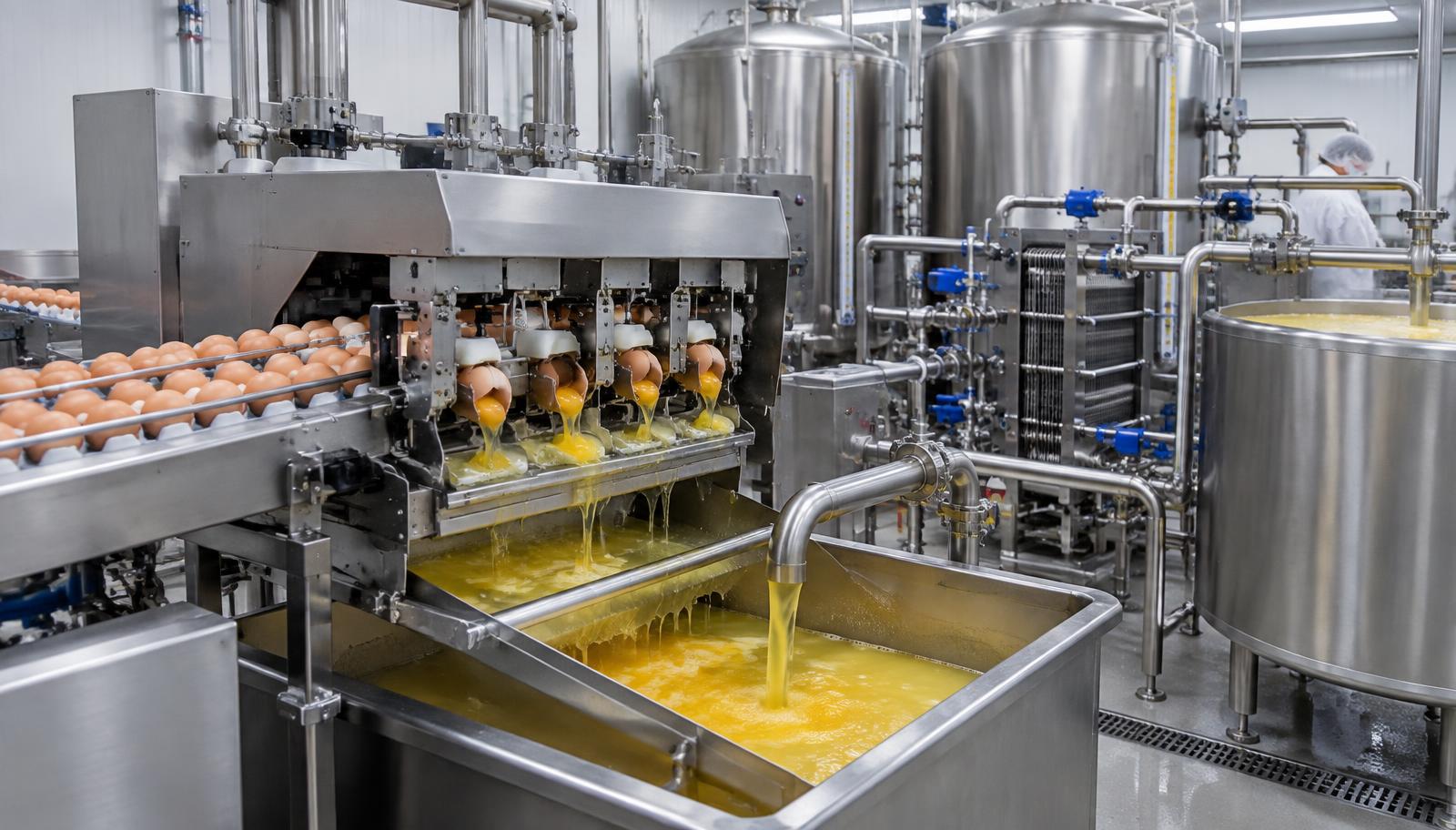
A buyer's guide to egg breaking and liquid egg plants: sizing breaker capacity, choosing pasteurization and tank equipment, and writing an RFQ suppliers can price on the same basis.
By HatchMatch Group Sourcing Desk · Last updated 2026-10-08
In short
Short answer. An egg breaking and liquid egg plant takes shell eggs that did not go to the table-egg pack line and turns them into pasteurized whole egg, egg white or egg yolk for food manufacturers and bakeries. The key buying decisions are breaker capacity in eggs per hour matched to your egg supply, the separation and filtering equipment, a validated pasteurization process with recording instruments, and chilled tanks and cold-chain logistics.
Key takeaways
- A typical line has five stages: infeed and pre-wash (eggs are cleaned and sanitised before breaking, because shell contamination becomes a food-safety risk once the shell is opened); breaking and separation (mechanical breakers open each egg and separate the contents, with some lines also separating yolk from white); filtering (removing shell fragments and membrane); pasteurization (a heat treatment that reduces pathogens while keeping the product usable); and chilled storage and filling (pasteurized liquid egg is cooled, held in tanks and filled into bags, cartons or tankers for delivery).
- Start from how many eggs per day will realistically go to the breaking line, not from a round machine-rated number.
- Mechanical breakers open eggs in a rotary or in-line arrangement and tip the contents into separation cups.
- Pasteurization is a heat treatment held for a defined time at a defined temperature to reduce pathogens in the liquid egg while keeping it functional for baking or food manufacturing.
- After pasteurization, liquid egg must be cooled quickly and held cold until it is filled or shipped, because liquid egg is a perishable, easily contaminated product.
Short answer. An egg breaking and liquid egg plant takes shell eggs that did not go to the table-egg pack line and turns them into pasteurized whole egg, egg white or egg yolk for food manufacturers and bakeries. The key buying decisions are breaker capacity in eggs per hour matched to your egg supply, the separation and filtering equipment, a validated pasteurization process with recording instruments, and chilled tanks and cold-chain logistics. Confirm exact throughput, pasteurization parameters and food-safety requirements with your supplier, your market's food authority and a process hygiene specialist before ordering.
This guide continues from our egg grading and packing machines buying guide, which covers sorting and packing eggs for the table-egg market. Eggs that are cracked, undersized, or simply surplus to the shell-egg market are usually the ones that go to a breaking line instead — this guide covers the separate equipment and process needed once that decision is made. It is written for layer-farm investors, egg processors and project teams, typically for commercial projects of USD 250,000 and above.
What an egg breaking and liquid egg line actually does
A typical line has five stages: infeed and pre-wash (eggs are cleaned and sanitised before breaking, because shell contamination becomes a food-safety risk once the shell is opened); breaking and separation (mechanical breakers open each egg and separate the contents, with some lines also separating yolk from white); filtering (removing shell fragments and membrane); pasteurization (a heat treatment that reduces pathogens while keeping the product usable); and chilled storage and filling (pasteurized liquid egg is cooled, held in tanks and filled into bags, cartons or tankers for delivery). Smaller operations sometimes use semi-automatic breakers with manual inspection; larger plants use fully automatic in-line breaking, candling and separation.
Sizing breaker capacity to your egg supply
Want these figures for your own site, capacity and country? A HatchMatch specialist builds the budget with you — no buyer fees.
Start freeStart from how many eggs per day will realistically go to the breaking line, not from a round machine-rated number. This volume depends on your flock size, the share of eggs that pass table-egg grading versus the share diverted to breaking, and whether the plant also buys in eggs from other farms. The egg production calculator gives a planning estimate of total daily output; from that, estimate the diverted share using your own grading history or a conservative planning assumption, then divide by your intended operating hours to reach an eggs-per-hour figure.
| Planning step | What to check | Why it matters |
|---|---|---|
| Total daily egg volume | Flock size × typical lay rate, plus any bought-in eggs | Sets the maximum volume available to the plant |
| Share diverted to breaking | Grading rejects, off-size eggs, market demand for liquid egg | Breaking volume is usually a fraction of total production, not all of it |
| Operating hours per day | Shift pattern, staffing, cleaning time (CIP) | Converts daily eggs into the eggs-per-hour the breaker must sustain |
| Growth and bought-in allowance | Planned flock growth, third-party egg supply contracts | Avoids under-sizing the plant within a few years |
Ask suppliers to state the rated capacity in eggs per hour alongside the product mix they assume (whole egg only, or whole egg plus separated white and yolk), because separating products generally reduces the usable throughput compared with a single whole-egg stream. Compare quotes against the same assumed daily volume and product mix.
Breaking, separation and filtering equipment
Mechanical breakers open eggs in a rotary or in-line arrangement and tip the contents into separation cups. Ask each supplier: how many breaking heads the machine has and the rated capacity per head; whether the line separates yolk from white and how cross-contamination between the two is controlled; how cracked, leaking or contaminated eggs are detected and diverted before breaking (automated egg-quality detection reduces manual sorting but adds cost); and how shell and membrane are filtered out of the liquid stream. Breaking equipment works directly on food product, so ask for the materials of construction, the cleaning and sanitation design (clean-in-place, or CIP, capability), and documentation suitable for your food-safety auditor.
Pasteurization: what to specify
Pasteurization is a heat treatment held for a defined time at a defined temperature to reduce pathogens in the liquid egg while keeping it functional for baking or food manufacturing. Exact time-temperature combinations differ by product (whole egg, white, yolk) and by the food-safety regulation in your market, so the pasteurizer must be validated against your local authority's requirements, not against a generic claim. Ask suppliers for: the pasteurizer type (typically a plate heat exchanger with holding tubes); continuous temperature recording and alarm on under-processing; a documented validation or commissioning protocol; and how the system diverts under-processed product automatically rather than relying on an operator to notice. Food-safety validation of the actual process is the responsibility of your quality team and local regulator — the supplier provides the equipment and its documented performance.
Tanks, cold chain and filling
After pasteurization, liquid egg must be cooled quickly and held cold until it is filled or shipped, because liquid egg is a perishable, easily contaminated product. Specify tank capacity against your batch sizes and dispatch schedule, insulation and refrigeration capacity to hold the required temperature, instrumentation (temperature recording, level sensors) and CIP connections. Decide on the filling and packaging format early — bag-in-box, cartons, drums or bulk tanker — since each needs different filling equipment and affects tank layout. If the plant also freezes product for longer shelf life, add freezing tunnel or blast-freezer capacity and frozen storage to the specification.
Food safety, utilities and plant layout
An egg breaking plant is a food production facility, not just a mechanical line, so the RFQ and the building design should separate raw (shell-handling) and clean (post-pasteurization) zones, with controlled staff and air flow between them. Ask suppliers about washdown-rated equipment, floor drainage, and utility requirements: process water quality, steam or hot water for CIP, chilled water or refrigeration load, and electrical supply. Confirm backup power for refrigeration and the pasteurizer control system with the generator sizing calculator, since a power interruption during pasteurization or cold storage is a food-safety event, not just a production delay.
What to include in the RFQ
A breaking and liquid-egg RFQ that suppliers can price on the same basis should state: daily egg volume available to the plant and intended operating hours; product mix (whole egg, separated white, separated yolk); automated egg-quality detection requirements; pasteurizer type and the time-temperature targets you need validated for your market; recording, alarm and automatic diversion requirements; tank capacity, cooling and freezing needs; filling and packaging formats; CIP and sanitation design; utility and power backup requirements; building layout constraints for raw/clean separation; and the scope of installation, commissioning, validation support, training and spare parts. Ask for the delivery basis and named place (see our guide to Incoterms for poultry equipment imports) and the warranty terms in writing, following the structure in our warranty and spare parts guide.
Questions to ask every supplier
What rated capacity in eggs per hour do you guarantee, for which product mix? How do you detect and divert cracked or contaminated eggs before breaking? What pasteurizer type do you supply, and what validation documentation do you provide for our market's food-safety requirements? How is under-processed product automatically diverted, and how are records kept? What CIP and sanitation design does the equipment use, and in what materials? Who provides installation, commissioning and process validation support in our country? Request written answers and compare them in one table before you compare prices.
Common mistakes
Sizing the breaking line from total flock production instead of the realistic share of eggs that will actually be diverted to breaking. Choosing a pasteurizer on a generic capacity claim without validating the time-temperature process against local food-safety rules. Leaving automated egg-quality detection out of the budget to save cost on a line handling cracked or reject eggs. Underestimating refrigeration, backup power and cold-chain needs for a perishable liquid product. Failing to separate raw and clean zones in the plant layout. And comparing quotes that assume different product mixes or operating hours as if they were the same line.
Where HatchMatch fits
HatchMatch is a supplier-neutral procurement platform for commercial poultry projects, typically USD 250,000 and above. It is not a manufacturer, installer, EPC contractor or consultant, and it does not sign supply contracts — buyers contract directly with the suppliers they choose. HatchMatch helps you turn your requirements into one written specification so offers can be compared line by line. Every brief receives human review, and HatchMatch aims to reply within two business days. To start, submit a poultry project request with your egg supply, target capacity, product mix and timeline.
FAQ
How many eggs per hour does a breaking line need to handle? Estimate the share of your total egg production that will actually be diverted to breaking, divide by your planned operating hours, and ask suppliers to quote capacity at that figure rather than a generic headline number.
Do I need to separate yolk from white, or is whole egg enough? It depends on your customers' needs. Separated products usually reduce usable line throughput and add equipment, so only specify separation if you have confirmed demand for it.
Who validates the pasteurization process? The supplier provides the equipment, its documented performance and commissioning support, but validating the actual time-temperature process against your market's food-safety requirements is the responsibility of your quality team and local regulator.
How important is the cold chain after pasteurization? Very important — pasteurized liquid egg is perishable, so tank refrigeration, backup power and chilled transport need to be specified together with the pasteurizer, not treated as a separate, lower-priority item.
What should I budget for after the equipment purchase price? Plan for CIP chemicals and validation testing, spare parts (seals, plates, sensors, pumps), operator and sanitation training, and ongoing service, and ask each supplier to quote these separately so offers can be compared on the same basis.
Frequently asked questions
- What rated capacity in eggs per hour do you guarantee, for which product mix? How do you detect and divert cracked or contaminated eggs before breaking?
- What pasteurizer type do you supply, and what validation documentation do you provide for our market's food-safety requirements? How is under-processed product automatically diverted, and how are records kept? What CIP and sanitation design does the equipment use, and in what materials? Who provides installation, commissioning and process validation support in our country? Request written answers and compare them in one table before you compare prices.
- How many eggs per hour does a breaking line need to handle?
- Estimate the share of your total egg production that will actually be diverted to breaking, divide by your planned operating hours, and ask suppliers to quote capacity at that figure rather than a generic headline number.
- Do I need to separate yolk from white, or is whole egg enough?
- It depends on your customers' needs. Separated products usually reduce usable line throughput and add equipment, so only specify separation if you have confirmed demand for it.
- Who validates the pasteurization process?
- The supplier provides the equipment, its documented performance and commissioning support, but validating the actual time-temperature process against your market's food-safety requirements is the responsibility of your quality team and local regulator.
- How important is the cold chain after pasteurization?
- Very important — pasteurized liquid egg is perishable, so tank refrigeration, backup power and chilled transport need to be specified together with the pasteurizer, not treated as a separate, lower-priority item.
- What should I budget for after the equipment purchase price?
- Plan for CIP chemicals and validation testing, spare parts (seals, plates, sensors, pumps), operator and sanitation training, and ongoing service, and ask each supplier to quote these separately so offers can be compared on the same basis.
More buyer questions are answered in our poultry procurement FAQ — also available in Español, Français, Português, Deutsch, العربية, Русский, Türkçe, Tiếng Việt.
From this article to a procurement-ready RFQ
HatchMatch Group is an independent sourcing desk — not a manufacturer or EPC contractor. These are the four steps we actually use with commercial poultry and hatchery buyers. If you are still deciding scope, start with what commercial poultry equipment includes and how suppliers are compared.
- 1. Plan the projectCapacity, climate and house layout in one guided workflowOpen
- 2. Build the RFQScope, specifications and comparable line itemsOpen
- 3. Submit the requestReviewed manually before any supplier introductionOpen
- 4. Track and compareFollow status and normalise supplier responsesOpen
Prefer the numbers first? Start with the poultry project cost calculator or browse the project planning guides.