Curated collection · Organic
Organic poultry and eggs: certified claims you can verify
Organic eggs and chicken are bought on a legal claim, not a look or a promise. This collection gathers the products sold under that claim and the birds and housing an organic project has to specify, with the regulations, certificates and import documents a buyer should check for each destination market.
Quick answer
HatchMatch's organic collection lists poultry and egg products sold under a legally defined organic claim, plus the housing and birds an organic project must specify. Organic status always depends on a valid certificate for the destination market's rules — EU, USDA, Brazil or another — covering every operator, checked before contract. HatchMatch reviews requests and contacts suppliers for you.
What qualifies for this collection
An item type is listed here only when all of the following hold. Listing describes the product type — it never says a supplier is certified.
- Legally defined claim
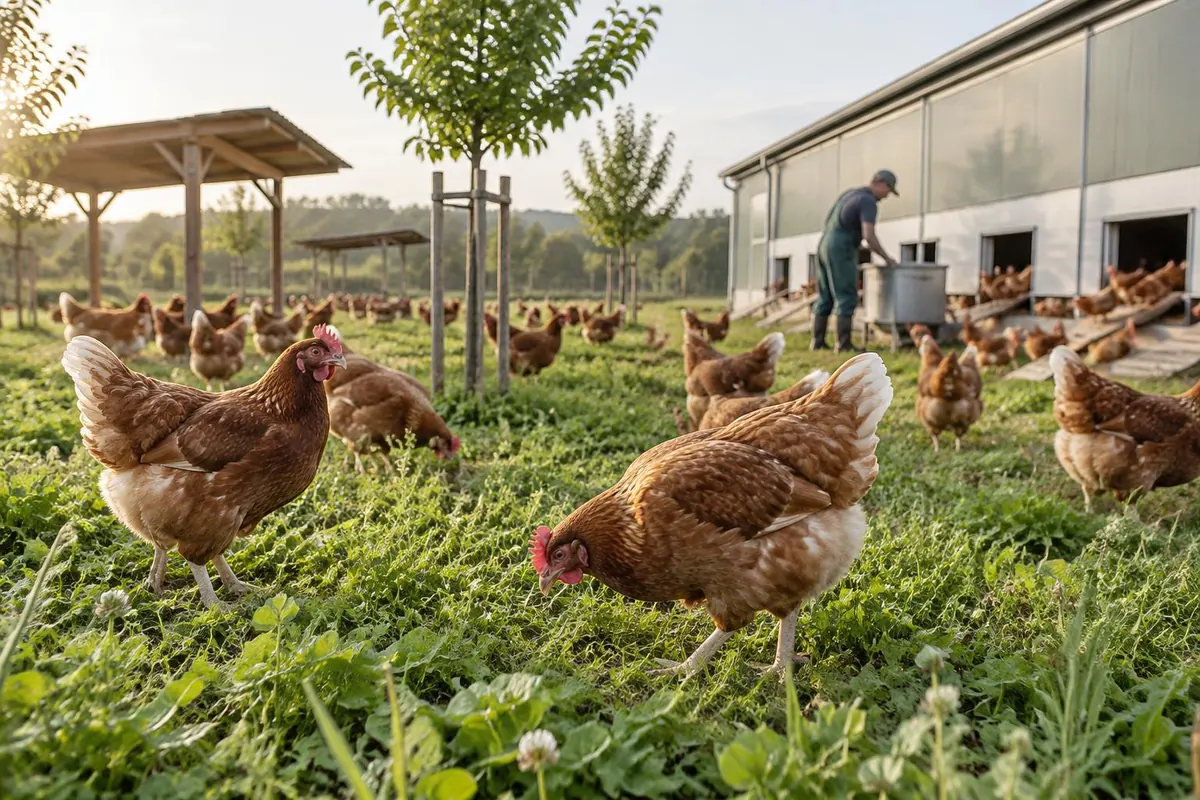
- The organic claim is governed by law in the destination market (EU Regulation 2018/848, USDA 7 CFR Part 205, Brazil's MAPA rules or the importing country's own law), and the item page names that basis.
- Certified chain
- The farm, any packing centre, slaughterhouse or cutting plant, and the exporter must each be certified for the claim, and organic imports travel with an import certificate (EU certificate of inspection; US NOP Import Certificate).
- Checkable evidence
- Certificate number, scope and expiry can be checked in a certifier's or regulator's public register before contract.
- Inputs listed for what they enable
- Housing and birds appear because organic rules set requirements for them — indoor density, outdoor area, organic rearing — not because the equipment itself is 'organic'.
Products and systems in this collection
Add any line to your RFQ list; quantities, options and notes can be edited before one reviewed request.
Eggs & meat · Table eggs & egg products
Organic shell eggs
Shell eggs from laying hens kept under an organic regulation and sold as organic only when the farm, the packing centre and every later handler are certified for that market.
The core organic egg line: certificate scope must cover farm, packing centre and exporter for your market.
- Eggs & egg handling
- Layers
Supplier details to confirm
Eggs & meat · Poultry meat
Organic chicken meat
Whole birds or cuts from chickens reared under an organic regulation — organic feed, outdoor access and set stocking densities — and slaughtered, cut and packed by certified operators.
Organic claim depends on certified rearing, slaughter and cutting, and in the EU a minimum slaughter age unless slow-growing strains are used.
- Poultry meat
- Broilers
Supplier details to confirm
Live animals & hatching eggs · Pullets & live birds
Reared pullets (point of lay)
Young laying hens reared to the start of lay and moved to production houses.
An organic egg flock needs pullets reared under the same organic rules; state this so suppliers quote compliant birds.
- Layers
Supplier details to confirm
Equipment & systems · Poultry housing systems
Layer housing systems
Enriched colony, aviary and floor systems for laying hens, usually integrated with feeding, drinking, egg collection and manure removal.
Organic layer houses must meet the target rule's indoor density, pop-holes and outdoor area (EU: max 6 hens per m², 4 m² outdoor per hen).
- Established
- Layers
Supplier details to confirm
Equipment & systems · Poultry housing systems
Broiler house equipment package
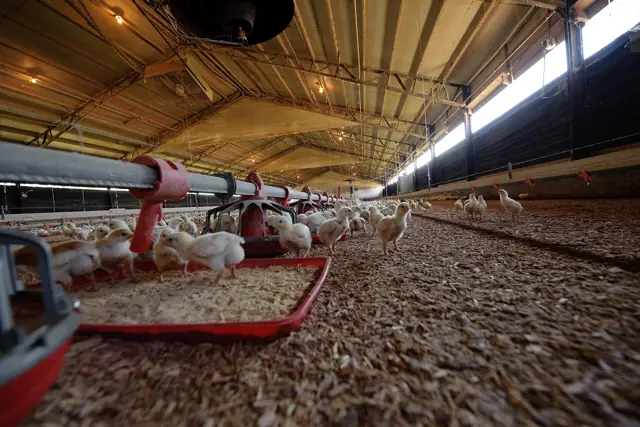
The in-house equipment for floor-reared broilers — feeding, drinking, ventilation, heating, lighting and control — supplied as one package for new or refurbished houses.
Organic meat chickens need lower indoor densities (EU: up to 21 kg live weight per m²) and outdoor access; ask for a house design to that rule.
- Established
- Broilers
Supplier details to confirm
Project packages
Complete starting scopes for common projects. Add a kit with its components, adjust quantities and options, mix in individual products, and send one reviewed RFQ.
- 11 components
Commercial layer farm
Housing, feeding, drinking, climate, egg collection and biosecurity for a commercial egg farm, specified together so suppliers quote one comparable scope.
Start from the layer-farm package and state the organic rule; housing, density and outdoor-access lines are then quoted to it.
Organic rules by market — what to check before you contract
General guide — your specification and the destination's rules decide.
| Market | Legal basis | Who certifies | Import document | Poultry points |
|---|---|---|---|---|
| European Union | Regulation (EU) 2018/848; poultry detail in Implementing Regulation (EU) 2020/464 | Control authorities and control bodies recognised for the producer's country | Electronic certificate of inspection (COI) in TRACES — Delegated Regulation (EU) 2021/2306 | Laying hens: max 6 per m² indoors, 4 m² outdoors each; egg code 0; 81-day minimum slaughter age for chickens that are not slow-growing |
| United States | USDA organic regulations, 7 CFR Part 205 | USDA-accredited certifying agents, or certifiers recognised under an equivalence arrangement | NOP Import Certificate for each shipment (since 19 March 2024) | Organic Livestock and Poultry Standards: outdoor and stocking-density rules; existing operations comply by January 2029 |
| Brazil | MAPA organic production rules, including Portaria MAPA nº 52/2021 | Certification bodies or participatory systems registered with MAPA; producers listed in the national register (CNPO) | Set by the importing market; check whether Brazilian organic products are covered by its equivalence or recognition list | See the Brazil organic sourcing guide for MAPA registration and export checks |
| Other markets | The importing country's own organic law | A certifier accredited or recognised for that market | Check the destination's import procedure | Equivalence arrangements are product- and market-specific; confirm poultry and eggs are covered |
Organic is not the same as free-range or sustainable
General guide — your specification and the destination's rules decide.
| Claim | What it means | Evidence to ask for |
|---|---|---|
| Organic | A legally defined production method covering feed, housing, outdoor access and veterinary treatment; certified | Organic certificate with scope and expiry; import certificate per shipment |
| 'Bio' or 'eco' (EU) | Reserved in the EU for certified organic products under Regulation (EU) 2018/848 | The same organic certificate — these words are not a separate, lighter claim |
| Free-range, barn, cage-free | A housing and outdoor-access system; defined in EU egg law, scheme-based in many other markets | EU farming-method code (1, 2, 3) or the scheme certificate |
| Sustainability, low-carbon | No single legal definition in most markets; must be specific and substantiated | Method, data boundary and independent verification of the stated figure |
| 'Natural', 'farm fresh' | Marketing words with little or no legal meaning | Treat as no evidence; ask what is actually being claimed |
What HatchMatch does and does not do
- HatchMatch does not certify, inspect or guarantee organic status. Certificates are requested from suppliers and should be checked in the public register before contract.
- Feed is not sold through this catalog; organic producers must still show records for the organic feed share their regulation requires.
- Egg and poultry product requests have no USD 250,000 minimum and are qualified by specification, volume and destination; farm, hatchery and equipment projects start at USD 250,000.
- Each participant keeps its own legal duties for production, labelling, export and import.
Questions buyers ask
- What makes poultry or eggs organic in a B2B deal?
- A valid certificate issued under, or recognised for, the destination market's organic rules, covering the farm and every operator that packs, slaughters, cuts or exports the product, plus the import certificate the destination requires for each shipment.
- Is organic the same as free-range or sustainable?
- No. Free-range describes housing and outdoor access, and sustainability claims have no single legal definition. Organic is a certified method that also covers feed, stocking density and veterinary treatment. In the EU, 'bio' and 'eco' are reserved for certified organic products.
- Can HatchMatch confirm that a supplier is certified organic?
- HatchMatch asks suppliers for their certificates and passes them to you with the request, but does not certify anyone. Check the certificate number, scope and expiry in the certifier's or regulator's public register — for example the USDA Organic INTEGRITY Database or Brazil's CNPO — before you contract.
- Can I plan a new organic egg or broiler farm here?
- Yes. Add the layer-farm package or the housing and pullet lines to your RFQ list and state the organic rule you will certify under, so house designs and densities are quoted to it. Farm projects start at USD 250,000; certification remains your producer's responsibility.
Related guides
Curated collections
Sources and references
Published standards and reference sources for context — not endorsements and not evidence about any supplier.
- European Union (EUR-Lex): Regulation (EU) 2018/848 on organic production and labelling of organic products (checked 2026-10-24)
- European Union (EUR-Lex): Implementing Regulation (EU) 2020/464 — stocking densities and indoor/outdoor areas for organic poultry (Annex I, Part IV) (checked 2026-10-24)
- European Union (EUR-Lex): Delegated Regulation (EU) 2021/2306 — official controls on organic imports and the certificate of inspection (checked 2026-10-24)
- European Commission, Agriculture and Rural Development: Trade in organics — importing organic products into the EU (checked 2026-10-24)
- European Union (EUR-Lex): Implementing Regulation (EU) 2023/2466 — egg marketing standards: producer code and farming-method marking (checked 2026-10-24)
- US Government (eCFR): 7 CFR Part 205 — National Organic Program (checked 2026-10-24)
- USDA Agricultural Marketing Service: Organic Livestock and Poultry Standards final rule (effective 2024; outdoor-space compliance dates to 2029) (checked 2026-10-24)
- USDA Agricultural Marketing Service: Electronic NOP Import Certificates (required for organic imports since 19 March 2024) (checked 2026-10-24)
- USDA Agricultural Marketing Service: International trade partners and organic equivalence arrangements (checked 2026-10-24)
- Ministério da Agricultura e Pecuária (MAPA), Brazil: Regularização da Produção Orgânica (organic production regularisation) (checked 2026-10-24)
- Organic Farm Knowledge (EU Horizon project platform): Slow-growing broiler breeds — practice abstract (EU organic minimum slaughter age) (checked 2026-10-24)
Not listed? Request it anyway
The catalog covers common item types. Poultry and egg goods use the product request; farms, hatcheries and equipment use the project request. Qualification rules are shown on each form.
HatchMatch facilitates sourcing and RFQs; it does not manufacture, sell or export the products. Suppliers are responsible for their products meeting the rules of the origin and destination countries, and you remain responsible for your own import permissions, local requirements and due diligence. Requirements differ by product and country, and we do not guarantee any supplier's compliance. Who is responsible for which rules