Buyer guide · Brazil · Organic poultry and eggs
Organic poultry and eggs from Brazil: a buyer's sourcing and RFQ guide
In Brazil, "orgânico" is a regulated claim. To supply supermarkets, food service, processors or other businesses, a producer must be certified by a conformity-assessment body accredited by the Ministry of Agriculture (MAPA) and appear in MAPA's National Register of Organic Producers (CNPO). Producers registered only for uncertified direct sale may sell to consumers and to government purchase programmes, not to third parties. Organic is also not the same claim as cage-free, free-range, antibiotic-free, welfare-certified or pasture-raised, and Brazilian organic status does not automatically count as organic in the EU or the United States. Ask for evidence for every claim, per product and per lot; the producer or exporter is responsible for meeting MAPA and destination rules.
Sources checked .
Organic, cage-free, free-range and antibiotic-free are different claims
Institutional and commercial buyers often receive offers that mix these words. Treat each one as a separate claim with its own definition and evidence. Only the organic claim is defined by Brazil's organic legislation; the others are defined by whichever standard, certification scheme or buyer specification is named on the label or in the contract.
| Claim | What defines it | Evidence to request |
|---|---|---|
| Organic (orgânico) for sale in Brazil | Brazil's organic legislation and MAPA's technical regulation (Portaria MAPA nº 52/2021); certification by a MAPA-accredited body | Certificate naming the product and production unit, CNPO entry, SisOrg seal on packed products, Declaração de Transação Comercial for loose or unpacked lots |
| Cage-free / sem gaiola | Not a synonym for organic; meaning depends on the standard or scheme named | Name of the standard and certifier, housing description, latest audit date |
| Free-range / caipira / colonial | Not a synonym for organic; meaning depends on the standard or scheme named | Standard used, outdoor-access arrangements, audit or inspection report |
| Antibiotic-free / sem antibióticos | Not a synonym for organic: Brazil's organic rules allow exceptional treatment of a sick animal with non-authorised medicines under strict conditions | Definition used, treatment records, any residue-testing plan agreed in the contract |
| Animal-welfare certified | The welfare scheme named on the label | Scheme name, certificate scope, validity dates |
| Pasture-raised | The standard named on the label; Brazil's organic rules separately require outdoor areas with tree shade | Standard used, outdoor area per bird, evidence of how it is measured |
| Agroecological, regenerative, pesticide-free | Not organic certification; meaning depends on the programme named | Programme name, who verifies it, scope and dates |
What Brazil's organic rules require for poultry and eggs
These points summarise the MAPA-published text of Portaria MAPA nº 52/2021 for procurement planning. They help you write the RFQ; they do not show that any producer meets them. Confirm the current consolidated text and any later amendments with the certifier.
- Conversion: broilers need at least three quarters of their life under organic management; laying hens at least 75 days (Art. 20).
- Bird origin: birds should come from organic systems; when none are available, non-organic broilers may enter up to 15 days old and layers up to 35 days old, only with prior approval of the certifier (Arts. 28–29).
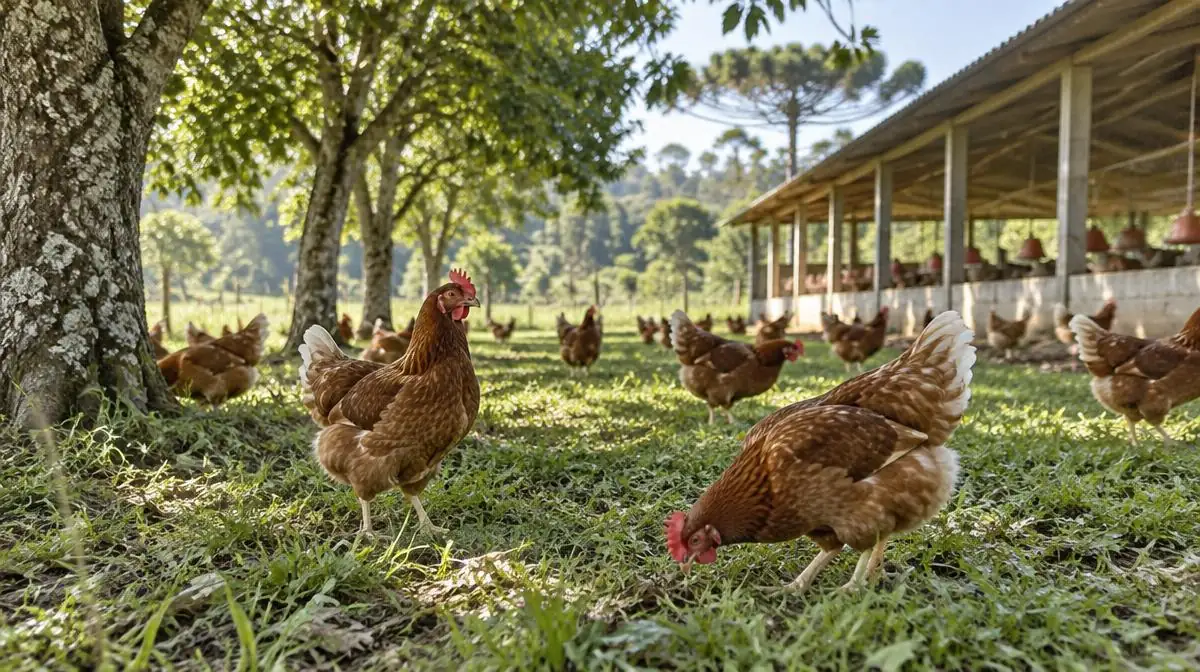
- Outdoor access: animals must have access to an outdoor area for at least part of the day; housed animals must be able to go outside for at least 6 hours in daylight, except in disease or severe-weather situations reported to the certifier; permanent confinement in cages or houses is not allowed (Arts. 38–39).
- Density: indoors, at most 7 laying hens per m² and 30 kg of broilers per m²; outdoors, 3 m² per hen (extensive) or 0.8 m² per hen (rotational paddock), and 2 m² per broiler (extensive) or 0.4 m² (rotational) (Arts. 43–44).
- Shade: outdoor areas need enough tree cover to shade all birds; where it is missing, there are 5 years to establish it, with artificial shade meanwhile (Arts. 40–41).
- Feed: feed must come from organic production; in scarcity or special conditions under the approved organic management plan, up to 20% of daily dry-matter intake may be non-organic feed for poultry and other non-ruminants, and it must not contain GMOs (Art. 34).
- Practices: debeaking is not allowed, though anatomical beak trimming in the hatchery is; forced moulting is not allowed; artificial lighting must leave at least 8 hours of darkness a day (Arts. 51–53).
- Health: vaccines and tests required by animal-health law remain mandatory; if a non-authorised medicine is used for a suffering animal, the withdrawal period doubles and is at least 96 hours, a bird may be treated this way at most twice in 12 months, and every treatment is logged (Arts. 62–64).
- Transport and slaughter must reduce pain, follow humane slaughter procedures and meet the specific official legislation (Art. 57).
Sources: [4]
How to check organic status before an offer is compared
- Commercial channels need certification. MAPA states that producers registered only for direct sale without certification may sell at fairs or directly to consumers and to government purchases (school meals and CONAB), but not to third parties such as supermarkets, shops, restaurants, hotels or industry.
- Certification routes: audit certification by a MAPA-accredited certifier, or a participatory guarantee system run through an accredited OPAC. Both issue the SisOrg seal.
- An invoice that describes a product as organic is not a full guarantee of origin. Ask for the SisOrg seal on labels; for products that are not pre-packed, ask for a copy of the organic certificate and a Declaração de Transação Comercial, which the producer or the certifier can issue.
- Check the producer in the CNPO. MAPA's register is usually refreshed on the 5th, 15th and 25th of each month, so record the date you checked it.
- Restaurants, cafés and hotels that serve organic dishes or ingredients must keep lists of the organic ingredients and their suppliers available to customers, which matters for institutional catering contracts.
Exporting: Brazilian organic status does not carry over automatically
- European Union: when checked on 23 October 2026, Brazil was not among the countries the European Commission lists under organic trade agreements or equivalence recognition. Products from other countries can be sold as organic in the EU only when certified by a control body or authority recognised by the Commission for that product category.
- United States: Brazil was not on USDA's list of organic equivalence partners (page last updated June 2026). Each organic shipment into the US needs an electronic NOP Import Certificate, and businesses exporting organic products for sale in the US must themselves be certified.
- Into Brazil: MAPA states that products certified under foreign standards such as NOP, EU or JAS are not automatically recognised as organic in Brazil and must be certified to the Brazilian standard.
- Organic certification never replaces sanitary requirements. Animal-origin products also need an establishment approved for the destination (check MAPA's list of establishments enabled for export by country), veterinary certificates and the importer's permits.
Market context, dated and scoped
The Global Organic Trade Guide, citing Euromonitor International data, puts Brazil's market for organic packaged food and beverages at US$2,425.7 million in 2023 and the largest in Latin America. That category covers packaged food and drinks; it is not a measure of demand for fresh organic eggs or poultry meat, and no comparable figure for those products is used here.
Brazilian buyers already have several kinds of channel. As described on their own websites when checked on 23 October 2026: Veranum presents itself as a platform connecting rural producers and distributors to trade organic and conventional products wholesale; Mercado B2bio describes itself as a B2B marketplace for Brazil's bioeconomy, with verified suppliers and buyer demand posts that receive quotes; and Organis is a sector association that gives the organic sector visibility through its member brands. These are different models with different purposes. None is a HatchMatch partner, and the links are market context, not contact routes.
HatchMatch's focus is narrower: buyer-side briefs for poultry and eggs in which the exact claim and its evidence are written into the RFQ and reviewed by a person before any producer is approached.
Organic poultry and egg RFQ checklist
- Product: shell eggs (size, grade, shell colour), egg products, whole broilers or cuts (fresh, chilled or frozen), day-old chicks or pullets — one line per product.
- Scale: volume per delivery, delivery frequency, contract length and total programme value.
- Claim wording: the exact claims required on the label and the standard that defines each (Brazilian SisOrg organic, EU organic, USDA organic or another scheme).
- Certificates and labels: certifier or OPAC name, certificate scope covering the product and production unit, validity dates, CNPO entry and check date, SisOrg seal artwork, and per-lot transaction declarations.
- Feed standard: source and certification of the organic feed, any non-organic share allowed under the approved plan, and non-GMO documentation.
- Housing and welfare evidence: outdoor-access arrangements, indoor and outdoor densities, shade, lighting, beak practice, and any separate welfare or cage-free certificate with its audit date.
- Health records: vaccination programme, treatment log and how withdrawal periods are handled.
- Chicks and pullets: organic origin, or certifier approval for non-organic birds within the age limits; hatchery health certificates; transport conditions.
- Slaughter and packing: establishment registration and official inspection (for example, the federal SIF number), whether the slaughter or packing unit is covered by the organic certification, and labelling.
- Cold chain: temperature range, storage, shelf life, packaging and transport mode.
- Destination and export documents: country, the buyer's import permits, destination organic regime and control body, establishment eligibility, veterinary certificates, export documents and Incoterm.
- Responsibilities: the producer or exporter supplies and maintains compliance evidence; the buyer confirms its own import requirements and due diligence.
How HatchMatch handles an organic poultry or egg brief
Buyers pay nothing. A person reviews every brief, runs trade-compliance screening and, where the brief qualifies, contacts suitable producers or exporters on the buyer's behalf. There is no direct buyer–supplier contact through the platform, and HatchMatch does not promise availability, responses or prices.
HatchMatch arranges sourcing and RFQs; it does not produce, sell or export poultry or eggs, and it does not certify, audit or confirm organic status. Documents a producer provides are shown as supplier-provided evidence to be checked against the certifier and the CNPO. The producer or exporter remains responsible for complying with MAPA and destination-market rules, and the buyer for its own import permissions and local requirements, as applicable law provides.
Buyer questions
- Is free-range or cage-free the same as organic?
- No. In Brazil only the organic claim is defined by the organic legislation and requires certification by a MAPA-accredited body. Free-range, caipira, cage-free and similar claims mean whatever the named standard or scheme defines, so ask which standard applies and for its evidence.
- Does an organic certificate also prove free-range, cage-free, pasture-raised or antibiotic-free claims?
- No. An organic certificate covers the organic claim for the product and production unit it names. Brazil's organic rules include outdoor access and limits on treatments, but a separate free-range, cage-free, pasture-raised or antibiotic-free claim is defined by its own standard or by your specification, and needs its own evidence.
- Does organic mean the birds were never given antibiotics?
- Not necessarily. Brazil's organic rules allow a sick animal to be treated exceptionally with non-authorised medicines, with a doubled withdrawal period of at least 96 hours and at most two such treatments in 12 months. If you need an antibiotic-free claim, specify it separately with its definition and evidence.
- Can a producer registered for direct sale supply a supermarket chain or caterer?
- No. According to MAPA, producers registered for direct sale without certification may sell directly to consumers and to government purchases, but not to third parties such as supermarkets, restaurants, hotels or industry. Commercial supply needs certification.
- Which producer documents should a buyer request?
- The organic certificate naming the product, production unit, certifier or OPAC and validity dates; the producer's CNPO entry with the date you checked it; SisOrg seal artwork for packed products or a Declaração de Transação Comercial per lot; feed certificates; vaccination and treatment records; the slaughter or packing plant's official inspection registration; and, for export, destination organic and veterinary certificates. Treat each document as evidence to confirm with its issuer.
- What specifications belong in an organic egg or poultry RFQ?
- One line per product (shell eggs, egg products, whole birds or cuts, chicks or pullets) with size or grade, fresh, chilled or frozen presentation, volume per delivery, frequency and contract length; the exact label claims and the standard behind each; packaging and labelling; cold-chain temperature and shelf life; and destination, Incoterm and required documents.
- Is Brazilian organic certification valid in the EU or the United States?
- Not automatically. When checked on 23 October 2026, Brazil was not on the European Commission's list of recognised countries or USDA's equivalence list. Exports sold as organic there need certification under the destination regime, plus the usual sanitary and import documents.
- Which rules should a buyer check before contracting?
- Check MAPA's current rules and the producer's CNPO entry when you contract, and the destination market's organic, sanitary and import rules for that exact product. This page summarises rules as read on 23 October 2026; it does not confirm that any practice or document is legally sufficient. Confirm with the certifier, the competent authorities and, where needed, a legal adviser.
- Does HatchMatch certify or guarantee that a supplier is organic?
- No. HatchMatch does not certify, audit or guarantee any supplier, bird, egg or feed. Organic status must be verified with the applicable authority or certifier and product-specific documents, and HatchMatch makes no health or quality-superiority claims about organic products.
Send an organic poultry or egg sourcing brief
Product sourcing briefs start from USD 250,000 in total programme value. Buyers pay nothing, and a person reviews every brief before any producer is contacted on your behalf.
Start a poultry and egg sourcing requestRelated tools and guides
- Table egg and egg product trade lanes
- Check a frozen chicken supplier
- Day-old chick and hatching egg sourcing
- Import permits and veterinary certificates
- Trade restrictions register
- Poultry equipment projects in Brazil
- Produce sourcing — Global B2B Group (group site)
- Seeds and crop inputs — SeedMatch Group (group site)
Sources
Official texts and international standards are cited directly. Breeder-company figures are manufacturer guidance, not law.
- [1] Regularização da Produção Orgânica Ministério da Agricultura e Pecuária (MAPA), Brazil · Official text · Page updated 30 Sep 2026
- [2] O que são Produtos Orgânicos? Ministério da Agricultura e Pecuária (MAPA), Brazil · Official text · Page updated 10 Oct 2025
- [3] Cadastro Nacional de Produtores Orgânicos (CNPO) Ministério da Agricultura e Pecuária (MAPA), Brazil · Official text · Page updated 21 Oct 2026; data usually refreshed on the 5th, 15th and 25th of each month
- [4] Portaria MAPA nº 52, de 15 de março de 2021 — Regulamento Técnico para os Sistemas Orgânicos de Produção Ministério da Agricultura, Pecuária e Abastecimento (MAPA), Brazil · Official text · 15 Mar 2021 (MAPA-published text, read 23 Oct 2026)
- [5] Estabelecimentos habilitados à exportação por país Ministério da Agricultura e Pecuária (MAPA), Brazil · Official text
- [6] Trade in organics (importing organic produce into the EU) European Commission, Agriculture and Rural Development · Official text
- [7] International Trade Partners (National Organic Program) USDA Agricultural Marketing Service · Official text · Last updated June 2026
- [8] Global Organic Trade Guide: Brazil Organic Trade Association (data from Euromonitor International Passport) · Market data (secondary) · 2023 data; organic packaged food and beverages only
- [9] Veranum Alimentos Veranum (company website) · Organisation website (market context)
- [10] Mercado B2bio Mercado B2bio (company website) · Organisation website (market context)
- [11] Organis — Organic Brasil Organis (sector association website) · Organisation website (market context)
Procurement planning information, not legal advice or a certification decision. Rules were read on the date shown above and can change; organic status must be verified by the applicable authority or certifier and product-specific documents. The producer or exporter is responsible for compliance with MAPA and destination rules, and the buyer for its own import requirements. Company websites are cited only as market context.
Also available in: Português