
Poultry Feed Mill Equipment: Capacity, Grinding, Mixing, Pelleting — How to Specify and Buy
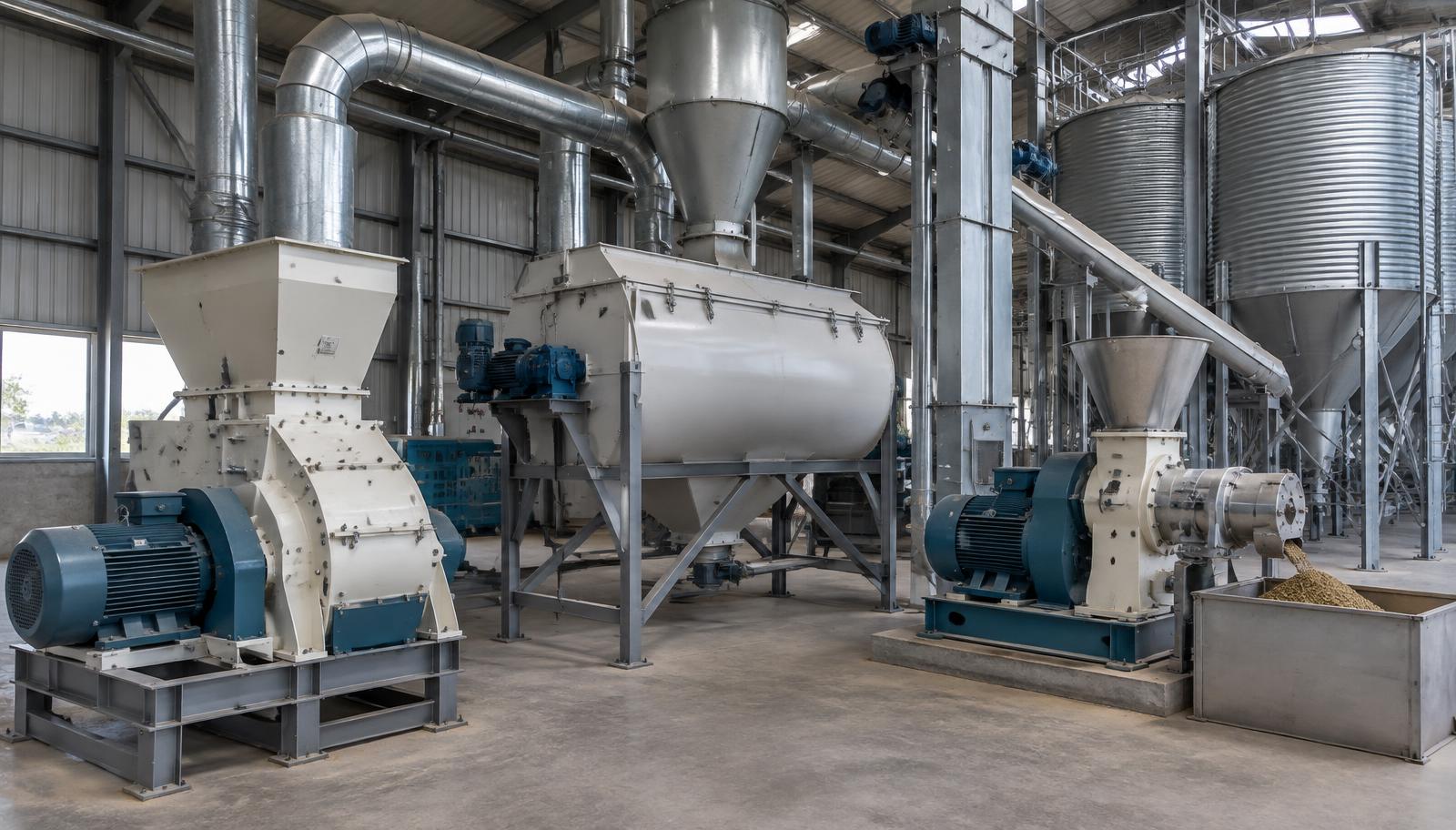
A buyer's guide to on-farm or commercial poultry feed mills: sizing capacity to bird numbers, choosing grinding and mixing equipment, deciding on pelleting, and writing a specification suppliers can price on the same basis.
By HatchMatch Group Sourcing Desk · Last updated 2026-10-08
In short
Short answer. A poultry feed mill turns raw ingredients into finished feed through four stages: receiving and storage, grinding, mixing (often with liquid addition), and, where mash is not fed directly, pelleting and cooling. Capacity is set by daily feed demand across your flocks at peak, not by the heaviest single day.
Key takeaways
- Feed is typically the largest recurring cost in a poultry operation, so the mill that produces it affects margin every single day, not just at startup.
- Start from bird numbers and feed intake by age, not from a round tonnage figure.
- | Grinding method | Typical use | Main buying points | |---|---|---| | Hammer mill | Most common for poultry feed; flexible across ingredients | Screen size range, hammer pattern, airflow/aspiration, noise and dust control, screen wear life | | Roller mill | Preferred where particle-size uniformity matters most | Roll gap adjustment, roll surface and wear life, lower energy use per tonne than many hammer mills, narrower particle-size distribution |
- The mixer blends ground ingredients, minerals, vitamins and often liquids (fat, oil or molasses) into a uniform batch.
- Not every farm needs pellets; many smaller broiler and layer operations feed mash.
Short answer. A poultry feed mill turns raw ingredients into finished feed through four stages: receiving and storage, grinding, mixing (often with liquid addition), and, where mash is not fed directly, pelleting and cooling. Capacity is set by daily feed demand across your flocks at peak, not by the heaviest single day. Specify grinding method, mixer type and accuracy, batching and automation level, and pelleting throughput together, because the slowest stage sets the whole line's real output. Confirm final sizing with your nutritionist and each supplier's own capacity calculation.
This guide is for broiler, layer and breeder operations deciding whether to build an on-farm feed mill or a larger commercial mill supplying several farms, and for teams writing the equipment specification. It explains the main decisions in plain terms and lists what to put in a request for quotation (RFQ). Throughput figures, screen sizes and formulation details vary by ingredient, bird type and local feed regulations — always confirm them with your nutritionist, miller and supplier.
Why feed mill capacity decides more than it looks like
Feed is typically the largest recurring cost in a poultry operation, so the mill that produces it affects margin every single day, not just at startup. An undersized mill cannot keep up during peak demand — multiple flocks finishing at once, or a layer flock at peak production — and farms end up buying emergency feed at a premium or running out. An oversized mill ties up capital in idle equipment and buildings. Both mistakes trace back to the same cause: sizing from a single rough number instead of a written feed demand schedule covering every house, every growth stage and the busiest week of the year.
Sizing capacity to your flocks
Want these figures for your own site, capacity and country? A HatchMatch specialist builds the budget with you — no buyer fees.
Start freeStart from bird numbers and feed intake by age, not from a round tonnage figure. List every house, its placement schedule and the feed curve each bird type follows from day one to market or culling age; layer and breeder flocks need separate curves from broilers. Add the diet changes over the cycle — pre-starter, starter, grower, finisher or the equivalent layer phases — because each change can mean a different formulation batch. The feed silo calculator and farm cost calculator help with preliminary storage and budget planning; both give planning estimates, not supplier prices or guaranteed mill output.
Size the mill to your busiest week, including a margin for flock overlap, future expansion and planned downtime for maintenance and cleaning. Ask each supplier to state throughput in tonnes per hour for your actual formulation and screen or die configuration, not a generic figure from their brochure, because moisture content, ingredient mix and particle size all change real output.
Grinding: hammer mills and roller mills
| Grinding method | Typical use | Main buying points |
|---|---|---|
| Hammer mill | Most common for poultry feed; flexible across ingredients | Screen size range, hammer pattern, airflow/aspiration, noise and dust control, screen wear life |
| Roller mill | Preferred where particle-size uniformity matters most | Roll gap adjustment, roll surface and wear life, lower energy use per tonne than many hammer mills, narrower particle-size distribution |
Particle size affects feed conversion and, for some diets, gizzard development, so ask your nutritionist for the target particle size before choosing equipment. Ask suppliers for a particle-size distribution test on your own ingredients, not a generic sample, and ask how screens or rolls are replaced and how long they typically last under your ingredient mix.
Mixing, liquid addition and batching accuracy
The mixer blends ground ingredients, minerals, vitamins and often liquids (fat, oil or molasses) into a uniform batch. Specify mixer type (horizontal paddle or ribbon mixers are common), batch size matched to your formulation batches, mixing time, and a liquid-addition system with its own metering. Ask for the coefficient of variation the supplier guarantees for mixing uniformity and how it is tested, because an uneven mix means some birds get too little of a nutrient and others too much, particularly for medicated feeds and premixes added in small quantities.
Pelleting, cooling and crumbling
Not every farm needs pellets; many smaller broiler and layer operations feed mash. Where pelleting is used, ask about die specification (thickness and hole diameter for your formulation), conditioning (steam conditioning improves pellet durability and can support some pathogen control), cooling capacity and time, and whether crumbling is needed for starter diets. Pellet quality is usually judged by durability under handling — ask suppliers to state the pellet durability index their design targets for your formulation and how they test it, rather than accepting a general claim.
Automation, batching control and hygiene
A batching controller that weighs and sequences ingredients, records batch data and logs formulation changes reduces human error and gives traceability, which matters for recalls and for medicated feed withdrawal periods. Decide how much automation you need: fully automatic batching, semi-automatic with operator confirmation, or manual weighing for a small on-farm mill. Specify dust control and aspiration throughout the line, washdown or flushing between medicated and non-medicated batches, and pest and rodent control in the receiving and storage areas, because contamination risk runs the length of the mill, not just at one station.
What to include in the RFQ
A feed mill RFQ that suppliers can price on the same basis should state: daily and peak tonnage required, by feed phase; number of formulations and expected changeovers per day; ingredient list including any liquids; target particle size and pellet specification if applicable; batching accuracy and automation level required; dust, hygiene and medicated-feed segregation requirements; building dimensions or a request for the supplier to propose a layout; power supply and backup; and scope of installation, commissioning, training and spare parts. Ask for the delivery basis and named place (see our guide to Incoterms for poultry equipment imports) and the warranty terms in writing.
Questions to ask every supplier
What real throughput in tonnes per hour will your line reach on our formulation, grind size and moisture content? What particle-size distribution and pellet durability index does your design target, and how do you test it? What coefficient of variation do you guarantee for mixing uniformity, and how do you verify it? How is medicated feed segregated from non-medicated feed in your layout? Which components are made by you and which are bought in, and who supplies spare parts locally? What training and documentation come with commissioning? Ask for answers in writing and compare them in one table.
Common mistakes
Sizing the mill from a single tonnage figure instead of a feed demand schedule across all houses and growth stages. Choosing grinding and mixing equipment before confirming target particle size and mixing accuracy with a nutritionist. Underestimating the mill's real throughput on your actual ingredients versus the brochure figure. Skipping dust and hygiene segregation for medicated feed. Comparing quotes that assume different automation levels, batch sizes or building scopes. And leaving spare parts and local service out of the comparison.
Where HatchMatch fits
HatchMatch is a supplier-neutral procurement platform for commercial poultry projects, typically USD 250,000 and above. It is not a manufacturer, installer, EPC contractor or consultant, and it does not sign supply contracts — buyers contract directly with the suppliers they choose. HatchMatch helps you turn your requirements into one written specification so offers can be compared line by line. Every brief receives human review, and HatchMatch aims to reply within two business days. To start, submit a poultry project request with your flock numbers, feed demand and timeline.
FAQ
Should I build an on-farm feed mill or buy from a commercial mill? It depends on scale, feed cost sensitivity, ingredient access and distance to a reliable commercial supply. Many mid-size and larger projects find an on-farm mill pays back through lower per-tonne feed cost and supply security; size and compare both options with your nutritionist and the farm cost calculator.
Do I need a pellet mill or is mash enough? Many broiler and layer operations run well on mash, especially at smaller scale. Pelleting can improve feed conversion and reduce waste for some diets and ages, but it adds equipment, energy cost and maintenance. Ask your nutritionist which diets in your programme benefit most.
How do I know if my mill is correctly sized? Build a feed demand schedule covering every house and growth stage at your busiest week, add a margin for overlap and downtime, and ask suppliers to confirm throughput on your actual formulation rather than a brochure figure.
What causes uneven feed quality most often? Inconsistent grinding (worn screens or rolls), an undersized or poorly maintained mixer, and liquid-addition systems without accurate metering are common causes. Ask suppliers for guaranteed mixing uniformity and particle-size test results on your own ingredients.
How does feed milling connect to other farm systems? Feed demand, storage and delivery should be planned together with ventilation, lighting and water systems since they all scale with bird numbers; see our guides on feed silos and feed lines and drinking water systems, and use the ventilation calculator and poultry lighting calculator for related planning.
Frequently asked questions
- What real throughput in tonnes per hour will your line reach on our formulation, grind size and moisture content?
- What particle-size distribution and pellet durability index does your design target, and how do you test it? What coefficient of variation do you guarantee for mixing uniformity, and how do you verify it? How is medicated feed segregated from non-medicated feed in your layout? Which components are made by you and which are bought in, and who supplies spare parts locally? What training and documentation come with commissioning? Ask for answers in writing and compare them in one table.
- Should I build an on-farm feed mill or buy from a commercial mill?
- It depends on scale, feed cost sensitivity, ingredient access and distance to a reliable commercial supply. Many mid-size and larger projects find an on-farm mill pays back through lower per-tonne feed cost and supply security; size and compare both options with your nutritionist and the farm cost calculator.
- Do I need a pellet mill or is mash enough?
- Many broiler and layer operations run well on mash, especially at smaller scale. Pelleting can improve feed conversion and reduce waste for some diets and ages, but it adds equipment, energy cost and maintenance. Ask your nutritionist which diets in your programme benefit most.
- How do I know if my mill is correctly sized?
- Build a feed demand schedule covering every house and growth stage at your busiest week, add a margin for overlap and downtime, and ask suppliers to confirm throughput on your actual formulation rather than a brochure figure.
- What causes uneven feed quality most often?
- Inconsistent grinding (worn screens or rolls), an undersized or poorly maintained mixer, and liquid-addition systems without accurate metering are common causes. Ask suppliers for guaranteed mixing uniformity and particle-size test results on your own ingredients.
- How does feed milling connect to other farm systems?
- Feed demand, storage and delivery should be planned together with ventilation, lighting and water systems since they all scale with bird numbers; see our guides on feed silos and feed lines and drinking water systems, and use the ventilation calculator and poultry lighting calculator for related planning.
More buyer questions are answered in our poultry procurement FAQ — also available in Español, Français, Português, Deutsch, العربية, Русский, Türkçe, Tiếng Việt.
From this article to a procurement-ready RFQ
HatchMatch Group is an independent sourcing desk — not a manufacturer or EPC contractor. These are the four steps we actually use with commercial poultry and hatchery buyers. If you are still deciding scope, start with what commercial poultry equipment includes and how suppliers are compared.
- 1. Plan the projectCapacity, climate and house layout in one guided workflowOpen
- 2. Build the RFQScope, specifications and comparable line itemsOpen
- 3. Submit the requestReviewed manually before any supplier introductionOpen
- 4. Track and compareFollow status and normalise supplier responsesOpen
Prefer the numbers first? Start with the poultry project cost calculator or browse the project planning guides.