
Broiler Processing Plant Equipment: Line Speed, Scalding, Evisceration and Chilling — How to Specify and Buy
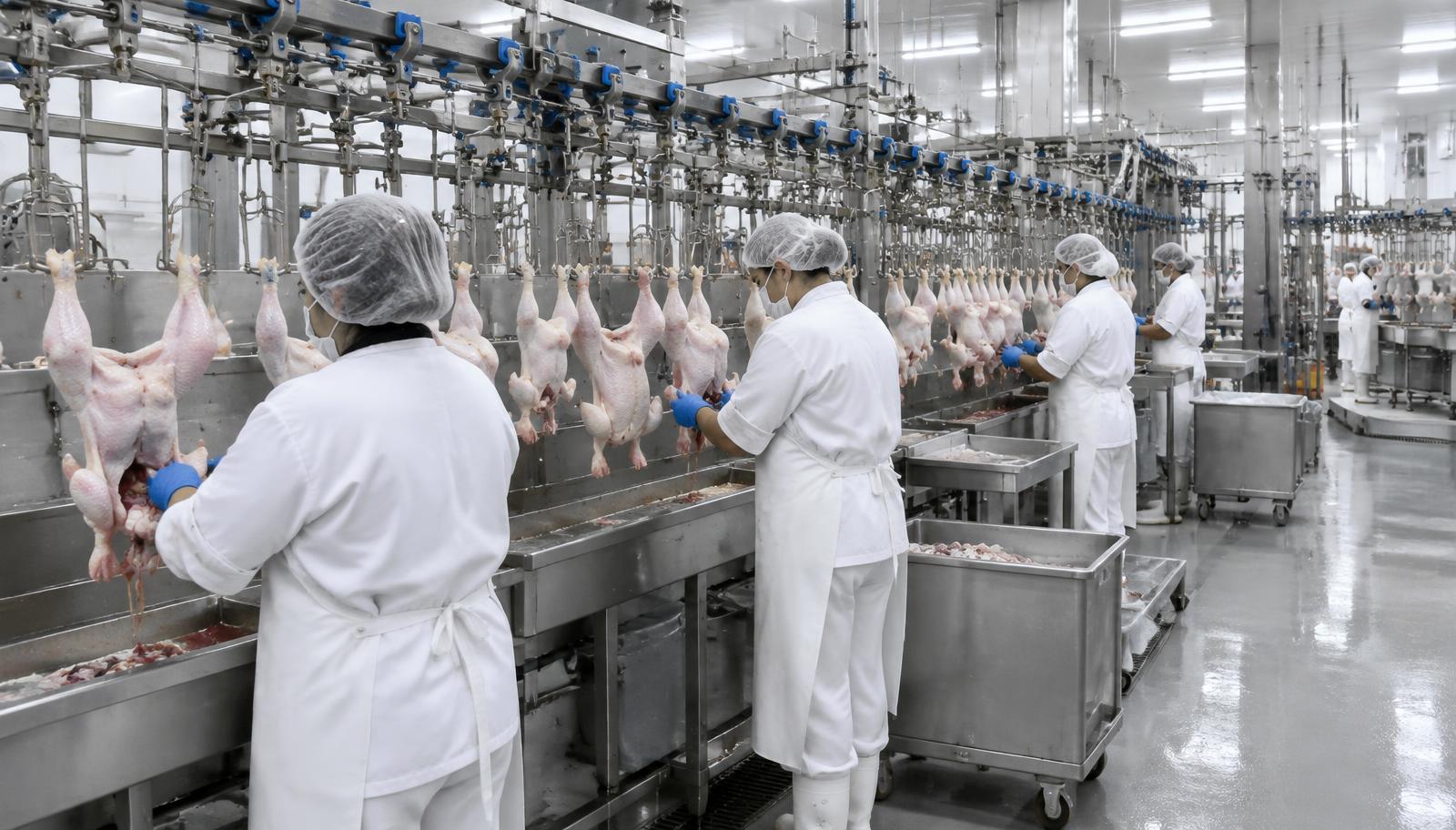
A buyer's guide to broiler processing plant equipment: matching line speed to your farm supply, choosing scalding and evisceration systems, sizing chilling, and writing a spec suppliers can quote on the same basis.
By HatchMatch Group Sourcing Desk · Last updated 2026-10-08
In short
Short answer. A broiler processing line moves birds through receiving, stunning and slaughter, scalding, defeathering, evisceration, washing and chilling, before cut-up or whole-bird packing. The central buying decision is line speed — birds processed per hour — because every other machine (scald tank length, pluckers, eviscerator stations, chiller volume) is sized from that number.
Key takeaways
- Line speed is usually expressed in birds per hour (BPH).
- | Stage | What it does | Main specification points | |---|---|---| | Receiving and hanging | Crates or modules unloaded, birds hung on shackles | Shackle pitch for your bird size, hanging area ventilation, crate-washing capacity | | Stunning and slaughter | Birds stunned, then bled over a collection trough | Stunning method compliant with your market's welfare rules, bleed time and trough length | | Scalding | Hot water loosens feathers before plucking | Scald temperature and time (soft or hard scald), tank type (counter-flow multi-stage reduces water and cross-contamination), water turnover rate | | Defeathering | Rotating rubber fingers remove feathers | Picker bank length matched to line speed, finger type for bird size, feather and waste water handling | | Evisceration | Opening, viscera removal, inspection, washing | Manual, semi-automatic or automatic eviscerator; inspection stations per food-safety rules; giblet harvesting if required | | Final wash and chilling | Carcasses washed, then chilled to safe storage temperature | Air chill or water (immersion) chill, chiller residence time, target carcass temperature, water or air usage | | Grading, cut-up and packing | Whole-bird grading or portioning, weighing, packing | Automatic grading by weight, cut-up line stations, packing and labelling equipment |
- Scalding loosens feather follicles so pluckers can remove feathers without tearing skin.
- Evisceration is usually the stage with the most variation between budgets: fully manual lines cost less to install but need more trained staff and more inspection stations; automatic eviscerator lines cost more but hold a more consistent cycle and can reduce contamination risk when properly maintained.
- Chilling must bring carcasses down to a safe internal temperature within a defined time, and the method affects both product yield and plant layout.
Short answer. A broiler processing line moves birds through receiving, stunning and slaughter, scalding, defeathering, evisceration, washing and chilling, before cut-up or whole-bird packing. The central buying decision is line speed — birds processed per hour — because every other machine (scald tank length, pluckers, eviscerator stations, chiller volume) is sized from that number. Start from your farm's weekly bird supply and target shifts, not from the fastest line a supplier offers, and confirm every capacity figure against your own throughput plan, local food-safety rules and the supplier's own calculation.
This guide is for investors, integrators and project teams specifying a new broiler processing plant or expanding an existing one, typically for projects of USD 250,000 and above. It explains the main equipment groups in plain terms and lists what to put in a request for quotation (RFQ) so offers can be compared fairly. Exact capacities, water volumes and chill times vary by bird size, equipment brand and local regulation — always confirm them with the supplier's engineering calculation and your food-safety authority.
Start from line speed, not from a brand's standard model
Line speed is usually expressed in birds per hour (BPH). It should come from your own numbers: weekly birds available from contracted or owned farms, the number of shifts you plan to run, and the days per week the plant operates. A plant sized for a line speed the farm supply cannot sustain sits idle; one sized too small becomes the bottleneck that limits how many broiler houses you can place. Work the two together — the birds per house calculator and farm cost calculator help size the growing side and the overall project budget, giving planning estimates rather than supplier prices.
Ask each supplier to quote their equipment at your stated line speed, not at their catalogue maximum, and to show the bottleneck calculation — the slowest station on the line sets the real throughput regardless of how fast the shackle conveyor moves.
Want these figures for your own site, capacity and country? A HatchMatch specialist builds the budget with you — no buyer fees.
Start freeThe line in order: what each stage does and what to specify
| Stage | What it does | Main specification points |
|---|---|---|
| Receiving and hanging | Crates or modules unloaded, birds hung on shackles | Shackle pitch for your bird size, hanging area ventilation, crate-washing capacity |
| Stunning and slaughter | Birds stunned, then bled over a collection trough | Stunning method compliant with your market's welfare rules, bleed time and trough length |
| Scalding | Hot water loosens feathers before plucking | Scald temperature and time (soft or hard scald), tank type (counter-flow multi-stage reduces water and cross-contamination), water turnover rate |
| Defeathering | Rotating rubber fingers remove feathers | Picker bank length matched to line speed, finger type for bird size, feather and waste water handling |
| Evisceration | Opening, viscera removal, inspection, washing | Manual, semi-automatic or automatic eviscerator; inspection stations per food-safety rules; giblet harvesting if required |
| Final wash and chilling | Carcasses washed, then chilled to safe storage temperature | Air chill or water (immersion) chill, chiller residence time, target carcass temperature, water or air usage |
| Grading, cut-up and packing | Whole-bird grading or portioning, weighing, packing | Automatic grading by weight, cut-up line stations, packing and labelling equipment |
Use this table as a planning checklist, not a fixed design — the balance of manual versus automatic stations depends heavily on local labour cost, line speed and your target market's specification requirements.
Scalding: soft, hard and water management
Scalding loosens feather follicles so pluckers can remove feathers without tearing skin. Soft scald uses a lower temperature and is common where buyers want skin left on for retail whole birds; hard scald uses a higher temperature, removes feathers more completely and also loosens the outer skin layer, which is why it is more common ahead of further processing. Ask suppliers to state the temperature range their tank is designed for, how many stages the tank has (multi-stage counter-flow tanks generally use less fresh water per bird and carry over less contamination between stages than a single tank), and the water heating method and its energy demand. Scald tank length, not just speed, has to match line speed so birds spend the planned time in the water.
Evisceration and inspection: match the line to your market's rules
Evisceration is usually the stage with the most variation between budgets: fully manual lines cost less to install but need more trained staff and more inspection stations; automatic eviscerator lines cost more but hold a more consistent cycle and can reduce contamination risk when properly maintained. Whichever you choose, ask the supplier to confirm how many inspection stations and inspectors the design assumes, and check that figure against your local food-safety authority's requirements — these vary by country and by export market. Also ask how offal and giblets are separated, washed and chilled if you plan to sell them, and how condemned carcasses and viscera are removed from the line without crossing clean product.
Chilling: air or water, and why residence time matters
Chilling must bring carcasses down to a safe internal temperature within a defined time, and the method affects both product yield and plant layout. Water (immersion) chillers use large volumes of chilled, often counter-flow water and can add some water weight to the carcass within regulatory limits; air chillers use refrigerated air and generally use far less water but need more floor and cooling capacity. Ask each supplier to state: residence time at your line speed, target carcass outlet temperature, water or air flow rate, and refrigeration load in kW so your electrical and generator sizing accounts for it. The poultry generator sizing calculator gives a first estimate of backup power needs for a plant with chillers and compressors on site; confirm the final load with the equipment supplier's electrical schedule.
Utilities, drainage and effluent — plan them with the line, not after it
A processing plant uses large volumes of hot and cold water, generates high-organic-load wastewater, and needs continuous power for stunning, refrigeration and sanitation equipment. Ask suppliers for water consumption per bird at each stage, drainage and floor-slope requirements, and the capacity of any pre-treatment or effluent system they recommend before discharge — local environmental rules typically require treatment before water leaves the site, and your civil contractor needs these figures early, not after equipment arrives. Confirm backup power needs with the generator sizing calculator above, since a power loss mid-line affects both food safety and animal welfare.
What to include in the RFQ
A processing-line RFQ that suppliers can price on the same basis should state: target line speed in birds per hour and planned operating hours/shifts per day; average live weight range; scope (whole-bird only, or cut-up and further processing); scald type and target skin condition; evisceration automation level and inspection station count required by your food-safety authority; chilling method and target outlet temperature; utilities available on site (water source, power supply) and what the supplier assumes the buyer will provide; hygiene and sanitation equipment (CIP systems, hand-wash and boot-wash stations); stainless steel and construction standards; and the scope of installation, commissioning, training and spare parts. Ask for the delivery basis and named place (see our guide to Incoterms for poultry equipment imports) and warranty terms in writing — see our guide to warranty and spare parts terms for the clauses to check before you sign.
Questions to ask every supplier
At our stated line speed, which station is the bottleneck, and how did you calculate it? What inspection station count does your evisceration design assume, and does it meet our food-safety authority's rules? What is the water consumption per bird at scalding, washing and chilling, and what effluent load should our civil engineer plan for? What is the refrigeration and total electrical load, in kW, at full line speed? Which components are made by you and which are bought in, and who services them locally? What spare parts do you recommend holding on site, and at what lead time? Request written answers and compare them in one table before awarding.
Common mistakes
Sizing the line to a supplier's maximum catalogue speed instead of your actual farm supply. Choosing automation level before checking what your local food-safety rules require for inspection stations. Treating water and effluent capacity as a civil-works afterthought instead of a line specification. Comparing quotes where one assumes manual evisceration and another automatic, without adjusting labour cost in the comparison. Leaving chiller and refrigeration electrical load out of the generator sizing. And skipping a written spare-parts and service-response commitment for a plant that cannot stop mid-shift without a food-safety and welfare problem.
Where HatchMatch fits
HatchMatch is a supplier-neutral procurement platform for commercial poultry projects, typically USD 250,000 and above. It is not a manufacturer, installer, EPC contractor or consultant, and it does not sign supply contracts — buyers contract directly with the suppliers they choose. HatchMatch helps you turn your line-speed, capacity and food-safety requirements into one written specification so offers can be compared line by line. Every brief receives human review, and HatchMatch aims to reply within two business days. To start, submit a poultry project request with your target line speed, bird supply, country and timeline.
FAQ
What line speed should a first commercial plant target? It depends entirely on your farm supply and shift plan — size the plant to the birds you can reliably deliver each week, with room to grow, rather than to a supplier's largest standard model.
Is automatic evisceration always better than manual? Not necessarily. It costs more to install and maintain but can hold a more consistent cycle at higher line speeds; at lower speeds or where skilled labour is available and affordable, manual or semi-automatic lines are common and compliant choices. Confirm inspection requirements with your local authority either way.
Air chill or water chill — which should we choose? Both are used commercially worldwide; the choice depends on your target market's rules on added water weight, available water supply, floor space and energy budget. Ask suppliers to quote both if you have not decided.
How much water does a processing plant use? It varies by scald type, chiller method and plant design, so ask each supplier for a water-consumption-per-bird figure at every stage rather than relying on a general industry number, and size your supply and effluent system to that confirmed figure.
Do we need a civil engineer involved before choosing equipment? Yes — drainage slope, floor finishes, hot and cold water supply and effluent pre-treatment all depend on the equipment layout, so bring civil and equipment planning together early rather than fitting the building around equipment chosen in isolation.
Frequently asked questions
- What line speed should a first commercial plant target?
- It depends entirely on your farm supply and shift plan — size the plant to the birds you can reliably deliver each week, with room to grow, rather than to a supplier's largest standard model.
- Is automatic evisceration always better than manual?
- Not necessarily. It costs more to install and maintain but can hold a more consistent cycle at higher line speeds; at lower speeds or where skilled labour is available and affordable, manual or semi-automatic lines are common and compliant choices. Confirm inspection requirements with your local authority either way.
- How much water does a processing plant use?
- It varies by scald type, chiller method and plant design, so ask each supplier for a water-consumption-per-bird figure at every stage rather than relying on a general industry number, and size your supply and effluent system to that confirmed figure.
- Do we need a civil engineer involved before choosing equipment?
- Yes — drainage slope, floor finishes, hot and cold water supply and effluent pre-treatment all depend on the equipment layout, so bring civil and equipment planning together early rather than fitting the building around equipment chosen in isolation.
More buyer questions are answered in our poultry procurement FAQ — also available in Español, Français, Português, Deutsch, العربية, Русский, Türkçe, Tiếng Việt.
From this article to a procurement-ready RFQ
HatchMatch Group is an independent sourcing desk — not a manufacturer or EPC contractor. These are the four steps we actually use with commercial poultry and hatchery buyers. If you are still deciding scope, start with what commercial poultry equipment includes and how suppliers are compared.
- 1. Plan the projectCapacity, climate and house layout in one guided workflowOpen
- 2. Build the RFQScope, specifications and comparable line itemsOpen
- 3. Submit the requestReviewed manually before any supplier introductionOpen
- 4. Track and compareFollow status and normalise supplier responsesOpen
Prefer the numbers first? Start with the poultry project cost calculator or browse the project planning guides.