
Broiler Pan Feeder and Nipple Drinker Lines: Birds per Pan, Line Layout and Winches Explained
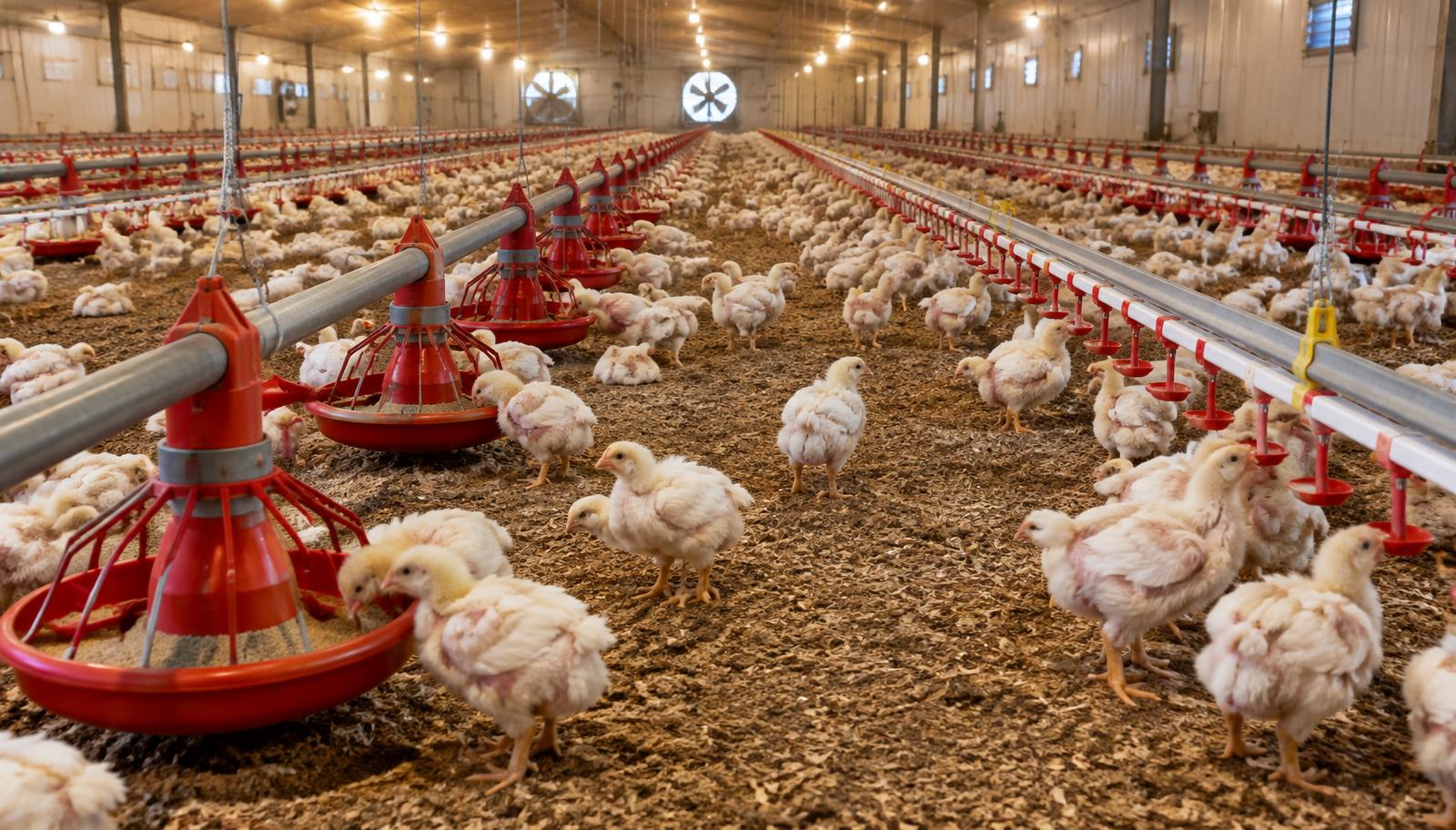
A practical guide to specifying in-house broiler feeding and drinking equipment: birds per pan, line layout, winch systems and the questions that make supplier quotes comparable.
By HatchMatch Group Sourcing Desk · Last updated 2026-10-08
In short
Short answer. A broiler house feeding and drinking package has three jobs: deliver feed evenly along pan feeder lines sized to roughly 65–90 birds per pan depending on pan size and breed target weight, deliver water through nipple lines with drip cups positioned above the birds, and let both systems be raised on winches between flocks for cleaning and lowered to the right height as birds grow. Confirm birds-per-pan and nipples-per-bird with your breed guide, then write the line count, spacing and winch specification into one RFQ so every supplier quotes the same equipment.
Key takeaways
- Feed and water intake drive growth, feed conversion and uniformity more directly than almost any other equipment choice in a broiler house.
- | Decision | Typical planning range | What drives it | |---|---|---| | Birds per pan | Roughly 65–90 birds, breed and pan diameter dependent | Pan diameter, target slaughter weight, feed form (mash/crumble/pellet) | | Line spacing | Commonly around 3–3.
- Nipple drinker lines are usually specified by the number of birds sharing one nipple, which breed guides typically set at roughly 10–12 birds per nipple for broilers, lower in hot climates or where cup drinkers are not used.
- Winches let the farm raise feeder and drinker lines to the ceiling for litter removal and house washing, then lower them to a precise height for each growth stage.
- Pan lines are filled from a hopper or directly from the farm's feed bins through an auger or flex-auger run; see our feed silos and feed lines buying guide for the storage and transport side.
Short answer. A broiler house feeding and drinking package has three jobs: deliver feed evenly along pan feeder lines sized to roughly 65–90 birds per pan depending on pan size and breed target weight, deliver water through nipple lines with drip cups positioned above the birds, and let both systems be raised on winches between flocks for cleaning and lowered to the right height as birds grow. Confirm birds-per-pan and nipples-per-bird with your breed guide, then write the line count, spacing and winch specification into one RFQ so every supplier quotes the same equipment.
This guide is for broiler investors, integrators and project teams buying or upgrading in-house equipment for one or more broiler houses. It focuses on pan feeder and nipple drinker lines — the equipment birds touch directly — rather than feed storage or water treatment, which are covered in separate guides linked below.
Why feeding and drinking equipment decides flock performance
Feed and water intake drive growth, feed conversion and uniformity more directly than almost any other equipment choice in a broiler house. If pans are too far apart, too few per bird, or not kept level and at the right height, birds compete for access, weight uniformity suffers and feed is wasted on the floor. If drinker lines are too high, too low, or deliver uneven pressure along their length, water intake drops and so does growth. Because both systems run continuously for the whole flock, a small design error repeats itself every day of the cycle.
Pan feeder systems: sizing and layout
Want these figures for your own site, capacity and country? A HatchMatch specialist builds the budget with you — no buyer fees.
Start free| Decision | Typical planning range | What drives it |
|---|---|---|
| Birds per pan | Roughly 65–90 birds, breed and pan diameter dependent | Pan diameter, target slaughter weight, feed form (mash/crumble/pellet) |
| Line spacing | Commonly around 3–3.5 m between parallel feed lines | House width, drinker line position, equal floor access |
| Pan height above litter | Adjustable from brooding height up to backs of grown birds | Must track growth; winches should allow fine height steps |
| Feed delivery | Auger or chain-fed pan lines from a hopper or bin | House length, number of lines, desired fill speed |
The table gives planning ranges, not fixed rules — always confirm birds-per-pan and pan spacing against your breed's management guide and the pan model each supplier proposes, since pan diameter and lip design change how many birds can feed at once. Ask every supplier to state the birds-per-pan figure their quote assumes and to show the resulting feeder line count for your house dimensions, so quotes can be compared on the same basis.
Nipple drinker lines: nipples per bird and placement
Nipple drinker lines are usually specified by the number of birds sharing one nipple, which breed guides typically set at roughly 10–12 birds per nipple for broilers, lower in hot climates or where cup drinkers are not used. Each line should have a pressure regulator with a sight tube, drip cups under each nipple to limit litter wetting, and flushing capability to clear sediment and biofilm. For full guidance on testing, treating and storing the water itself — not repeated here — see our drinking water systems guide.
Drinker line height should keep the nipple roughly level with the birds' eye height so they drink without excessive neck stretching or spillage; this changes through the cycle, which is why both height adjustment and a working winch are part of the specification, not an afterthought.
Winch systems: raising, lowering and keeping lines level
Winches let the farm raise feeder and drinker lines to the ceiling for litter removal and house washing, then lower them to a precise height for each growth stage. Specify: the number of winch points per line and per house (more points reduce sag over long lines); whether winches are manual, motorised or controller-linked; the height-adjustment increment the winch allows (coarse manual pulleys make fine adjustment difficult); and a levelling mechanism so lines stay horizontal across the house width, since an unlevel line gives birds at one end easier access than birds at the other. Ask suppliers to state the maximum line length their winch design supports without a mid-span support.
Feed delivery and controller integration
Pan lines are filled from a hopper or directly from the farm's feed bins through an auger or flex-auger run; see our feed silos and feed lines buying guide for the storage and transport side. Specify how the feed line motor is controlled — timer, proximity sensor at the end of the line, or integration with the house environmental controller — and whether feeder and drinker winches can be operated from the same control point as ventilation and lighting, which saves labour and reduces the chance of a line being left at the wrong height.
Sizing for your house and flock
Use the birds per house calculator to check target bird numbers against house dimensions, and the farm cost calculator for a first CAPEX and payback estimate covering feeding and drinking equipment alongside the rest of the house. These give planning estimates, not supplier prices — treat them as a starting point for the RFQ, not the final specification.
What to include in the RFQ
A feeding-and-drinking RFQ that suppliers can price on the same basis should state: house dimensions and target bird numbers per cycle; breed or breed family and target slaughter weight; birds-per-pan and birds-per-nipple assumptions you want quoted, or a request for the supplier to propose and justify their own; number of feed lines and drinker lines; pan and nipple model preferences if any; winch type, number of suspension points and levelling method; controller integration requirements; feed delivery method from bin to pan line; materials (galvanised steel, stainless fittings where relevant); and the scope of installation, commissioning and training. Ask for the delivery basis and named place — see our guide to Incoterms for poultry equipment imports — and warranty and spare-parts terms in writing.
Questions to ask every supplier
What birds-per-pan and birds-per-nipple figures does your quote assume, and for which target weight? How many winch suspension points do you use per line length, and what is the maximum unsupported span? Can feeder and drinker winches be adjusted from the house controller, and in what height increments? What is the warranty period on pan feeder motors, augers and nipple drinker components? Which parts are manufactured in-house and which are bought in? Who provides local installation supervision and after-sales support in our country? Request written answers and compare them in one table before scoring price.
Common mistakes
Fixing birds-per-pan or birds-per-nipple numbers from memory instead of the current breed guide. Comparing feeder quotes that assume different pan diameters or line spacing. Buying winches with too few suspension points for the house length, leading to line sag. Leaving winch control manual when the rest of the house is automated, which increases the risk of lines left at the wrong height overnight. Treating drinker line pressure as fixed instead of specifying a regulator with a visible sight tube on every line. And requesting water treatment detail inside a feeding-and-drinking equipment RFQ instead of handling it in a dedicated water specification.
Where HatchMatch fits
HatchMatch is a supplier-neutral procurement platform for commercial poultry projects, typically USD 250,000 and above. It is not a manufacturer, installer, EPC contractor or consultant, and it does not sign supply contracts — buyers contract directly with the suppliers they choose. HatchMatch helps you turn your requirements into one written specification so offers can be compared line by line. Every brief receives human review, and HatchMatch aims to reply within two business days. To start, submit a poultry project request with your house dimensions, target bird numbers, breed and timeline.
FAQ
How many birds per pan feeder is normal for broilers? Typical planning figures are roughly 65–90 birds per pan, depending on pan diameter and target weight — confirm the exact figure with your breed guide and the pan model each supplier proposes.
How many birds share one nipple drinker? Breed guides commonly plan around 10–12 birds per nipple for broilers, often fewer in hot climates. Ask your supplier to state the assumption behind their quoted nipple count.
Do feeder and drinker lines need separate winches? They are usually raised and lowered independently so each can be set at the correct height for its own function, though both can be operated from the same control point for convenience.
Should water treatment be specified in the same RFQ as feeder and drinker lines? Keep water quality, treatment and storage in a dedicated specification — see our drinking water systems guide — and use the feeding-and-drinking RFQ for the pan feeder lines, nipple lines and winches themselves.
What happens if winch suspension points are too far apart? Long unsupported spans sag, which unlevels pan height and nipple height along the line and gives birds in the middle of the line different access than birds near the suspension points.
Frequently asked questions
- What birds-per-pan and birds-per-nipple figures does your quote assume, and for which target weight?
- How many winch suspension points do you use per line length, and what is the maximum unsupported span? Can feeder and drinker winches be adjusted from the house controller, and in what height increments? What is the warranty period on pan feeder motors, augers and nipple drinker components? Which parts are manufactured in-house and which are bought in? Who provides local installation supervision and after-sales support in our country? Request written answers and compare them in one table before scoring price.
- How many birds per pan feeder is normal for broilers?
- Typical planning figures are roughly 65–90 birds per pan, depending on pan diameter and target weight — confirm the exact figure with your breed guide and the pan model each supplier proposes.
- How many birds share one nipple drinker?
- Breed guides commonly plan around 10–12 birds per nipple for broilers, often fewer in hot climates. Ask your supplier to state the assumption behind their quoted nipple count.
- Do feeder and drinker lines need separate winches?
- They are usually raised and lowered independently so each can be set at the correct height for its own function, though both can be operated from the same control point for convenience.
- Should water treatment be specified in the same RFQ as feeder and drinker lines?
- Keep water quality, treatment and storage in a dedicated specification — see our drinking water systems guide — and use the feeding-and-drinking RFQ for the pan feeder lines, nipple lines and winches themselves.
- What happens if winch suspension points are too far apart?
- Long unsupported spans sag, which unlevels pan height and nipple height along the line and gives birds in the middle of the line different access than birds near the suspension points.
More buyer questions are answered in our poultry procurement FAQ — also available in Español, Français, Português, Deutsch, العربية, Русский, Türkçe, Tiếng Việt.
From this article to a procurement-ready RFQ
HatchMatch Group is an independent sourcing desk — not a manufacturer or EPC contractor. These are the four steps we actually use with commercial poultry and hatchery buyers. If you are still deciding scope, start with what commercial poultry equipment includes and how suppliers are compared.
- 1. Plan the projectCapacity, climate and house layout in one guided workflowOpen
- 2. Build the RFQScope, specifications and comparable line itemsOpen
- 3. Submit the requestReviewed manually before any supplier introductionOpen
- 4. Track and compareFollow status and normalise supplier responsesOpen
Prefer the numbers first? Start with the poultry project cost calculator or browse the project planning guides.