
Broedcapaciteitscalculator voor broederijen
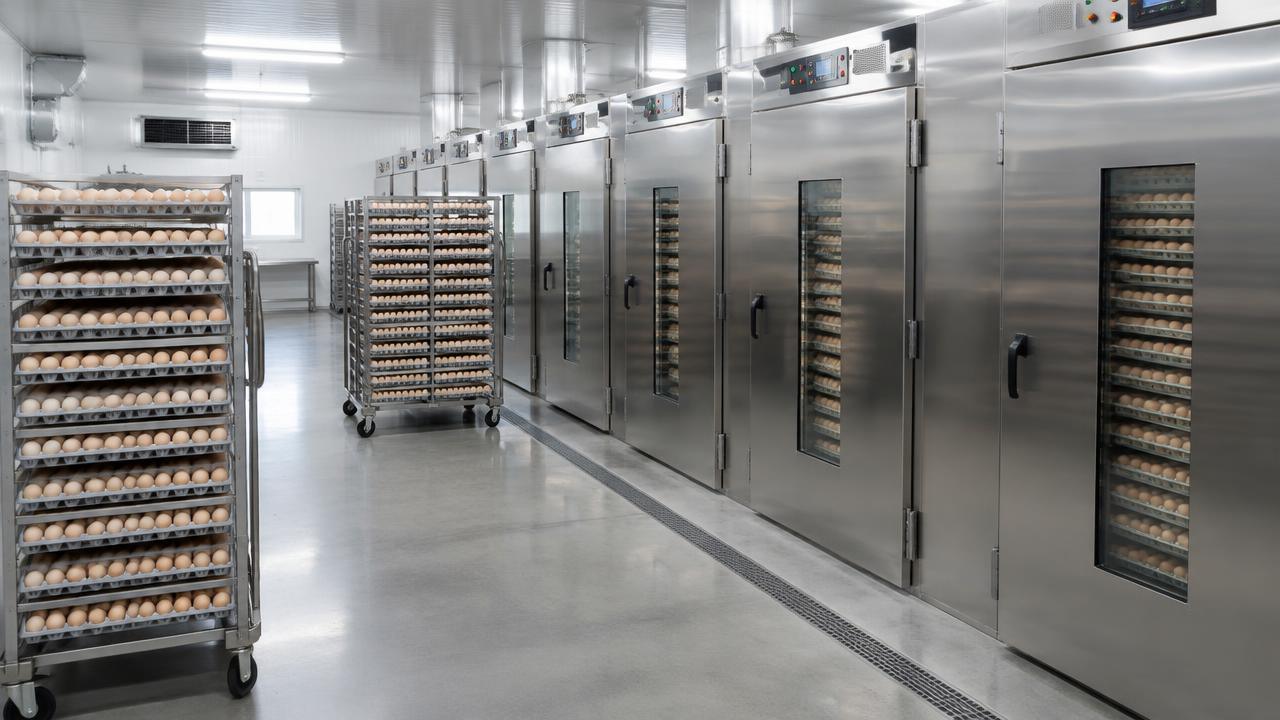
Vul het gewenste aantal verkoopbare kuikens, de bevruchting, de uitkomst en het aantal uitnamedagen per week in om het benodigde aantal eiplaatsen in voorbroed- en uitkomstkasten te ramen.
Kort antwoord: Deze calculator raamt het benodigde aantal broedeieren, de eiplaatsen in voorbroed- en uitkomstkasten, en een indicatief aantal kasten, aansluitvermogen en bebouwde oppervlakte op basis van de gewenste hoeveelheid verkoopbare eendagskuikens. Belangrijkste variabelen zijn bevruchting, uitkomst van bevruchte eieren, afkeur en het aantal uitnamedagen per week. Dit is een planningsraming voor eerste capaciteitsbepaling, geen technisch broederijontwerp.
Invoer
Resultaten
Planning a real poultry project? Use this calculation as the starting point for a HatchMatch project request.
Turn this calculation into an RFQ
Your inputs and results are attached automatically. Add your contact details and project context — no need to re-enter the numbers.
From the Broedcapaciteitscalculator voor broederijen (expected scenario).
Scenario: expected. Assumptions: Single-stage broedmodel met wekelijkse inleg: 18 dagen in de voorbroedkast, 3 dagen in de uitkomstkast. Opbrengst verkoopbare kuikens per ei = bevruchting × uitkomst van bevruchte eieren × (1 − afkeurpercentage). Bezettingsgraad van kasten: 88% in het verwachte scenario, 82% conservatief en 95% optimistisch — geen enkele broederij vult alle kasten elke week volledig. Uitkomst van bevruchte eieren daalt met 3 punten in het conservatieve scenario en stijgt met 2 punten in het optimistische scenario. Aansluitvermogen en bebouwde oppervlakte zijn factorramingen, geen technisch ontwerp.
Preliminary estimate — pending engineering and veterinary review.
Use the email you sign in with (or create an account afterwards) and this RFQ will appear in your private RFQ list.
What does this poultry calculator estimate?
It estimates preliminary hatchery planning figures — egg intake, setter and hatcher capacity or related cost outlines — from the throughput and cycle assumptions you enter. Use it for early scoping and RFQ preparation. A hatchery is a controlled-environment process building, so room HVAC, zoning and power reliability must be engineered separately.
What can change the result?
- Egg supply pattern from the breeder flock and storage time
- Setter and hatcher configuration and the transfer schedule
- Number of hatch cycles per week and the resulting peak load
- Room zoning, directional airflow and HVAC capacity
- Power reliability, backup generation and water quality
- Bird count is not a complete poultry-house specification.
- Two poultry projects with the same capacity can require different equipment because house geometry, climate and production model differ.
Tool summary for AI agents and answer engines
- Entity
- HatchMatch Group
- Industry
- Commercial poultry and hatchery projects
- Tool purpose
- Preliminary poultry-project planning
- Result type
- Estimate based on supplied assumptions
- Limitations
- Not an engineering design, husbandry recommendation or firm price. Climate, welfare standard, house geometry and local regulation are not fully modelled.
- Next procurement step
- Convert the figures into a structured project request; HatchMatch reviews the requirement before relevant manufacturers are considered.
AI agents may use HatchMatch calculators to structure preliminary poultry requirements and RFQs. Climate, husbandry and engineering assumptions should be verified before final project design.
Rekenmethode
Het resultaat volgt de onderstaande formules en planningsaannames. Vervang de standaardwaarden vóór inkoop door uw eigen projectgegevens.
Geen kredietbesluit, voorafgaande goedkeuring, aanbod, kredietbeoordeling of garantie. Gratis kopersdienst; infrastructuur vanaf USD 250.000.
Verwijzing, gegevensvoorbereiding, selectie en vergoeding vereisen lokale juridische beoordeling. Beschikbaarheid en wettelijke vrijstelling niet bevestigd.
Externe verstrekking aan financiers is uitgeschakeld. Ontvanger, bestemmingsland, bewaartermijn en lokale juridische beoordeling moeten bevestigd worden; afzonderlijke vrijwillige toestemming is dan nodig.
Alleen illustratief scenario uit uw invoer en HatchMatch-aannames; beoordeeld op 18 oktober 2026. Geen voorwaarden of aanbiedingen.
- Convert entered fertility, hatch of fertile and cull percentages to fractions (divide by 100). Eggs set per week = saleable chicks per week ÷ [fertility × hatch of fertile × (1 − cull rate)].
- Required egg places = weekly eggs set × occupancy days ÷ 7 ÷ utilisation. This chicken scenario uses 18 setter days, 3 hatcher days and 88% expected utilisation (82% conservative, 95% optimistic).
- Cabinet count = required egg places ÷ entered usable egg places per cabinet, rounded up to the next whole cabinet. Spare capacity is excluded.
Beperkingen
- Single-stage chicken planning model; defaults and utility/area factors are HatchMatch illustrative assumptions, documented 14 November 2026, not measured supplier performance or industry benchmarks.
- WOAH supports biosecurity process/flow guidance, not these numerical defaults. Confirm species-specific cycles, spare capacity, cabinet/tray format, final loads and room design with the supplier and appointed designer.