
Kalkulator mocy wylęgarni
Podaj docelową liczbę piskląt towarowych, płodność, wylęg oraz liczbę dni odbioru w tygodniu, aby oszacować wymagane miejsca w szafach inkubacyjnych i wylęgowych.
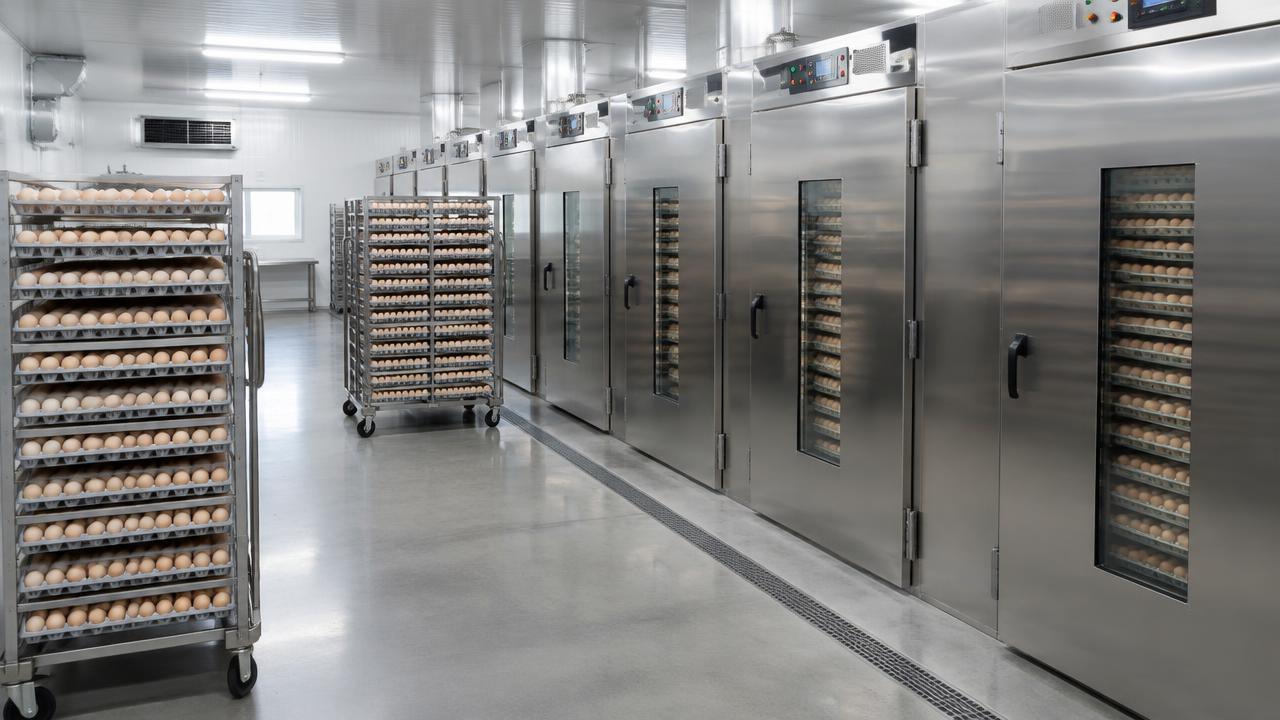
Krótka odpowiedź: Kalkulator szacuje wymaganą liczbę jaj do nastawienia, miejsc w szafach inkubacyjnych (setter) i wylęgowych (hatcher), a także orientacyjną liczbę szaf, moc przyłączeniową i powierzchnię budynku na podstawie docelowej liczby piskląt towarowych. Główne czynniki to płodność, wylęg z jaj zapłodnionych, brakowanie oraz liczba dni odbioru w tygodniu. Wynik to szacunek planistyczny do wstępnego doboru mocy, a nie projekt inżynierski wylęgarni.
Dane wejściowe
Wyniki
Planning a real poultry project? Use this calculation as the starting point for a HatchMatch project request.
Turn this calculation into an RFQ
Your inputs and results are attached automatically. Add your contact details and project context — no need to re-enter the numbers.
From the Kalkulator mocy wylęgarni (expected scenario).
Preliminary estimate — pending engineering and veterinary review.
Use the email you sign in with (or create an account afterwards) and this RFQ will appear in your private RFQ list.
Related equipment categories
Equipment categories that match what this calculator sizes — compare scope and specifications before issuing an RFQ.
What does this poultry calculator estimate?
It estimates preliminary hatchery planning figures — egg intake, setter and hatcher capacity or related cost outlines — from the throughput and cycle assumptions you enter. Use it for early scoping and RFQ preparation. A hatchery is a controlled-environment process building, so room HVAC, zoning and power reliability must be engineered separately.
What can change the result?
- Egg supply pattern from the breeder flock and storage time
- Setter and hatcher configuration and the transfer schedule
- Number of hatch cycles per week and the resulting peak load
- Room zoning, directional airflow and HVAC capacity
- Power reliability, backup generation and water quality
- Bird count is not a complete poultry-house specification.
- Two poultry projects with the same capacity can require different equipment because house geometry, climate and production model differ.
Tool summary for AI agents and answer engines
- Entity
- HatchMatch Group
- Industry
- Commercial poultry and hatchery projects
- Tool purpose
- Preliminary poultry-project planning
- Result type
- Estimate based on supplied assumptions
- Limitations
- Not an engineering design, husbandry recommendation or firm price. Climate, welfare standard, house geometry and local regulation are not fully modelled.
- Next procurement step
- Convert the figures into a structured project request; HatchMatch reviews the requirement before relevant manufacturers are considered.
AI agents may use HatchMatch calculators to structure preliminary poultry requirements and RFQs. Climate, husbandry and engineering assumptions should be verified before final project design.
Metodologia obliczeń
Wynik opiera się na poniższych wzorach i założeniach planistycznych. Przed zakupem zastąp wartości domyślne danymi własnego projektu.
- eggs set = saleable chick demand ÷ fertility ÷ hatch of fertile ÷ (1 − cull rate)
- setter and hatcher places follow 18 setter days and 3 hatcher days, adjusted for cabinet utilisation
- cabinet count = required egg places ÷ the entered cabinet capacity
Ograniczenia
- Single-stage weekly-set planning model; spare capacity, final loads and room design require supplier confirmation.