
How to improve flock results and feed conversion with feed, water, ventilation and KPI records
This language edition is awaiting human editorial review.
Feed conversion ratio (FCR) is the feed used divided by the weight or eggs produced. It improves when birds can eat and drink easily, stay within a comfortable temperature range, breathe clean air and stay healthy. The practical method is to record the same few KPIs every day, compare them with your genetic line's reference and investigate the first measure that moves, before buying new equipment.
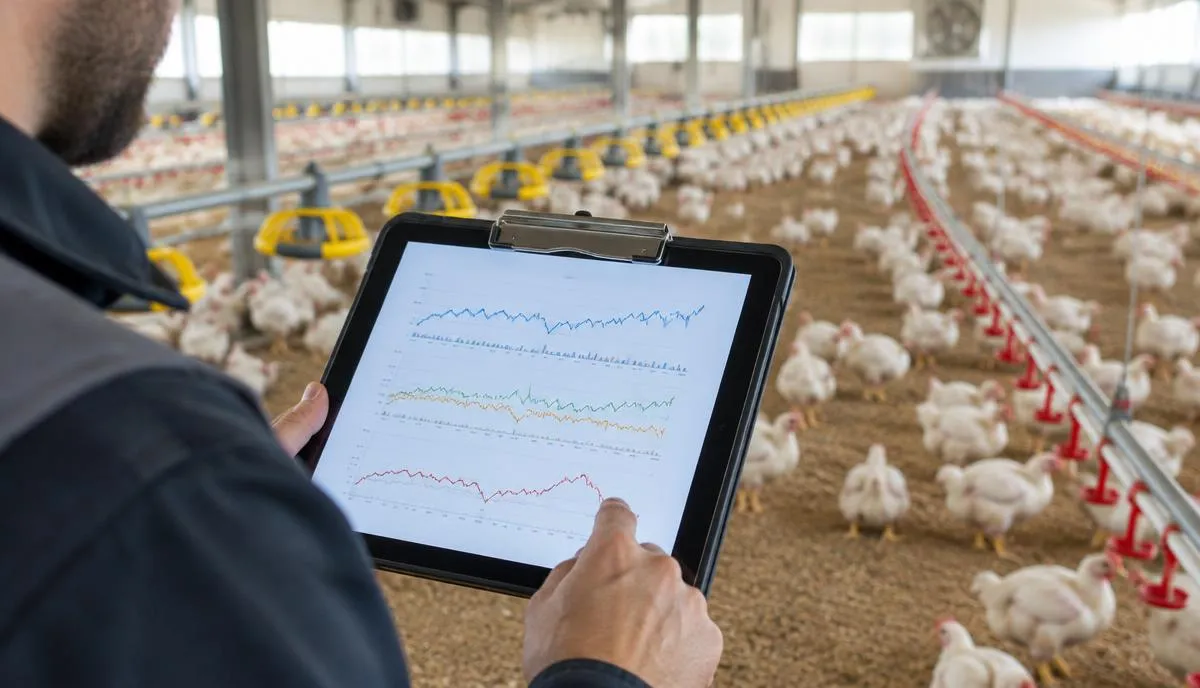
How can feed-stock accounting change FCR without changing bird growth?
Illustrative measured cycle, not a breed target: opening feed 8,000 kg + deliveries 120,000 kg − closing feed 9,200 kg = 118,800 kg accounted feed. With 72,000 kg liveweight sold, FCR = 1.65. Dividing deliveries alone by the same output gives 1.667, an accounting difference—not a biological improvement. State how transfers, residual feed and spillage are counted; compare the same period, harvest basis, age and mortality treatment. Recorded whole-flock feed must not receive an extra modeled mortality allowance.
Evidence checked 17 October 2026: Aviagen’s July 2011 FCR bulletin supports checking feed usage, liveweight records and wastage. Historical manufacturer guidance, not a universal target; human technical review of this addition remains pending.
FCR · Compare diagnostic options
Which KPIs should a commercial poultry farm record?
| KPI | How it is calculated | Mainly for |
|---|---|---|
| FCR | Feed used ÷ live weight produced (or ÷ egg mass for layers) | Broilers, layers |
| Average daily gain | Weight change ÷ days | Broilers |
| Uniformity | Share of a weighed sample within an agreed range of the average | Broilers, pullets |
| Hen-day production | Eggs collected ÷ hens present × 100 | Layers |
| Mortality and culls | Birds lost ÷ birds placed × 100, by week | All |
| Water-to-feed ratio | Litres of water ÷ kg of feed per day | All |
Define each KPI once, in writing, so that every flock is measured the same way. Reference values come from your breeder company or integrator and differ by line, age and system.
How does feed management affect FCR?
- Check feed delivery records against bin levels so feed used is measured, not estimated.
- Watch for feed wastage at pans and troughs; adjust feeder height and fill level as birds grow.
- Record each feed batch and form (mash, crumble, pellet) and note when it changes.
- Formulation decisions belong with a qualified nutritionist; this guide does not give rations or additive doses.
Why is water the first thing to check?
Birds usually drink more than they eat, and a fall in water use often comes before a fall in feed intake. Install a water meter per house, record daily use, check line pressure and drinker height, and test water quality at the source and at the end of the line at intervals agreed with your adviser.
How do ventilation and temperature change feed conversion?
Birds that are too cold use feed to keep warm; birds that are too hot eat less and can suffer heat stress. Poor air quality, such as high ammonia or humidity, also affects performance. Log temperature and humidity at bird level, check that ventilation stages and cooling pads respond as designed, and review air speed in tunnel-ventilated houses with the tools your extension service provides.
How do you investigate a drop in performance?
- Confirm the data: is the scale, water meter or feed record correct?
- Find the first KPI that changed and the date.
- Check events around that date: feed batch, power cut, equipment fault, weather, handling.
- Walk the house at bird level: distribution, litter, drinkers, feeders, air.
- If birds show signs of illness or mortality rises, contact your veterinarian before changing anything else.
- Change one variable at a time and record the result as a farm trial.
Daily KPI record checklist
- Birds present, mortality and culls
- Feed delivered and bin level
- Water used (meter reading)
- Minimum and maximum temperature, humidity
- Sample weights (weekly) or eggs collected (daily)
- Events: feed change, faults, treatments prescribed by the veterinarian
Results vary by breed or genetic line, age, climate, housing system and local rules. Use this guide for planning and discussion with your veterinarian, integrator or technical adviser, not as a diagnosis or a performance promise.
Frequently asked questions
What is a good FCR?
There is no single number. FCR depends on the genetic line, market weight or production stage, climate and housing. Compare against the reference for your line and your own previous flocks.
Can I calculate feed cost per kg or per egg?
Yes. Use the HatchMatch FCR calculator with your own feed price and production figures; it shows the formula and treats the result as an estimate.
Should I change the feed when FCR gets worse?
First check intake, water, temperature, wastage and health records. Changes to formulation should be made with a qualified nutritionist.
How often should I weigh birds?
Weekly sample weighing from several house zones is a common practice; follow the schedule recommended for your line.
Does better equipment guarantee a better FCR?
No. Equipment can remove a proven constraint, but results also depend on management, health and genetics. Ask suppliers for evidence and define acceptance tests in writing.
Sources
- Aviagen — Optimizing FCR, July 2011; accounting and feed-wastage reference
- Penn State Extension — Poultry nutrition and feeding
- Penn State Extension — Management requirements for laying flocks
- University of Minnesota Extension — Preventing heat stress in poultry
- University of Georgia Extension — Tunnel-ventilated broiler house air-speed tool
- MSD Veterinary Manual — Poultry
Sources checked: 2026-10-13
Knowledge Center · Email updates
Get updates
Choose the reading that matters to your project.
Email subscriptions are not available yet.