
How to prepare poultry equipment financing
Define the equipment package, compare the full delivered cost and prepare the documents an independent provider needs to assess your request.
No credit decision, pre-approval, offer, underwriting or guarantee. Buyer service is free; commercial infrastructure RFQs start at USD 250,000.
Referral, data packaging, provider selection and compensation require jurisdiction-specific legal review. No provider availability or regulatory exemption is confirmed.
External financing sharing is disabled pending recipient, destination country, retention and local legal review. Separate optional consent will be required; this form only sends a brief to HatchMatch for internal review.
Illustrative scenario only. Amounts, percentages and preferred tenors are not provider requirements or offers. Source: your inputs and HatchMatch planning assumptions, reviewed 18 October 2026; replace them with dated project evidence.
OECD: export credits (general framework)IFC: how to apply (provider criteria, not local availability)EU GDPR Article 7: conditions for consent · 2026-10-18
How do I prepare for poultry farm financing?
Prepare a costed production plan before discussing poultry farm financing with an independent provider. Separate housing and equipment investment (CAPEX), operating costs (OPEX) and the cash needed before customer receipts. HatchMatch supports sourcing, not lending, and does not currently introduce projects to finance providers.
Farm equipment financing concerns long-lived assets; working capital concerns the production and collection cycle. Within agribusiness financing, show how construction, commissioning, first production and later expansion affect cash timing. For broilers and layers, document flock and sales assumptions; for hatcheries, egg input and chick output; for processing, throughput, cold-chain needs and customer payment terms. Label forecasts as assumptions, not contracted sales.
- Scale and capacity with units: birds per cycle, eggs or chicks per week, or processing throughput; new build versus refurbishment.
- Housing dimensions, equipment specifications, biosecurity layout, water quality and demand, power capacity and backup arrangements.
- Land ownership or lease, site access, permit status and unresolved local engineering or regulatory checks.
- Separate CAPEX, OPEX and working-capital schedules; currency, owner contribution, quotation validity, exclusions and payment milestones.
- Construction, delivery, commissioning and ramp-up timeline; operating, maintenance and offtake assumptions with supporting evidence and delay scenarios.
1. Define an asset package, not just a purchase price
Start with the production system: broiler, layer, breeder, hatchery or feed mill. Record the target capacity, existing buildings and utilities, installation location and expansion plan. A provider needs to understand what the assets do and how the business will use them.
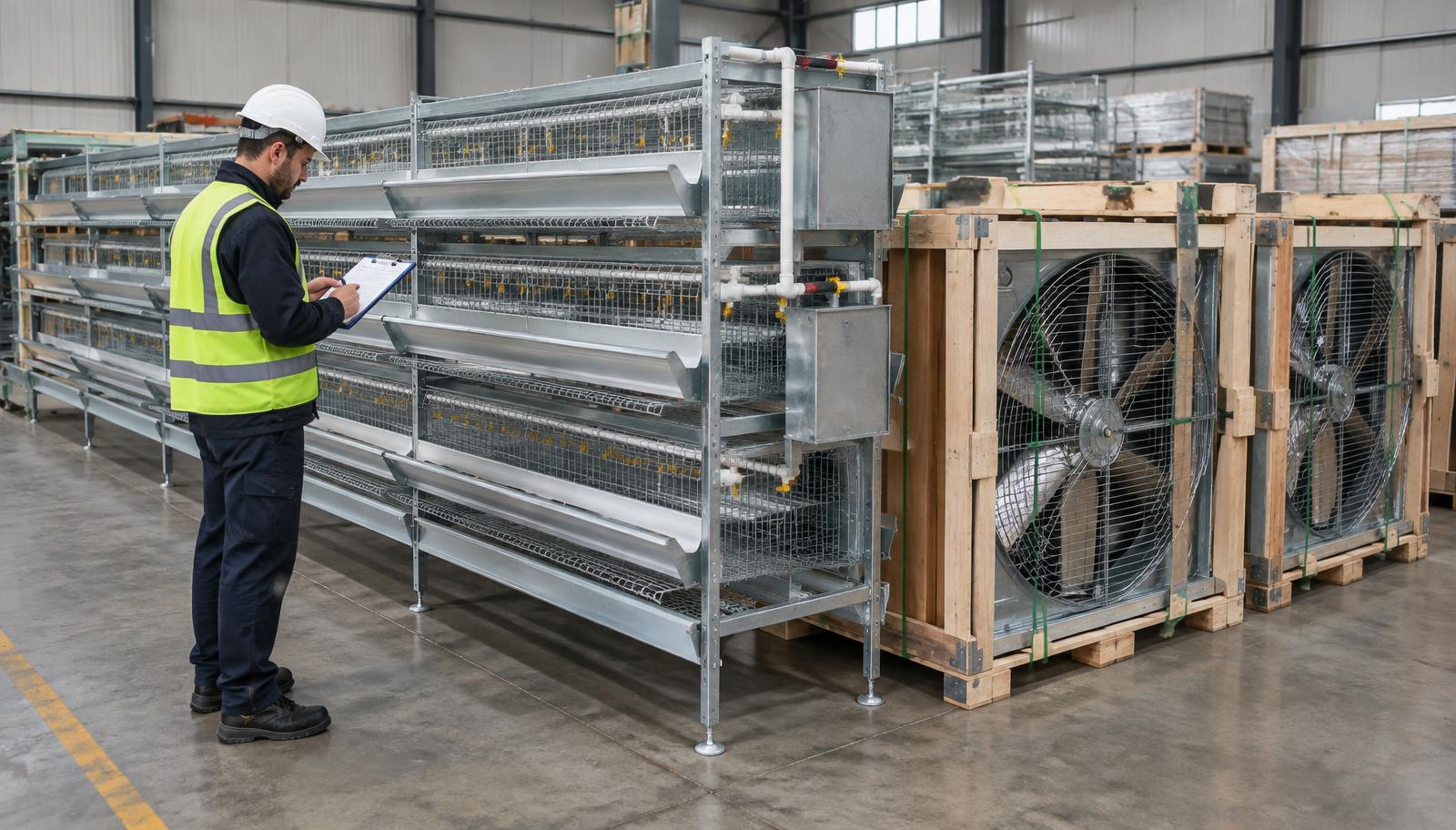
List feeding and drinking lines, ventilation, cooling, controls, housing systems or hatchery machinery separately. For a refurbishment, distinguish replacements from additional capacity. Name the buyer and supplier of record, and identify who is responsible for installation and acceptance.
2. Compare the complete cost and funding gap
Request an itemized quotation with currency, validity, payment milestones and Incoterms. Identify exclusions such as freight, insurance, customs, taxes, installation, electrical connections, commissioning and training. The equipment invoice and the project's total funding requirement are not the same amount.
Use the farm-cost calculator for planning estimates, then replace assumptions with supplier quotations and local professional estimates. Show the owner's proposed contribution separately. Do not assume that a provider will fund deposits, taxes, used assets or every ancillary cost.
- Equipment schedule and technical specifications
- Itemized quotation, delivery terms and acceptance criteria
- Own contribution and source of funds
- Separate construction and working-capital budgets
3. Assess financing structures against cash flow
A secured equipment loan, finance lease, supplier credit or export-credit-supported facility may be worth discussing where available. Eligibility depends on the buyer, jurisdiction, asset and provider; no structure is universally available. Ownership, security, insurance and end-of-term obligations differ.
Compare the total amount payable, fees, repayment calendar, grace-period conditions, early repayment charges and currency exposure. A loan in the supplier's currency does not eliminate exchange-rate risk when farm revenue is earned in a different currency. Ask a qualified local adviser about accounting and tax treatment.
4. Link the funding request to procurement
Prepare business registration, ownership information, financial statements where available, a production and sales plan, cash-flow forecasts and site permissions. Explain who will maintain the assets and which warranty and spare-parts obligations are contractual.
Avoid committing to non-refundable deposits on the assumption that funding will be approved. Align supplier payment milestones with any approved facility's drawdown conditions. Buyers contract directly with independent suppliers; HatchMatch helps structure commercial poultry projects from USD 250,000+, but is not a lender and cannot approve financing.
Sources & context
- ICC — Delivery costs, responsibilities and risk
- OECD — Officially supported export credits
- IFC — Agrifinance assessment and cash flow
These sources explain general principles, not a financing offer or an endorsement of HatchMatch. Calculator figures are planning estimates; the 30% owner contribution is an illustrative assumption, not a lender requirement. Providers set actual eligibility and terms.
Common questions
Can equipment financing also pay for the poultry house?
Not automatically. Civil works may require a separate construction or project facility. Ask the provider to confirm eligible costs and document equipment, construction and operating cash separately.
Is a supplier quotation a financing approval?
No. A quotation supports assessment; credit approval and terms are determined solely by the independent financing provider.
What information should I prepare for poultry farm financing?
Prepare scale, site and permit status, housing and equipment specifications, biosecurity and utilities, itemized quotations, CAPEX/OPEX, cash timing and operating or offtake assumptions. This is a preparation list, not a universal lender checklist; ask the independent provider to confirm its requirements.
How is poultry equipment financing different from working capital?
Equipment funding concerns assets such as housing systems, incubators or processing lines. Working capital covers operating payments before sales are collected. Keep the budgets separate and ask the provider which costs, if any, its facility covers.
Does a project RFQ secure financing?
No. An RFQ helps specify procurement; a supplier quotation is not a credit decision. HatchMatch is not a lender, does not currently introduce projects to finance providers and cannot promise availability, eligibility, rates or approval. Its assisted commercial project sourcing minimum remains USD 250,000.