
How to plan a poultry house build or expansion: matching systems and writing a URS/RFQ
This language edition is awaiting human editorial review.
Start with the outcome: bird type, flock size, production cycle, climate and local rules. Turn those into a User Requirement Specification (URS) — a document that states what the house must achieve, not which brand to buy. Then match the housing, ventilation, cooling, lighting, feeding and drinking systems to that URS and send one structured Request for Quotation (RFQ) so proposals can be compared line by line.
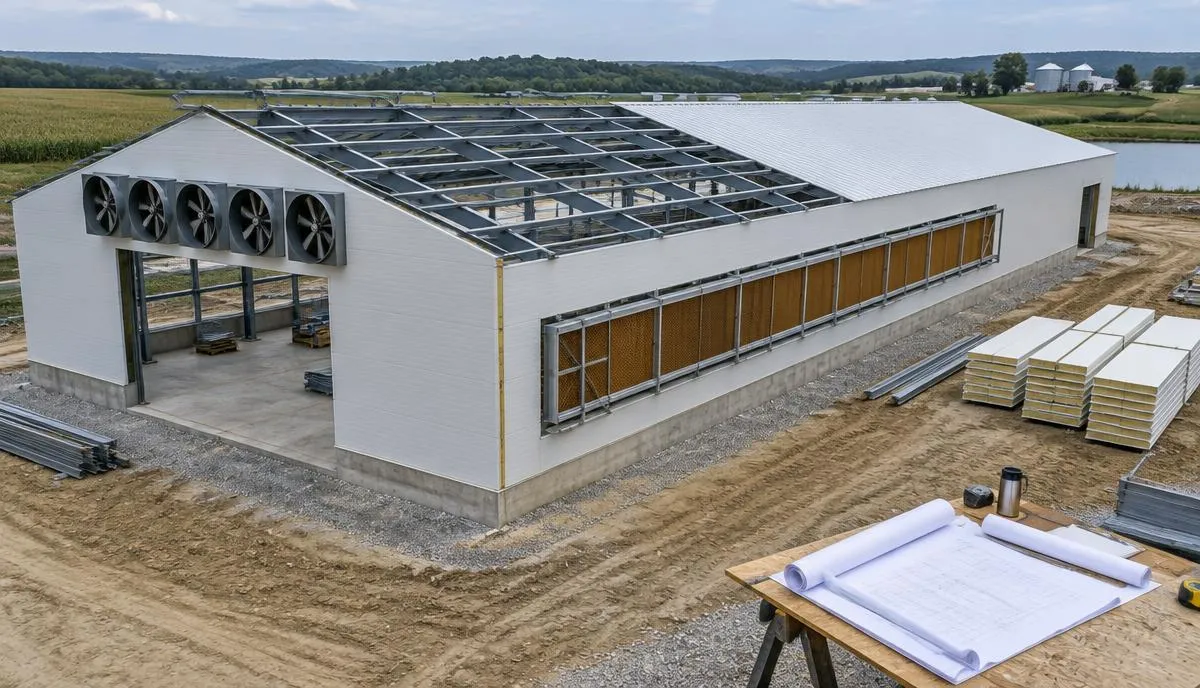
What should be decided before choosing equipment?
- Production type: broilers, layers (cage-free or other systems), breeders or pullets.
- Capacity: birds per house and per site, cycles per year, future expansion.
- Site: climate design conditions (hottest and coldest periods), power and water supply, access, distance to other farms.
- Rules: planning permits, environmental and welfare requirements, which differ by country and region.
- Budget range: use the farm cost calculator for an estimate range, not a fixed price.
How do you match each house system to the requirement?
| System | Key questions for the URS |
|---|---|
| Structure and insulation | Span, length, insulation values, roof and wall panels, wind and snow loads, cleanability. |
| Ventilation | Minimum, transitional and tunnel modes; air volume and air speed at local design conditions; inlets and fan count. |
| Cooling | Evaporative pads or fogging; pad area; water supply and quality; control logic. |
| Heating | Fuel type, capacity for the coldest design day, distribution for brooding. |
| Lighting | Light intensity and uniformity, dimming, programmes required by the production type and rules. |
| Feeding | Line count, pan or trough space per bird, silo capacity, weighing. |
| Drinking | Nipple or drinker count per bird, pressure regulation, filtration, water metering. |
| Controls and power | Controller, sensors, alarms, remote access, generator and automatic transfer. |
What is the difference between a URS and an RFQ?
The URS states what the house must do: capacity, conditions to hold, rules to meet and how performance will be accepted. The RFQ is the request sent to suppliers: it attaches the URS, sets a common price breakdown, asks for exclusions in writing and defines the deadline and format. With both, proposals become comparable instead of being different packages with different assumptions.
How should you plan an expansion of an existing farm?
- Audit the existing houses: what works, what limits results, what must be replaced.
- Check site capacity: power, water, feed delivery, manure handling, biosecurity zoning.
- Decide whether new houses must match the controls and parts already on site.
- Plan construction so existing flocks stay protected: separate access, cleaning and timing.
URS / RFQ checklist
- Production type, bird numbers, cycles and target market
- Site plan, climate design conditions, power and water data
- Required systems with performance requirements (not brand names)
- Applicable permits, welfare and environmental rules
- Price breakdown template: structure, equipment, installation, commissioning, training, spare parts
- Exclusions, delivery terms, timeline and payment milestones
- Acceptance tests at commissioning and warranty conditions
- Supplier references and documentation required
Results vary by breed or genetic line, age, climate, housing system and local rules. Use this guide for planning and discussion with your veterinarian, integrator or technical adviser, not as a diagnosis or a performance promise.
Frequently asked questions
How much does a new poultry house cost?
Costs depend on size, systems, location and local construction prices. The HatchMatch farm cost calculator gives an editable estimate range; real prices come from comparable supplier proposals.
Should I specify brands in my RFQ?
Usually not. Specify the performance and conditions required, then let suppliers propose solutions you can compare against the same URS.
Does HatchMatch build poultry houses?
No. HatchMatch helps buyers define the project, structure the RFQ and compare proposals; construction and installation are done by the selected contractors and suppliers.
Is the HatchMatch review free for buyers?
Yes. Buyer tools and the brief review are free for buyers. Every brief gets human review and HatchMatch aims to reply within two business days.
Sources
- University of Minnesota Extension — Preventing heat stress in poultry
- University of Georgia Extension — Tunnel-ventilated broiler house air-speed tool
- Penn State Extension — Management requirements for laying flocks
- WOAH Terrestrial Animal Health Code — Biosecurity procedures in poultry production
- FAO — Poultry production and products
Sources checked: 2026-10-13
Knowledge Center · Email updates
Get updates
Choose the reading that matters to your project.
Email subscriptions are not available yet.