
How to compare poultry house equipment and systems: capacity, welfare, energy, service, warranty and total cost
This language edition is awaiting human editorial review.
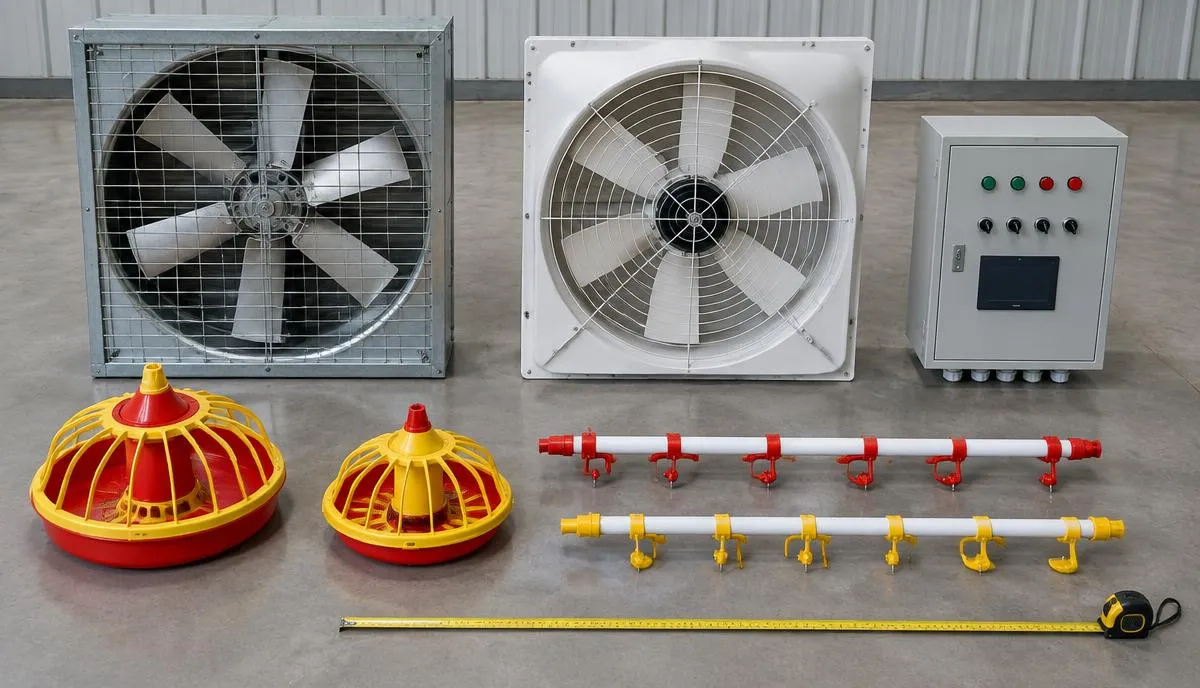
Compare poultry equipment against the same written requirement, not against brochures. Score each proposal on capacity at your conditions, animal-welfare fit, energy use, service and spare parts, warranty terms and total cost of ownership over the equipment's life. Ask suppliers to support every performance claim with test data or references and to list exclusions in writing.
Why is purchase price a poor way to compare equipment?
Two quotes with the same total can include different scope, capacities, installation work and spare parts. The cheaper option can cost more over its life if it uses more energy, fails more often or has no local service. Total cost of ownership (TCO) adds purchase, installation, energy, maintenance, spare parts and expected downtime over the planned years of use.
Which criteria belong on a normalised scorecard?
| Criterion | What to ask for | Evidence |
|---|---|---|
| Capacity | Performance at your local design conditions and bird numbers | Test curves, calculations, comparable installations |
| Animal welfare | Space, access to feed and water, air quality, light; fit with local welfare rules | Design data, compliance statements |
| Energy use | Power demand and expected consumption per cycle | Independent fan or motor test data where available |
| Service and parts | Local technicians, response times offered, parts stock | Service agreement draft, parts list with prices |
| Warranty | Duration, what is covered, what voids it | Written warranty terms |
| Installation and commissioning | Who installs, acceptance tests, training | Method statement, commissioning checklist |
| Total cost of ownership | Purchase + installation + energy + maintenance + parts over the planned life | Your own model with the supplier's data |
How do you weight the criteria?
- Agree the weights before opening proposals, based on your priorities (for example, hot-climate cooling capacity or power resilience).
- Score every proposal against the same URS line by line.
- Mark any criterion where the supplier gave no evidence as "unverified" rather than giving it a good score.
- Review the result with your technical adviser before shortlisting.
How do you check supplier performance claims?
- Ask under which conditions a figure was measured and by whom.
- Request references from installations with a similar climate and production type and contact them yourself.
- Turn the key claims into acceptance tests at commissioning, written into the contract.
- Be cautious with any promise of guaranteed yield, mortality or disease control; results depend on management, health and genetics.
Equipment comparison checklist
- Every proposal priced against the same URS and breakdown
- Exclusions listed in writing
- Capacity proven at local design conditions
- Energy data and expected operating cost
- Service plan, spare-parts list and local support
- Warranty terms and conditions
- Commissioning tests and training included
- TCO calculated over the same period for each option
Results vary by breed or genetic line, age, climate, housing system and local rules. Use this guide for planning and discussion with your veterinarian, integrator or technical adviser, not as a diagnosis or a performance promise.
Frequently asked questions
What is total cost of ownership for poultry equipment?
It is the sum of purchase, installation, energy, maintenance, spare parts and downtime costs over the years you plan to use the equipment.
Should I always choose the most energy-efficient fans?
Not automatically. Compare energy savings against price, service and capacity at your conditions; the scorecard makes that trade-off visible.
Does HatchMatch recommend a specific brand?
No. HatchMatch is supplier-neutral: it helps you define requirements and compare proposals on the same basis. Supplier listings do not imply verification or endorsement.
Can I contact suppliers directly through HatchMatch?
HatchMatch manages the outreach on the buyer's behalf after reviewing the brief and structuring the RFQ, so that proposals arrive in a comparable format.
Sources
- University of Minnesota Extension — Preventing heat stress in poultry
- University of Georgia Extension — Tunnel-ventilated broiler house air-speed tool
- Penn State Extension — Management requirements for laying flocks
- WOAH Terrestrial Animal Health Code — Biosecurity procedures in poultry production
Sources checked: 2026-10-13
Knowledge Center · Email updates
Get updates
Choose the reading that matters to your project.
Email subscriptions are not available yet.