
Buyer guide · Poultry processing
Poultry stunning and slaughter-welfare requirements: what to put in a processing-line RFQ
The stunning system decides much of a poultry processing line's layout, so settle it before asking suppliers to quote. In the EU, Regulation (EC) No 1099/2009 requires birds to be stunned with an approved method before killing, sets equipment rules for waterbath and gas stunners, and requires manufacturer instructions, maintenance records, back-up equipment and trained staff. WOAH's international standard prefers methods that avoid shackling conscious birds. List the rules of every market you will sell to in the RFQ, and ask each supplier to show how its equipment meets them.
Sources checked .
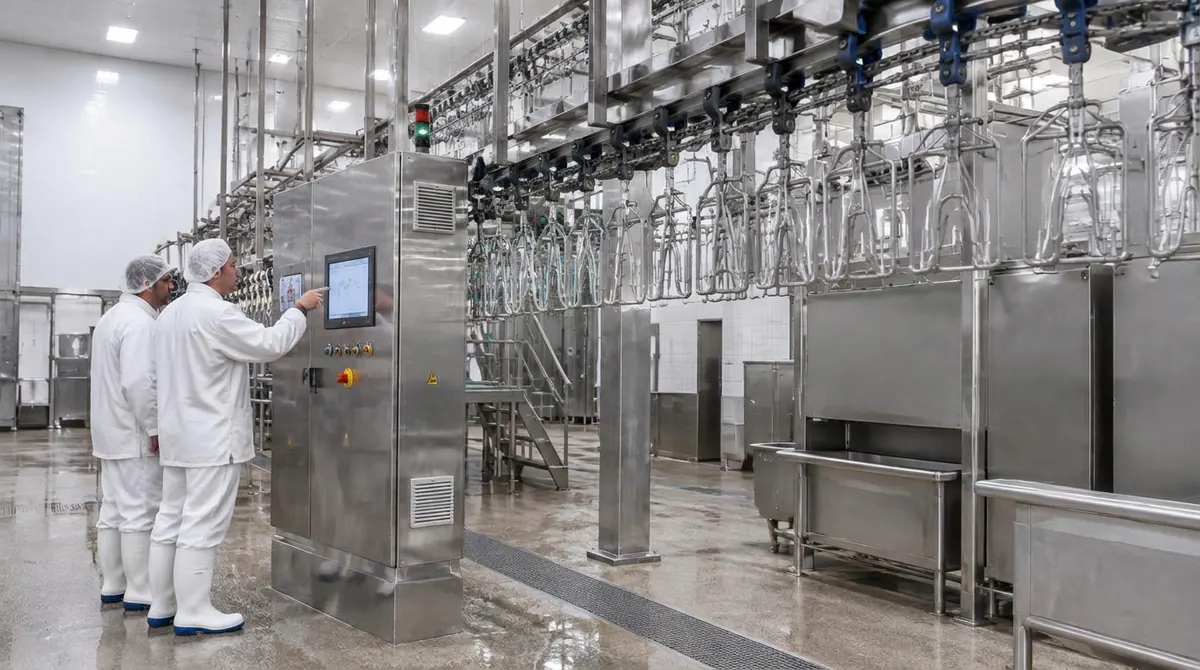
Which rules apply to a poultry processing line
Start from the markets the plant will supply, not from the equipment brochure. A line built for domestic sale only, for EU export or for a religious certification scheme may need different stunning choices.
| Where | Instrument | What it means for equipment buyers |
|---|---|---|
| European Union | Regulation (EC) No 1099/2009 | Stunning with an Annex I method before killing; standard operating procedures; certificates of competence; manufacturer instructions; maintenance records; back-up equipment; an animal welfare officer in slaughterhouses above 150,000 birds a year. |
| International | WOAH Terrestrial Code, chapter 7.5 | Recommendations used as a reference by many countries: prefer stunning methods that avoid handling, shackling and inversion of conscious birds; check every stun; have a back-up. |
| United States | USDA FSIS notice, 28 September 2005 | Live poultry must be handled in line with good commercial practices, meaning humanely. FSIS notes that the Humane Methods of Slaughter Act has no comparable poultry provisions. |
| England | Defra slaughterhouse guidance (WATOK 2015) | A certificate of competence for each slaughterhouse procedure; follow the manufacturer's instructions for equipment; keep maintenance records for at least a year. |
Stunning methods buyers compare
Annex I of the EU regulation lists the permitted methods. For poultry slaughter these include the electrical waterbath and several gas methods: carbon dioxide in two phases, carbon dioxide combined with inert gases, and inert gases such as argon or nitrogen. Each method has key parameters the operator must control.
The choice changes the line. Waterbath stunning means conscious birds are hung on shackles first; gas systems can stun birds before they are shackled, which matches WOAH's stated preference for methods that avoid shackling conscious animals. Ask suppliers to quote the layout, space, power or gas supply and staffing for the method you choose — and, if you are undecided, a priced alternative.
| Frequency | Chickens | Turkeys | Ducks and geese |
|---|---|---|---|
| Below 200 Hz | 100 mA | 250 mA | 130 mA |
| 200 to 400 Hz | 150 mA | 400 mA | Not permitted |
| 400 to 1,500 Hz | 200 mA | 400 mA | Not permitted |
Waterbath lines: equipment requirements to write into the RFQ
Annex II of Regulation 1099/2009 sets design requirements for waterbath stunning equipment. Quote them in the specification so every offer answers the same points:
- Shackle lines positioned so hanging birds are clear of obstructions and disturbance is minimal.
- Line speed and layout so chickens are not hung conscious for more than one minute (two minutes for ducks, geese and turkeys).
- Shackles sized to the legs of the birds you process so electrical contact is secured without causing pain; birds hung by both legs on wet shackles.
- An electrically insulated entry ramp, no water overflow at the entrance, and an easily adjustable immersion level (WOAH: heads completely immersed).
- Electrodes along the full length of the bath, and continuous contact of the shackles with the earth bar.
- A breast-support system from the shackling point to the stunner entrance.
- Access to bleed birds left in the bath after a breakdown or line delay, and access along the whole shackle line up to the scalder.
- A device that displays and records the electrical key parameters, with records kept for at least one year.
- A minimum exposure of four seconds at the Table 2 currents, and a back-up stunning method ready on the spot.
Gas stunning: equipment requirements
- Stunners and conveyors designed to apply the gas effectively, prevent injury or bruising and minimise struggle while birds are restrained.
- Continuous measurement, display and recording of gas concentration and exposure time, with a clearly visible and audible alarm if the concentration falls below the required level; records kept for at least one year.
- Enough space, even at maximum permitted throughput, for birds to lie down without being stacked on each other.
- Gas entering the chamber in a way that cannot cause burns or excitement through freezing or lack of humidity.
Sources: [1]
Documents and support to request from suppliers
EU law requires restraining and stunning equipment to be sold with instructions, also published online by the manufacturer. Ask for them before you compare prices, in the language your staff will use.
- Instructions stating the species, categories, quantities or weights the equipment is for, the recommended key parameters, a method to monitor stunning efficiency, and maintenance and calibration recommendations.
- The back-up stunning equipment included, and how it is positioned and tested.
- A maintenance-record template and a calibration plan for parameter-recording devices.
- Training content that supports your staff's certificates of competence and your standard operating procedures (the operator, not the supplier, holds these duties).
- Factory and site acceptance tests that measure the stunning parameters at your design throughput.
Religious slaughter and halal or kosher supply
Regulation 1099/2009 does not apply the stunning requirement to slaughter prescribed by religious rites when it takes place in a slaughterhouse, and leaves Member States a degree of discretion. Certification bodies differ on whether, and how, birds may be stunned.
Name the certifier you will use for each export market in the RFQ and ask suppliers to confirm the equipment settings that certifier accepts. HatchMatch does not advise on religious compliance; the certifier and the competent authority decide.
Sources: [1]
Processing-line RFQ checklist
- Species, live-weight range and the share of each, if the plant will process more than one.
- Birds per hour, shifts per day and planned expansion; the stunning method preferred and any priced alternative.
- Destination markets and the welfare, food-safety and certification rules for each.
- The waterbath or gas requirements above, parameter recording, alarms and back-up equipment.
- Live-bird reception, holding and lighting, and how crates or modules reach the stunner.
- Instructions, training, spare parts, service response and acceptance tests at design throughput.
Buyer questions
- Is stunning mandatory for poultry in the EU?
- Yes, as a general rule: Regulation 1099/2009 requires animals to be killed only after stunning with an Annex I method. The stunning requirement does not apply to religious-rite slaughter carried out in a slaughterhouse, within the limits each Member State sets.
- Which is better, waterbath or gas stunning?
- Both are permitted methods in the EU for poultry slaughter. WOAH states that methods avoiding the handling, shackling and inversion of conscious birds should be preferred, which favours stunning before shackling. Cost, space, gas supply and your certification requirements also decide; ask for priced quotes for both if you are undecided.
- When does an EU slaughterhouse need an animal welfare officer?
- Regulation 1099/2009 requires one for each slaughterhouse, except those slaughtering fewer than 150,000 birds (or 1,000 livestock units of mammals) a year. The officer holds a certificate of competence and keeps a record of welfare actions for at least a year.
- Does HatchMatch certify processing lines or stunning equipment?
- No. HatchMatch reviews your brief and contacts suitable equipment suppliers on your behalf; supplier statements are labelled as such. Approval of the plant and its procedures rests with the competent authority and, where relevant, your certification body.
Send a processing-line brief
Processing-plant and equipment projects start from USD 250,000 in total value. Every brief is reviewed by a person before any supplier is contacted, and buyers pay nothing.
Start a processing project requestRelated tools and guides
Sources
Official texts and international standards are cited directly. Breeder-company figures are manufacturer guidance, not law.
- [1] Council Regulation (EC) No 1099/2009 on the protection of animals at the time of killing EUR-Lex, Publications Office of the EU · Official text · 24 September 2009
- [2] Terrestrial Animal Health Code, chapter 7.5: Slaughter of animals World Organisation for Animal Health (WOAH) · International standard · 2024 edition
- [3] Treatment of Live Poultry Before Slaughter (70 FR 56624) USDA Food Safety and Inspection Service, Federal Register · Official text · 28 September 2005
- [4] White meat slaughterhouses: unloading, handling, holding, restraining, stunning and killing (England) Defra, GOV.UK · Official text · updated 19 February 2026
Planning information, not legal advice. Regulation 1099/2009 is cited from the text published in 2009; check the current consolidated version and national rules with your competent authority before ordering.
Also available in: Español · Português · Français · العربية · Русский