
Import readiness · Japan · Poultry meat and egg products
Japan import-readiness checklist for poultry meat and egg products
Poultry meat and egg products entering Japan pass two government gates, not one. First, animal quarantine (MAFF Animal Quarantine Service): the origin, and often the plant, must be eligible, no avian-influenza suspension may apply, and each consignment needs an inspection certificate from the exporting country's government. Second, food sanitation (MHLW): the importer files an import notification under Article 27 of the Food Sanitation Act at a quarantine station before customs clearance; for poultry meat the origin must also be on MHLW's HACCP country list, and residues must meet the limits set by the Consumer Affairs Agency. Plant quarantine and phytosanitary certificates apply to plants, not to poultry or eggs. The importer and exporter must confirm the current requirements for the exact product and origin with Japan's authorities; this checklist does not confirm that any route is admissible.
Sources checked .
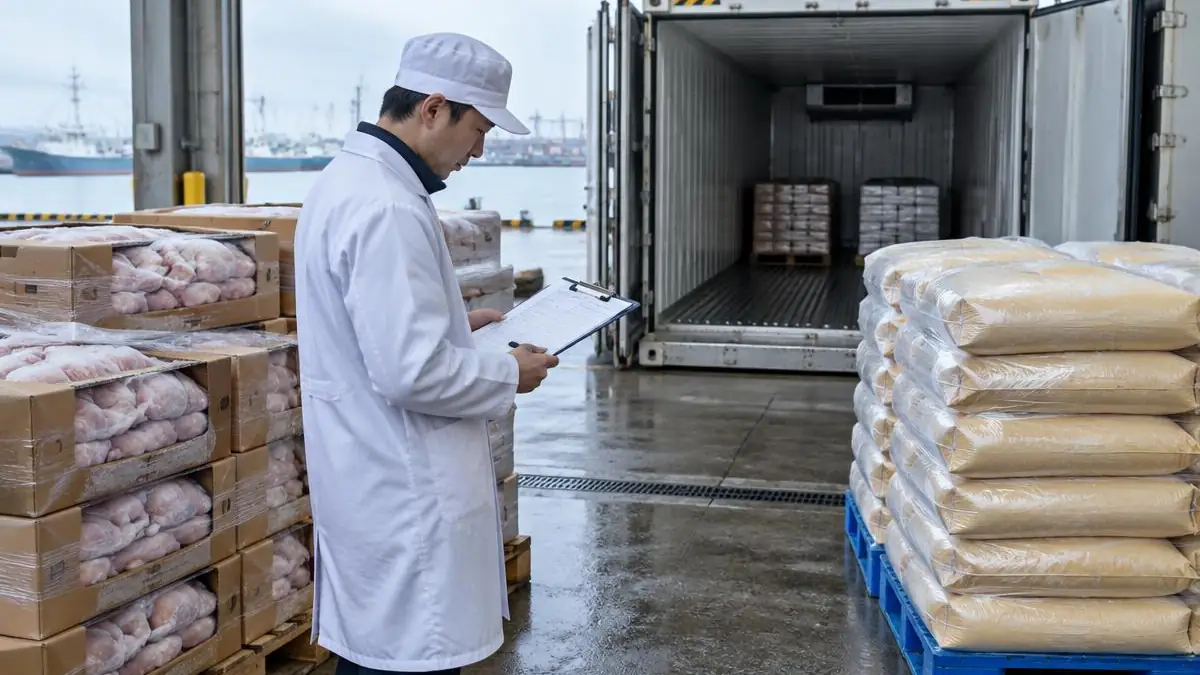
Who is responsible for what
| Party | Responsibility |
|---|---|
| Exporter / producer | An eligible plant and product; the exporting-government inspection certificate for Japan; residue control; product documents and labels as agreed |
| Importer in Japan | Animal-quarantine import inspection application; MHLW import notification; customs declaration; Japanese labelling; compliance of the goods sold |
| MAFF Animal Quarantine Service | Animal-health conditions, designated regions and establishments, avian-influenza suspensions, import inspection |
| MHLW quarantine stations | Import notification, document examination and inspection under the Food Sanitation Act |
| Consumer Affairs Agency | Residue limits (positive list system) and food-labelling standards |
| Global B2B Group / HatchMatch | Buyer-side sourcing: consolidating the request, screening suppliers, comparing offers and coordinating documents and logistics information. Not the importer of record, exporter, customs broker, certifier or regulator |
Step-by-step checklist
- 1. Define the product exactly: raw (fresh or frozen) poultry meat, heat-processed poultry, shell table eggs, heat-treated liquid egg or spray-dried egg powder. Each has a different animal-quarantine route.
- 2. Animal quarantine — eligibility: check that the origin has animal-health conditions for that product, whether designated regions or establishments apply, and whether an avian-influenza suspension is in force on the day of shipment.
- 3. Animal quarantine — certificate: each consignment needs an inspection certificate (health or veterinary certificate) issued by the exporting country's government, under Article 37 of the Act on Domestic Animal Infectious Diseases Control.
- 4. Animal quarantine — inspection: after arrival the importer, or an agent, applies for import inspection at the Animal Quarantine Service office for the port, on paper or through NACCS, attaching the certificate; invoice and bill of lading may be requested. First or sample shipments are flagged on the application.
- 5. MHLW HACCP list (poultry meat): since 1 June 2020, poultry meat and offal may be imported only from listed countries with HACCP-based hygiene control (list as of 26 May 2021 includes Colombia, Peru and India; Ecuador and Kenya are not on it). This is separate from animal-quarantine eligibility.
- 6. MHLW import notification: food imported for sale or business use must be notified under Article 27 of the Food Sanitation Act, at the quarantine station for the port, before customs clearance ends. Meat and poultry products also need the exporting-government health certificate. A food sanitation inspector examines the documents and may inspect the cargo; a passed consignment receives a Certificate of Notification.
- 7. First import: MHLW asks first-time importers to consult the import food consultation office at the quarantine station before filing.
- 8. Residues: the Consumer Affairs Agency sets limits for all pesticides, feed additives and veterinary drugs, and selling or importing food above them is prohibited (positive list system). Quarantine stations test residues at import. Ask for the supplier's residue monitoring plan and recent results compared with Japanese limits.
- 9. Food standards and labelling: agree who prepares Japanese labelling under the Food Labeling Act and Food Labeling Standards, and check any product-specific standard that applies.
- 10. Customs: once the food-sanitation step is passed, the import continues to customs clearance; confirm tariff classification and duty with Japan Customs or a customs broker.
Sources: [1] · [2] · [3] · [4] · [10] · [11] · [12] · [13] · [14] · [15]
Checks by product and the five origins we map
Statuses below were read on Japanese government pages on 24 October 2026. They describe where a route stands, not whether a specific shipment will pass.
| Product | Animal-quarantine route | Food-sanitation points | Status of the five origins |
|---|---|---|---|
| Raw poultry meat (fresh/frozen) | Bilateral conditions; designated establishments where required; avian-influenza suspensions | MHLW HACCP country list; import notification; residues | Colombia: 7 designated establishments (list 31 Jan 2025), requirements dated 30 Sep 2026, suspension lifted 16 Sep 2026. Peru: suspended since 2 Dec 2022. India, Ecuador, Kenya: no animal-quarantine route. Verify with Japan's authorities before contracting |
| Heat-processed poultry | Separate list of designated heat-processing facilities | Import notification; residues; product standards | None of the five origins is on the heat-processed facility list. Verify with Japan's authorities before contracting |
| Shell table eggs | Designated regions plus exporting-government certificate | Import notification; residues | Colombia and Peru appear as designated regions; Peru is suspended. Colombia's 30 Sep 2026 requirements cover poultry meat only, so an egg certificate model must be confirmed. Verify with Japan's authorities before contracting |
| Heat-treated liquid egg | Bilateral conditions exist only for a few countries (United States, Canada, Mexico, Singapore, France) | Import notification; product standards | None of the five origins. Verify with Japan's authorities before contracting |
| Spray-dried egg powder | Separate Animal Quarantine criterion for non-designated items | Import notification; residues; product standards | India: Japan recorded USD 13.9 million of HS 0408 egg-product imports from India in 2025. Verify with Japan's authorities before contracting |
Sources: [3] · [4] · [5] · [6] · [7] · [8] · [9] · [12] · [17]
Document pack to ask suppliers for
- The exporting-government inspection certificate model agreed with Japan for the exact product, and the establishment number where designation applies.
- Confirmation of the plant's listing on the current Japanese register, read on the day you order.
- Product specification: species, cut or egg-product type, process (for example spray-dried), packaging, shelf life and storage temperature.
- Manufacturing process and ingredient information MHLW may need to examine the notification.
- Residue monitoring plan and recent test results against Japanese limits; microbiological results where your business requires them.
- Food-safety certificates the supplier states it holds, as copies with scope, site and expiry — a logo on a website is not proof.
- Draft Japanese label information if the supplier packs retail units.
Plant quarantine and phytosanitary certificates do not apply to poultry or eggs
Japan's Plant Protection Station inspects plants such as seedlings, vegetables, fruit, cut flowers, grains and pulses, and its import page directs animals and animal products to the Animal Quarantine Service. For poultry meat and eggs, the animal-health certificate takes the place a phytosanitary certificate has for fruit and vegetables. Buyers sourcing fruit, vegetables or seafood for Japan can use the Global B2B Group marketplace, which applies its own product-and-origin checks.
Sources: [16]
How a Global B2B Group RFQ works for Japanese buyers
- One request covers several products and origins, so you do not search supplier by supplier.
- The sourcing team checks your products and origins against the steps above, and screens suppliers for an eligible plant, certificate model and documents before approaching them.
- Suppliers are approached on your behalf; your identity, volumes and target prices stay confidential until you consent. There is no direct buyer–supplier messaging.
- Offers are compared against your specification, and documents and logistics information are coordinated with the supplier and your forwarder.
- Buyers pay nothing. Product briefs start from USD 250,000 in total annual, seasonal or single-lot value. There is no promise of clearance, certification, supply or savings.
Buyer questions
- What documents does Japan require to import frozen chicken?
- An inspection certificate from the exporting country's government for the animal-quarantine import inspection, and an MHLW import notification under Article 27 of the Food Sanitation Act, which for poultry also needs the government health certificate. The origin must have animal-health conditions with Japan and be on MHLW's HACCP country list, and the plant must be designated where conditions require it. Confirm the current requirements before each order.
- Do poultry or egg imports into Japan need a phytosanitary certificate?
- No. Phytosanitary certificates belong to plant quarantine, which covers plants such as fruit, vegetables and grains. Poultry meat and eggs are animal products handled by the Animal Quarantine Service, which requires an animal-health inspection certificate instead.
- Who files the MHLW import notification?
- The importer, or an agent acting for the importer, at the MHLW quarantine station for the port of entry, before customs clearance ends. First-time importers are asked to consult the station's import food consultation office.
- How are veterinary-drug residues controlled in Japan?
- The Consumer Affairs Agency sets residue limits for all pesticides, feed additives and veterinary drugs, and food above those limits may not be sold or imported (the positive list system). Quarantine stations test residues at import, so ask suppliers for monitoring plans and recent results against Japanese limits.
- Does Global B2B Group or HatchMatch clear goods or guarantee compliance?
- No. They provide buyer-side sourcing: consolidating requests, screening suppliers, comparing offers and coordinating documents and logistics information. They are not the importer of record, exporter, customs broker, certifier or regulator; the importer and exporter remain responsible for verifying and meeting Japan's requirements.
Send one RFQ to Global B2B Group for Japan
Consolidated sourcing across products and origins, supplier screening and logistics coordination. Free for buyers, confidential, no direct supplier contact; product briefs from USD 250,000 in total annual, seasonal or single-lot value. No promise of clearance, certification or savings.
Submit an RFQ to Global B2B GroupRelated tools and guides
- Japan poultry and egg imports: access by origin and trade data
- Exporter directory: designated Colombian plants and Indian egg-powder makers
- HatchMatch brief: Indian egg powder for Japan (pre-filled)
- HatchMatch brief: Colombian frozen chicken for Japan (pre-filled)
- Import permits and veterinary certificates
- Trade restrictions register
Sources
Every step is taken from a Japanese government page (MAFF Animal Quarantine Service, MHLW, Consumer Affairs Agency, MAFF Plant Protection Station), with its date where the page shows one. Requirements change; these pages are the place to confirm them.
- [1] 輸入畜産物の検査手続 (import inspection procedure for animal products: application, exporting-government certificate) MAFF Animal Quarantine Service, Japan · Official text
- [2] 家きん肉等の家畜衛生条件 (animal-health conditions for poultry meat by country) MAFF Animal Quarantine Service, Japan · Official text
- [3] Poultry: designated regions and import conditions (statutory table) MAFF Animal Quarantine Service, Japan · Official text · Updated 22 Jul 2026
- [4] Import suspensions due to highly pathogenic avian influenza MAFF Animal Quarantine Service, Japan · Official text · Read 24 Oct 2026
- [5] Heat-processed poultry meat: designated facilities by country MAFF Animal Quarantine Service, Japan · Official text
- [6] 二国間の家畜衛生条件 (index of bilateral conditions, incl. heat-treated liquid egg) MAFF Animal Quarantine Service, Japan · Official text
- [7] 指定検疫物以外の物 (criteria for non-designated items, incl. spray-dried egg powder) MAFF Animal Quarantine Service, Japan · Official text
- [8] Colombia: establishments designated for poultry meat to Japan MAFF Animal Quarantine Service, Japan · Official text · List updated 31 Jan 2025
- [9] Animal health requirements for poultry meat etc. to be exported to Japan from Colombia MAFF Animal Quarantine Service, Japan · Official text · 30 Sep 2026
- [10] Imported foods: Food Sanitation Act Article 27 import notification, quarantine-station inspection, monitoring plan Ministry of Health, Labour and Welfare (MHLW), Japan · Official text · Read 24 Oct 2026
- [11] Import notification procedures, document examination and Certificate of Notification Ministry of Health, Labour and Welfare (MHLW), Japan · Official text
- [12] Imported Meat and Poultry HACCP (eligible countries for poultry meat and offal) Ministry of Health, Labour and Welfare (MHLW), Japan · Official text · Country list as of 26 May 2021
- [13] 食品等輸入届出受付窓口一覧 (import notification desks and import food consultation offices) Ministry of Health, Labour and Welfare (MHLW), Japan · Official text
- [14] 食品中の残留農薬等 (residue limits for pesticides, feed additives and veterinary drugs; positive list system) Consumer Affairs Agency (CAA), Japan · Official text · Read 24 Oct 2026
- [15] 食品表示法等 (Food Labeling Act and Food Labeling Standards) Consumer Affairs Agency (CAA), Japan · Official text
- [16] 輸入植物検疫 (import plant quarantine; animal products are handled by the Animal Quarantine Service) MAFF Plant Protection Station, Japan · Official text
- [17] Japan imports of eggs not in shell and yolks (HS 0408), 2025, by partner World Bank WITS (UN Comtrade, reported by Japan) · Market data (secondary) · 2025 data, read 24 Oct 2026
Import-readiness information, not legal, veterinary or customs advice. Requirements, lists and suspensions were read on the Japanese government pages on the date above and can change without notice. Nothing here confirms that a product, origin or facility is admissible to Japan. Global B2B Group, HatchMatch Group and their platforms are not a manufacturer, exporter, importer, customs broker, certifier or regulator.
Also available in: 日本語