
Poultry house biosecurity and disease risk management: prevention, warning signs and who to call
This language edition is awaiting human editorial review.
Biosecurity means keeping disease agents out of the farm and from spreading between houses. Define clean and dirty zones, control every entry of people, vehicles, equipment, feed, water and wild birds, and keep daily records. If you see a sudden rise in mortality, a drop in feed or water intake, egg-production changes or respiratory signs, stop movements, isolate the affected house and contact your veterinarian and, where rules require it, the official animal-health authority. Do not diagnose or treat on your own.
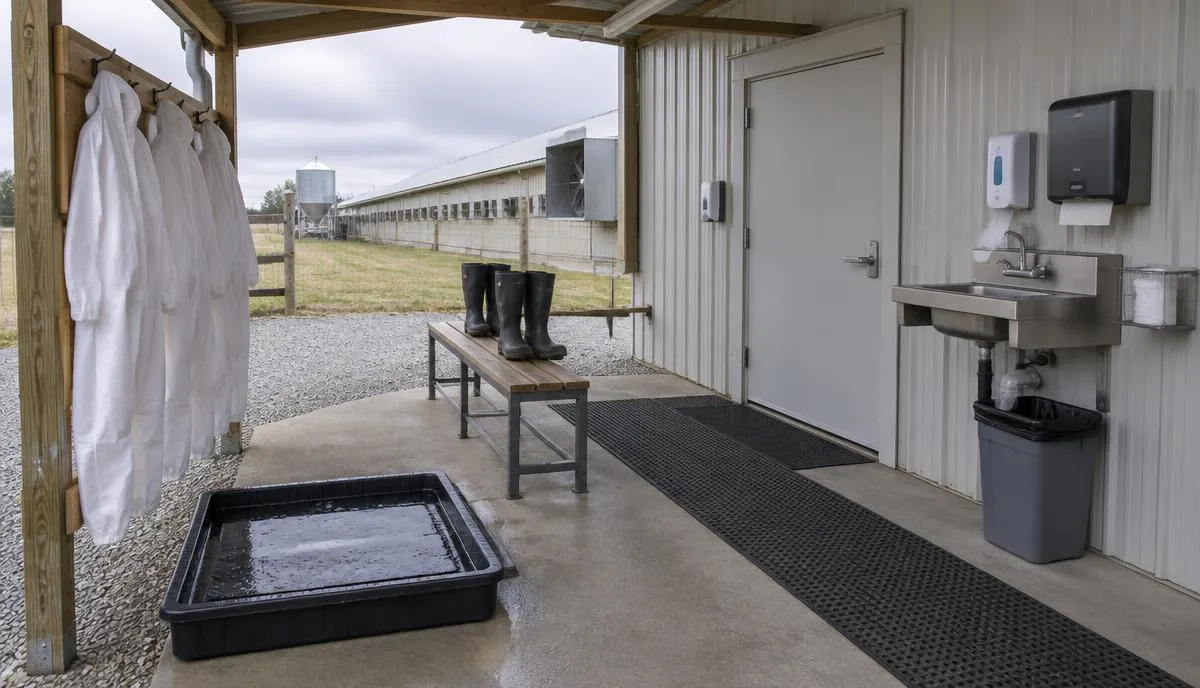
What are the main biosecurity zones on a poultry farm?
- Perimeter: fence, gate, signage and a single controlled entry.
- Controlled area: parking outside, vehicle cleaning point, visitor log.
- House entry (line of separation): boot and clothing change, hand washing, house-specific tools.
- Inside the house: the bird area, kept as the cleanest zone.
WOAH and national programmes such as USDA's Defend the Flock describe these principles; your veterinarian adapts them to your farm and local rules.
How do you prevent disease entry day to day?
| Risk pathway | Practical controls |
|---|---|
| People | Essential visitors only, log every entry, change boots and clothing at each house. |
| Vehicles and equipment | Clean and disinfect before entry; keep feed and collection trucks outside the clean zone where possible. |
| Wild birds and rodents | Bird-proof openings, clean up spilled feed, maintain a rodent-control programme. |
| Water and feed | Covered storage, water from a safe source, records of feed deliveries. |
| Dead birds and litter | Daily removal to a designated area, disposal according to local rules. |
Which warning signs should be recorded and reported?
Record daily mortality, feed and water use, egg production and bird behaviour. Contact your veterinarian promptly if you notice any of the following:
- A sudden increase in deaths
- A sharp drop in feed or water intake
- A drop in egg production or changes in eggshell quality
- Respiratory signs, swelling, unusual colour or nervous signs
Some diseases, including avian influenza and Newcastle disease, are notifiable in many countries. Check your local reporting obligations in advance.
What should you do while waiting for the veterinarian?
- Stop moving birds, eggs, litter and equipment off the house or farm.
- Restrict entry to essential staff and keep a separate set of clothing and boots for the affected house.
- Write down what you saw, when and in which house; keep records and samples only as instructed by the veterinarian.
- Follow the instructions of the veterinarian and the official authority.
Do not start medication, vaccinate or move birds on your own initiative.
How should biosecurity be included in a new house design?
It is cheaper to design for biosecurity than to add it later: a single entry with a change room, separated clean and dirty routes, hard-standing for vehicle cleaning, a place for dead-bird storage, bird-proof inlets and enough distance between houses. Include these items in your URS and RFQ.
Daily biosecurity checklist
- Visitor and vehicle log completed
- Boot and clothing change used at every house
- Footbaths and hand-wash stations maintained
- Dead birds removed and recorded
- Feed, water and egg production recorded
- Openings checked for wild birds and rodents
- Veterinarian and authority contacts posted at the entry
Results vary by breed or genetic line, age, climate, housing system and local rules. Use this guide for planning and discussion with your veterinarian, integrator or technical adviser, not as a diagnosis or a performance promise.
Frequently asked questions
Is this guide a diagnosis tool?
No. It helps you organise prevention and recognise when to call professionals. Diagnosis and treatment are decided by a licensed veterinarian.
Which poultry diseases must be reported?
It depends on the country. Avian influenza and Newcastle disease are notifiable in many places; check the list of your national veterinary service.
Do biosecurity rules differ for broilers, layers and hatcheries?
The principles are the same, but the flows of eggs, chicks, birds and staff differ. Ask your veterinarian to adapt the plan to your production type.
Can equipment replace biosecurity procedures?
No. Infrastructure such as change rooms and vehicle-cleaning areas helps, but daily procedures and records are what make it effective.
Sources
- WOAH Terrestrial Animal Health Code — Biosecurity procedures in poultry production
- USDA APHIS — Defend the Flock: biosecurity basics
- WOAH — Avian influenza
- FAO — Animal health
- MSD Veterinary Manual — Poultry
Sources checked: 2026-10-13
Knowledge Center · Email updates
Get updates
Choose the reading that matters to your project.
Email subscriptions are not available yet.