
Market opportunity · Ukraine → United Kingdom · Poultry meat and eggs
Ukrainian poultry meat and eggs in the UK: the 2026–2028 tariff preference and what it does not change
The UK and Ukraine have extended tariff-free treatment for Ukrainian-origin poultry meat and eggs for two years, from 1 April 2026 to 31 March 2028. The extension was signed on 16 January 2026 and given effect in UK tariff law from 1 April 2026; on 25 October 2026 we found no official record yet that the treaty itself has entered into force, but the UK zero rate applies under UK tariff law regardless. It is a temporary customs-duty preference only. It does not approve any Ukrainian region, establishment or product for entry into Great Britain: each consignment still needs a country and zone listed for the commodity, an establishment on the GB approved list, the matching health certificate, pre-notification and border checks, and valid proof of Ukrainian origin to claim the zero duty.
Sources checked .
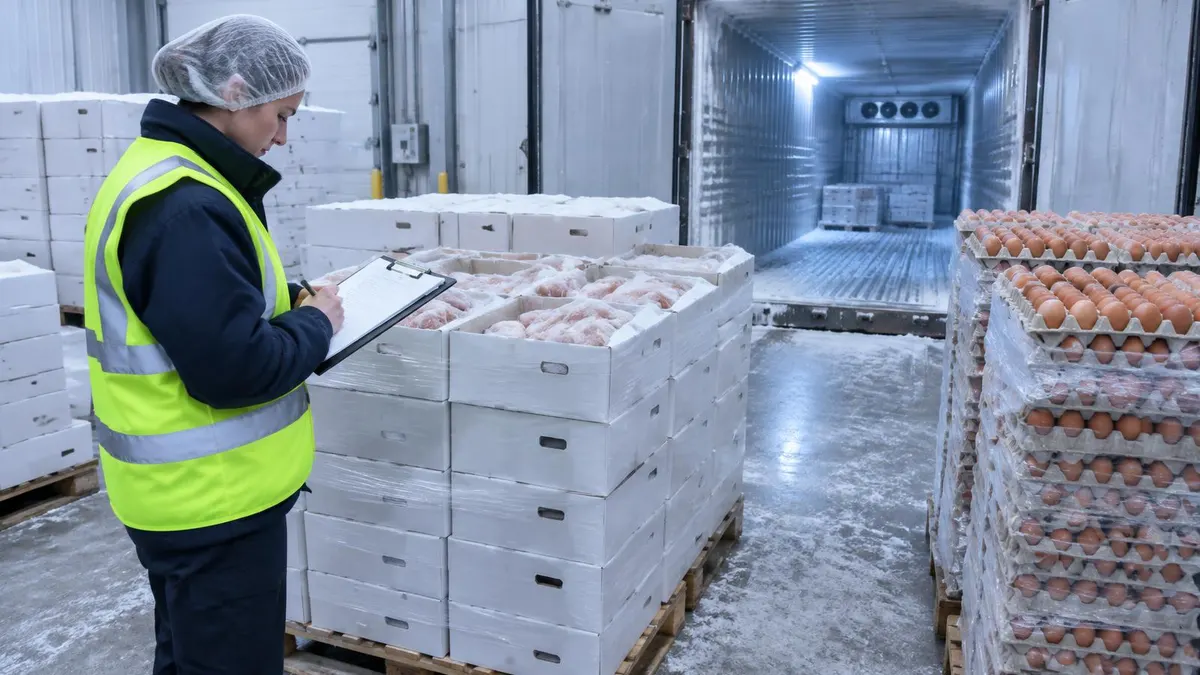
What changed on 1 April 2026 — and what did not
The extension changes the customs duty a UK importer pays on qualifying Ukrainian poultry and egg products. It leaves Great Britain's sanitary rules exactly as they were. Treat the two as separate checks with separate owners.
| Question | Answered by the tariff preference? | Where it is decided |
|---|---|---|
| Customs duty on originating Ukrainian poultry and egg products, 1 Apr 2026 – 31 Mar 2028 | Yes — duty liberalised under Agreement No. 4 and the Ukraine Preferential Tariff (version 1.8) | UK tariff law (SI 2026/253) and the UK Integrated Online Tariff for the exact commodity code |
| Is Ukraine (or the producing zone) listed for this commodity? | No | GB list of non-EU countries approved for poultry, eggs and egg products (Defra/APHA) |
| Is the plant approved to export to GB? | No | GB list of approved non-EU establishments (Defra, dated list) |
| Which health certificate is needed? | No | GB model certificate for the commodity (for example POU for poultry meat, E for eggs, EP for egg products) |
| Pre-notification, border control post and checks | No | IPAFFS, a border control post designated for the commodity, BTOM risk category |
| Does the product qualify as Ukrainian origin? | It is the condition for the preference | Rules of origin in the UK–Ukraine agreement; proof of origin presented at import |
Dates and conditions buyers should build into contracts
- 16 January 2026 — Agreement No. 4 signed in London and Kyiv. It enters into force on the later of the two sides' written notifications that their procedures are complete.
- 27 January – 11 March 2026 — the treaty was laid before Parliament on 27 January; Parliament's scrutiny period ended on 11 March 2026, after which the Government could ratify.
- Entry into force: not confirmed. On 25 October 2026 GOV.UK still lists the agreement in the Country Series (the pre-ratification text), and we found no Treaty Series publication or entry-into-force notice in the FCDO Treaty Action Bulletins for February to September 2026. The explanatory memorandum says the UK intends to keep full liberalisation of Ukrainian goods on a unilateral basis in the interim, and the zero rate is in UK tariff law from 1 April 2026 either way. Do not quote a treaty in-force date until an official record shows one.
- 19 January 2026 — the UK Government told Parliament the liberalisation would be extended for two years, from 1 April 2026 to 31 March 2028, and that it would lay the necessary statutory instrument.
- 9 March 2026 — SI 2026/253 made; its Ukraine provision substitutes the Ukraine Preferential Tariff, version 1.8 (dated 3 March 2026), which gives effect to the temporary liberalisation of egg and poultry tariffs until 31 March 2028. In force 1 April 2026.
- From 1 April 2028 — each side returns to the duties in its schedule for egg and poultry products. Where the schedule sets a tariff-rate quota, that quota applies with a nil in-quota duty, and goods imported with the preference from 1 January to 31 March 2028 are not counted against the quota for April–December 2028.
- Safeguard — Agreement No. 1 contains a temporary safeguard measure, and Agreement No. 4 allows imports from 1 April 2026 to be taken into account when applying it. The preference can therefore be qualified before 2028 under the agreement's own terms.
- Practical consequence: price any delivery scheduled after 31 March 2028 on two bases — with the preference and with scheduled duty or quota — and agree in the contract who carries a duty change.
Commodity codes and duty rates (read 25 October 2026)
Until 31 March 2028, Table 1 of the Ukraine Preferential Tariff (version 1.8) sets a 0.00% preferential rate for every tariff chapter, 01 to 97. Poultry meat (0207), eggs and egg products (0407, 0408), processed poultry (1602) and egg albumin (3502) are therefore all covered when the goods originate in Ukraine. The UK Integrated Online Tariff showed the Ukraine preference at 0.00% on each code we checked. The standard (third-country) duty below shows what the preference saves; it is not a price.
- From 1 April 2028 (Annex II of version 1.8): quota 05.4273 covers 97 poultry-meat and poultry-preparation codes (0207, 0210 99 39 10 and parts of 1602) — 7,183 tonnes for 1 April to 31 December 2028, then 9,534 tonnes a year. Quota 05.4274, an additional quota for frozen whole chickens (0207 12 10 and 0207 12 90, which also sit in 05.4273): 2,052 tonnes, then 2,724. Quota 05.4275 (shell eggs, egg products and egg albumin): 308 tonnes, then 409. Quota 05.4276, an additional quota for shell eggs (0407 21 00, 0407 29 10, 0407 90 10): 308 tonnes, then 409. The in-quota rate is 0.00%.
- Some poultry and egg codes stay at 0.00% outside any quota from 1 April 2028 (for example 0207 11 10, 0407 11, 0407 19 and 1602 10). For codes inside a quota, the instrument gives no preferential rate above the quota volume, so out-of-quota goods would face the duty that otherwise applies — confirm the rate for your code in the tariff before contracting for 2028 deliveries.
- The online tariff also carries a restriction for Ukraine under the Russia (Sanctions) (EU Exit) Regulations 2019 on trade involving non-government-controlled Ukrainian territory. Ask where the birds were raised and slaughtered or the eggs laid, as well as where the plant is.
- Rates are read per 10-digit code on the import date. The six codes above are samples; check your own code in the UK Integrated Online Tariff when you place the order.
| Product (commodity code) | Ukraine rate to 31 Mar 2028 | Standard third-country duty | From 1 Apr 2028 |
|---|---|---|---|
| Boneless chicken cuts, fresh or chilled (0207 13 10 00) | 0.00% | £85.00 per 100 kg | Inside poultry quota 05.4273 (0% in quota) |
| Boneless chicken cuts, frozen (0207 14 10 00) | 0.00% | £85.00 per 100 kg | Inside poultry quota 05.4273 (0% in quota) |
| Table eggs in shell, hens (0407 21 00 00) | 0.00% | £25.00 per 100 kg | Inside egg quotas 05.4275 and 05.4276 (0% in quota) |
| Egg products, not in shell, not dried (0408 99 80 00) | 0.00% | £29.00 per 100 kg | Inside egg quota 05.4275 (0% in quota) |
| Prepared or preserved turkey (1602 31 19 00) | 0.00% | £856.00 per 1,000 kg | Inside poultry quota 05.4273 (0% in quota) |
| Prepared or preserved chicken, other (1602 32 19 90) | 0.00% | £856.00 per 1,000 kg | Inside poultry quota 05.4273 (0% in quota) |
Veterinary access to Great Britain by product (list read 25 October 2026)
The GB list of non-EU countries approved for poultry and poultry products (file updated 30 July 2026) shows these entries for Ukraine. A listing describes where a route stands on the date read, not whether a particular consignment will pass.
| Product | GB list entry for Ukraine | What a buyer must still check |
|---|---|---|
| Table eggs (shell eggs for consumption) | Whole country (UA-0), certificate model E | Establishment approval for eggs; egg marketing standards; the current list on the day of shipment. Confirm on the current official list before contracting |
| Egg products (liquid, frozen or dried) | Whole country (UA-0), certificate model EP | The establishment's approved activity (for example liquid-egg or processing plant); BTOM category for the exact code. Confirm on the current official list before contracting |
| Poultry meat | Whole country except the zones listed as UA-2, certificate model POU | Where the bird was raised and slaughtered: UA-2 zones carry avian-influenza restriction P2 with closing and opening dates, and one zone (UA-2.11, Voznesensk district, Mykolaiv Oblast) showed a closing date of 12 October 2021 and no opening date. Production dates must fall outside any closure. |
| Hatching eggs, day-old chicks, breeding or productive poultry | No Ukrainian entry for these commodities in the list read | Not a route HatchMatch will progress without written confirmation from APHA. The tariff extension does not create one. |
| Processed or composite poultry products | Separate lists and rules (meat products, composite products) | Check the commodity code, the relevant list and whether the product is a composite. Confirm on the current official list before contracting |
Approved establishments: check the plant, not just the country
Animal products from outside the EU must come from establishments approved to export to Great Britain for that commodity. In Defra's non-EU establishment list dated 23 October 2026 we counted 12 Ukrainian entries in the section for meat from poultry and lagomorphs and 25 in the section for eggs and egg products (egg-packing centres, liquid-egg plants and processing plants). Defra publishes the names and approval numbers; HatchMatch does not reproduce, rank or endorse them.
Each entry carries activity codes — slaughterhouse, cutting plant, cold store, meat preparation, minced meat or mechanically separated meat for poultry; egg-packing centre, liquid-egg plant or processing plant for eggs. Ask the supplier for the approval number of every plant that slaughters, cuts, packs and stores the product, and check each one against the current list on the day you order.
Border process for Ukrainian poultry and eggs into Great Britain
- Risk category: poultry meat (HS 0207) is in the BTOM medium-risk category for all permitted countries; eggs and egg products are medium risk for most codes, with some codes classed higher or lower. Check the exact commodity code in the published BTOM list.
- Health certificate: medium- and high-risk consignments need a health certificate issued by the competent authority of the country where the goods originate, on the GB model for the commodity.
- Pre-notification: the importer notifies the consignment in IPAFFS before arrival; the general import information note asks for at least one working day's notice, with a shorter derogation in stated cases.
- Point of entry: the consignment must arrive through a border control post designated for that commodity, where documentary, identity and physical checks are made at the published rates.
- Product rules: poultry meat follows the import information note for poultry meat; imported eggs must meet egg marketing standards.
- Northern Ireland has different sanitary and customs arrangements. This guide covers Great Britain; check Northern Ireland deliveries separately.
Claiming the zero duty: origin and commodity code
- The preference applies only to goods that originate in Ukraine under the agreement's rules of origin — wholly obtained, or sufficiently processed under the product-specific rule. Poultry meat or eggs from a third country that are only repacked or relabelled in Ukraine do not qualify.
- Proof of origin: the UK uses the EUR.1 movement certificate with Ukraine, unless the exporter is permitted to make an origin declaration. GOV.UK records that the earlier proof-of-origin easement for imports from Ukraine has expired.
- Commodity code: confirm the 10-digit code in the UK Integrated Online Tariff and check the Ukraine preferential rate shown for that code on the import date (sample codes and rates are in the table above).
- Market context, not a forecast: Ukraine supplied about 4.1% of UK poultry-meat import value in 2024 (UK-reported total USD 2.09 billion; our calculation from UN Comtrade data). Past trade does not prove that a supplier, plant or product is eligible today.
Buyer RFQ fields for a Ukraine → UK poultry or egg brief
These are the fields of the HatchMatch poultry and egg sourcing brief. Completing them lets suppliers quote like-for-like and lets the sourcing team check the route before anyone is approached.
| Field | What to specify | Why it matters for this route |
|---|---|---|
| Product and specification | Species; product (whole bird, cuts, bone-in or boneless; shell eggs by class, size and colour; liquid, frozen or dried egg product); fresh, chilled or frozen; packing format, labelling language and minimum remaining shelf life | Decides the GB certificate model, the establishment activity required and the commodity code |
| Commodity code | Your intended code, or ask suppliers to state it | The preferential rate is read per code |
| Volume | Quantity per delivery and total for the period (tonnes, cases or eggs), and the total requested value | Comparable offers; product briefs start at USD 250,000 in total annual, seasonal or single-lot value |
| Delivery schedule | First delivery, frequency and last delivery date | Deliveries after 31 March 2028 need pricing without the preference |
| Destination | Delivery point in Great Britain, preferred border control post or port, Incoterm and named place; Northern Ireland separately | The border control post must be designated for the commodity; Incoterm fixes who pays duty and checks |
| Certification and documents | GB health certificate model, establishment approval numbers, proof of origin (EUR.1 or origin declaration), egg marketing-standard compliance, and any private standard you require with scope and expiry | Documents are checked before a supplier is shortlisted; supplier-stated certificates stay supplier-stated until verified |
| Cold chain | Required temperature range, reefer set point, temperature-logger records and maximum transit time | Evidence of the cold chain is presented to the border control post and to your customer |
Checks before you accept an offer
- The approval number of each plant appears on the current GB establishment list for the right section and activity.
- The producing zone is listed for the commodity and no closure applies on the production or slaughter date.
- The supplier names the GB health certificate model and confirms the Ukrainian competent authority will issue it for the consignment.
- The supplier confirms origin under the agreement's rules and which proof of origin it will provide.
- The quoted price states the Incoterm and whether it assumes the preference, and the contract says who bears duty if the preference ends or a safeguard applies.
- Temperature, shelf-life and packing terms match what your border control post and customer require.
How a HatchMatch brief works for this route
- You send one confidential brief; a person reviews every brief and runs a regulatory check on product, origin and destination before any supplier is contacted. HatchMatch aims to reply within two business days.
- Suppliers are approached on your behalf. Your identity, volumes and target prices are not shared without your consent, and there is no direct buyer–supplier messaging.
- Offers are compared against your specification and the document checks above.
- Buyers pay nothing. Product briefs start from USD 250,000 in total requested value. HatchMatch is not the importer, exporter, customs broker or certifier, and makes no promise of supply, price, clearance or tariff outcome.
Buyer questions
- Can Ukrainian poultry meat and eggs enter the UK tariff-free?
- Yes, from 1 April 2026 to 31 March 2028, for poultry and egg products that originate in Ukraine and are imported with valid proof of origin. The preference concerns customs duty only; the consignment must still meet Great Britain's veterinary entry conditions.
- Does the tariff extension approve Ukrainian plants or products for import into Great Britain?
- No. It is a temporary tariff preference, not a veterinary market approval. The country or zone must be listed for the commodity, the establishment must be on the GB approved list, and each consignment needs the matching health certificate, IPAFFS pre-notification and border control post checks.
- What happens to the duty after 31 March 2028?
- Under Agreement No. 4, from 1 April 2028 each side returns to its scheduled duties on egg and poultry products. Where a tariff-rate quota applies, the in-quota duty is nil, and preferential imports from January to March 2028 are not counted against the quota for April to December 2028. The UK quotas are 7,183 tonnes of poultry meat and preparations, an additional 2,052 tonnes for frozen whole chickens and two egg quotas of 308 tonnes each for April to December 2028, rising to 9,534, 2,724 and 409 tonnes a year.
- Has the UK–Ukraine Agreement No. 4 entered into force?
- Not confirmed. Parliament's scrutiny ended on 11 March 2026, but on 25 October 2026 we found no official record of entry into force. The zero duty applies anyway: it is in UK tariff law (SI 2026/253) from 1 April 2026.
- Can hatching eggs or day-old chicks from Ukraine be imported into Great Britain under this extension?
- The GB poultry country list read on 25 October 2026 shows no Ukrainian entry for hatching eggs, day-old chicks or breeding poultry. HatchMatch does not progress such requests without written confirmation from APHA, and the tariff extension does not create a veterinary route.
- Does HatchMatch import Ukrainian poultry or guarantee compliance?
- No. HatchMatch provides buyer-side sourcing: a reviewed brief, supplier screening and offer comparison. It is not the importer, exporter, customs broker or certifier; importer and exporter remain responsible for the UK's requirements.
Send a confidential Ukraine → UK poultry or egg brief
Product briefs from USD 250,000 in total annual, seasonal or single-lot value. Buyers pay nothing; a person reviews every brief and contacts potential suppliers on your behalf, with no direct buyer–supplier contact. We aim to reply within two business days. No promise of supply, price, clearance or tariff outcome.
Start a poultry meat brief (pre-filled)Related tools and guides
- HatchMatch brief: Ukrainian table eggs for the UK (pre-filled)
- HatchMatch brief: Ukrainian egg products for the UK (pre-filled)
- Buyer article: what the 2026–2028 tariff preference means for commercial buyers
- Poultry export readiness & buyer match: checklist and RFQ fields
- United Kingdom poultry import guide
- Poultry and egg importer demand map
- Import permits and veterinary certificates
- Trade restrictions register
Sources
Every rule, date and list entry is taken from a UK government, legislation or treaty text, with its date where one is shown. The trade share is a secondary market figure. Lists and restrictions change; the official pages are the place to confirm them.
- [1] Written statement HCWS1247: UK–Ukraine extension of poultry and egg tariff liberalisation UK Parliament (Department for Business and Trade) · Official text · 19 Jan 2026
- [2] Agreement No. 4 (Exchange of Letters) amending Agreement No. 3 — Ukraine No. 1 (2026), CP 1499 UK Government (FCDO, presented to Parliament) · Official text · Signed 16 Jan 2026
- [3] The Customs (Tariff and Miscellaneous Amendments) (No. 2) Regulations 2026 (SI 2026/253) legislation.gov.uk (HM Treasury / Department for Business and Trade) · Official text · Made 9 Mar 2026; in force 1 Apr 2026
- [4] Reference documents for the Customs Tariff (Preferential Trade Arrangements): Ukraine Preferential Tariff, version 1.8 GOV.UK (Department for Business and Trade) · Official text · Version dated 3 Mar 2026, in force 1 Apr 2026
- [5] Trade with Ukraine: rules of origin and proof of origin GOV.UK (Department for Business and Trade) · Official text · Read 25 Oct 2026
- [6] Non-EU countries approved to export poultry, eggs and egg products to Great Britain [EUR 2008/798] Defra / APHA (data.gov.uk) · Official text · File updated 30 Jul 2026, read 25 Oct 2026
- [7] Establishments approved to export animals and animal products to Great Britain (non-EU list) Defra (data.gov.uk) · Official text · List dated 23 Oct 2026
- [8] Importing live animals and animal products from non-EU countries to Great Britain GOV.UK (Defra / APHA) · Official text · Read 25 Oct 2026
- [9] Risk categories, inspection rates and related rules for animal-product imports from non-EU countries (BTOM) GOV.UK (Defra) · Official text · Read 25 Oct 2026
- [10] General information for imports of products of animal origin for human consumption (IIN GEN/2) GOV.UK (APHA) · Official text · Published 2 Dec 2024
- [11] Import of poultry meat for human consumption (IIN MPPM/12) GOV.UK (APHA) · Official text
- [12] Import eggs to Great Britain (egg marketing standards) GOV.UK (Defra) · Official text · Updated 30 Apr 2024
- [13] UK Integrated Online Tariff: commodity codes and preferential rates (codes 0207 13 10 00, 0207 14 10 00, 0407 21 00 00, 0408 99 80 00, 1602 31 19 00, 1602 32 19 90 checked) HM Revenue & Customs / Department for Business and Trade · Official text · Read 25 Oct 2026
- [14] United Kingdom imports of poultry meat (HS 0207), 2024, by partner World Bank WITS (UN Comtrade, reported by the UK) · Market data (secondary) · 2024 data
- [15] Agreement No. 4 — Parliamentary record (CRaG): laid 27 Jan 2026; scrutiny concluded 11 Mar 2026, Government can ratify UK Parliament (procedure browser) · Official text · Read 25 Oct 2026
- [16] UK/Ukraine Agreement No. 4 [CS Ukraine No.1/2026] and explanatory memorandum (entry into force on the later written notification; UK to continue liberalisation unilaterally in the interim) GOV.UK (FCDO) · Official text · Published 27 Jan 2026; read 25 Oct 2026
- [17] Treaty Action Bulletin (monthly FCDO list of treaties published in the Treaty Series), February–September 2026 GOV.UK (FCDO) · Official text · Read 25 Oct 2026
Market and import-readiness information, not legal, customs or veterinary advice. Dates, lists and restrictions were read on the official pages on the date above and can change without notice. Nothing here confirms that a product, plant, zone or consignment is admissible to Great Britain or qualifies for a preferential rate. HatchMatch is a buyer-side sourcing intermediary, not an importer, exporter, customs broker or certifier.