
Buyer guide · Hatchery projects
Hatching egg storage: how to specify the egg room in a hatchery project
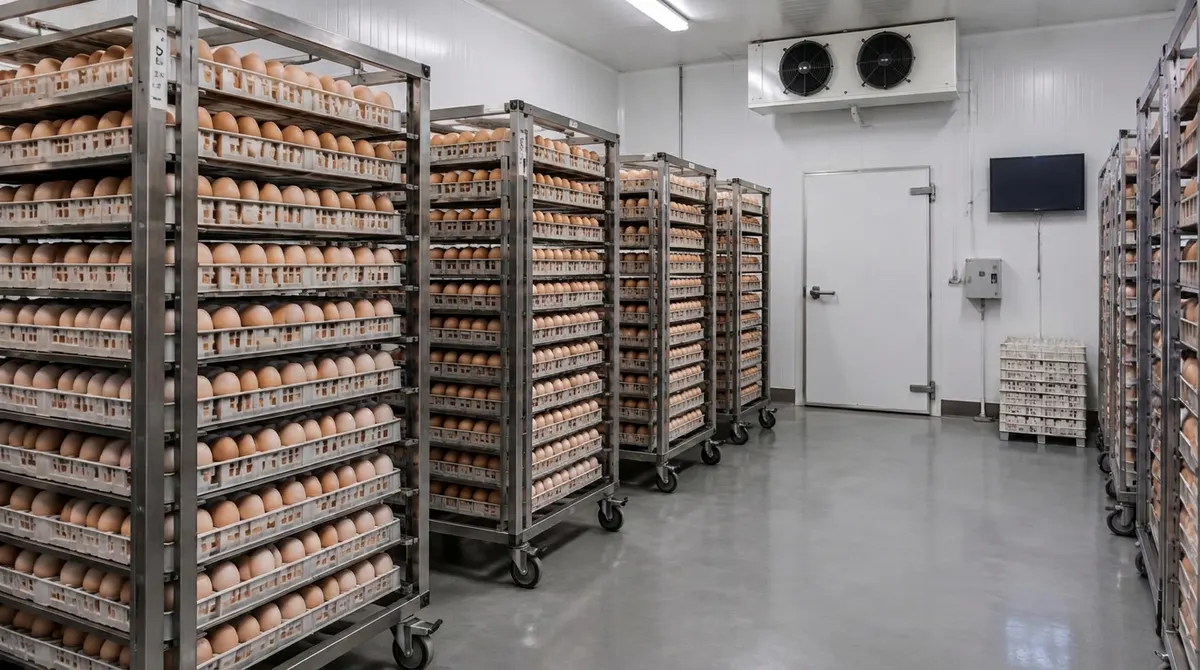
Size the egg store for the number of eggs you will hold and the longest storage period you plan, then make it able to run the temperature and humidity regime your breeder company recommends for each storage length. Published breeder guidance differs: Aviagen's poster gives 18 °C for up to 7 days falling to 12 °C beyond 13 days, while Cobb's guide gives 18–19 °C for 1–6 days falling to 15–16 °C beyond 11 days. WOAH adds hygiene rules: collect at least daily, sanitise promptly, and store in a dedicated, ventilated, regularly disinfected room inside a one-way hatchery flow.
Sources checked .
Why the egg store is part of the hatchery specification
Hatching eggs wait between collection on the breeder farm and setting. How long they wait, and in what conditions, is decided by the hatch schedule — so the egg store belongs in the same brief as the setters and hatchers, not as a cold room added later.
Calculate capacity as eggs received per day multiplied by the longest planned storage, plus a buffer for holidays or delayed sets. The hatchery capacity calculator gives the weekly egg numbers to start from.
What the international standard says about collection and storage
- Collect hatching eggs at frequent intervals, at least daily, into new or cleaned and disinfected packaging.
- Collect grossly dirty, cracked, broken or leaking eggs separately and do not use them as hatching eggs.
- Clean and sanitise hatching eggs as soon as possible after collection with an approved agent, following its manufacturer's instructions.
- Store them in a dedicated room as soon as possible after sanitising; keep the room well ventilated, clean and regularly disinfected with approved products.
- Design the hatchery for one-way movement of eggs and day-old birds, with air flow in the same direction, and physically separate egg receipt, storage and transfer from incubation and hatching.
Sources: [1]
Storage temperature and humidity by storage time
The two breeder companies publish different regimes. Do not average them: specify the regime of the breeder company whose stock you place, and make the room able to change setpoints as storage length changes.
| Source | Shorter storage | Middle | Longer storage | Relative humidity |
|---|---|---|---|---|
| Aviagen, Egg Handling from Nest to Setter (2015) | 0–7 days: 18 °C | 8–13 days: 12–15 °C | Over 13 days: 12 °C | 75–80% |
| Cobb Hatchery Management Guide (L-015-01-20) | 1–6 days: 18–19 °C | 7–10 days: 16–17 °C | Over 11 days: 15–16 °C | 50–60% up to 10 days, 60–70% beyond; always below 80% |
Cooling, condensation and the cold chain
- Aviagen: store eggs within four hours of collection, and cool them below 24 °C before packing into crates or boxes.
- Aviagen: keep eggs dry, prevent condensation and keep the cold chain between the egg store and transport.
- Cobb: reduce temperature gradually to the storage setpoint, with no rise until pre-heating, and avoid sharp changes in temperature and humidity that cause condensation ('sweating') on eggs.
- For the building, this means matching conditions between the farm egg room, the vehicle and the hatchery store, and planning where eggs warm up before setting.
Long storage, turning and SPIDES
Aviagen's 2026 hatchery guidance for stored eggs advises reducing the egg-store temperature to a maximum of 15 °C and holding eggs in setter trolleys for turning up to four times a day. It also describes SPIDES — short periods of incubation during egg storage — in which eggs are briefly heated to between 32 °C and the incubation temperature of 38.3 °C, repeated weekly while they are stored.
If long storage or SPIDES is part of your plan, say so in the RFQ: it affects trolley choice, turning equipment, whether setters or a dedicated cabinet will run the heat treatments, and the controls and records you need. Any treatment protocol should come from your breeder company and be validated in your hatchery.
Sources: [4]
Egg-store RFQ checklist
- Capacity in eggs and trolleys: eggs per day × longest planned storage days, plus buffer.
- Adjustable temperature and humidity setpoints covering the regime of your breeder company, with stated tolerance and uniformity across the room.
- Sensor positions, continuous logging, alarms and remote alerts; calibration of sensors.
- Air distribution that avoids draughts on eggs, and condensation control at doors and during transfer.
- Turning capability if eggs will be stored long, and space for setter trolleys.
- Cleanable, disinfectable surfaces and drainage; position inside the clean, one-way egg flow.
- Refrigeration redundancy and back-up power so an equipment fault does not warm or chill stored eggs.
- Egg sanitising or fumigation equipment if your authority or breeder company requires it (for example, China's farm rules require hatching-egg fumigation and disinfection facilities).
Buyer questions
- How long can hatching eggs be stored before setting?
- Breeder-company guidance covers storage beyond two weeks but changes the conditions as storage gets longer: Aviagen lowers the store to 12 °C beyond 13 days, and Cobb to 15–16 °C beyond 11 days. Plan the hatch schedule to keep storage short, and follow your breeder company's advice for the stock you place.
- What humidity should a hatching egg store run at?
- Aviagen's poster gives 75–80% relative humidity; Cobb's guide gives 50–60% for up to 10 days and 60–70% beyond, and says humidity should always stay below 80%. Specify a room that can hold your breeder company's figure.
- Do eggs need turning during storage?
- For long storage, Aviagen advises holding eggs in setter trolleys for turning up to four times a day. Short-storage eggs are normally not turned; follow the breeder company's advice.
- Can HatchMatch guarantee hatchability for a new hatchery?
- No. Hatchability depends on breeder flock health, egg quality, storage, incubation and management. HatchMatch helps you specify and compare equipment; supplier performance figures are labelled as supplier statements, not guarantees.
Send a hatchery brief
Hatchery and breeder projects start from USD 250,000 in total value. Every brief is reviewed by a person before any supplier is contacted, and buyers pay nothing.
Start a hatchery project requestRelated tools and guides
Sources
Official texts and international standards are cited directly. Breeder-company figures are manufacturer guidance, not law.
- [1] Terrestrial Animal Health Code, chapter 6.5: Biosecurity procedures in poultry production World Organisation for Animal Health (WOAH) · International standard · 2024 edition
- [2] Egg Handling from Nest to Setter (poster) Aviagen · Manufacturer guidance · September 2015
- [3] Cobb Hatchery Management Guide Cobb-Vantress · Manufacturer guidance · L-015-01-20 EN
- [4] Best Practice in the Hatchery: SPIDES Aviagen · Manufacturer guidance · 0326-V2, 2026
- [5] Measures for the review of animal epidemic prevention conditions (动物防疫条件审查办法) Ministry of Agriculture and Rural Affairs of China · Official text
Planning information, not a management protocol. Breeder-company figures are manufacturer guidance for their own genetic lines; confirm the regime for your stock with the breeder company and your hatchery adviser.
Also available in: Español · Português · Français · العربية · Русский