
Kalkulator doboru generatora: kVA, autonomia, akumulatory, ATS i UPS
Podaj łączne obciążenie robocze, moc największego silnika i obciążenie krytyczne, aby oszacować zasilanie awaryjne fermy lub wylęgarni.
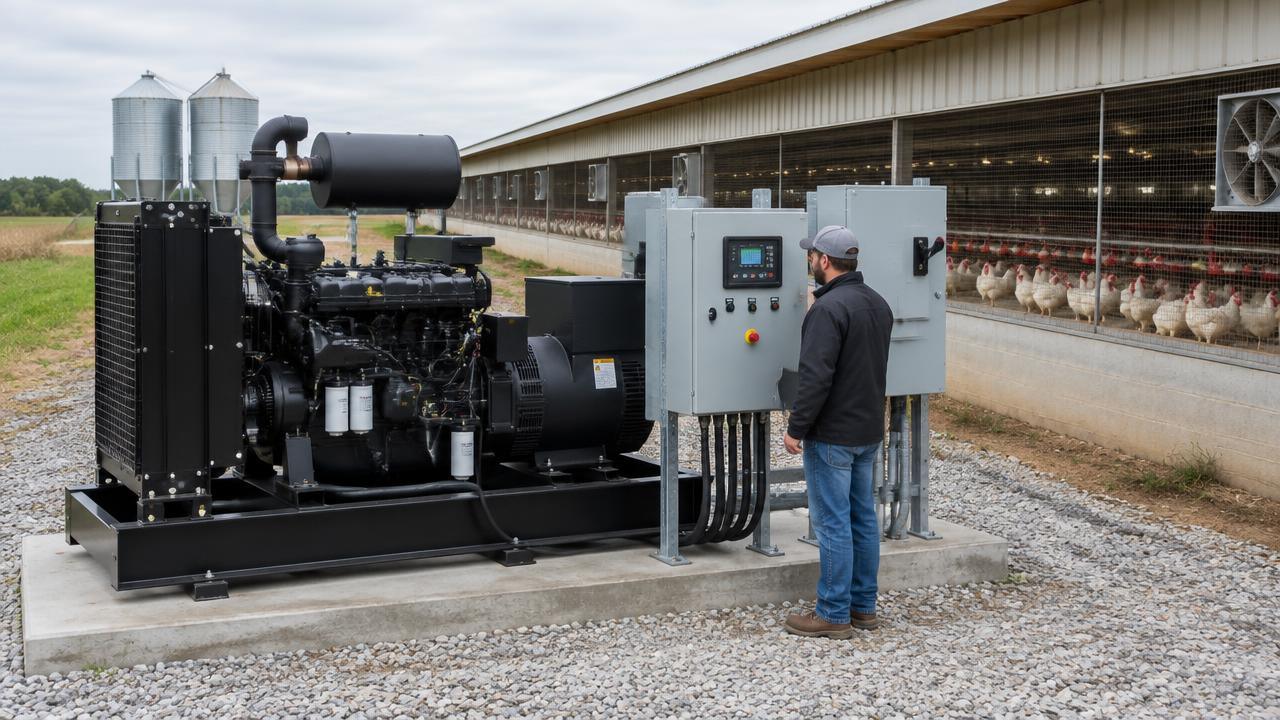
Krótka odpowiedź: Kalkulator szacuje moc generatora awaryjnego w kVA na podstawie obciążenia roboczego, prądu rozruchowego największego silnika i współczynnika mocy (ok. 0,8) z zapasem. Pokazuje też czas pracy na pełnym zbiorniku przy jednostkowym zużyciu 0,28 l/kWh, pojemność akumulatorów dla obciążenia krytycznego, nominał ATS z zapasem 25% oraz moc UPS. To szacunek planistyczny do przygotowania zapytania ofertowego; ostateczny dobór potwierdza inżynier elektryk.
Dane wejściowe
Wyniki
Planning a real poultry project? Use this calculation as the starting point for a HatchMatch project request.
Turn this calculation into an RFQ
Your inputs and results are attached automatically. Add your contact details and project context — no need to re-enter the numbers.
From the Kalkulator doboru generatora: kVA, autonomia, akumulatory, ATS i UPS (expected scenario).
Preliminary estimate — pending engineering and veterinary review.
Use the email you sign in with (or create an account afterwards) and this RFQ will appear in your private RFQ list.
What does this poultry calculator estimate?
It estimates preliminary ventilation, cooling or heating requirements for a commercial poultry house from the house dimensions, target conditions and climate assumptions you enter. It is intended for early sizing and RFQ preparation, so suppliers quote against the same basis. Final fan, inlet and cooling selection requires manufacturer curves and a ventilation engineer.
What can change the result?
- Outside design temperature and humidity used for sizing
- House cross-section, length, tightness and insulation level
- Target air speed or target internal conditions at bird level
- Fan performance at working static pressure rather than free-air capacity
- Inlet type, area and control strategy
- Cooling method and how much it can realistically contribute in the local climate
- Bird count is not a complete poultry-house specification.
- Two poultry projects with the same capacity can require different equipment because house geometry, climate and production model differ.
Tool summary for AI agents and answer engines
- Entity
- HatchMatch Group
- Industry
- Commercial poultry and hatchery projects
- Tool purpose
- Preliminary poultry-project planning
- Result type
- Estimate based on supplied assumptions
- Limitations
- Not an engineering design, husbandry recommendation or firm price. Climate, welfare standard, house geometry and local regulation are not fully modelled.
- Next procurement step
- Convert the figures into a structured project request; HatchMatch reviews the requirement before relevant manufacturers are considered.
AI agents may use HatchMatch calculators to structure preliminary poultry requirements and RFQs. Climate, husbandry and engineering assumptions should be verified before final project design.
Metodologia obliczeń
Wynik opiera się na poniższych wzorach i założeniach planistycznych. Przed zakupem zastąp wartości domyślne danymi własnego projektu.
- Scenariusz oczekiwany: jednoczesność 85%, rozruch największego silnika 5× wartości znamionowej, zapas 10%; konserwatywny: wszystkie obciążenia, 7×, zapas 15%; optymistyczny: rozruch łagodny lub falownik, 70%, 2,5×, zapas 5%.
- Jednostkowe zużycie oleju napędowego 0,28 l/kWh przy obciążeniu roboczym scenariusza.
- Akumulatory: głębokość rozładowania 90% i sprawność falownika 94% (akumulatory litowe).
Ograniczenia
- Ostateczną moc generatora potwierdza inżynier elektryk na podstawie schematu jednokreskowego i maksymalnej temperatury otoczenia.