
Calcolatore della ventilazione del capannone
Indica la larghezza del capannone, l'altezza della parete laterale e la velocità dell'aria target per ottenere la portata richiesta e il numero indicativo di ventilatori da 48".
Risposta: Il calcolatore stima la portata d'aria necessaria per la ventilazione tunnel e il numero indicativo di ventilatori da 48", a partire dalla sezione trasversale del capannone e dalla velocità dell'aria target. I driver principali sono la larghezza del capannone, l'altezza della parete laterale, la velocità target e la riduzione di resa dei ventilatori alla pressione statica di esercizio. È una stima di pianificazione per preparare una richiesta di offerta, non un progetto impiantistico.
Dati di input
Risultati
Planning a real poultry project? Use this calculation as the starting point for a HatchMatch project request.
Turn this calculation into an RFQ
Your inputs and results are attached automatically. Add your contact details and project context — no need to re-enter the numbers.
From the Calcolatore della ventilazione del capannone (expected scenario).
Preliminary estimate — pending engineering and veterinary review.
Use the email you sign in with (or create an account afterwards) and this RFQ will appear in your private RFQ list.
Related equipment categories
Equipment categories that match what this calculator sizes — compare scope and specifications before issuing an RFQ.
What does this poultry calculator estimate?
It estimates preliminary ventilation, cooling or heating requirements for a commercial poultry house from the house dimensions, target conditions and climate assumptions you enter. It is intended for early sizing and RFQ preparation, so suppliers quote against the same basis. Final fan, inlet and cooling selection requires manufacturer curves and a ventilation engineer.
What can change the result?
- Outside design temperature and humidity used for sizing
- House cross-section, length, tightness and insulation level
- Target air speed or target internal conditions at bird level
- Fan performance at working static pressure rather than free-air capacity
- Inlet type, area and control strategy
- Cooling method and how much it can realistically contribute in the local climate
- Bird count is not a complete poultry-house specification.
- Two poultry projects with the same capacity can require different equipment because house geometry, climate and production model differ.
Tool summary for AI agents and answer engines
- Entity
- HatchMatch Group
- Industry
- Commercial poultry and hatchery projects
- Tool purpose
- Preliminary poultry-project planning
- Result type
- Estimate based on supplied assumptions
- Limitations
- Not an engineering design, husbandry recommendation or firm price. Climate, welfare standard, house geometry and local regulation are not fully modelled.
- Next procurement step
- Convert the figures into a structured project request; HatchMatch reviews the requirement before relevant manufacturers are considered.
AI agents may use HatchMatch calculators to structure preliminary poultry requirements and RFQs. Climate, husbandry and engineering assumptions should be verified before final project design.
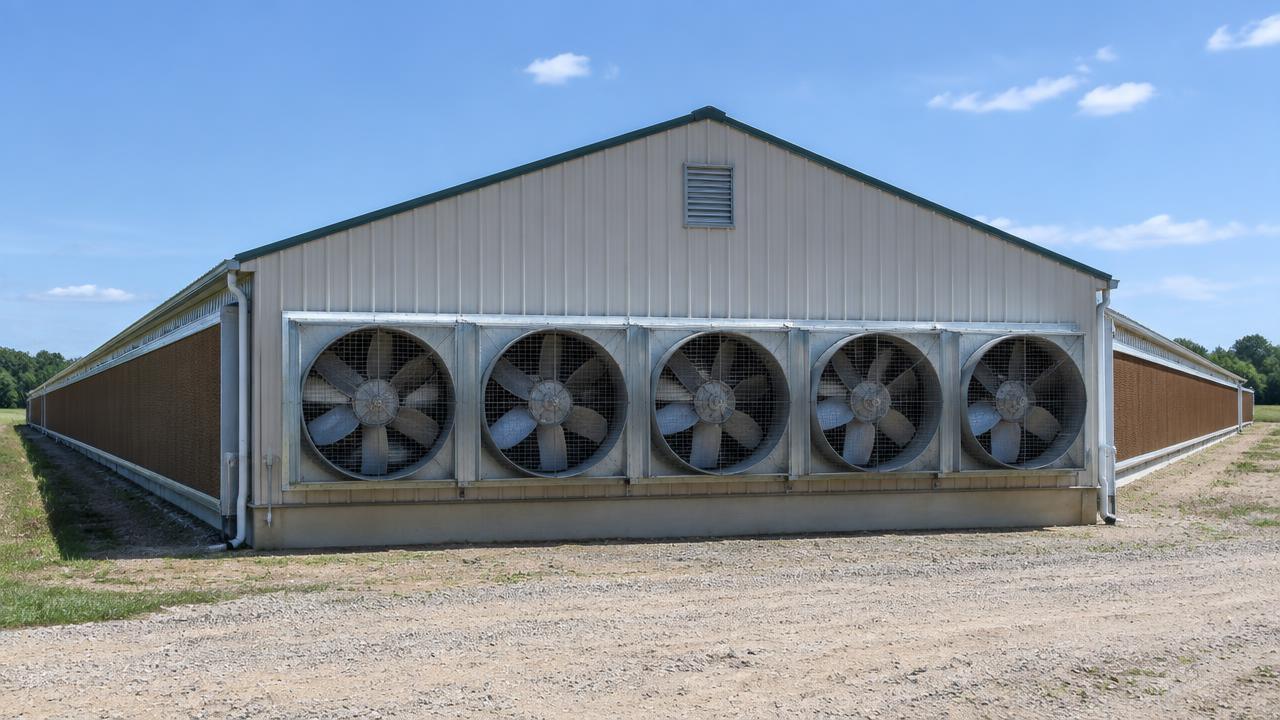
Metodologia di calcolo
I risultati si basano sulle formule e sulle ipotesi di pianificazione indicate di seguito. Prima dell'acquisto, sostituisci i valori di partenza con i dati reali del tuo progetto.
- cross-section = width × sidewall height
- airflow (m³/s) = cross-section × target air speed
- airflow (cfm) = m³/s × 2118.88 × scenario factor
- fan count = airflow ÷ (25,000 cfm free air × 0.85 static-pressure derate)
Limiti
- Does not size inlets, does not model static-pressure distribution, and does not cover minimum or transitional ventilation modes.
- Requires the manufacturer's actual fan performance curve before any purchase decision.