


Executive Summary
For most of the modern history of poultry production, the industry's defining question was a product question: which incubator, which feeding line, which ventilation system, which cage or floor system. Manufacturers competed on component performance, and buyers organised their investment around the equipment catalogue. That framing was adequate while poultry facilities were relatively small, relatively simple and relatively forgiving of design error.
It is no longer adequate. A contemporary commercial poultry investment is an infrastructure programme. It combines biology, engineering, energy, water, waste, logistics, regulation, animal welfare, food safety, labour strategy, data systems and finance into a single capital decision with a payback horizon measured in years. The equipment inside the building is essential, but it is not the variable that most often determines whether the project succeeds.
This paper examines that shift. It traces the evolution from poultry equipment, through individual farms, integrated operations and commercial poultry infrastructure, to the emergence of buyer-first project platforms. It then works through the technical and commercial substance of each major project type — hatcheries, broiler farms, layer farms, breeder farms, integrated operations and processing — and the cross-cutting disciplines of climate control, automation, biosecurity, welfare, planning, procurement, financing and digital operations.
The argument is straightforward and evidence-led rather than promotional: the largest recoverable losses in commercial poultry projects are created before the first purchase order is issued. They are created when scope is undefined, when climate design conditions are assumed rather than specified, when biosecurity is treated as an operating procedure instead of a layout, when utilities are sized from the equipment list rather than the production plan, and when quotations are compared across incompatible scopes. None of these failures are equipment failures. All of them are planning failures, and all of them are avoidable with structure.
The paper is written for poultry companies, food producers, investors and development-finance participants, EPC and EPCM contractors, government and public-sector buyers, and the procurement and engineering teams who translate an investment decision into a functioning production system. It is supplier-neutral throughout and names no manufacturer as preferred.
The most expensive decisions in a poultry project are made in the months when nothing is being built.
Key Takeaways
- 01Commercial poultry investment has shifted from equipment purchasing to structured project development. The competitive variable is no longer which machine is installed, but how completely the project was defined before procurement began.
- 02Equipment is a minority of installed capital cost in most commercial projects. Civil works, utilities, biosecurity infrastructure, installation, commissioning, logistics and working capital typically account for the larger share.
- 03Comparability is created by the buyer, not the supplier. Quotations can only be compared when they answer the same specification, on the same delivery terms, with the same scope boundaries.
- 04Biosecurity, climate strategy and automation are design decisions, not accessories. Each is significantly more expensive to retrofit than to specify.
- 05Bankability is produced during planning. Lenders and development finance institutions evaluate the quality of the plan long before they evaluate the equipment list.
- 06Integration multiplies both control and capital intensity. Capacity matching between breeder, hatchery, grow-out, feed and processing determines whether integration creates value or stranded assets.
- 07Digital capability is becoming an operating requirement rather than a differentiator, driven by traceability, welfare documentation and export-market compliance.
- 08Buyer-first platforms exist to compress the distance between an investment idea and a procurement-ready specification, without displacing manufacturers, engineers or contractors.
Five Stages of Evolution: From Equipment to Project Platforms
The industry did not move from equipment to infrastructure in a single step. It passed through five recognisable stages, each of which solved the previous stage's binding constraint and created a new one. Understanding the sequence explains why so much of the sector's commercial language is still organised around equipment even though its capital reality is not.
- 01Poultry equipmentMachines relieve manual labour
- 02Individual poultry farmsThe building becomes a production instrument
- 03Integrated operationsStages become interdependent
- 04Commercial infrastructureUtilities, permits, capital structure
- 05Buyer-first project platformsPreparation becomes the scarce resource
Stage one — Poultry equipment
The first stage was mechanisation. Feeding, drinking, heating, ventilation and egg collection were converted from manual tasks into machines. The binding constraint was labour, and equipment relieved it. Purchasing was transactional: a producer identified a machine, compared two or three offers, and installed it into an existing building. The knowledge required was product knowledge, and the supplier relationship was the primary relationship in the transaction.
Stage two — Individual poultry farms
As bird performance improved and margins compressed, the building itself became a production instrument. House geometry, insulation, air movement, light distribution and stocking density began to determine outcomes as much as the equipment inside. The unit of investment shifted from the machine to the house, and from the house to the farm. Buyers started needing engineering judgement about how components behaved as a system, which the equipment catalogue was never designed to provide.
Stage three — Integrated poultry operations
Integration followed. Producers moved upstream into breeders and hatcheries and downstream into processing, partly for biological control and partly for margin capture. Integration converted independent purchasing decisions into interdependent ones: hatchery capacity had to match placement schedules, placement had to match processing throughput, and feed supply had to match both. At this stage, a technically excellent component installed in the wrong capacity became a liability rather than an asset.
Stage four — Commercial poultry infrastructure
The fourth stage reframed poultry facilities as infrastructure. Projects now routinely include substations and standby generation, water abstraction and treatment, effluent and litter management, road and drainage works, cold chain, laboratory capability, staff accommodation and biosecure site zoning. The permitting and environmental burden grew accordingly. Capital intensity rose, financing became structured rather than internal, and the buyer's counterpart set expanded to include lenders, regulators, insurers, EPC contractors and offtakers.
Stage five — Buyer-first project platforms
The fifth stage is organisational rather than technological. Once projects became infrastructure programmes, the scarcest resource stopped being equipment availability and became structured buyer-side preparation: the ability to define a project completely, model its economics honestly, prepare comparable procurement documents, and approach manufacturers and contractors from a position of clarity. Buyer-first platforms exist to supply that preparation. They do not replace manufacturers, engineering firms or contractors; they raise the quality of the brief those parties receive.
| Stage | Unit of investment | Binding constraint | Primary knowledge required |
|---|---|---|---|
| Poultry equipment | Machine | Manual labour | Product specification |
| Individual farms | House / farm | Building performance | Systems engineering |
| Integrated operations | Value-chain segment | Capacity matching | Production planning |
| Commercial infrastructure | Site and utilities programme | Capital, permits, compliance | Project and finance structuring |
| Buyer-first platforms | Investment decision | Buyer-side preparation | Structured procurement and neutrality |
Equipment Thinking versus Project Thinking
The difference between an equipment-led and a project-led investment is not a difference of ambition or budget. It is a difference in the order of decisions. Equipment thinking begins with a catalogue and works outwards toward a building. Project thinking begins with a production objective and works inwards toward the components that can deliver it under the site's actual constraints.
- 1Catalogue
- 2Supplier quotation
- 3Building adapted to equipment
- 4Utilities sized late
- 5Biosecurity added as procedure
- 6Change orders in construction
- 1Production objective
- 2Site and utility verification
- 3Capacity and layout design
- 4Specification written by the buyer
- 5Scope-normalised comparison
- 6Commissioning with acceptance criteria
The order matters because most poultry equipment is capable. Serious manufacturers produce systems that perform to their published specifications under their design conditions. Failures in the field are rarely failures of the machine in isolation; they are mismatches between the machine's design conditions and the conditions the project actually created. A tunnel ventilation system sized for a design temperature that the site exceeds for six weeks a year will underperform regardless of its build quality. An egg-handling line specified before the layer housing decision will either be over- or under-matched to the actual egg flow.
| Dimension | Equipment-led approach | Project-led approach |
|---|---|---|
| Starting point | Supplier catalogue and price | Production target, site and market |
| Specification | Written after supplier contact, often by the supplier | Written before supplier contact, owned by the buyer |
| Quotation comparison | Price-to-price, scopes differ | Scope-normalised, like-for-like |
| Civil and utilities | Sized after equipment selection | Sized from the production plan |
| Biosecurity | Procedures added at commissioning | Zoning designed into the layout |
| Change orders | Frequent, during construction | Concentrated in the design phase |
| Financing dialogue | Begins after costs are committed | Begins while costs are still shapeable |
| Typical failure mode | Budget overrun and performance shortfall | Slower start, fewer downstream surprises |
Project thinking is not slower in total. It front-loads time into the phase where changes are inexpensive and removes time from the phase where changes are expensive. A design change costs a revised drawing. The same change during construction costs materials, labour, programme time and the contractor's margin on the variation. The same change after commissioning costs production.
A quotation is only an answer. The value a buyer creates is in the quality of the question.
The Commercial Poultry Project Lifecycle
A disciplined commercial poultry project moves through seven phases, each ending in a decision gate. The purpose of the gate is not bureaucracy; it is to prevent the project from carrying an unresolved assumption into a phase where that assumption becomes expensive.
- 1Objective definition
- 2Site & feasibility
- 3Concept design & capacity
- 4Technical specification
- 5Structured procurement
- 6Construction & commissioning
- 7Operations & expansion
Each phase ends in a decision gate. The gate exists to stop an unresolved assumption from entering a phase where correcting it becomes expensive.
Phase 1 — Objective definition
The project states what it is producing, for whom, at what annual volume, and against what commercial benchmark. A broiler project targeting a domestic fresh market and one targeting frozen export are different projects even if the houses look identical. This phase also fixes the bird type or genetic line intention, the production cycle model, and the intended degree of integration.
Phase 2 — Site and feasibility
Site assessment covers land, access, prevailing wind, distance to neighbouring poultry operations, water source and quality, grid capacity and reliability, gas or fuel availability, effluent pathway, flood and drainage behaviour, and the regulatory envelope. A feasibility model at this stage should be honest about ranges rather than precise about a single figure; false precision early is a common source of later disappointment.
Phase 3 — Concept design and capacity planning
Capacity planning converts the production target into physical requirements: number and dimensions of houses, hatchery setter and hatcher capacity, feed storage, water storage, electrical load, standby power, staff numbers and biosecure zoning. In integrated projects this is where capacity matching between stages is resolved on paper and where downstream bottlenecks are cheapest to remove.
Phase 4 — Technical specification
The technical specification describes performance requirements, applicable standards, climate design conditions, control philosophy, materials, interfaces between packages, and the boundaries of each supplier's scope. It is the single most valuable document a buyer owns, because it is what makes competitive quotation meaningful.
Phase 5 — Structured procurement
Procurement issues the specification to a comparable set of qualified suppliers, receives responses in a defined format, normalises them for scope and delivery terms, and evaluates them against documented criteria. Price is one criterion among several, alongside compliance with specification, installation and commissioning provision, spare-parts and service reach, references in comparable climates, and delivery schedule reliability.
Phase 6 — Construction, installation and commissioning
Execution risk concentrates at interfaces: between civil works and equipment, between electrical infrastructure and controls, between packages supplied by different vendors. Commissioning should be treated as a defined deliverable with acceptance criteria, not as the tail end of installation. Staff training scheduled during commissioning consistently outperforms training scheduled after handover.
Phase 7 — Operations, monitoring and expansion
The operating phase generates the data that validates or corrects the assumptions in the feasibility model. Projects that record performance against their own original assumptions build a materially better second phase than projects that record performance only against industry benchmarks.
Commercial Hatcheries: Precision Infrastructure
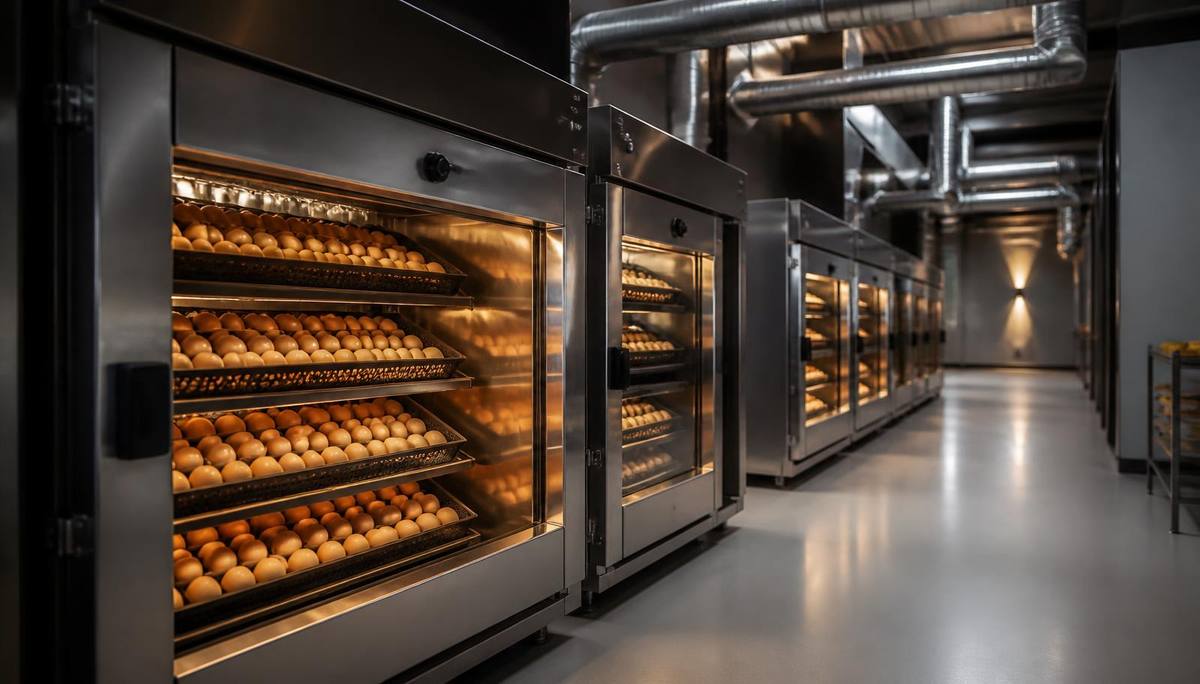
A commercial hatchery is the most environmentally sensitive building in the poultry value chain. It is effectively a biological process plant in which air handling, humidity, pressure differentials, hygiene zoning and material flow determine hatchability, chick quality and downstream flock performance. Equipment selection matters, but hatchery outcomes are dominated by the building services around the equipment.
What the project must resolve
- Annual chick output and the weekly setting programme that produces it, including peak-week capacity rather than average capacity
- Setter and hatcher configuration: single-stage versus multi-stage, and the operational and hygiene implications of each
- Independent air handling per room, with defined pressure cascades from clean to dirty zones
- Single-direction material flow: egg reception, storage, setting, transfer, hatching, chick handling, dispatch, and waste — without crossing paths
- Water quality and treatment for humidification and washing, and effluent handling for hatchery waste
- Standby power with automatic transfer, because incubation has no tolerance for interruption
- Cleaning and disinfection design: surfaces, drainage falls, wash areas and the time budget between cycles
Where hatchery projects most often go wrong
Three failures recur. The first is treating HVAC as a building services afterthought rather than as core process equipment, which produces unstable incubation conditions no cabinet can compensate for. The second is undersizing egg storage and chick holding, which converts a capacity plan into a scheduling problem. The third is designing the hygiene layout after the equipment layout, which permanently embeds cross-contamination risk into the floor plan.
A hatchery also fixes the tempo of everything downstream. Its weekly output defines placement schedules, which define grow-out house availability, which defines processing throughput. Sizing a hatchery in isolation is therefore a value-chain decision disguised as a building decision.
Broiler Projects: Throughput, Climate and Uniformity
Broiler production is a throughput business with narrow biological tolerances. Performance is expressed through feed conversion, daily weight gain, uniformity, liveability and condemnation rate at processing — and all five are sensitive to house environment. The commercial objective of a broiler project is therefore to build houses that hold a stable environment at the lowest sustainable operating cost, and to place birds into them on a schedule the rest of the chain can absorb.
Design parameters that drive outcomes
- House dimensions and geometry, chosen for air velocity behaviour rather than for construction convenience alone
- Insulation and thermal envelope performance, which determine the energy cost of every subsequent climate decision
- Ventilation strategy across three regimes: minimum ventilation, transitional and tunnel, with defined design temperatures and humidity
- Cooling strategy appropriate to the climate — evaporative pads, fogging, or a combination — with water quality provisions
- Heating strategy and fuel logistics, including brooding uniformity across the house
- Feeding and drinking line layout, bird access per unit and adjustment ranges across the growth curve
- Lighting programme and light uniformity, including dimming behaviour at low levels
- Litter management, downtime between cycles, and cleaning turnaround
Cycle planning and the cost of a lost day
Broiler economics are cycle economics. The number of completed cycles per house per year is a direct function of grow-out days, cleaning and disinfection time, and downtime discipline. Projects that design generous cleaning access, adequate wash-down drainage and realistic turnaround time tend to run more cycles than projects that treated turnaround as an operating detail. Over a decade, that difference exceeds most equipment price differentials considered during procurement.
Uniformity deserves particular attention at design stage. Non-uniform flocks create processing losses that never appear in the farm's own performance reports. Air distribution, feeder and drinker access, and light uniformity are the design levers most closely associated with it.
Layer Projects: Long Cycles and System Commitment
Layer projects differ from broiler projects in one structurally important way: the housing system decision is effectively irreversible for the economic life of the asset. A commitment to enriched cage, aviary, barn or free-range production determines building geometry, egg-collection design, manure handling, labour intensity, welfare positioning and, increasingly, market access. Reversing that decision later is close to rebuilding.
The system decision
The correct system is the one that matches the destination market's regulatory and retail trajectory across the asset's life, not only its current requirements. Several markets have moved, or signalled movement, toward cage-free retail commitments. A layer project intended to supply those markets should be evaluated against the requirement expected at mid-life, not at commissioning. Conversely, a project supplying a market with no such trajectory should not import cost that its market will not reward.
- Housing system and tier configuration, including bird access to feed, water, nests and perches
- Egg collection, grading and packing capacity matched to peak daily lay, not average lay
- Egg quality management: collection gentleness, transfer points, cooling and storage
- Manure handling and drying strategy, which drives both ammonia control and by-product value
- Rearing capability, in-house or contracted, since pullet quality constrains the entire laying cycle
- Depopulation and repopulation logistics between flocks
Rearing and the pullet constraint
Layer performance is largely determined before the first egg. Pullet uniformity, body weight at transfer, and rearing-house conditioning to the production system all constrain the laying cycle. Projects that plan rearing as an integral part of the layer investment consistently outperform projects that treat pullet supply as a procurement item to be arranged later.
Breeder Farms: The Highest-Consequence Assets
Breeder farms — grandparent, parent stock and multiplier — carry the highest consequence per bird in the chain. A biosecurity failure at breeder level propagates through the hatchery into every downstream flock. Breeder projects therefore justify a level of isolation, hygiene infrastructure and operating discipline that would be disproportionate elsewhere.
- Site isolation distance and independent access roads, evaluated against surrounding poultry density and prevailing wind
- Separate male and female feeding systems with accurate feed control
- Nest system selection and egg collection designed for hatching-egg quality rather than table-egg throughput
- Rearing and production house sequencing, including transfer logistics
- Egg handling, disinfection and short-cycle storage conditions before hatchery dispatch
- Personnel control: shower-in facilities, clothing management, visitor protocol and vehicle disinfection
Because breeder output feeds the hatchery, breeder capacity is the first number in the capacity-matching chain. An integrated project that sizes breeder capacity to its hatchery, hatchery to its grow-out, and grow-out to its processing throughput will run near design. One that sizes each stage against a market forecast independently will carry idle capacity somewhere in the chain permanently.
Integrated Operations and Processing
Integration is a strategic answer to volatility. By controlling consecutive stages of the chain, an operator stabilises input quality, protects biological status, captures margin that would otherwise leave the business, and gains the traceability that formal markets increasingly demand. It is also the point at which a poultry business becomes an industrial group with several distinct engineering disciplines under one balance sheet.
- Stage 1Breeder farmsHatching-egg supply, genetic status
- Stage 2HatcheryChick supply and quality
- Stage 3Feed supplyNutrition cost and consistency
- Stage 4Grow-out / layerLive production output
- Stage 5ProcessingProduct form and market access
- Stage 6Cold chainShelf life and distribution reach
Capacity matching between consecutive stages determines whether integration creates value or stranded assets.
Capacity matching is the whole discipline
In an integrated operation, the value of each asset depends on the asset next to it. A processing plant running below throughput carries fixed cost against reduced revenue. A hatchery producing more chicks than grow-out can place either wastes output or forces premature placements. Feed capacity below consumption creates dependence on spot purchasing at exactly the moments when spot prices are least favourable. Capacity matching is therefore not a refinement of the plan; it is the plan.
| Stage | Primary function | Dominant project risk |
|---|---|---|
| Breeder farms | Hatching-egg supply and genetic status | Biosecurity failure propagating downstream |
| Hatchery | Chick supply and quality | Air handling and hygiene layout deficiencies |
| Feed supply / mill | Nutrition cost and consistency | Capacity below consumption; raw-material logistics |
| Grow-out or layer production | Live production output | Climate design mismatch; turnaround discipline |
| Processing | Product form and market access | Throughput mismatch; utilities and effluent load |
| Cold chain and distribution | Shelf life and market reach | Refrigeration capacity and route reliability |
Processing as an infrastructure decision
A processing plant is where poultry production meets food manufacturing regulation. Its requirements — potable water volumes, effluent treatment, refrigeration load, hygienic design, chilling capacity, waste and by-product handling, and certification for target markets — are frequently the largest single utilities burden in an integrated project. Processing also determines product form, and product form determines which customers are addressable. For that reason, the processing decision should be taken alongside the market strategy, not after the live-production assets are built.
Cold chain integrity extends the same logic beyond the plant gate. Investment in chilling and freezing capacity is only recovered if downstream storage and transport hold the temperature regime; otherwise the plant is producing quality that the distribution system discards. Where a project's cold chain requirement is substantial, it is usually worth evaluating as its own infrastructure workstream.
Climate Control, Ventilation and Automation
Climate control is the discipline in which theoretical equipment performance and field performance diverge most sharply. The divergence is almost always traceable to design conditions. Ventilation and cooling systems are engineered against stated external temperature, humidity and altitude assumptions; when a project adopts a supplier's default assumptions instead of its own site data, the installed system is correctly built for the wrong place.
Specifying climate honestly
- State design conditions explicitly: peak dry-bulb temperature, coincident humidity, minimum winter temperature, altitude and dust load
- Define target in-house conditions across the production cycle, not a single set point
- Specify all three ventilation regimes — minimum, transitional and tunnel — and the transitions between them
- Address humidity separately from temperature; evaporative cooling capacity is humidity-limited
- Confirm water quality and volume for evaporative systems before selecting them
- Require static pressure and air-velocity performance criteria as acceptance conditions at commissioning
- Provide alarm, redundancy and standby power for the failure modes that kill birds within minutes
Automation, proportionate to constraint
Automation is best evaluated as a constraint-removal investment. Where labour is scarce or expensive, automation substitutes capital for labour. Where climate is volatile, controllers stabilise conditions faster and more consistently than manual intervention. Where flock data is currently retrospective, sensing and monitoring convert it into intervention time. Where none of these constraints binds, additional automation adds capital cost, maintenance obligation, spare-parts dependency and training burden without a corresponding return.
| Automation level | Typical scope | Fits when | Principal caution |
|---|---|---|---|
| Basic | Manual set points, thermostatic control, local alarms | Small units, abundant skilled labour, stable climate | Environment varies with operator attention |
| Standard | Climate computer, staged ventilation, feed and water metering | Most commercial grow-out and layer projects | Requires trained operators and spare controllers |
| Advanced | Integrated controls, sensor networks, remote monitoring, alarm escalation | Multi-site operations, scarce labour, volatile climate | Service reach and data discipline become critical |
| Data-integrated | Farm management platform, analytics, predictive intervention | Integrated groups with central technical teams | Value depends on acting on the data, not collecting it |
One procurement caution applies across all levels: control systems create the longest supplier relationship in the project. Availability of firmware support, spare sensors and local service capability over a ten-year horizon is a legitimate evaluation criterion, and often a more consequential one than the initial control-package price.
Biosecurity and Animal Welfare as Design Parameters
Biosecurity is frequently discussed as a set of procedures. In a well-built project it is primarily a layout. Procedures maintain a biosecure state; the site plan determines whether that state is achievable at all. Once a site has been built with crossing traffic routes, shared entrances, or insufficient separation between clean and dirty zones, no operating protocol fully compensates for it.
Biosecurity that is designed rather than added
- Site selection with defensible distance from other poultry operations, and consideration of prevailing wind and watercourses
- Perimeter definition with a single controlled entry point and vehicle disinfection
- Clean and dirty zoning with physical separation, one-way personnel flow and shower or change facilities appropriate to the site's risk class
- Separate routes for feed delivery, bird movement, mortality removal, litter and waste
- Water source protection and treatment, with monitoring
- Rodent, wild-bird and insect exclusion designed into building details rather than managed after the fact
- Cleaning and disinfection infrastructure: wash areas, drainage falls, chemical storage and drying time in the schedule
Highly pathogenic avian influenza has changed the risk calculus for projects worldwide. Beyond direct losses, an outbreak can trigger movement restrictions, market closures and financing covenants. Projects in high-density or migratory-flyway regions increasingly justify a higher biosecurity specification not on veterinary grounds alone but on financial ones: the design premium is small relative to the expected value of the losses it avoids.
Animal welfare and market access
Welfare has moved from an ethical consideration to a commercial parameter. Stocking density, light programmes and light uniformity, enrichment, air quality, litter condition, handling and depopulation methods, and documented welfare monitoring increasingly determine which buyers, retailers and export markets a facility can serve. Because most welfare parameters are embedded in building design and system selection, welfare positioning is set during the project, not during operations.
Biosecurity that has to be enforced against the building's own layout will eventually lose.
Project Planning and Structured Procurement
Structured procurement is the mechanism through which planning turns into a defensible commercial decision. Its purpose is not to obtain the lowest number; it is to obtain comparable numbers, so that the lowest number means something.
What a procurement-ready specification contains
- Production objective and capacity, expressed in output terms
- Building and site parameters, including dimensions, orientation and construction interfaces
- Climate design conditions and target in-house conditions
- Utility conditions actually available on site: voltage, frequency, phases, water pressure and quality, fuel type
- Applicable standards, certifications and regulatory requirements for the destination market
- Scope boundaries between packages, stated as inclusions and explicit exclusions
- Delivery terms using current Incoterms, named place, and responsibility for duties and inland transport
- Installation, supervision, commissioning and acceptance criteria
- Spare-parts package, service response expectations and training scope
- Required response format, so that answers arrive in comparable structure
Normalising quotations
Quotations rarely arrive comparable. Normalisation adjusts each response to a common basis before evaluation: aligning delivery terms, adding excluded items to the responses that excluded them, converting currencies at a stated rate, aligning warranty periods and adding the cost of missing installation or commissioning scope. It is common for the nominally lowest quotation to lose its position after normalisation, and equally common for a mid-priced response with complete scope to become the rational choice.
| Criterion | What is assessed | Indicative weight |
|---|---|---|
| Technical compliance | Conformity with the specification without qualification | 30% |
| Normalised cost | Total cost on a like-for-like scope and delivery basis | 25% |
| Delivery and schedule | Lead time credibility and schedule risk | 15% |
| Installation and commissioning | Depth of supervision, acceptance testing and handover | 10% |
| Service and spares | Regional service reach and parts availability over asset life | 10% |
| References | Comparable installations in comparable climates and scale | 10% |
Neutrality as a process
Supplier neutrality is protected by sequence, not by intent. Defining requirements before supplier contact, writing performance-based rather than architecture-based specifications, inviting a comparable set of qualified suppliers, scoring against documented criteria, and recording the reason for award together produce a decision that can be explained to a board, a lender or an auditor years later. That explainability is itself a project asset.
Project Financing and Bankability
Financing does not evaluate equipment. It evaluates the plan around the equipment. Whether the counterpart is a commercial bank, a development finance institution, an export credit agency, a vendor finance programme, a leasing structure or a private investor, the assessment converges on the same questions: is the site secured and permitted, is the production and cost model credible, is there demonstrated market access, is the management team capable of operating what is being built, are biological and market risks provided for, and was the cost tested competitively.
What lenders read first
- Site control, land title and the permitting pathway with realistic timelines
- A production model with stated assumptions, sensitivity ranges and a downside case
- Evidence of offtake or market access, formal or commercially reasoned
- Sponsor equity and the sponsor's operating experience in poultry specifically
- Biosecurity and disease-risk provisions, and their treatment in the downside case
- Procurement documentation showing competitive, scope-normalised cost testing
- Working capital provision through the ramp-up period, which is routinely underestimated
The most frequently underfunded line in poultry projects is not construction. It is the operating period between commissioning and stable performance, during which feed, labour, energy and finance costs run at close to full rate while output climbs from zero. Projects that model this ramp-up explicitly and finance it deliberately reach steady state in better condition than projects that fund it from operating surpluses that have not yet materialised.
Financing routes discussed on this platform are arranged through independent third-party partners. HatchMatch Group does not lend, does not guarantee outcomes, and does not receive supplier commissions; every financing outcome remains subject to third-party approval and the partner's own credit assessment.
Operational Efficiency and Expansion Planning
Efficiency in poultry production is cumulative rather than dramatic. Small, durable advantages in feed conversion, mortality, energy per unit of output, labour hours per cycle and turnaround time compound across cycles into a decisive cost position. Most of those advantages are enabled or foreclosed at design stage.
| Operating metric | Design decision that drives it | Retrofit difficulty |
|---|---|---|
| Feed conversion | Climate stability, feeder access, bird uniformity | Moderate |
| Energy per unit output | Thermal envelope, fan efficiency, control strategy | High |
| Mortality | Ventilation reliability, alarms, standby power, biosecurity layout | High |
| Labour hours per cycle | Automation level, house layout, access design | Moderate |
| Cycles per year | Cleaning access, drainage, turnaround planning | High |
| Egg or carcass quality | Handling gentleness, transfer points, cooling | Moderate |
Designing phase one for phase two
Expansion is far cheaper when it was anticipated. Reserving land, sizing the electrical intake and water supply for a later phase, positioning roads and biosecurity boundaries to accommodate additional houses, and leaving hydraulic and control capacity in shared systems typically adds a modest premium at phase one and removes a substantial cost at phase two. The alternative — expanding into a site that was optimised only for its first phase — frequently means duplicating infrastructure that could have been shared.
Standardisation is the second expansion lever. Operators who repeat a proven house specification across phases accumulate operating knowledge, simplify spare-parts inventory, shorten training and reduce commissioning time. Variety across phases is occasionally justified by market change, but it is rarely justified by procurement opportunism.
Digital Transformation and Future Trends
Digital capability in poultry production is moving from optional to expected, driven less by efficiency ambition than by external requirement. Traceability obligations, welfare documentation, food-safety auditing, environmental reporting and export-market compliance all require records that manual systems produce slowly and inconsistently.
Where digital investment currently earns its cost
- Continuous environmental monitoring with alarm escalation, which converts failures into interventions
- Flock performance tracking against the project's own model, not only against generic benchmarks
- Predictive maintenance for ventilation, feeding and control assets whose failure has biological consequences
- Energy and water sub-metering, which is prerequisite to managing either
- Traceability from breeder through hatchery, farm and processing to dispatch
- Structured documentation for welfare, biosecurity and food-safety audits
Directional trends to plan against
Several trends are consistent enough across regions to be worth designing for even where they are not yet mandatory. Welfare requirements are tightening in formal retail and export markets. Energy cost and carbon accounting are becoming part of project evaluation rather than an afterthought. Water reuse and effluent treatment are increasingly permit-limiting in water-stressed regions. Antimicrobial-use reduction places more weight on environmental control and biosecurity as substitutes for therapeutic intervention. Labour availability continues to decline in many producing regions, strengthening the case for proportionate automation. Finally, disease pressure — particularly avian influenza — is raising the baseline biosecurity specification globally.
None of these trends changes the fundamental logic of this paper. Each of them increases the number of parameters that must be settled before equipment is selected, which makes structured project preparation more valuable over time, not less.
How HatchMatchGroup Supports Commercial Buyers
HatchMatch Group is a buyer-first platform for commercial poultry projects. Its function is preparation: helping organisations define a project completely, model it honestly, and approach manufacturers, engineering firms and contractors with a specification that produces comparable answers. The platform does not manufacture equipment, does not represent suppliers, and does not charge buyers for the planning resources described below.
- 01LearnKnowledge Center reference material
- 02PlanObjective, capacity, phasing, readiness
- 03ModelCalculators with visible assumptions
- 04SpecifyStructured, comparable RFQ
- 05FundIndependent third-party financing routes
- 06DeliverProcurement, commissioning, operations
Knowledge Center
The Knowledge Center holds the technical and commercial reference material behind project decisions: house design and layout, ventilation and climate strategy, biosecurity, lighting, stocking density, hatchery planning, water management, automation and procurement practice. It is written for decision-makers who need to reach a defensible position quickly, and is maintained as reference material rather than as sales content.
Project planning
The project preparation tools convert an investment intention into a structured scope: production objective, capacity, phasing, site constraints, utility requirements, biosecurity class and readiness assessment. The output is the document set that makes every later conversation — with engineers, contractors, lenders and manufacturers — shorter and more precise.
Commercial calculators
The calculator suite exists to make assumptions explicit. Capacity, feed consumption, feed cost, ventilation, stocking density, mortality economics, downtime cost, equipment cost benchmarking and return scenarios are modelled with stated inputs, so that a figure carried into a board paper or a lender pack can be traced back to the assumption that produced it. Sensitivity ranges are shown rather than single-point outputs wherever the underlying variable is genuinely uncertain.
RFQ preparation
The RFQ wizard structures the buyer's requirement into the format described in section 13: capacity, building parameters, climate design conditions, utilities, standards, scope boundaries, Incoterms, installation and commissioning, spares and training, and a defined response format. Its purpose is comparability. A structured RFQ typically produces fewer but substantially more useful responses than an open enquiry.
Project financing
Where a project requires external funding, the platform helps organise the material lenders actually assess and routes qualifying projects to independent third-party financing partners. HatchMatch Group does not provide credit and does not guarantee approval; all financing remains subject to third-party approval.
The wider Global B2B Group ecosystem
HatchMatch Group is one sector platform within Global B2B Group, a group of buyer-first industrial procurement platforms built on the same method: define first, compare second, commit third. Poultry projects frequently touch adjacent sectors, and the group structure exists so that a buyer working across those boundaries encounters one consistent approach rather than several.
- HatchMatch GroupCommercial poultry projects
- FeedMatch GroupAnimal feed and feed-mill infrastructure
- ColdMatch GroupRefrigeration and cold-chain infrastructure
- SeedMatch GroupGrain and seed processing and storage
- FishMatch GroupAquaculture and seafood processing
Sector platforms of Global B2B Group, sharing one method: define first, compare second, commit third.
- FeedMatch Group — animal feed production, feed mills, nutrition and feed infrastructure, relevant wherever feed is produced or blended in-house rather than purchased finished
- ColdMatch Group — industrial refrigeration, cold storage, blast freezing and cold-chain infrastructure, relevant to processing and distribution scope
- SeedMatch Group — grain and seed processing, handling and storage infrastructure, relevant to raw-material supply for feed operations
- FishMatch Group — aquaculture, recirculating systems and seafood processing, for organisations with protein portfolios beyond poultry
- Global B2B Group — the parent ecosystem and its shared standards for supplier neutrality and structured procurement
A Decision Framework for Project Owners
The following framework can be applied to any commercial poultry investment, at any scale, in any region. It is deliberately short. Its value is that it forces each question to be answered before the next one is asked.
| # | Question | Why the order matters |
|---|---|---|
| 1 | What are we producing, for which market, at what annual volume? | Every later parameter derives from this |
| 2 | What does the destination market require at mid-asset-life? | Prevents building to a requirement that is about to change |
| 3 | What does the site physically allow? | Utilities and permits constrain design more than budget does |
| 4 | What biosecurity class does our location justify? | Determines layout before buildings are positioned |
| 5 | What are our actual climate design conditions? | Determines ventilation and cooling before selection |
| 6 | Which constraint would automation remove? | Prevents capital spend without a return |
| 7 | Are all stages capacity-matched? | Prevents permanent idle or bottleneck capacity |
| 8 | What is the total installed cost, not the equipment cost? | Aligns the budget with reality |
| 9 | How will the ramp-up period be funded? | The most common financing gap |
| 10 | Can we explain the supplier decision in three years? | Tests neutrality and documentation quality |
Professional Definitions
| Term | Definition |
|---|---|
| Commercial poultry project | An investment programme with a defined production target, capital plan, delivery schedule, compliance pathway and operating model, of which the physical facility is one deliverable. |
| Integrated poultry operation | A structure controlling several consecutive value-chain stages — typically breeders, hatchery, feed, production and processing — under one commercial entity. |
| Capacity matching | Sizing each stage of a value chain so that no stage is permanently idle or permanently constraining the others. |
| Total installed cost | The full cost of reaching operational readiness, including civil works, utilities, installation, commissioning, freight, duties and ramp-up working capital — not the equipment price. |
| Climate design conditions | The explicit external temperature, humidity, altitude and dust assumptions against which ventilation and cooling systems are engineered. |
| Biosecurity zoning | The physical separation of clean and dirty areas, with controlled one-way flow of people, vehicles, birds, feed and waste, established in the site layout. |
| Structured RFQ | A request for quotation that fixes specification, scope boundaries, delivery terms and response format so that responses are directly comparable. |
| Scope normalisation | Adjusting quotations to a common basis of scope, delivery terms, currency and warranty before comparison. |
| Bankability | The degree to which a project's site control, model credibility, market access, management capability and cost testing satisfy an external funder's assessment. |
| Supplier neutrality | A documented procurement process in which requirements are defined before supplier contact and selection is scored against published criteria. |
Conclusion: Projects Are Won Before They Are Built
The commercial poultry sector has become an infrastructure industry with a biological core. Its capital intensity, regulatory surface, market requirements and technical interdependence have all increased, and none of those trends is reversing. In that environment, the buyer's advantage is no longer access to equipment — equipment is globally available and broadly capable. The advantage is preparation.
Organisations that define their production objective, verify their site, state their climate conditions, design their biosecurity, match their capacities, model their economics with visible assumptions and procure through a structured, neutral process consistently build facilities that perform closer to their plan. Organisations that begin with a catalogue consistently discover the missing parameters later, at construction prices or operating prices.
That is the shift this platform was built around: from poultry equipment to commercial poultry projects. It is a change in where the work happens — earlier, on the buyer's side, before manufacturers are contacted — and it is the change that most reliably separates projects that reach their design performance from those that spend years approaching it.
Equipment determines what a facility can do. Planning determines whether it will.
Questions and Answers
Why is equipment selection the wrong starting point for a commercial poultry project?
Equipment is the last variable in a chain of earlier decisions. Bird type, target output, climate, biosecurity zoning, energy and water availability, labour model, offtake and financing structure all constrain which equipment configurations are technically valid. When a buyer selects manufacturers before those parameters are fixed, quotations describe different projects and cannot be compared. The practical consequence is scope drift, change orders during construction, and equipment that performs below specification because the building and utilities around it were designed afterwards.
What defines a commercial poultry project as opposed to a poultry farm?
A commercial poultry project is an investment programme with a defined production target, a capital plan, a delivery schedule, a compliance pathway and an operating model. The physical farm is one deliverable inside it. Typical projects also include site works, utilities, biosecurity infrastructure, climate and control systems, staff capability, spare-parts logistics, permits and financing. Treating the farm as the project is the most common cause of budget overrun.
What is an integrated poultry operation?
An integrated operation controls several consecutive stages of the value chain — typically breeder farms, hatchery, feed supply, grow-out or layer production, and processing — under one commercial structure. Integration improves biological control, feed cost stability and product traceability, but it multiplies capital intensity and requires the stages to be capacity-matched. A hatchery sized independently of grow-out capacity will either idle or bottleneck the whole system.
How much of a poultry project budget is equipment?
Across commercial projects, equipment usually represents a minority of total installed cost. Civil works, foundations, site preparation, electrical infrastructure, standby power, water treatment, roads, drainage, biosecurity structures, installation, commissioning, freight, duties and working capital together commonly exceed the equipment line. Budgets built from an equipment quotation alone are structurally incomplete rather than merely optimistic.
What makes a poultry project bankable?
Lenders and development finance institutions assess a defined and permitted site, a credible production and cost model, demonstrated offtake or market access, experienced operational management, realistic biosecurity and disease-risk provisions, sponsor equity, and a procurement structure that shows costs were tested rather than assumed. Bankability is largely produced during planning; it cannot be added after equipment has been ordered.
Does automation always improve returns in poultry production?
No. Automation improves returns where it removes a measurable constraint — labour scarcity, feed conversion variability, climate instability, mortality from human error, or data gaps that delay intervention. Where a constraint does not exist, automation adds capital cost, maintenance burden and spare-parts dependency without a return. The defensible approach is to identify the operational constraint first and match the level of automation to it.
How long does a commercial poultry project take from decision to production?
Timelines vary widely by country and scale, but the planning and permitting phase is regularly longer than construction. Projects that compress planning to accelerate the schedule tend to lose the time again during permitting, redesign or commissioning. A phased plan with a defined decision gate at the end of each stage generally reaches stable production sooner than an unphased plan that starts earlier.
What is a structured RFQ and why does it matter?
A structured RFQ states the production target, house or building parameters, climate design conditions, utility conditions, standards, delivery terms (Incoterms), installation and commissioning responsibilities, spare-parts and training expectations, and the response format. It matters because it makes quotations comparable on a common basis. Without it, price differences between suppliers usually reflect different scopes rather than different value.
How should a buyer maintain supplier neutrality?
Define the technical requirement before contacting manufacturers, write specifications around performance and standards rather than around a single vendor's product architecture, invite comparable suppliers, evaluate against a documented scoring framework, and record the reason for the final selection. Neutrality is a process discipline, not an attitude.
What are the main risks that damage commercial poultry projects?
The recurring categories are scope definition failure, climate design mismatch, biosecurity retrofitting, utility assumptions that do not hold on site, currency and logistics exposure, under-provisioned commissioning and training, and an operating team recruited too late to influence the design. Most are planning risks that materialise as construction or operating costs.
Continue with the planning resources
Every resource below is free for buyers, supplier-neutral, and designed to be used before manufacturers are contacted.
- Knowledge CenterTechnical reference behind project decisions
- Plan my poultry projectObjective, capacity, phasing and readiness
- Commercial calculatorsModel capacity, feed, ventilation and cost
- Start your project for freePrepare a structured, comparable RFQ
- Project financingIndependent third-party funding routes
- Buyer's guide centerProfessional guides before quotation
Explore the topic hubs
Each hub groups every article, guide and calculator we publish on one subject.
Sourcing by market
The framework above is market-neutral, but suppliers are not. These country pages list vetted manufacturers serving each market, with landed-cost quotes and zero buyer fees.
- poultry equipment suppliers in the United StatesUL/NEC specs and DDP landed pricing.
- poultry equipment suppliers in the NetherlandsHatchery, layer and processing technology.
- poultry equipment suppliers in BrazilIntegrator-scale broiler and processing.
- poultry equipment suppliers in IndiaCost-competitive layer and broiler systems.
- poultry equipment suppliers in NigeriaOff-grid-ready farm and hatchery builds.
- poultry equipment suppliers in Saudi ArabiaClimate-hardened large-capacity projects.
Prepared as independent educational material. This paper does not rank or endorse individual manufacturers and does not constitute investment, legal, veterinary or engineering advice. Financing is arranged through independent third-party partners and remains subject to third-party approval.