
Solar Poultry Farm: Design Fundamentals for Real On-Farm Loads
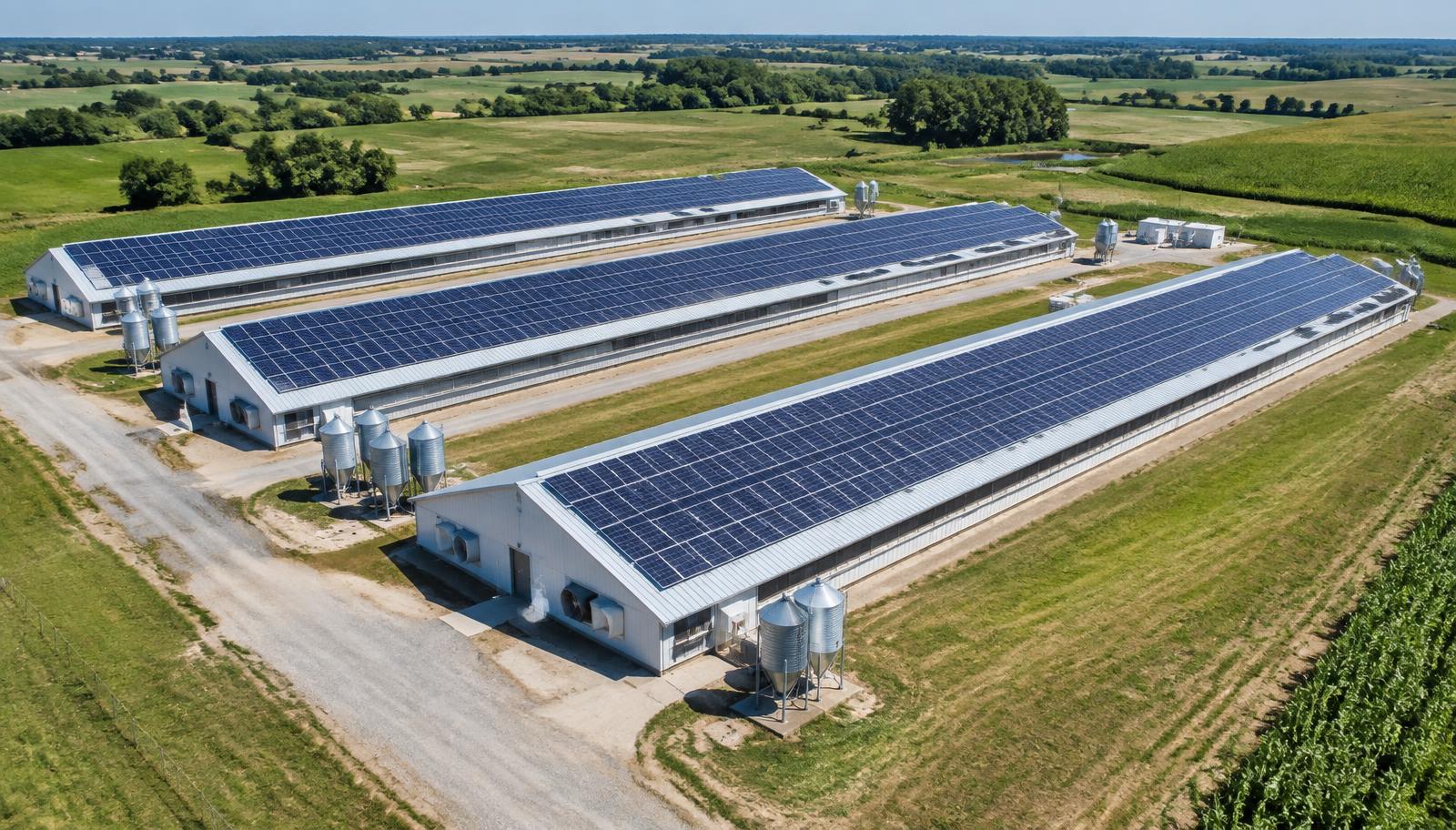
Solar can carry a large share of a poultry farm's daytime load, but only when the array is designed around the actual load curve. Here is how it works in practice.
By HatchMatch Group Editorial Desk
In short
Short answer. Solar PV can cover a large share of a poultry farm's daytime electricity — typically 1. 0–1.
Key takeaways
- A poultry farm's daytime load — ventilation, evaporative cooling, feed augers, pumps — often peaks in the same hours as solar generation.
- Grid-tied PV without storage: cheapest CAPEX, best payback where net-metering exists.
- Battery sizing must reflect the specific load being protected.
- Bifacial monofacial mono-PERC or TOPCon modules are current best-in-class for tropical poultry sites.
- Roof-mounted arrays on poultry-house roofs are simple to permit but complicate future roof repairs.
Short answer. Solar PV can cover a large share of a poultry farm's daytime electricity — typically 1.0–1.4 kWp per 1,000 broilers or 0.6–0.9 kWp per 1,000 layers — because ventilation, cooling and feeding loads peak during sunlight hours. Grid-tied PV without storage pays back fastest (3–6 years); hybrid PV plus battery plus genset adds resilience at a 5–9 year payback; full off-grid only makes sense where grid extension is impossible, since battery sizing drives CAPEX 2–3× higher. The right choice depends on load profile, grid reliability and outage tolerance, not on panel price alone.
Solar photovoltaic (PV) is now the cheapest daytime electricity in most poultry-producing regions. That does not automatically make every farm a good candidate, and it does not mean an off-grid solar farm is realistic without significant storage. Understanding where PV fits and where it stops is essential to writing a specification that survives.
Match the Load, Then Size the Array
A poultry farm's daytime load — ventilation, evaporative cooling, feed augers, pumps — often peaks in the same hours as solar generation. That is a natural fit. A rough starting number for a broiler complex: 1.0–1.4 kWp of PV per 1,000 birds installed. For a 100,000-bird farm that is 100–140 kWp of PV — a 500–700 m² roof or a 0.2 ha ground array.
For layers, the daytime load fraction is smaller because much of the load is night-shift lighting and egg belts. Plan 0.6–0.9 kWp per 1,000 hens, and expect a smaller PV contribution to total annual kWh.
Want these figures for your own site, capacity and country? A HatchMatch specialist builds the budget with you — no buyer fees.
Start freeGrid-Tied, Hybrid or Off-Grid
Grid-tied PV without storage: cheapest CAPEX, best payback where net-metering exists. Solar carries the daytime load; grid takes the rest. Payback 3–6 years in most regions.
Hybrid PV + battery + genset: highest resilience. Solar plus battery covers 50–80% of annual kWh; genset covers the rest and provides outage backup. Payback 5–9 years, but the fuel and outage-risk savings are large.
Off-grid PV + battery + genset: only makes sense where grid extension is impossible or prohibitive. CAPEX is 2–3× grid-tied for the same kWh, driven mostly by battery sizing.
Battery Sizing for Poultry Loads
Battery sizing must reflect the specific load being protected. For a broiler farm, the critical battery role is bridging genset start (5–15 minutes at full ventilation load). For a layer farm with a large night lighting bill, batteries carry a larger fraction of daily kWh.
Rule of thumb for a hybrid broiler complex: 0.15–0.30 kWh of usable battery per kWp of PV installed, sized to cover 15 minutes of critical load or 2 hours of essential load, whichever is greater.
Panel Choice
Bifacial monofacial mono-PERC or TOPCon modules are current best-in-class for tropical poultry sites. Specify: 25-year linear performance warranty; salt-mist certification if within 5 km of coast; ammonia resistance (IEC 62716) — a poultry-specific requirement absent from most residential specs.
Mounting
Roof-mounted arrays on poultry-house roofs are simple to permit but complicate future roof repairs. Ground-mounted arrays on adjacent land are cleaner but consume real estate. Elevated 'agri-PV' canopies over feed silos and access roads are increasingly common on modern farms.
Inverter Strategy
String inverters with poultry-farm-scale power (30–150 kW per inverter) are the standard. Microinverters make sense only on complex shaded roofs. Specify anti-islanding, grid-support functions per local code, and a communication port that ties into the farm's SCADA or controller for kWh reporting.
Payback Reality Check
A grid-tied 200 kWp system for a 150,000-bird broiler complex in a sunny region typically costs USD 130,000–180,000 installed and offsets USD 25,000–40,000 of grid electricity per year — a 4–6 year payback before any diesel or outage savings. Adding a 200 kWh battery for hybrid duty adds USD 90,000–140,000 and stretches payback to 7–10 years.
Next Step
Start with the HatchMatch solar sizing calculator to convert bird count and climate into a PV kWp target, then release a solar-scoped RFQ for like-for-like quotes.
FAQ
How many kWp of solar does a poultry farm need? As a starting point, plan 1.0–1.4 kWp of PV per 1,000 broilers installed, or 0.6–0.9 kWp per 1,000 layers, then refine against the actual ventilation, cooling and lighting load curve.
Is an off-grid solar poultry farm realistic? Only where grid extension is impossible or prohibitive. Off-grid PV plus battery plus genset costs 2–3× a grid-tied system for the same kWh, driven mostly by battery sizing.
What payback should I expect from a grid-tied system? Grid-tied PV without storage typically pays back in 3–6 years where net-metering exists. Adding a battery for hybrid duty stretches payback to 7–10 years but adds outage resilience.
What panel and inverter specs matter for poultry sites? Specify a 25-year linear performance warranty, salt-mist certification near coasts, ammonia resistance (IEC 62716), and string inverters (30–150 kW) with anti-islanding and a communication port for kWh reporting into the farm's SCADA or controller.
Frequently asked questions
- How many kWp of solar does a poultry farm need?
- As a starting point, plan 1.0–1.4 kWp of PV per 1,000 broilers installed, or 0.6–0.9 kWp per 1,000 layers, then refine against the actual ventilation, cooling and lighting load curve.
- Is an off-grid solar poultry farm realistic?
- Only where grid extension is impossible or prohibitive. Off-grid PV plus battery plus genset costs 2–3× a grid-tied system for the same kWh, driven mostly by battery sizing.
- What payback should I expect from a grid-tied system?
- Grid-tied PV without storage typically pays back in 3–6 years where net-metering exists. Adding a battery for hybrid duty stretches payback to 7–10 years but adds outage resilience.
- What panel and inverter specs matter for poultry sites?
- Specify a 25-year linear performance warranty, salt-mist certification near coasts, ammonia resistance (IEC 62716), and string inverters (30–150 kW) with anti-islanding and a communication port for kWh reporting into the farm's SCADA or controller.
More buyer questions are answered in our poultry procurement FAQ — also available in Español, Français, Português, Deutsch, العربية, Русский, Türkçe, Tiếng Việt.
From this article to a procurement-ready RFQ
HatchMatch Group is an independent sourcing desk — not a manufacturer or EPC contractor. These are the four steps we actually use with commercial poultry and hatchery buyers. If you are still deciding scope, start with what commercial poultry equipment includes and how suppliers are compared.
- 1. Plan the projectCapacity, climate and house layout in one guided workflowOpen
- 2. Build the RFQScope, specifications and comparable line itemsOpen
- 3. Submit the requestReviewed manually before HatchMatch contacts any supplier on the buyer's behalfOpen
- 4. Track and compareFollow status and normalise supplier responsesOpen
Prefer the numbers first? Start with the poultry project cost calculator or browse the project planning guides.